
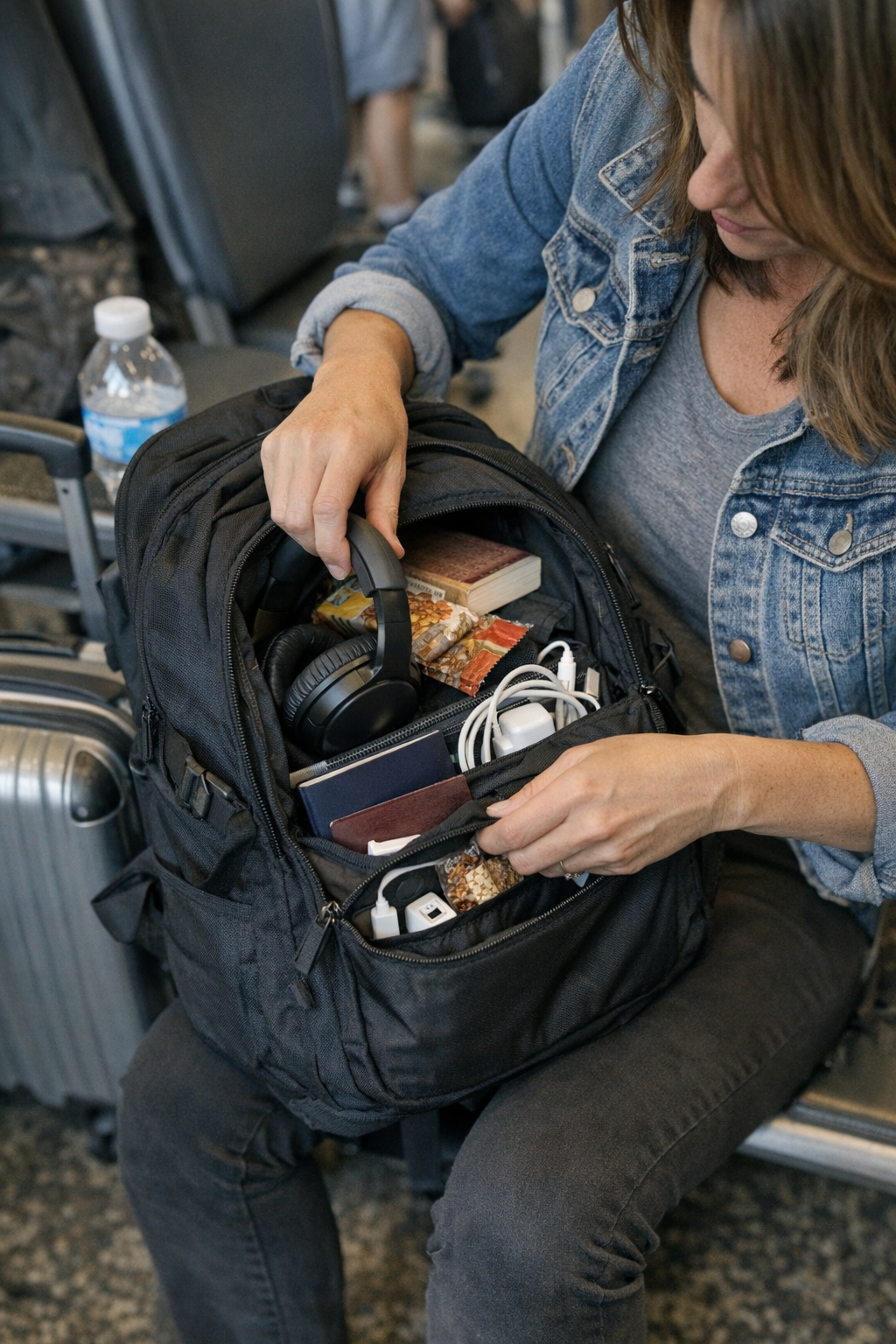
The gap between a carefully zipped carry-on at home and the chaos inside after multiple airport stops is bigger than most travelers expect. Once the first security check or boarding call hits, the friction begins—not just at a single checkpoint but with every repeated reach for your charger, passport, or snack in real airport motion. The bag that seemed “ready” in your kitchen often fails after only a few rounds of interrupted access, blocked outer pockets, or buried essentials.
When “Organized” Turns Against You
Perfect packing almost always breaks down at the first unpredictable reach. That clean grid you built at home collapses when the boarding queue tightens or your outer pocket jams from overstuffing. Two pouches slide on top of each other—the charger covers your passport, and now even the first ID check feels like a puzzle. Each step toward being “organized” starts making you slower: every return knocks the layout just enough off-balance that you lose track of where essentials actually are.
This is the headache most travelers never see coming. Your bag keeps looking neat each time you repack in a rush. But inside, each movement—another dig, another awkward shift—reminds you how much function you’ve given up to maintain that “photogenic” order for just a single snapshot.
The Build-Up of Small Malfunctions
Travel trouble rarely shows up as one major breakdown. Instead, it’s the drain of micro-frustrations: you breeze through security, toss your documents back, and minutes later your passport is buried beneath headphones and snack wrappers you just crammed away. The single-sleeve organizer that kept cables sorted in your living room now forces you to move three items to grab one. Those same tech sleeves—tight and clean at departure—slip into chaos after two rushed returns in the boarding area.
The repetition piles up. Dig for gum and end up dragging out your Kindle during a gate delay. Store hand sanitizer “neatly” but spend an extra twenty seconds unearthing it from a deep, packed toiletry pouch. Overhead-bin grabs become a scramble—one stuck pouch, a shifted document case, headphones tangled behind your backup battery. Each tiny inefficiency stacks. Not dramatic, but enough to slow you down where every second matters: at boarding, in the aisle, or just trying to find your seat with one hand already full.
Where Packing Logic Actually Breaks Down
The telltale signs aren’t in that first hour—they show during transitions when your flow is tested. After a second ID check, you reach for headphones. Instead, your fingers hit a paperback jammed by a shifting pouch. That half-zipped return at security now blocks every subsequent reach. The weakest point isn’t one bad move—it’s the slow chain of micro-blocks as every retrieval becomes not just slower, but less certain, more disruptive to everyone behind you in line.
Every “smart” setup begins to slide into confusion: pouches for tech get crammed with leftover receipts, toiletries slide to the bottom where they were never meant to live, and the neat divisions you trusted at home disappear under pressure. The categories that made sense in a quiet room stop working when your hands are full, the clock is running, and you just need to clear the aisle—now.
A Better Standard: Reach First, Order Second
If you want your carry-on to actually hold up, stop packing by category and start by repeated need. Essentials you grab again and again—passport, boarding passes, chargers, snacks, wipes—should dominate your main, quick-access zippered pocket. Not the squarest or “cleanest” spot, but the path you can work with one hand mid-movement. That single zipper becomes the nerve center at each pain point: security trays, gate calls, seat settling, bin grabs.
One adjustment you’ll notice instantly: less rummaging, fewer silent curses during every transit moment. By splitting high-frequency items away from deep-storage ones, you stop re-sorting the whole bag just to free your passport or charging cable at a pinch point. Suddenly, the bag feels like it’s working with your routine instead of against it—quietly absorbing stress instead of manufacturing more.
Spotting the Wrong Setup—Before It Costs You Again
- Opening two or three pouches because the right item is always behind something else
- Digging deeper each time for the same essential—ID or snacks keep sinking out of reach
- A “tidy” bag that interrupts you every time you actually try to use it on the move
- Every attempted compartment “reset” is harder and slower as your trip wears on
- Outer pockets that look slick but seize up in lines, under bins, or squeezing onto your seat
The same structure that wins at home creates new interruptions on the go. Your setup’s so-called “rigidity” keeps you stuck repeating awkward motions hour after hour, obstacle after avoidable obstacle.
Packing for Flow, Not Just Storage
The aim isn’t to create a static, impressive “once-only” display. Real travel demands a bag that forgives—accepts rushed returns and absorbs new priorities as they appear. Items rarely go back where you planned, and your logic must flex with the turbulence of movement, gate changes, and actual in-transit needs.
Make quick-access pockets your primary setup—they’re your lifeline for things you pull out a dozen times per trip. Choose pouches and organizers that accept less-than-perfect returns and still let you navigate your bag fast, without derailing the rest of your layout. Let the shifting contest between tech, documents, and snacks play out on your terms by designing for timing—not just an idealized category list.
The Real Difference in Everyday Travel
Flip your system and the changes are small but cumulative. Your main zipper routine—trained by airport repetition—means less rummage time between stages. Security is not a re-packing drama: essentials out and back in, without restarting the order each tray cycle. Boarding line tension drops because you can reach headphones or a snack without unpacking layers. Overhead-bin drops and seat entries become “grab-and-go” smooth. Even hotel repacking works because your essential zones remain shaped by access, not misplaced tidiness.
The improvement isn’t dramatic in one snapshot—instead, it compounds: less wasted time, fewer stuck zippers, lower repacking fatigue, and a carry-on that feels like a working tool, not just a showpiece. Lasting travel order isn’t what survives the first photo—it’s what holds up through the fourth forced reach, the seventh boarding call, the tenth time your hand dives in and finds exactly what’s needed without hesitation.
The setups that succeed are the ones that quietly handle repetition, interruption, and imperfect returns. Packing order matters only if it survives real use. That is the difference CarryOnSupply is built for.
See practical carry-on tools and packing solutions at CarryOnSupply