
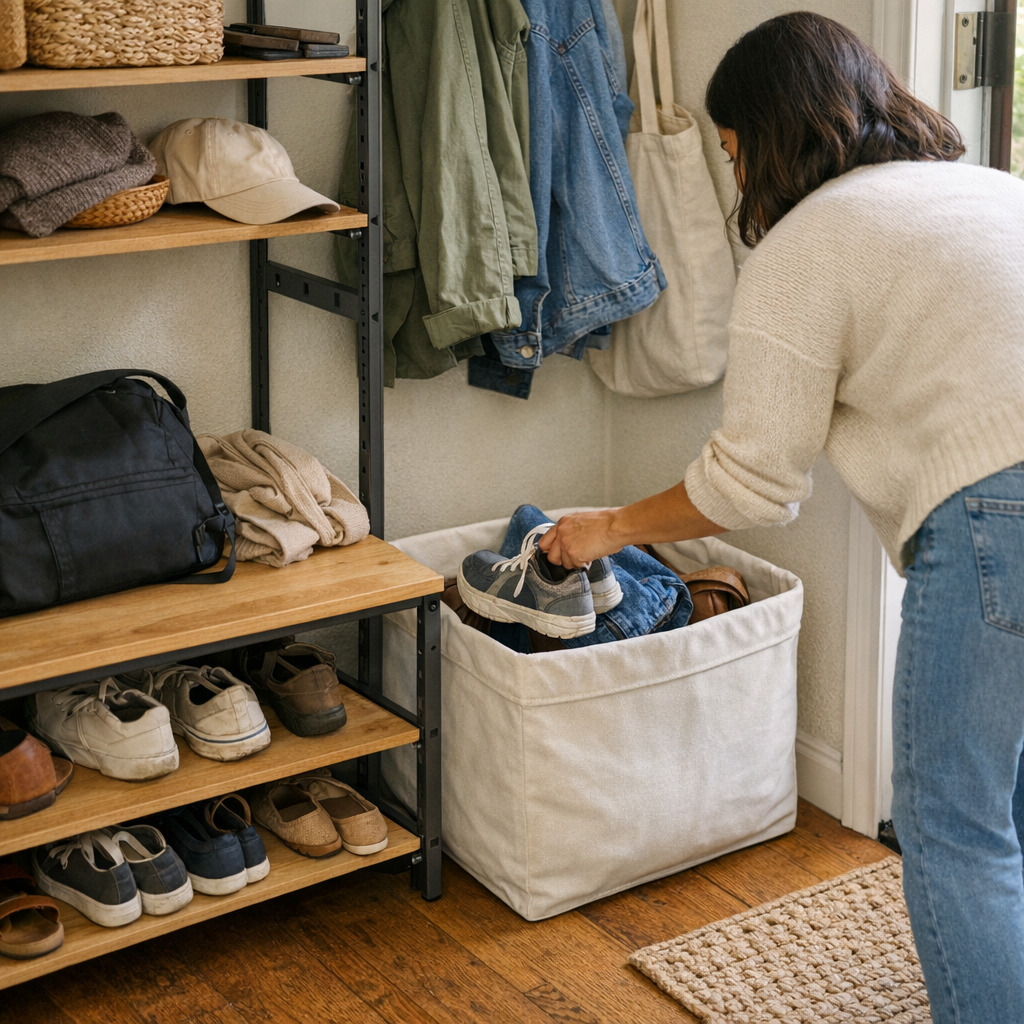
The entryway is where easy routines start breaking down—fast. Set up your storage once, and the illusion of order lasts a week—maybe less. Then the old friction returns: bags pile up, shoes sprawl until you’re side-stepping a spreading row, and last month’s “donate” jacket sneaks back onto a hook because there’s no real exit. The more you try to reclaim the area, the quicker it refills with overflow. In transition spaces, control feels temporary and the true bottleneck is what keeps coming back.
When Entryway Storage Isn’t Enough
At first glance, labeled cubbies and a row of hooks promise structure. They hold—until outgrown cleats and donation-marked gear creep back, quietly mixing with daily essentials. You might spot a half-used tote on the bench edge or a jacket you meant to remove now hiding among current coats. The slow recirculation doesn’t announce itself. It appears as a tightening path, a bench blocked by overflow, resets that take longer, and a creeping sense that you’re fighting yesterday’s clutter every time you come home.
The Quiet Return: How Outflow Problems Undermine the Setup
This is the daily headache: without a real route for outgoing items, what’s leaving gets stuck. High-traffic homes feel it most. Kids drop their bags, someone swaps shoes last-minute, and overflow meant for Goodwill ends up right back in the main fray. By week’s end, half the donation pile is tangled back into daily rotation, only visible when you trip on it, not when you try to find it. The reset now means sorting out what should’ve left last week—all because nothing marks a clear threshold for what goes out.
Temporary piles harden into semi-permanent fixtures. That donation bag under the bench settles in, and the shoe rack—designed for rotation—becomes overflow storage for what no one uses. The result: every reset takes longer, and the threshold narrows until just getting through the door feels like wading through a backlog.
Why a “Donate” Bin at the Threshold Reshapes the Routine
Add a visibly marked “donate” bin and you break the cycle. Not because it polishes the look, but because it gives outgoing gear an exit. The point isn’t perfection. It’s making the flow one-way for what’s meant to leave, so nothing quietly recycles back and builds hidden clutter.
Placement matters:
- Hide the bin and you guarantee unused items sneak back into storage. It just becomes invisible overflow.
- Place it where you naturally drop shoes and bags—but out of the main rush path—and it becomes a habit, not a hurdle.
The donate bin draws a visible line: shoes too small, jackets never worn, bags meant for somewhere else now have a destination that isn’t “back in.” The daily split—what stays, what goes—happens at the threshold rather than getting buried until the next big reorganization.
Real-World Reset: What Changes After a Week
Install a donate bin and within days, you see the shift: the bench edge stays clear, less energy is wasted relabeling what’s already supposed to go, and resets get quicker. Instead of resorting the same pile over and over, you deal with items once—right at the door, right in flow. The headache of repeating the same reset shrinks fast because the routine itself divides what’s active from what’s out.
Surface Order vs. Functional Dividing Lines
It’s a common blind spot: color-coded bins and matching hooks look organized, but unless something intercepts outflow, storage becomes slow accumulation. Here’s how the gap shows up:
- The shoe row inches out, squeezing passage even when it looks lined up from afar.
- That labeled cubby fills with limbo items, so “stored” just means “deferred.”
- The bench becomes a catchall, so sitting—or even pausing—is an afterthought, not an option.
What matters most isn’t appearance—it’s whether your setup forces a decision at the threshold. Does it let things go, or just hide what’s undecided? A dedicated bin means questionable items get a deadline, not a free pass back into the mix.
Tactics That Make Entry and Exit Smoother
Where the Bin Belongs—and Where It Doesn’t
Place the bin near where shoes and bags land—close enough that dropping things in is automatic, but never in the way when the whole family moves through at high speed. Usually, that’s a wall-adjacent spot, right at the edge of the transition zone. If you tuck it out of sight, it loses power; if you place it in the traffic lane, it becomes another obstacle.
Don’t let it fill up and stall out. A weekly (or midweek, for busy households) empty keeps the donate bin from becoming just another holding zone. A stuck bin is worse than none—it underlines that the flow is broken.
Small Adjustments for Big Relief
- Label it obviously. Use “Donate,” “Going Out,” or a high-contrast tag so it signals its purpose—no ambiguity for kids, guests, or teammates.
- Match the size to your churn, not your ambition. Oversized bins just invite backup, and tiny ones lose authority. It should fit your likely outgoing volume for that week, not become the next drop zone itself.
- Make it part of reset, not an afterthought. Donation drop-offs go on the same rhythm as your entryway refresh—so exit flow stays as routine as the rest of your week.
What You Gain: A Threshold That Lets Go—and Stays Ready
With a working donate bin, entryways stop pretending at control and actually hold it. Footpaths aren’t squeezed by mystery shoes and last season’s gear. Resetting isn’t a separate, dreaded chore—it’s standard, short, and lets everyone move through without pausing to negotiate with old clutter.
The payoff is quiet, but clear: instead of path-blocking drift, you get a daily entry route that stays workable, routines that don’t break under small stress, and a front zone that actually helps life move forward—not back into last week’s patterns. Even as routines shift or more gear comes in, the space stays ready, because it sheds old weight before it takes up the zone again.
See practical entryway storage solutions for real transition spaces at Betweenry.