
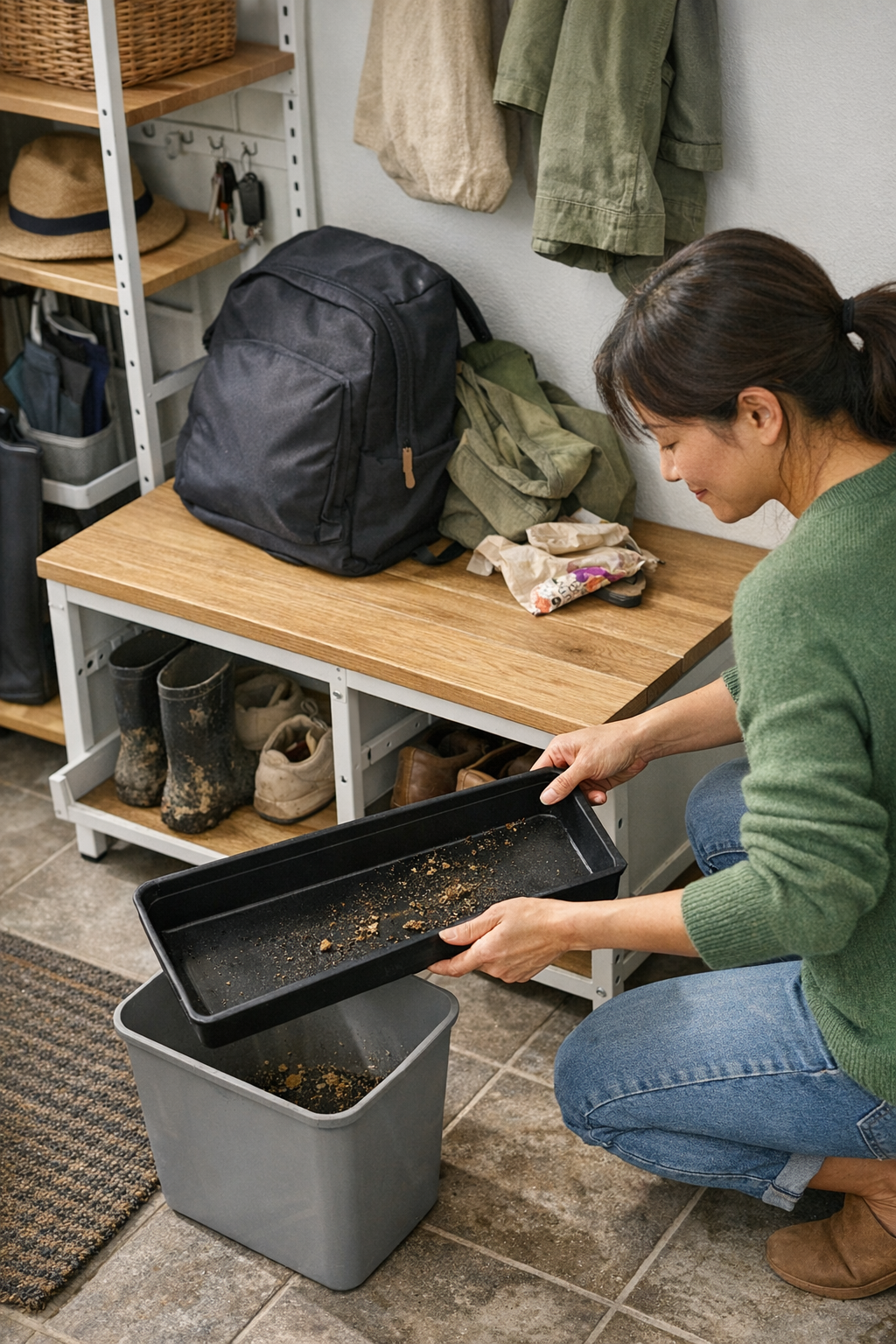
Entryways show their true nature at the worst moment: when you have exactly one hand free and the threshold’s already crowded. Drop a bag at the door—watch the clear zone vanish. Line up shoes in the tray—see the row creep sideways, blocking the pull handle that’s supposed to make resets easy. The difference between an entry that bounces back daily and one that sags into mess isn’t about how pretty it looks on day one. It’s what happens on day ten, with two pairs of boots wedged deep, a tote slumped across the edge, and a liner you can’t reach without reshuffling the whole load. The real divide? Whether cleaning fits real-life movement—or becomes just another “reset” nobody wants to start.
“Removable” in Name Only: The Hidden Hassles That Slow Down Resets
Plenty of storage benches and drop-zone bins promise a “removable liner”—but that feature rarely survives daily routines unscathed. If pulling the liner means sliding out mud-caked shoes, prying up a wedged-in tray, or nudging aside a week’s worth of dropped bags, resets just don’t happen. Every pass-through adds another obstacle: an edge that catches, a shoe that blocks release, a drip of winter slush that dries before anyone bothers to clear it. By the third or fourth day, you’re not using the “removable” feature at all. What’s left is overflow, a clogged access lane, and a threshold that quietly fails to keep up.
Everyday Choices That Turn Small Setups Into Big Obstacles
Picture the after-school stack: backpacks thud down, snacks scatter, and boots overflow the liner’s intended area. It barely takes two days—one messy return, one extra delivery box wedged in—for access to get lost. That liner you meant to keep handy? Buried. The difference between a reset that takes five seconds and one that feels like a project is simple: Can you grab the liner edge, right now, without disturbing everything? A setup that lets you lift, tip, and replace with one hand actually gets used—while a buried or blocked liner lets grit collect until it becomes part of the furniture.
The Fastest Test: What “Accessible” Really Looks Like
If you can’t see where to pull, the liner may as well be fixed. Real access is practical, not theoretical. Look for a finger-width notch at the front, a built-in tab, or a lip that invites an easy grip—even when half the gear is still piled in. If the liner’s buried under a tightly-packed shoe row, or squeezed so tight you need two hands to free it, every reset becomes a reason to quit.
Entryways aren’t static—activity pushes the limits every day. Shoes drift beyond the tray’s edge, wall hooks fill, and bags that were supposed to be “temporary” linger indefinitely. Once liner access is blocked for two days, new dirt lands outside the intended zone. Overflow turns the liner from a helpful feature to a neglected base plate, and you find yourself skirting the mess rather than resetting it.
Movement, Not Perfection: What Actually Keeps the Threshold Calm
Surface-level order at the entryway fades fast. Functional calm depends on whether reset moves fit naturally into passing routines—or pile up as irregular chores. If clearing the tray means arm-wrestling boots out of the way or shifting a bench that blocks half the door, that “reset” slides to the bottom of the weekend list. An accessible liner, pulled out in seconds, lets you slip daily dirt back outside the moment it appears—preventing slow buildup that always gets harder to undo.
Recurring Pinch Points: What Slows Down the Entry Flow
Wet arrivals, instant complications: Stepping inside with soaked shoes, the easy move is to drop them right at the door. But if the liner lifts smoothly, water and salt land on a surface you can empty in a swoop—no need to clear everything first. The right setup saves tomorrow’s threshold from last night’s delay.
The bench that traps, not just seats: What looks like extra seating often doubles as a drop zone. If every new bag tossed in means covering the liner’s handle or wedging the tray in place, overflow follows fast. Soon, movement clogs; that storage solution starts creating the very bottleneck it claimed to solve.
Shoe creep, the unrelenting spread: Today’s neat row means little tomorrow. If liner access is visible and stays open, returns are quick—grit stays in bounds, and the tray gets cleared before obstruction sets in. Hide the edge for too long, and shoes, grit, and daily spillover start attacking the rest of the entry, forcing everyone to sidestep the buildup just to get in or out.
The Habit Hinge: When Small Features Change the Routine
The switch isn’t dramatic—just a liner with a finger-width pull, always reachable. Suddenly, cleaning up grit is a two-second motion as you step in or out. That pull moves a reset into the time it takes to drop your bag—not the time nobody ever finds for a full entryway clear-out. In homes with staggered schedules and repeated comings-and-goings, this makes the critical difference: The threshold stays navigable, and resets never become intimidating.
The Real Access Sweet Spot
Perfect fit is a trap. If a liner rattles loose with every shift, it’s annoying; if it jams tight, it’s worse. You want a tray that anchors for normal use but slides free when you need it, even with ten pounds of mixed boots and stray gloves nearby. If every return home means contorting around a jammed tray or nudging a bag out of the way to find the handle, you’re not just living with minor annoyance—you’re building a routine that’s quietly unsustainable.
Reset in Motion: Where Clean Zones Actually Last
Entryway cleaning rotas are fiction for most households. What actually keeps a threshold under control are micro-resets every two or three days—or every time a mud wave sneaks in. An easy-access liner, visible and free to pull, means these quick clears become standard. The area stays ready for feet, bags, and short-notice guests—without the stress of a looming cleanup project hanging over every weekday. That built-in readiness means you aren’t paying back a week’s neglect in one go.
The Real Difference: Accessibility Beats Aspirational Organization
It isn’t about a liner that could be removed—it’s about whether you can remove it without effort, without clearing a path, and without breaking the flow of actual daily entry. The setups that work aren’t just clean; they let the threshold get dirty and cleared, again and again, before things pile into full-scale backlog. If your routine clashes with your entry storage instead of syncing with it, consider whether “removable” has become a feature in name only—and what a real upgrade might finally make possible.
If you’re ready to make entry storage that actually fits daily life, Betweenry offers setups made for real movement—so your threshold stays clear, no matter what the day brings in.