
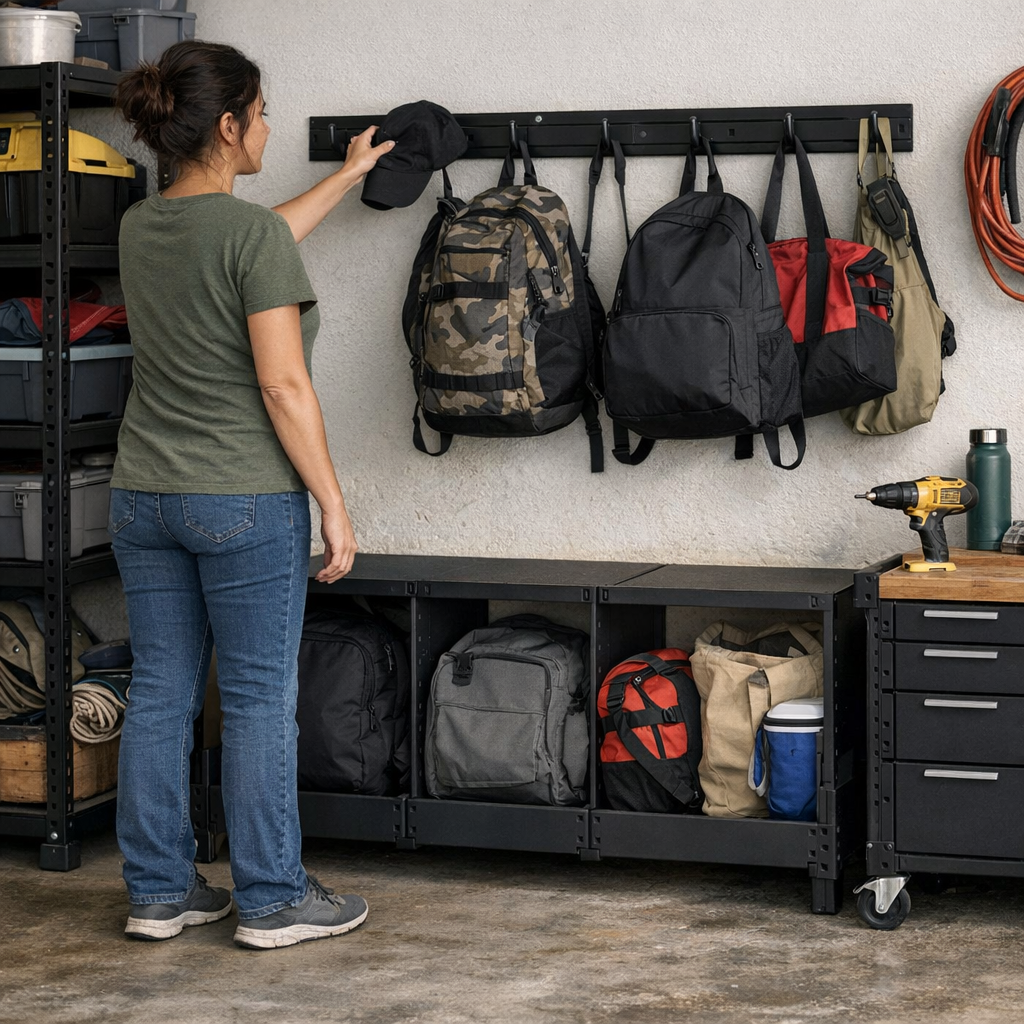
Bag storage setups decide whether your space moves freely—or bottlenecks with every busy day. Walk into a garage, mudroom, or workshop and you know it instantly: in one, bags are stored with intention, and grabbing what you need is mindless. In another, bags explode across every surface, paths choke up, and you find yourself sidestepping, shifting, or flat-out detouring through a gauntlet of pile-ups. These trouble spots take over surprisingly fast—often as soon as storage gets chosen for looks, not for living.
When “Tidy” Storage Trips Up Your Routine
The neatness of wall hooks, slim shelves, or a new rail has instant appeal. On setup day, everything feels under control. Then routine sets in: by Thursday, those five hooks hold seven bags, straps corkscrewing together, canvas flopping to the floor. A stacked bin that looked minimal ends up blocking your access to the cabinet, forcing an awkward reach every time you need a tool.
This isn’t a rare problem—it’s what happens when storage solves the look but ignores what life actually throws at it. Slim bins and hooks clear the wall, sure, but once the family is late for practice or a bulky backpack doesn’t hang up neatly, the system falls apart. Bins become black holes for overflow, rolling carts wander and sprawl into walkways, and suddenly your “organized zone” is just new clutter in disguise. Instead of friction fading, it quietly multiplies.
Where Setup Fails: Overflow, Obstruction, and the Slowed-Down Reset
The flaws show up quickly—just watch after a handful of real-life returns. That “catch-all” shelf with good intentions? It’s now a leaning mountain of tangled bags and loose straps that slide right off the edge. Wall hooks fill up fast, and overflow bags drop straight onto the floor, or, worse, sprawl over a bench or worktop, seizing even more space. The once-open corner turns into a hesitation point—do you shove, reroute, or risk stepping on someone’s gym bag?
The classic dead-end hallway makes this painfully clear: peg rails go in to keep bags off the floor, but after one missed return, a single gym bag sits right where you need to walk. By the week’s end, a casual drape becomes a layered pile-up, forcing everyone to take an awkward sideways slide or, more likely, just avoid the area until the next big clean. The promise of “enough storage” unravels alarmingly fast—just a couple imperfect days and the whole flow bottlenecks, making the space feel smaller than ever.
The Real Scene: Why “Organized” So Often Slows You Down
Picture the daily scramble: you’re late, one hand on your bag, reaching for a jacket with the other. The only way to hang up your bag is to shift that rolling cart—again—back into its spot, which it never seems to stay in. Rows of bags bristle off hooks at shoulder level, a stray tote pokes your elbow, and a bin wedged under the shelf means you can’t step back without catching your heel. Weekend plans for a quick reset collide with reality: untangling, restacking, uncovering blocked doors, buying back your route through the space. “Organized” doesn’t mean friction-free. As soon as routines get rushed, everything piles up.
What Actually Works: Storage That Bends Without Breaking
The setups that last handle the chaos of real returns—gear slung down, extra equipment appearing unplanned, resets that take seconds, not minutes. If you have to shift one bag to put up another, the system’s already too rigid. If a missed return means a slip hazard, the whole routine gets upended. Function beats form every single time: setups must absorb imperfect days and overflow, not demand perfection to keep the path clear.
The acid test: Does your storage flex when you toss in “just one more bag”? If two people come home at once, do you still have a walkable route? Can you drop, hang, or shove things away without needing a full reorganize by Friday?
Making Room for Error: The Smart Drop Zone
Here’s where a simple low cubby—open at the front, under those overloaded pegs—completely shifts the routine. Suddenly, instead of bags spilling across the floor or bristling from every hook, stray returns have an instant landing pad. You no longer choreograph a delicate dance just to reach the cabinet or bench. People can drop a bag and keep moving. The system absorbs overflow and quietly resets itself with almost no extra thought. The room holds more, but feels less cluttered, and you buy back the one thing every busy route needs: clear, predictable movement.
And it’s more than a visual fix. Gone are the habitual sidesteps and panicked sweeps just to open a door. The space stays open even as it fills up, and the cycle of frustrated rearranging breaks.
Five Telltale Signs Your Bag Storage Doesn’t Actually Work
- The floor’s always covered—even after you tidy, stray bags creep back by the end of the week.
- You find yourself untangling straps, wrangling rolling carts, or restacking bins more than once a week.
- “Passing through” means dodging, shuffling, or shifting some other object just to make room.
- The wall section you installed for storage is technically used—but half the time, you’re still blocked during the morning rush.
- The area only looks clear after a deep reset and never holds up in real, repeated use.
Sharper Tactics: How to Make Bag Storage Actually Flow
- Layer vertical and floor solutions. Pair durable hooks for the “hang-and-go” crowd with an open cubby beneath for rushed returns and bulkier items. Missed the hook? No problem—the bag still lands out of the way.
- Leave room for real-life overspill. If you install modular rails or shelves, set up a floor “catch” area for overflow so nothing spirals out into the path or blocks a door.
- Pave a home for mobile units. Rolling carts and chests are only helpful if they stay put. Demarcate a parking spot—tape, mat, or floor decal—so mobile units don’t slowly invade walkways.
- Prioritize resets that happen naturally. Setups should self-correct: after a week of heavy use, a quick sweep or toss-in restores order. Avoid organizing systems that only pay off after a marathon tidy on Sunday night.
What Matters: Movement Over Mere Appearance
The ultimate test isn’t how “organized” a space looks when empty, but how it holds up on a week of missed hooks, armful returns, and lopsided overflow. A well-placed cubby, modular bin, or rugged wall hook buys you margin—so you can move, drop, stash, and reset quickly, even when things go sideways.
When storage is tuned to the way life really hits it, you don’t waste time shuffling, dodging, or constantly re-staging every square foot. What’s left is simple: less friction, more room to move, and a setup that holds up through the mess, not just in photos.
Find setups and modular organizers for real spaces and routines at StackNest.