
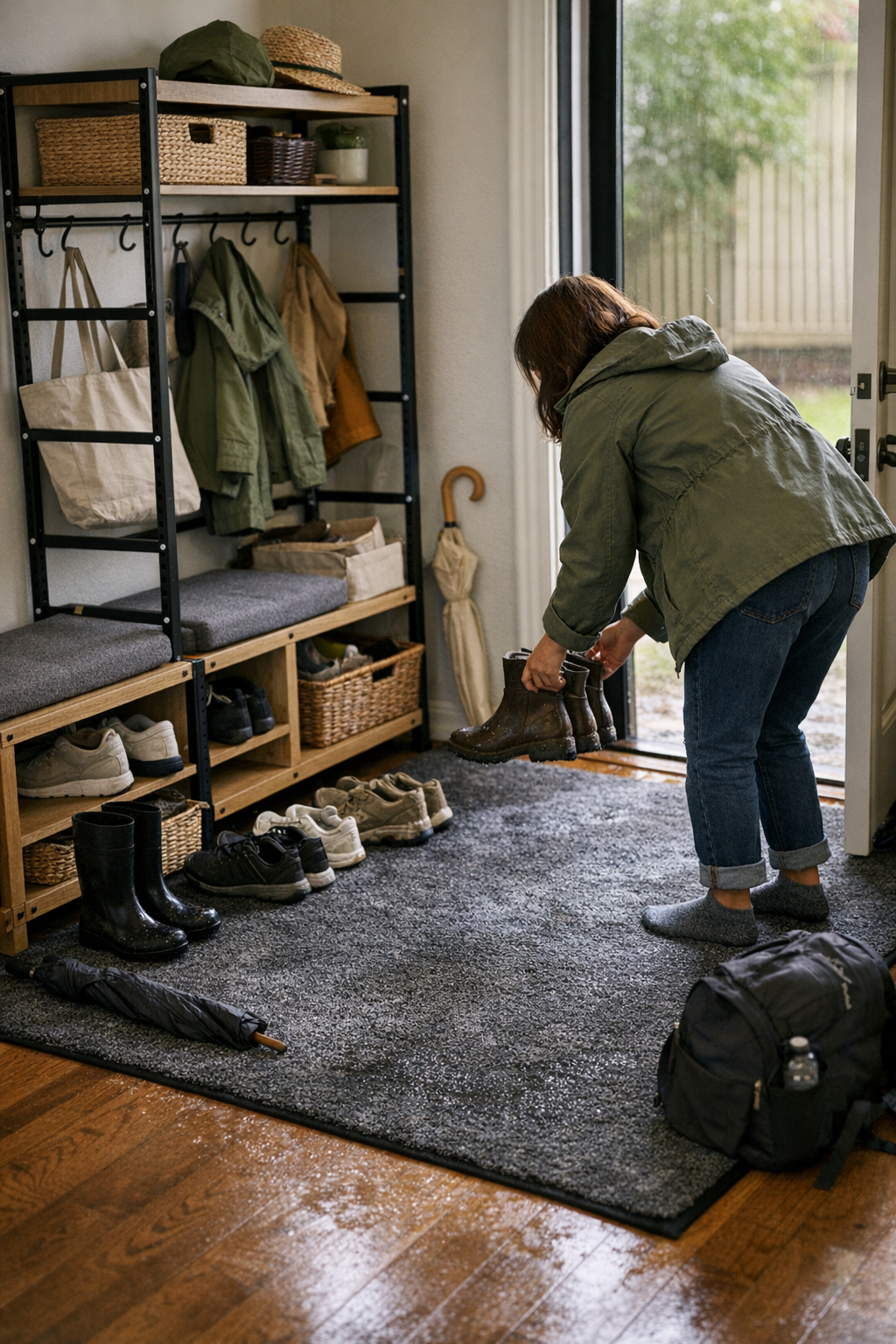
Entryways fail fast when weather hits. By day three of rain, your so-called organized threshold starts showing real cracks: shoes nudge past the mat, water sneaks onto bare floors, and that thin “clean zone” fades under the strain of repeated comings and goings. Resetting the area is no longer just setting shoes straight—it’s wrestling damp backpacks off half-exposed flooring, mopping puddles that spread under the bench, and dragging furniture back toward the wall after each scramble. What looked tidy on Sunday collapses by Wednesday, and the damage—swollen wood seams, gritty stains, blocked passage—grows stubborn. For most homes, entry routines reveal their weakest points long before you notice the repair bills stacking up.
Where Entry Setups Fall Short—And Why It Matters Over Time
Weakness isn’t obvious until the routine repeats. One thin mat and a bench give the illusion of control, but rain and traffic expose how easily the area slips out of order. Mats are too narrow, or set an inch too far from the door, so wet shoes push onto vulnerable floors by necessity, not choice. The first few users line up shoes neatly—but as each new pair arrives, overflow hits. Boots dangle off the mat edge; bags drop wherever there’s space, straddling mat and wood, leaking water just past your line of defense. The intended containment zone slowly becomes a launchpad for wet mess. Benches, meant for calm and storage, turn into overflow collectors. The routine that made sense on the showroom collapses in the real midweek rush.
How Drift and Overflow Quietly Compromise Your Threshold
It’s not the puddle you see—it’s what seeps and spreads at the edges. Bags, dropped fast, slide past a shrinking mat and collect drips that splash into seams, not just on top. Shoes drift outward, inching the mat off alignment bit by bit. What started as a defined landing zone blurs into a wet sprawl. By Thursday, you’re nudging the bench aside, drying corners you didn’t know were wet, and awkwardly stepping around piled shoes just to get through the door. Oversight creeps in: a wall shelf holding hats can’t stop shoes from drifting out, and a vertical shoe rack loses its utility if wet soles miss the mat entirely. Real trouble doesn’t announce itself—it builds quietly at the threshold, outpacing every “good enough” fix.
Real Entryway Routines: Where The Weakness Shows
Actual entry flow exposes every flaw. Four roommates arrive within ten minutes—each tracks in rainwater, forced to step past an already soft, saturated mat. The final person just punts shoes to wherever there’s a dry patch—usually bare floor. Meanwhile, that utility bench acts as both seat and overflow shelf, inevitably blocked by a dropped gym bag or a soaking-wet backpack slung over the side, trailing a cold puddle underfoot. Getting through isn’t smooth: you have to side-step, step over, or risk a slip with every pass.
A “staged” entry—bench, crisp mat, and neat shoe pairs—cracks under real use. The visit of a single guest doubles shoe chaos instantly. You scramble to wedge things closer, but now there’s a finger of water inching under the bench and shoes crowding the wall. With every reset, the mental line between “clean” and “contaminated” gets grayer, and the illusion of order erodes. By the end of the week, floor damage sets in quietly, and the sense of reliable structure gives way to just hoping the weather changes.
The Anatomy of a Functional Wet Mat Zone
Containment—not appearance—keeps damage in check. The real threshold needs a mat zone that meets the mess head-on: covering the full landing space, anchoring through scrambles, and defending the most-used footpath. Core requirements for real performance are:
- Width: Run wall-to-wall if possible, or cover at least the span needed for all daily shoes side by side. Any shoes past the edge? Your mat is too narrow—water will escape and multiply cleanup.
- Depth: Three feet minimum from door, so no one steps off early. Less, and you lose coverage as soon as two people arrive or one pair of boots enters the mix.
- Placement: Position so that the first wet step lands squarely on the mat. Any gap—inches matter—means floors take the brunt before the mat even gets a shot.
- Absorbency: Choose mats built to trap water and grit, not just show a greeting. Lightweight or purely decorative mats only move the problem into the next layer down.
What Happens When Mat Zones Miss The Mark?
Failure creeps in subtly. Shoes stacked just outside the mat gradually soak into the wood. Overflows at corners morph tidy resets into drawn-out routines—first a quick tidy, then a scramble to mop unseen wet spots under the bench, then a fight with warped seams. Wall storage or racks lose all value if the “zone” isn’t big or sticky enough to hold daily items in place. Once the floor feels spongy or seams ripple, you’re past routine fix and staring down repairs. Small flaws, repeated unnoticed, snowball into big cleanup and bigger costs.
How A Well-Sized, Well-Placed Mat Changes The Routine
A high-absorbency, boundary-hugging mat stabilizes chaos fast. Every shoe finds its place—there’s no room for drift. The border is visual and physical: you feel it with every step in and out, and stray water has nowhere to hide. Instead of crawling after hidden damp or lifting the bench to find secret puddles, a quick visual check shows you exactly where to reset. Lining up shoes post-rush becomes a matter of seconds. The difference isn’t aesthetic—it’s operational. Routine doesn’t require a rescue, just a practiced pass.
Even on soaked days, a wall-to-wall mat holds the line: bags drop onto a defined strip, shoes stay sorted, and bare floor keeps dry the way you intended. Overflow pressure softens—multiple arrivals don’t overthrow the setup, and latecomers aren’t forced to improvise directly onto clean wood. While absorbent mats still hit their limit during heavy storms, the broad zone keeps water from spreading, and routine resets don’t spiral into full recoveries. The entryway acts like a true buffer, not a shaky first impression.
Tips From Real-World Use
- Measure the mess, not just the space: If you spot shoes or bags just outside the mat after busy days, your zone is undersized. Size up or place multiple mats where drop patterns split—cover the real spillover line, not just the visual one.
- Time your reset, not just your cleaning: After the busiest return of your week, clock the full reset process. If you’re moving benches or drying where you can’t see, your layout isn’t holding up to actual flow.
- Block off spill points directly: Shoes cluster at corners, or water creeps under furniture? Set a threshold bar, a distinct rug edge, or a shallow tray—clear physical boundaries tighten up routine and limit mess spread without daily micromanagement.
Why Most “Organized” Entryways Don’t Hold Up—and What Actually Works
Magazine-ready entryway setups hide weak links when real use kicks in. The actual pass-or-fail moments aren’t the staged photo or the clean Sunday—they’re back-to-back arrivals, muddy dog sprints, kid runs with raincoats dripping onto every surface. Decorative mats and narrow layouts flatter guests but unravel under pressure. Anchored, high-absorbency mats (sized and placed for your true routine) block, catch, and hold up against repeated friction that porous solutions can’t touch. Betweenry storage that fits the movement—modular, resistant to drift, and designed for reset speed—makes the entryway work beyond appearances. A setup matched to actual behavior is what keeps everything moving, not just looking sorted for visitors.
Ultimately, form isn’t enough. Choose structure and placement with repeated entry routines in mind, and your entryway becomes the one part of the house that quietly stands up—rain, boots, bags, and all.