
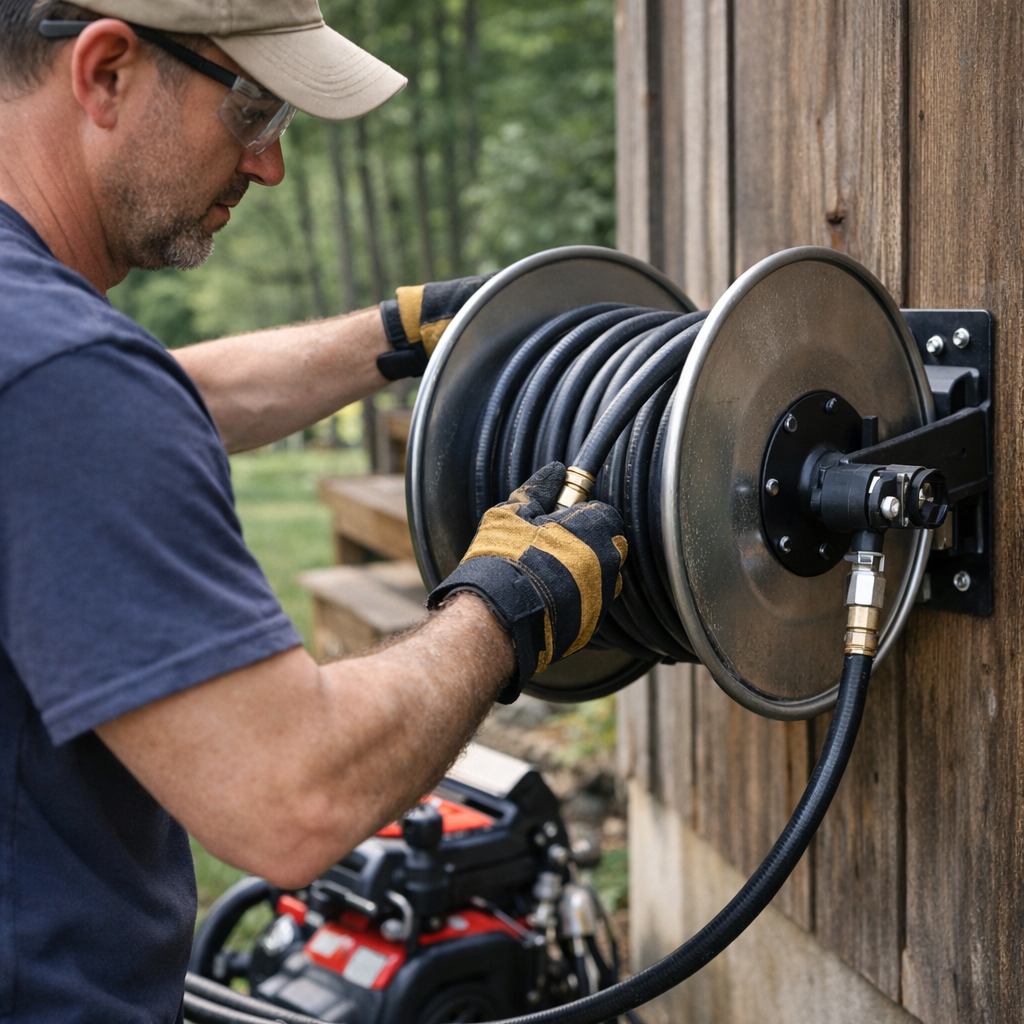
No one thinks about hose storage—right up until a twisted, stubborn hose brings your cleanup to a crawl just as you’re packing away tools. If you spend your weekends rinsing post-sanding dust from decks, blasting concrete slabs clean, or washing the grit off drills and fasteners at the end of a job, you already know the difference the hose makes. You need a line that feeds smoothly, drops exactly where you need it, and lets you finish the work, not fight the equipment. But what happens between uses—where and how you store the hose—decides whether tomorrow’s job starts smooth or snarls from the first pull.
Hose Storage: Where Shortcuts Backfire Fast
At first glance, every reel and wall hook looks ready to take years of abuse—chunky welds, “heavy-duty” stickers, and claimed capacity to match your hose’s length. But those claims fade in real use. Store a pressure washer hose on a narrow reel for a few weeks, and the consequences start to bite. Maybe it’s kinks that flat-out refuse to straighten after yesterday’s job. Or it’s tight “memory” coils that spring right back the moment you unroll, forcing a wrestling match before you’ve even pulled out the battery for a swap.
This isn’t a mild nuisance at the end of a long project. It’s the final insult after hauling saws, tucking away bits, pushing through fatigue—just to lose another chunk of time untangling or, worse, discovering a cracked hose where it bends. A shortcut in storage adds up to a real leak in your workflow. More than once, all that’s needed to spoil a finish prep is a hose that simply refuses to cooperate.
Reel Width: The Detail That Makes or Breaks Workflow
The make-or-break detail is hiding in plain sight—a reel’s core diameter. Ignore that number, and you’re left with tight coils that choke your work, even if the hose “fits.” A rack or hook just a few inches too narrow will stress every section it contacts, teaching the hose to twist back against you the next time you circle a sawhorse or duck under scaffolding. What looked “close enough” on the shelf winds up costing you more in effort and hose replacements, week after week.
Oversized reels aren’t a luxury—they’re mandatory for anyone who wants speed and durability. Run the job with a wider loop, and those little friction points vanish. The hose glides past piles of scrap, curves easily under benches, and stays supple through repeated use, no matter how many tools you swap out or batteries you burn through in a day. That means less risk of kinks at the fittings—no need to pause and baby the line or police every bend as you adjust your working position. Over a season of real work, the hours saved are impossible to ignore.
Real-World Scene: The Hidden Time Drain of Poor Storage
Imagine you’re losing daylight, hustling to rinse sawdust after fast cuts or clear debris so a finish coat can go down before weather moves in. With a rack that’s sized for the hose, your routine feels clean—no tangles at your boots, no snagging on sawhorse legs, no lost time as you swing the nozzle behind stacks of lumber. But swap in a hose trained by tight storage, and control vanishes fast. Suddenly, you’re double-backing to unhook coils, feet catching on springy loops, pressure drops flicker as the hose pulls against itself, and the battery you just swapped in is already draining.
If the hose loops tight every time, frustration builds with each uncoil, costing you more minutes than you want to admit. Missed patches dry too soon. What should’ve been a smooth takedown session turns into manual wrestling just to get the hose back on the rack. Eventually, you spot those callused, splitting ends at the connectors—signs you’re headed for another premature replacement. All because of a shortcut at storage.
Leveling Up: The Payoff from Smarter Hose Racks
The fix isn’t glamorous—but it’s one of those upgrades you feel by the end of the first week. Swapping a narrow hook for a wider rack (12-inch loop or more) means your hose releases in seconds, rolls flat on the worksite, and doesn’t waste your arm strength trying to “remember” those old tight coils. Takedown becomes a rhythm: wind, stow, move on. No tiptoeing around the hose or wasting time coaxing it straight. A practical rule? Stick to a reel that’s at least double your hose’s required bend radius—for most, that’s a simple, high-impact adjustment.
And don’t discount those time savings. Ten seconds per deploy, two or three deploys a week—across months of sanding, drilling, or prepping, you’re gaining back whole afternoons you’d otherwise lose untangling kinks. That difference is real: less fatigue, more focus on cutting, fastening, and finishing, and less dread when pulling the line for the next setup.
Frequently Asked Hose Storage Questions (From Actual Users)
Can I use any hose reel if my pressure washer hose physically fits?
No—fit isn’t the same as function. If the reel or hook is tighter than your hose’s specified minimum bend radius, you’re laying the groundwork for constant frustration. Those small bends work against the hose’s inner structure, degrading it with every wind and unwind. Don’t trust “universal” unless specs back it up with bend radius numbers.
Why does my hose keep coiling up or kinking, no matter what I do?
Most of the time, the issue starts at storage. Every time your hose rests on a hook or reel that’s undersized, it holds onto that curve. By the time you notice the resistance, you’ve reinforced that shape for dozens of cycles. The fix is straightforward: go bigger on the rack, give the hose room, and see the kinking subside with regular use.
Does hose material actually change how much storage matters?
It matters—just not as much as most think. Polyurethane hoses take abuse better than rubber, but neither escapes the impact of tight storage. Even the most “kink-resistant” material suffers long-term if it’s always bent too sharp. Treat every hose to a spacious rack, and you’ll stretch both its lifespan and its day-to-day performance—especially when site work is rough on every other tool, too.
Simple Shifts, Tangible Payoffs
This isn’t about chasing the most expensive reel or over-complicating your setup. It’s about treating your hose as the tool it is—with the right storage for real work conditions. Double the minimum bend radius for your hose, check that against your storage, and don’t hesitate to upsize. The footprint you give up on the wall or trailer is nothing compared to fewer cracks, smoother flow, and less downtime resetting your gear.
Don’t let the final task of the day—coiling the hose—be the place you invite problems for the next project. Protect your tools, your time, and the ease of every cleanup job by storing smarter. Over months of drilling, cutting, sanding, and washer use, that’s the kind of efficiency that genuinely pays off—and leaves you ready for real work, not another tangled hassle.
For practical tools and gear that work as hard as you do, visit Gumboll.