
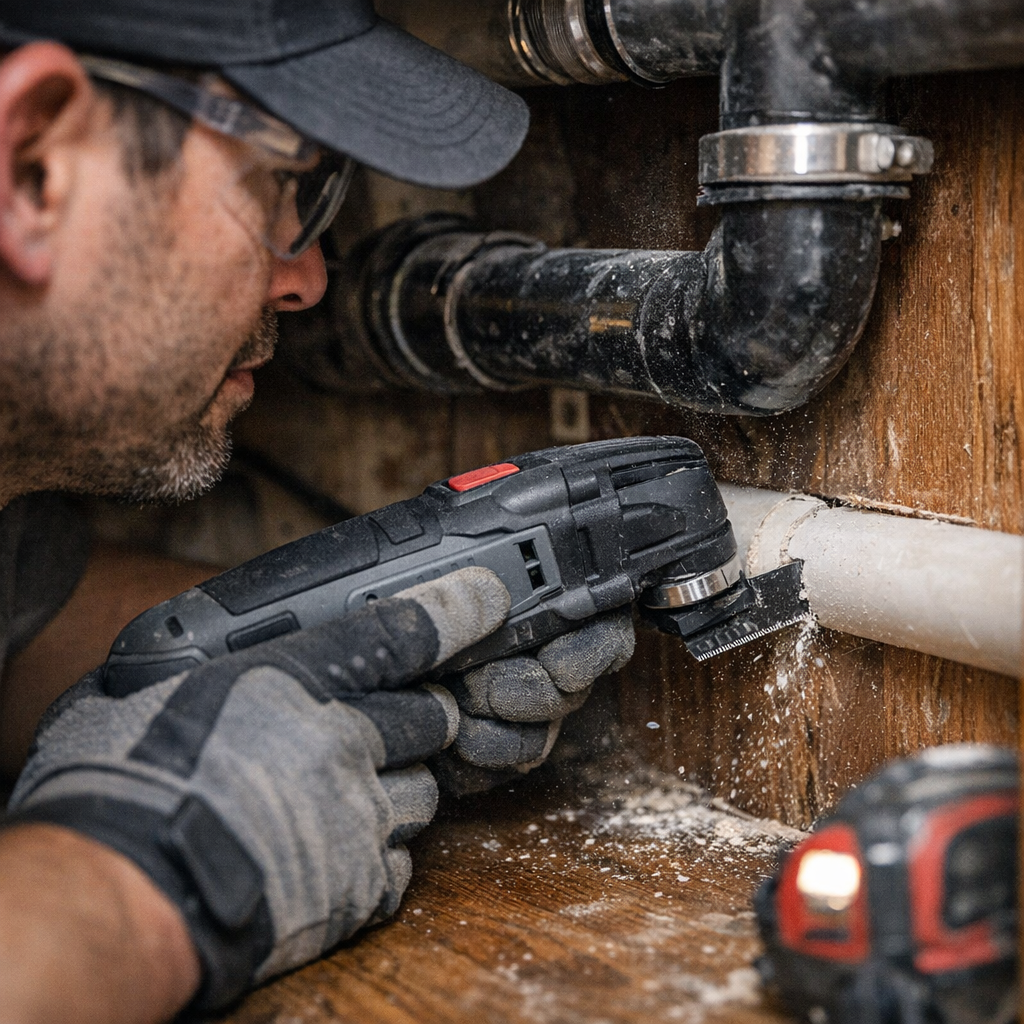
Crammed under a cabinet, knee pressed against cold tile, one hand straining to hold a multitool steady while the other fights gravity—this is where shortcuts and spec sheets stop mattering, and real control becomes the only thing that counts. When the angle is wrong, the cabinet lip blocks your sightline, and every inch of movement risks splintering trim or scuffing a pipe, you feel the difference between a tool that just fits and a tool that actually helps you get the line right. It’s not raw power—most cordless multitools will chew through drywall, plywood, or copper the first few passes—but the details shaping the last pass: vibration, grip, blade stability, and the real biting control that lets you finish one-handed, in the dark, with dust settling on your sleeves.
The First Friction: When “Good Enough” Stops Working
It doesn’t take long on a real job—especially an old rental or a retrofit—to realize the headache isn’t always reaching the work. Any multitool might squeeze behind a joist for the first couple of cuts, and if both hands are free, you’ll fly through clean plywood edges. But those are the rare easy moments. Arms stretched overhead, shoulder wedged under a furnace duct, the job changes: tool stability starts making or breaking your cuts. Even a faint shudder in the handle, if ignored, turns straight lines jagged or pitches the blade sideways when you’re flush-cutting casing or notching subfloor. Before you know it, you’re left with gaps to fill, corners to sand, and hand cramps that never make it onto a punch list.
Shave a few millimeters off on every cut, and suddenly panel fit and outlet covers become a grind. That “almost straight” kerf? Multiply it by six rooms or a dozen pipes, and it becomes the difference between walking away finished and coming back with sanding blocks.
The Creep of Fatigue and Wander
These aren’t big, dramatic failures—they’re subtle, stacking annoyances. Vibration starts as a hum, ends as a buzz in your bones. A multitool that feels stable for the first outlet soon becomes a fight after a run of maple baseboard or dense cement board. The grip demands a tighter squeeze, your wrist starts to stiffen, and by the tenth cut, you’re compensating so much you lose all sense of the original line. Small mistakes—drifting off a mark, slipping against a copper pipe—now need hand-filing or double passes, with more dust and less patience.
Real Difference: One Closet Install, Two Tools
Picture this: two multitools, brand-new blades, a cramped closet. The first tool—short body, real vibration-dampening grip—stays on mark, whether slicing a drywall patch or making clean corners in old pine. Twenty cuts in, you still feel in control. The other tool, just slightly heavier and less balanced, starts wobbling as soon as you reach overhead. By cut five, it’s sliding away from the pencil line, gouging drywall, the edge going ragged. Now every notched stud or panel needs extra work with a rasp or filler—work added by tool drift, not user error.
Balance and design are everything when a task isn’t at bench height. Even a few extra ounces in the wrong spot multiplies your effort, especially one-handed or with arms extended. The awkward “walking” motion of a blade meeting resistance breaks focus, breaks rhythm, and makes simple jobs feel heavier than they should.
Cramped Realities: The Truth of Working in Tight Spaces
Here’s where theory gets tested: Wedged under a 1960s kitchen sink, hacking through a PVC trap that’s up against the back wall, you trust your multitool—because every slip could mean a leak or an ugly scar on the cabinet. Elbow grinding against wood, dust falling into your shirt, you start to notice every bit of vibration or front-heavy bulk. With the right tool, the blade bites neatly, steady at slow speed, following the contour of the pipe without jumping or leaving a shredded edge. With the wrong one, after two passes, vibration ramps up, the tool skips out of the groove, and you’re left with a cut edge too rough to seal, plus another chunk of wasted time wrestling with sandpaper.
This is not a rare ordeal—it’s standard in crawlspaces, behind shower pans, inside laundry alcoves. The takeaway: Every bit of control counts more in contorted jobs, magnified by every cut and every mistake you can’t un-do in cheap laminate or brittle ABS.
Upgrades That Pay Off on Every Job
The surprise is how much subtle improvements flip the script. Swapping to a multitool with an 80mm short body and genuine anti-vibration grip, you suddenly last longer before the pins-and-needles start. The bigger breakthrough is in the accessories—moving from basic blades to sharp Japanese-tooth versions brings:
- No more lurching starts—the blade glides into cuts, with less bouncing or chatter in knots and tight corners.
- Smoother finishes every time—even when kicking up dust or hitting an old drywall screw hidden in the wood.
What changes, job after job? Less fatigue, steadier hands, cleaner results—fewer return trips with a sanding pad or filler. Your workflow stops stalling, and you actually end up finishing more, fixing less.
The Warning Signs: When Vibration Becomes the Boss
You don’t always catch the problem in the moment. Only when your palm is fizzing and you notice your blade’s wandered out of its track do you realize fatigue has taken over. You’re stopping to massage your hand, double-checking every new cut, momentum gone.
Multitools with anti-vibration grips and well-matched blades aren’t just easier on your hands—they keep the job on track when the angles are bad and the space is tight. Pair Japanese-tooth blades for wood and finer teeth for stubborn plastics or pipes. These aren’t minor tweaks—they’re the difference between consistent results and an afternoon of chasing flaws.
Finish Strong: The Real Difference After Hours of Work
Specs matter far less than what you feel after the fifth battery swap or the fortieth flush cut. A well-engineered multitool—compact, balanced, gripping true, and vibrating less—delivers repeatable results, not just on open bench cuts but in the contorted, overhead, or awkward spaces that never make the promo reels. Set your pace, finish with fewer redos, and spend less time on cleanup you didn’t plan for.
And don’t ignore comfort when things heat up. If you’re working gloved in summer, or fingers sweating in a furnace-blasted crawlspace, grips that resist slip, heat, and fatigue buy you more usable hours—especially when the job can’t wait and you’re fighting through a mess of old wiring or stubborn hardware in a corner nobody sees but everyone will notice if it’s rough.
The bottom line? Tools aren’t made equal once you’re past the setup phase. In the spots nobody brags about—half-lit crawlspaces, behind toilets, backs of cabinets—it’s the feel in your hand, not the nameplate, that decides if you keep momentum… or wish you’d brought better gear.
Find practical multitools, blades, and jobsite gear at Gumboll