
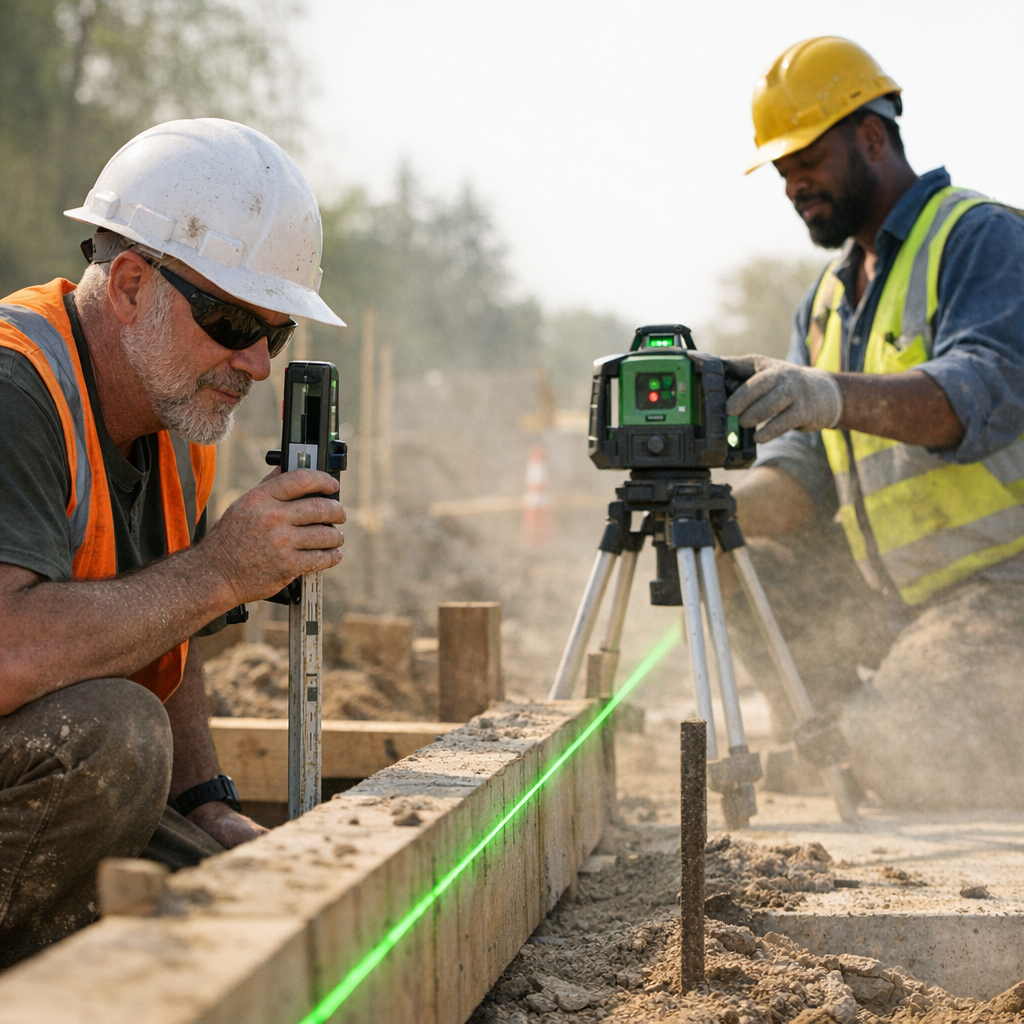
You know the sinking feeling: middle of the job, sunburn already settling in, and your laser level line has all but vanished. This morning, laying out formwork or marking fence posts, the beam was razor-sharp. Now—midday glare, dust hanging in the air, heat rising off the slab—you’re crouched down, straining to catch the ghost of a line you depend on for straightness and square. Every wasted minute crawling, wiping concrete, or guessing distances is budget leaking out, and accuracy flipping a coin. Out here, beam performance is the difference between knocking out the rest of your layout—or doubling back in frustration to re-check everything by eye.
Why Most Lasers Go Missing Outdoors
It’s easy to think all laser levels are equal, at least until you hit a real jobsite. In a shaded trailer or your garage, everything looks bright—until dust, sunlight, or a pale work surface chews up the beam. Out on exposed concrete or pale deck boards, weaker models just dissolve. Missed lines aren’t just a small nuisance: they breed subtle mistakes that creep through every step, whether you’re setting anchor bolts or stretching string for a fence line. By the time you spot a crooked run or an offset hole, it’s already hours or hardware wasted.
Sun, Dust, and Tool Realities in the Field
Real-world pace means you’re drilling anchor points, fastening bracket lines, and moving stakes—often solo, often with dust and glare fighting you every step. By late morning, even a laser that seemed fine inside can turn unreliable. After a round of hammer drilling or sawing, dust hangs over your workspace and the line weakens into a blur. You end up bending, shifting your plywood just to pick up the beam, or checking a measurement with a tape for the third time. This isn’t just annoying—it breaks your momentum, burns time, and racks up fatigue. No one wants to second-guess every cut or hole under the pressure of a tight schedule.
What Makes a Laser Level Actually Jobsite-Ready?
The disconnect happens because spec sheets rarely match jobsite reality. You want numbers to promise clarity, but the fine print buries the difference between a tool that carries its weight and one that falls apart as conditions change. Out here, beam strength, diode quality, and smart optical tech mean everything. These are the factors that keep your layouts tight and your workflow steady as the site goes from early cool to baking chaos.
Specs That Pay Off—Not Just on Paper
A high-output green diode (think class 3R, 5mW or more) is a start. In full sun on dusty OSB, these outshine basic red by an order of magnitude. But even a strong beam reaches its limit: that’s when pulse mode paired with a receiver becomes essential. When the naked eye can’t catch that line—across ten meters of sun-scoured concrete or through a haze of drywall powder—a good receiver finds it every time. With this setup, you keep working at full speed and precision, attacking each task with the confidence that your marks are trustworthy, not up for debate.
Where Line Visibility Makes or Breaks Workflow
Imagine this reality: You’re lining up posts across uneven terrain. After the third round of drilling, the site is dusted white, and afternoon glare is merciless. Your “inside-bright” laser is a memory—now it’s a matter of stooping, re-aiming, or just guessing. Workflow stalls. By day’s end, you’re mentally worn, physical accuracy drops, and every measurement feels like a gamble.
Contrast that with a purpose-built outdoor tool. The line stays crisp, even stretching across dull slabs, mottled cut marks, or shadowed boards. No need to “hunt” for your line—you see it, trust it, and move fast. The job runs smoother, your accuracy holds, and the risk of error shrinks. After hours in the field, you realize how many slowdowns you’ve dodged—not through luck, but through gear that’s actually up to the conditions.
Tiny Slips, Big Consequences
Every pro knows minor slip-ups add up—especially with invisible layout lines. You catch yourself “eyeballing” where you should be exacting. It’s the same frustration as a worn drill bit chewing through hardware or a blade that bogs in OSB. It adds invisible costs: rework, remeasuring, and—eventually—redrilling holes or recutting studs, just to reclaim lost accuracy. It’s real-world drag that basic tools never account for.
Upgrades That Actually Matter in the Field
“Overkill” isn’t the point—workable margin is. Jumping from 12 to 27 meters of visible range can mean the difference between hustling through a perimeter check or wandering around with a tape measure, muttering. More than that, the right receiver lets you work blind to the beam—firing lines through sun-glare, around corners, or over gritty rebar mats—without a pause. That’s control that cuts out the guesswork, keeps your head up, and actually lets you work, not chase fading lines.
Real-World Tips: Keep Your Layout Moving
Stash backup batteries within reach. High-output lasers burn through juice when temperatures climb and outputs are running at full. The last thing you need is a power-out mid-layout—especially with a site full of partial stakes and unsettled marks.
Clean your lens as routinely as you sweep your slab. No beam, however bold, can punch through a dusty film. Quick lens wipes between measurements are the cheapest insurance against lost visibility.
Jobsite Questions—No-Nonsense Answers
Why does my laser vanish outside but stay bright indoors?
Most budget lasers lack the muscle—weak diodes and no outdoor mode—so sunlight wipes them out. Outdoor-grade models are engineered to throw stronger beams and sync with detectors that pick up what you can’t see, keeping you consistent under any conditions.
Is green automatically better than red outside?
Green is easier for the eye to spot, but it’s only as good as the power behind it. Output and detector compatibility matter more than the color itself. Even high-viz green can turn ghostly on a bad slab if the internals aren’t up to snuff.
Do I really need a receiver for site work?
Anything over a few meters in the open, especially on bright slabs or bare ground, becomes guesswork without a receiver. Detectors read what’s invisible, meaning you keep moving with pace and precision—instead of stopping to squint and hope.
Don’t Let the Line Disappear—Or Your Momentum
The lines that fade mid-job drag down the whole day: slower drilling, less sure cutting, constant rechecking, and mounting fatigue. Better visibility isn’t a magic bullet, but it is the difference between staying on pace and fighting your tools every step. Out here, the right laser means less crawling, more control, and confidence that the line you trust at 8 a.m. is still working for you by 3 p.m. Get the gear that earns back those lost minutes—and keeps every stake and saw cut on track, start to finish.
Find your next outdoor-ready laser level and practical jobsite essentials at Gumboll.