
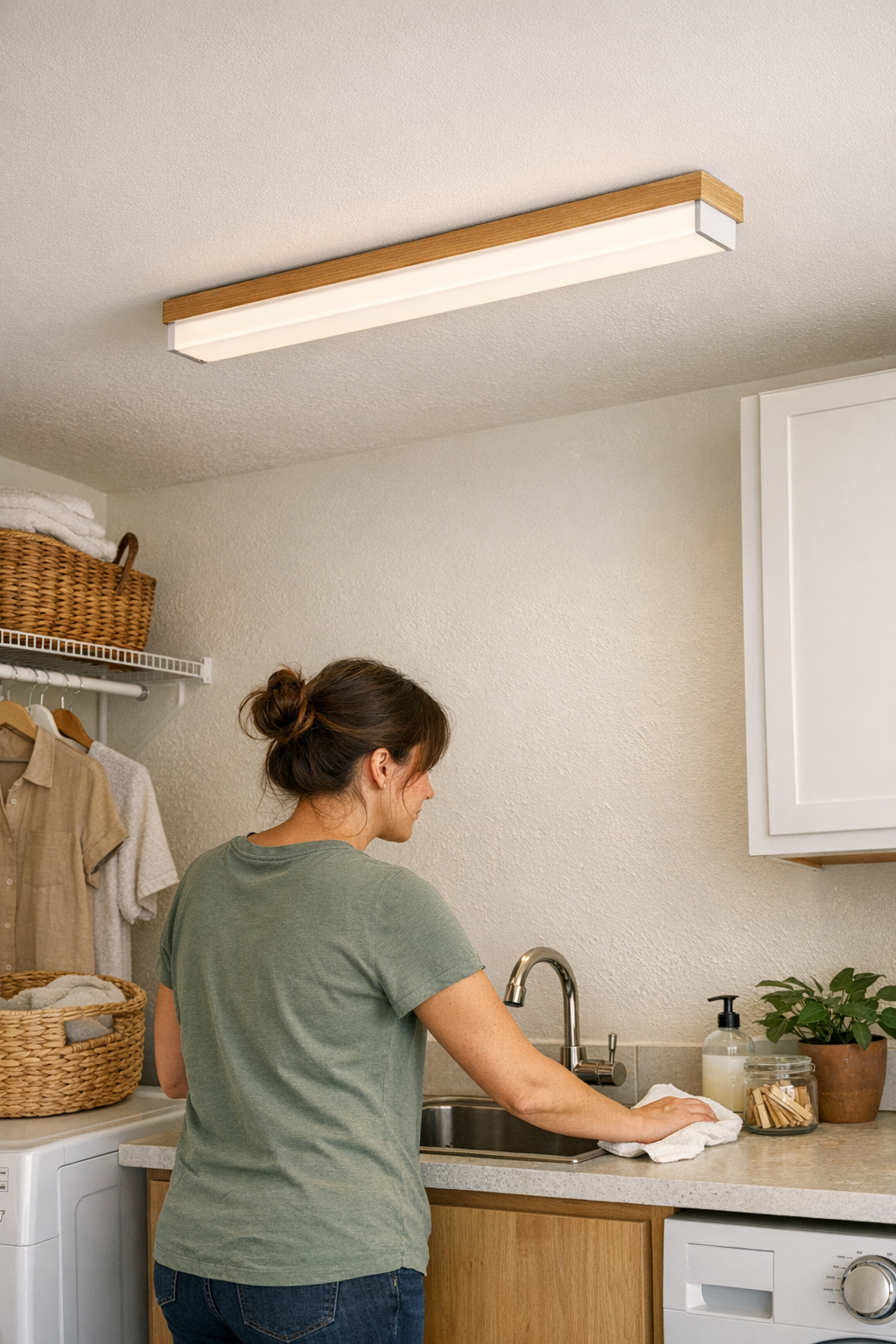
Most indoor lighting problems don’t show up when the fixture is new or the room is empty—they reveal themselves after months of daily use. Dust builds up where you can’t reach. Light bounces off slick surfaces, turning a bright fixture into scattered glare. One week you’re ignoring it, the next you’re on a ladder, scrubbing haze off a mirror sconce or wiping lint from a hallway ceiling light that never seems clean for long. If walking under a fixture means dodging shadows, pausing at a stair turn to check your footing, or tolerating uneven light over a bathroom sink, you’re not alone—these are common signals that the fixture’s design doesn’t stand up to real life.
The Hidden Price of “Visually Interesting” Fixtures
Where does lighting become a hassle most often? Bathrooms clouded by steam, hallways that always look dingy near the floor, stair landings where one step is never fully clear, or laundry corners packed with dust and lint. Decorative fixtures with exposed bulbs or deep grooves promise character but collect dust, steal time, and project shadows along every edge. Each ornamental seam traps more debris, each glass globe shows fresh grime, and glare becomes a constant distraction. A fixture chosen for style quickly turns into a maintenance job—never quite clean, always letting its flaws show first during the routines you rely on.
Real Friction in Repeated Use
Take the hallway by a busy laundry nook: three loads in, lint clings to every exposed lamp, roughening shadow lines across the floor. At the stair’s twist, your foot hesitates as the bottom step blends into gloom—unlit, thanks to a fixture that throws its light sideways instead of down. In front of the bathroom mirror, you tilt your head, chasing a clean reflection through streaky shadows—the result of a sconce whose “open” look just means more places for fog and dust to settle. What started as design now feels like an obstacle, week after week.
The Quiet Value of Sealed and Flush Fixtures
The most reliable fixtures don’t call attention to themselves—they disappear into your routine. A flush mount or sealed, damp-rated light may look plain at first, but after a few months, its advantages become obvious. No exposed hardware means nowhere for dust to cling. Smooth edges shed lint with a single wipe. The old pattern of chasing grime or dodging stray glare lines vanishes, replaced by light that’s level across the space—even after steam, spills, or busy weeks. Suddenly, the mirror is always readable, the counter edge stays visible, and the next deep clean slips further into the calendar.
When Cleaning Stops Being a Project
Imagine swapping an ornate, semi-flush light over your utility counter for a closed, flush mount. Suddenly, shadows flatten out—no more missed drips or stray streaks hiding at the edge. Instead of making a mental note to deep-clean “when there’s time,” you pass a wet cloth over a seamless surface and it’s done. No awkward reaching; no invisible dust waiting for morning sun to expose it. The counter is just there, clearly lit and quick to check. Day after day, the small annoyances that used to slow you down simply stop showing up.
The Way Dust Changes Light (and Movement)
Every bit of dust, every patch of foggy residue, does more than look dirty—it’s a physical obstacle, warping and scattering the light itself. Dust on a fixture sends beams off-course, breaking up a steady spread into dim pockets and sudden hot spots that pull your attention or distort your next step. Here’s how this shows up:
- Above sinks: Critical lighting breaks into uneven zones, creating dark spots just where you need precision—for shaving, washing, or checking skin.
- Stair landings: Glare bursts off a dusty bulb while corners are lost to shadow, making each step less certain, especially when moving quickly or with arms full.
- Mirrors: Glass films reflect light unpredictably so a clear view can turn into a guessing game, forcing you to lean in or reposition just to get even lighting on your face.
Week by week, these small defects build up. A room that looked “bright” with its fresh fixture now undermines what matters most: steady movement and reliable sightlines, especially where floors change or hands are busy.
Matching Fixture to Routine: What to Consider
Lighting that feels right on day one can reveal weak spots with every routine. The true test is whether it stands up to moisture, dust, and the constant churn of daily activity. For:
- Laundry closets and mudrooms, select enclosed, simple designs that can shed lint and outlast humidity. Fewer grooves mean less for dust to grip.
- Bathrooms—ceilings or mirrors, pick bathroom-rated or damp-rated fixtures with fully sealed domes. These keep out steam and stray particles, preventing haze and stray shadows from ever forming.
- Hallways and stairs, use flush or semi-flush ceiling lights aimed to blanket the full width. Place them to eliminate both dark zones on the floor and glare at eye level—so every step is predictable, not guesswork.
These aren’t just little “upgrades”—they remove routine obstacles entirely. In steamy, dusty, or high-traffic spaces, a truly easy-to-clean fixture shrinks cleaning jobs and restores real clarity where you walk, work, and check the details.
Two Quick Routine-Savers
- Avoid placing fixtures directly in the path of steam or lint release. Even the best-sealed model stays cleaner longer if it’s not fighting every burst from a showerhead or dryer vent.
- Choose smooth, closed fixtures for any ceiling or wall light that’s awkward to reach. Over stairs, counters, and narrow passageways, every reduction in dust and grime makes every future cleaning easier—especially when a ladder is a hassle.
The Long Game: Lighting That Fades Into the Routine
The best indoor lighting slips out of sight—never blinding, never leaving you in the dark, never demanding more cleaning or attention the longer you live with it. You notice the difference when you stop pausing in shadowy hallways, never hesitate on stairs, or realize you’ve gone weeks without wiping haze from a bathroom fixture. Real improvement isn’t flash; it’s the absence of repeated trouble. Visibility is smoother, movement is confident, and the fixtures just support daily life—silently making routines less demanding.
Every step through a busy space is a reminder that lighting structure isn’t just style—it’s how easily you move, see details, and trust your spaces to work as expected. The right fixture unmakes old problems, and the frustration of dust, glare, or shadow simply fades. For high-use spots, silent strength and easy upkeep end up mattering most.