
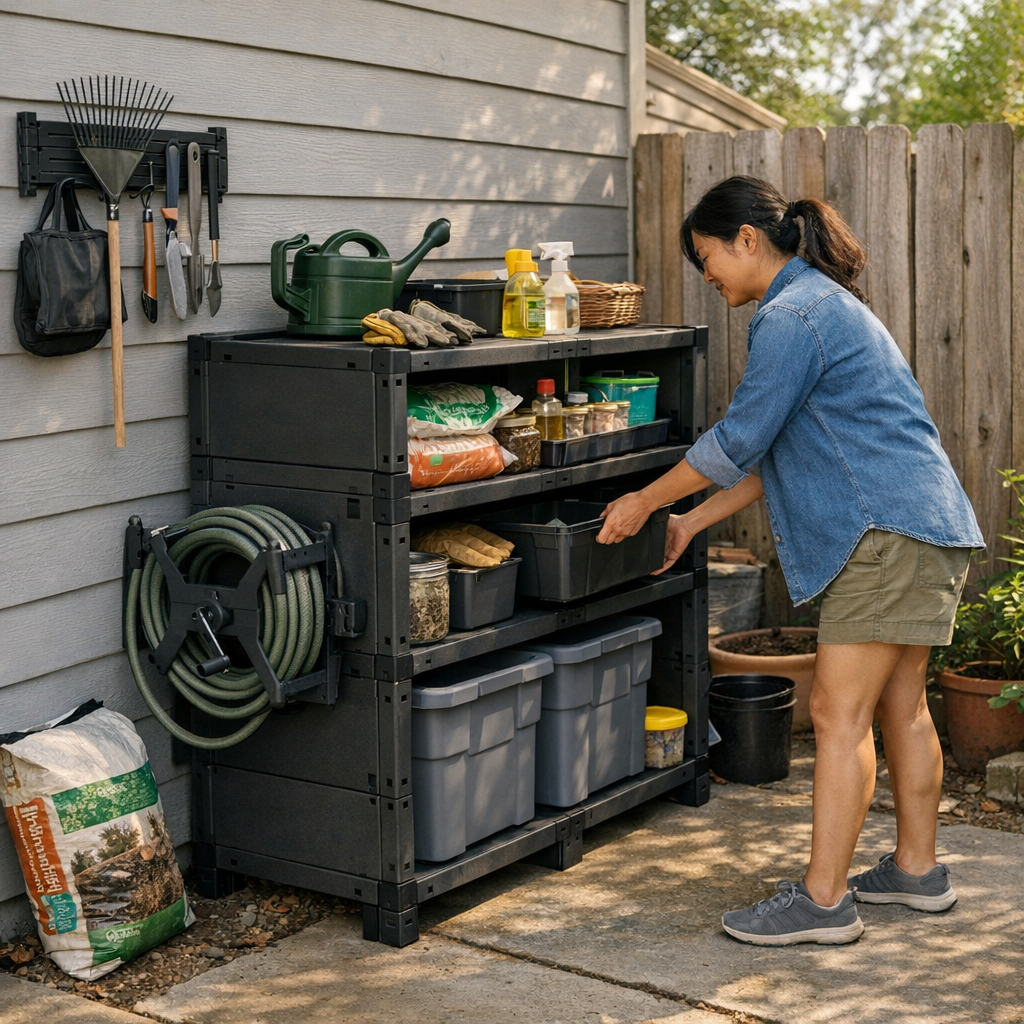
Every outdoor storage area looks organized on day one. But the real test kicks in after two weeks—a mower that blocks the side yard path, a batch of wet tools balanced on the garage edge, or bins creeping back into the space you swore would stay clear. What turns once-neat storage into an obstacle course isn’t just clutter habits or lack of square footage—it’s how the setup fails to keep up with actual, repeated use.
The Hidden Reset Burden of Wall Storage
Wall-mounted storage delivers that initial promise: tools in a row, open shelves, fresh space underfoot. It’s easy to believe the problem is solved—until real routines return. One not-quite-dry hedge trimmer takes over an entire shelf “just for today.” A muddy rake leans against the wall, never meeting its intended hook. By the third or fourth week, folding chairs have migrated—one on the wall, one by the stairs, neither fully stored but always blocking something else.
Return friction sneaks in, day by day. The more awkward it is to rehang or stack an item, the more likely it’s left somewhere in-between—a bucket on the ground, a pair of garden shears exiled to a corner. Hooks get overloaded. The prime slots that once held seasonal gear get swamped with daily-use clutter. Soon, your “everything on the wall” plan feels like working around a fence line of half-returned, half-forgotten stuff that never quite goes away.
Spotting the Setup That’s Working Against You
- Leaning tools: Are shovels, rakes, or hoses forever propped at the edge of the wall rack, waiting for “next time” to get put up? If putting things back always feels like a small effort, the reset burden is already collecting in your routine.
- Half-returned gear: Is there always a soccer ball, cooler, or pile of pool toys camped out on the patio steps or just inside the gate? If items block your movement or gather in not-quite-out-of-the-way spots, your system is slowing you down.
- Stray bins and overflow: Bins meant for hooks end up on the ground. Dead corners become the default dumping zone. Over time, the “floor stays clear” promise collapses, and the layout forces a shuffle each time you walk through.
Each tiny snag means a small reset, and those resets add up. Instead of one clear-out at the start of summer, you’re renegotiating with your own storage every weekend, just to keep the path open.
Where Floor-Based Units Quietly Win
Floor storage is rarely pretty—but in the spots where movement matters, it saves you. Lower friction, faster returns. Drop muddy boots in a bin. Stash a hose loop in a chest. There’s no balancing act, no puzzle to solve each time. That difference is loudest on weekends—when guests, kids, or yard projects pile up, the path by the garage stays open because items go straight into a bin or chest, not scattered across three different places.
Bulky gear and folding carts get contained, not orphaned at the edge of the wall system. The area stays usable, not showroom-tidy but clear enough to haul groceries, find your tools, or let the dog through without tripping over last week’s project.
When “All Up Off the Floor” Fights Your Routine
In tight outdoor strips—side yards, patio edges, or that narrow wedge between fence and house—it’s easy to believe that wall hooks alone will solve everything. But with several people (or pets) using the area, overflow finds its own way down. See planters or garden carts “stored” a foot off the system, hoses looping across the walkway, bins squatting in corners. The more you squeeze floor space, the more you end up blocking flow. Movement stalls, objects pile up, and the sparkling vertical system quietly starts sinking the entire zone back into daily shuffle.
Return Flow: The Make-or-Break for Real Use
The test isn’t a perfect “after” photo, it’s the fourth week of busy routines. Are you slotting gear back where it actually belongs—or detouring to the easiest landing spot out of impatience? Floor units and modular chests survive the cycle-pressure: the fast returns, odd-shaped items, dirty tools that no one wants to fuss over. Wall setups hold up if you only ever use the same few tools, the same way, every time. But the moment your real gear list expands—bikes, chairs, project leftovers—you see hesitation: “Should I reshuffle the whole system tonight, or just set this here for now?” That’s the gap where clutter returns.
Recognizing What Actually Works—Not Just What’s Tidy
Reality check: You come home with groceries, and the footpath is blocked by a pile of bins and a chair that never went back up. Walk to the mower—first, slide the coolers out of the way, scoot aside last week’s balloon weights. The system didn’t fail on day one, but bit by bit, it puts your routine on pause every time you just want to move through. The loop resets: organize, shift, work around, promise a seasonal cleanout that keeps getting pushed back.
Adding a single floor bin or modular chest breaks this loop. Now you can drop a muddy pair of boots, fold and stash a chair, or park garden toys the moment you’re done. No unnecessary lifts, no puzzle-solving—just a clear return flow that keeps the area open. Tidiness follows from convenience, not from occasional resets.
Strategy: Pair, Don’t Just Pile Higher
Instead of building up another row of hooks, combine a single wall rack for your core tools—what absolutely needs to hang—with one or two floor-based containers for everything that won’t sit neat. Now, the tricky and oversized gear lands where it belongs, not at the foot of the steps or in the path to the side gate. In real family yards or busy garden zones, a catch-all bin outperforms the fantasy that “everything up” will keep working once life gets busy again.
Let Your Routine Lead the Setup
No system fixes everything. But the right outdoor storage setup erases the small frictions you feel daily: gear that always lingers at the edge, paths that keep blocking, corners that never truly clear. Watch where your own returns actually collect. Which items demand easiest possible drop-off, and which can live neatly hung? Setup that follows these patterns is the setup that holds, even when nobody wants another reset.
The difference isn’t a photo-op finish—it’s how the space actually moves after a normal week. Let real use—not just a clean floor—drive your next change.