
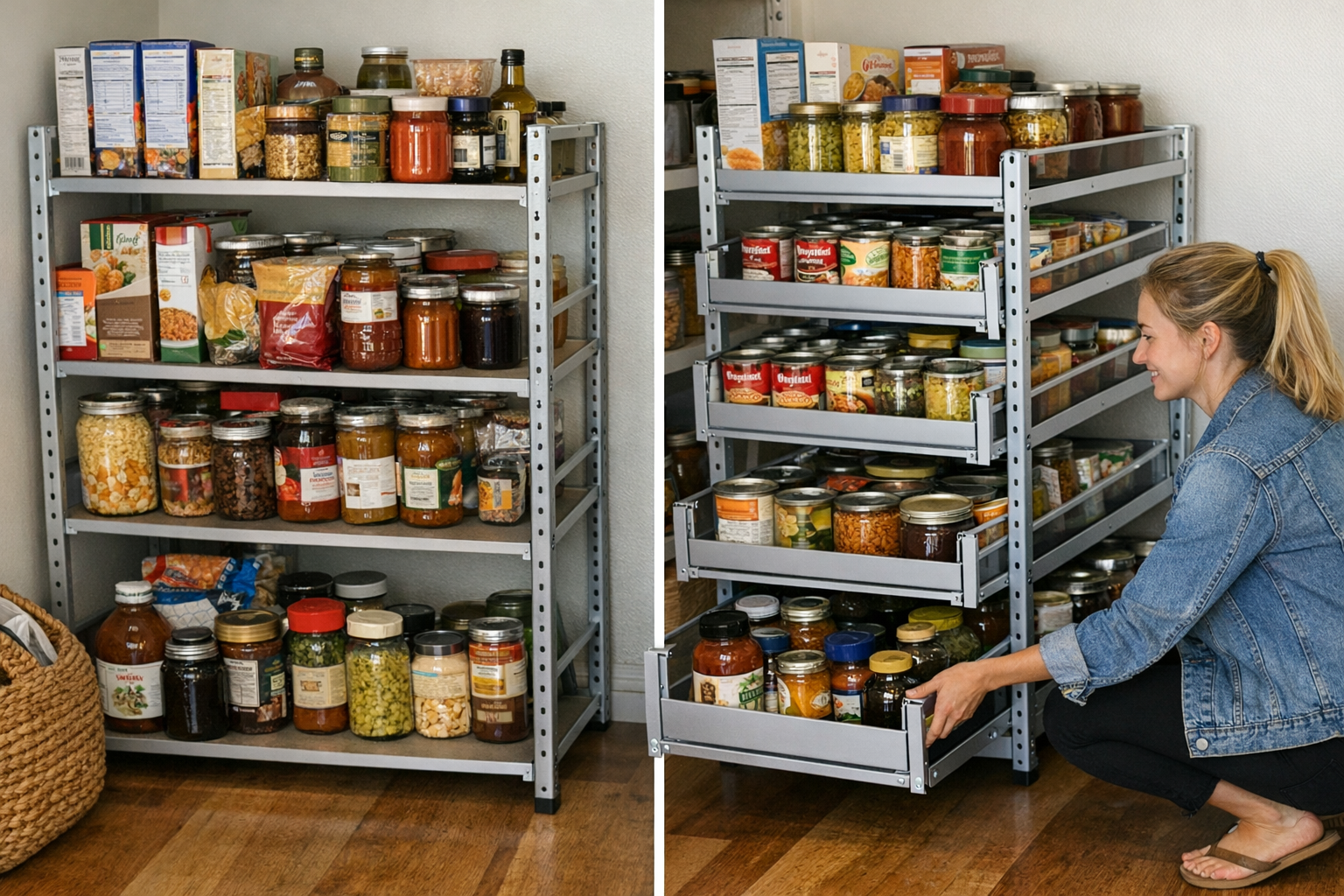
The state of your pantry—orderly or chaotic—often comes down to a single, invisible factor: shelf style. If you’ve ever wedged a bag of groceries onto an already-crowded shelf, or found yourself restacking boxes just to reach one unlabeled can, you know the hidden negotiation behind every “organized” pantry. Pull-out or fixed—your choice doesn’t just shape how your shelves look. It quietly controls whether your pantry works with you, or against you, every time you open the door.
Why Shelf Design Makes or Breaks Your Pantry Over Time
Open a freshly organized pantry and both pull-out and fixed shelves give you that staged, picture-perfect moment: boxes in neat rows, everything upright, nothing lost. But real use doesn’t freeze in this snapshot. Kids grab snacks from the front, last week’s soup slides backward, a new haul of pasta finds the only open space—behind what’s already there.
The real difference appears not on install day, but in the weeks that follow. Organization unravels by inches. Easy access—the promise of every storage system—gets chipped away by hidden layers, overstuffed bins, and the quiet creep of disorder across every shelf.
Where Fixed Shelves Frustrate in Daily Kitchen Life
Invisible Stock, Repeated Reach-Arounds
With fixed shelves, the routine is familiar—and frustrating. You reach for oatmeal and remove an entire row of boxes just to see if it’s still hiding at the back. Deep shelves tempt you to stack and layer, but the price is always convenience: crushed snack bars, toppled jars, and long-expired cans gathering dust in the unseen rear. After a busy week, the front may still look organized, but the back is pure guesswork.
Refilling after shopping rarely means just adding—more often it’s reshuffling, stacking, trying to find space without knocking over last week’s order. Small items vanish behind larger packages. That package of rice you bought “just in case” becomes a yearly discovery, not a current ingredient.
Why Pull-Out Shelves Change the Game
Pull-out pantry shelves aren’t about adding space. They reveal what you already own—no digging, no shifting, no forgotten corners. Whether you’re prepping dinner or composing a lunchbox, a single pull instantly lines up every can and box. Pasta is visible. Soup isn’t hiding. The question “are we out?” turns into a quick glance, not a scavenger hunt.
The day-to-day impact sneaks up: organizing no longer means emptying half the shelf. There’s less double-buying (“I didn’t know we already had two jars of salsa”) and fewer minor avalanches when you reach for something in the middle. And perhaps best of all, habitual clutter fails to take root because the shelf surface never disappears from view.
The Hidden Downsides of “Tidy-Looking” Fixed Shelves
Even the best-looking fixed shelf setup breaks down faster than you expect. As weeks go by, single categories blend, bins that made sense fill with mismatched items, and the back-half of the shelf becomes a no-man’s land for orphan snacks and backup supplies.
These slow-burn problems linger: food waste from lost items, accidental duplicate purchases, and the slow loss of category clarity. Every “quick” tidy-up just delays the full-on reset that, inevitably, comes when you can’t find a core ingredient.
Pull-out shelves act as a self-correcting system: everything’s visible, so you don’t end up building accidental stockpiles or discovering mystery cans months later. Adjusting, restocking, and spot-sorting all happen in the open—no need to excavate. Even after a heavy shop, realignments are fast and intuitive.
When Deeper Shelves Aren’t the Solution
It’s easy to think deeper shelves equal better storage: more depth, more supplies. But this logic breaks down in practice. Deep, fixed shelves turn into dark zones where forgotten items go to hibernate. Piling up fancier vertical stacks only accelerates disorder—unstable towers topple, bags in the back never see daylight, and the time required to reset climbs higher every week.
Pull-out shelves unlock the entire depth without forcing you to stack, bend, or blindly reach. You access the back as simply as the front, and every inch is equally useful. Instead of shifting rows, you regain both visibility and speed—with no untidy collapse waiting by Friday evening.
One Shelf, Noticeable Difference: Where the Shift Pays Off
Sometimes you only need to swap one shelf to see the change. Convert the hardest-working zone—like your bottom pantry shelf—from fixed to pull-out, and the relief is immediate. Post-grocery restocks stop being a clumsy shuffle. Cereal stays lined up instead of buried. The back wall no longer grows forgotten towers. Forgotten spices and snack bars stop multiplying—because nothing is stuck out of sight.
What used to take fifteen minutes—pulling, sorting, repacking—shrinks into a few simple motions. Even occasional batch resets feel lighter, because the shelf’s transparency stops buildup before it starts. If you’re short on time or patience, this one swap buys back both.
Tip: Don’t Overcrowd Your Pull-Outs
Pull-out shelves do the heavy lifting for you, but they have limits. Distribute weight evenly and avoid cramming the edges—overloading can strain the hardware and shorten lifespan. Treat them as practical helpers, not infinite storage, and they’ll save you daily aggravation for years.
When Fixed Shelves Still Work—And Where They Don’t
There are places where fixed shelving holds its own. Ultra-shallow shelves—where everything’s in one row—don’t develop the “hidden layer” problem. If you can always see every item in a single glance, fixed may be just right and mechanically simpler. Corner niches, tight utility closets, entryway cubbies: anywhere that makes layering impossible lets fixed shelving pull its weight without becoming a future headache.
The Shelf Test: How Much Work Do You Do?
The real assessment isn’t about what looks good. It’s about how often you’re forced to fix, search, or restart your order. If every restock feels like defusing a delicate tower, or if “resetting” means pulling half your inventory just to see what’s left, your shelves are working against you.
Sometimes clarity is the best upgrade: a single shelf that removes the blind spots, a system that gives up hiding spots for lost ingredients, or a reset routine that finally fits the rush of weeknights. Whether it’s your pantry, crowded laundry wall, or the zone where household chaos gathers, the right shelf shifts your daily effort from “constant correction” to “occasional adjustment.” One sliding shelf often keeps the whole system intact, even when everything else feels one step behind.