
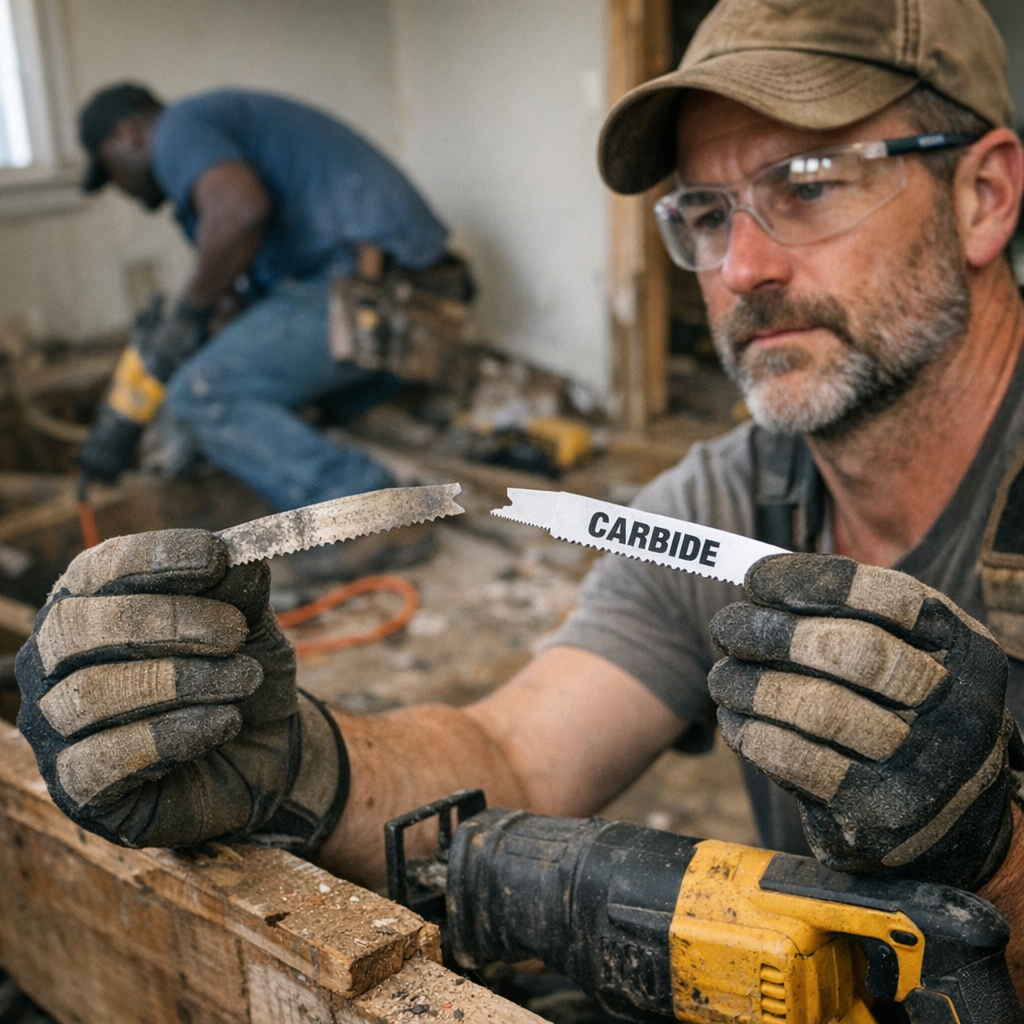
The saw’s kicking. You’re halfway through a stack of nail-riddled studs—another gritty remodel, another mix of old wood and surprise fasteners. The first few cuts went smooth, but now each pass drags. Your blade flexes. Edges stray off course. Cut ends fray and splinter so badly you start dreading the cleanup. This is exactly when you stop caring about blade specs—and start caring about which blade keeps you working instead of fighting your gear.
The Hidden Pain of “Good Enough” Blades
When you’re ripping through clean, hardware-free lumber, nearly any new blade does the job. Bi-metal, carbide-tipped—they look the same out of the box, and both feel sharp on that first stud or two. That’s why the hardware aisle makes it seem like blade choice is an afterthought. But in the real world, jobs rarely stay textbook neat for long.
Why Decent Suddenly Isn’t
The real gap opens the moment a blade meets nails, screws, or composite—when you swap a trim-out for demo work, or hit a buried bracket nobody warned you about. Bi-metal teeth round off fast. Each push needs more muscle. The saw starts protesting, heat builds up, and every little shake in your arms gets amplified. By cut ten, you’re not slicing—you’re wrestling. By cut fifteen, you’re mentally tallying the extra sanding and recuts ahead.
When the Material Fights Back
Not every board wants to be cut. Fiber cement, bent-deck lumber with secret fasteners, old siding layered with staples—these materials grind down a blade quicker than you’d believe. With a bi-metal blade, two or three decently clean cuts often become an uphill slog of smoke, noise, and ugly kerfs. The saw vibrates, dust erupts, and soon, correcting a ragged finish takes longer than the cutting did.
Carbide-tipped blades don’t just outlast—they outwork. Even on abrasive composites, or plowing through drywall with hidden conduit and nails, they keep their edge. Instead of burning through five blades, you’ll often finish the job with one, still sharp enough for a presentable cut. Every pass feels steadier: less wandering, less force, and less guesswork about where your cut is heading.
Scene in Reality: Reno Wall, Hidden Headaches
Picture a string of still-painted joists riddled with old finish nails. The job: cut out every last one, fast. Start with a bi-metal blade—first, clean, then every cut gets shakier. Your hands buzz, forearms tense, and the saw’s sound changes from a hum to a grind. Switch to carbide, and suddenly, the work is predictable again. Cuts run straight, the line doesn’t stutter, and tool vibration finally settles. Now it’s your work that sets the pace, not your blade’s mood swings.
Dull Blades—The Real Cost You Pay
We’ve all tried stretching a blade: flipping it after dulling one edge, clearing build-up, nursing it through “just one more” pass. Sometimes, that hack gets you through. Just as often, it leaves you with bad lines, extra sanding, and burns on both your cut and your patience. Tool fatigue sets in—the blade flexes, your saw jumps, and suddenly, you’re patching damage just to keep things presentable.
The real cost isn’t the blade—it’s the compounding aggravation of unpredictable performance. Bi-metal blades, once dulled, start wandering, carving wider, less controllable paths that mean rework or filler. Even the most seasoned builder can’t sand away a bad cut made with tired steel teeth.
Carbide-tipped blades aren’t a cure-all, but they take the edge off these headaches. On tough jobs—laminates, structural lumber riddled with hardware, or any mix of nails, screws, and stubborn glue—you get more cuts per blade, steadier hands, zero drama. That steadiness and control often mean less rework, less fatigue, and, in a tight deadline, the difference between finishing before dark and apologizing to a client for the dust and filler you left behind.
The Subtle Impact of the Right Blade
It’s not the badge—it’s the output at hour three that matters. The right blade keeps your workflow moving. Cutting more, stopping less. I’ve switched to a 6-inch carbide, 8 TPI, for demolition after losing whole afternoons nursing bi-metal blades. The difference: one blade lasted an entire teardown and cut the time I spent with a belt sander by a third. Not magic. Just sharper, and it stayed that way to the bitter end.
When It’s Time to Go Carbide
If you mostly handle single-pass trim work, or standard pine studs with the rare staple, bi-metal is fine—until the job isn’t. The grind starts when you’re stuck cutting reclaimed wood, demo-ing through layers of material, or facing run after run of abrasive composite. That’s when bi-metal chews through your patience and your budget.
Carbide makes the grind routine, not a hassle. You notice it when the twentieth board cuts as cleanly as the first. When you’re not stopping to clear hot blades or breathing in clouds of dust from burned-out steel. In those repetitive, abrasive conditions, the return is less fatigue, fewer crooked lines, and a workflow you don’t have to keep interrupting for tool swaps or finish repairs.
Pro Tip: Tag Your Blades, Control Your Downtime
If you can’t predict what each job throws at you, stash both types. But when you hit the hard stuff—hidden fasteners, rough edges, weird laminates—send in carbide and keep it marked for demo. The difference isn’t just a longer-lasting blade, but fewer fixes at cleanup, and less time wondering which cut you’ll need to redo.
The Takeaway: Field Reliability Over Factory Specs
Blade labels tell you little. What matters is out there: repeated, messy, unpredictable cuts. Carbide delivers a steadier cut, a stabler saw, and a job that doesn’t get stopped cold by the wrong tool. For the work that pushes back—nails, mystery metal, multi-layer boards—the upgrade is visible, not theoretical.
Forget the packaging. Next time the job kicks up more than chips and sawdust, you’ll know why your blade choice wasn’t just an afterthought—it was the difference between job done and job delayed.