
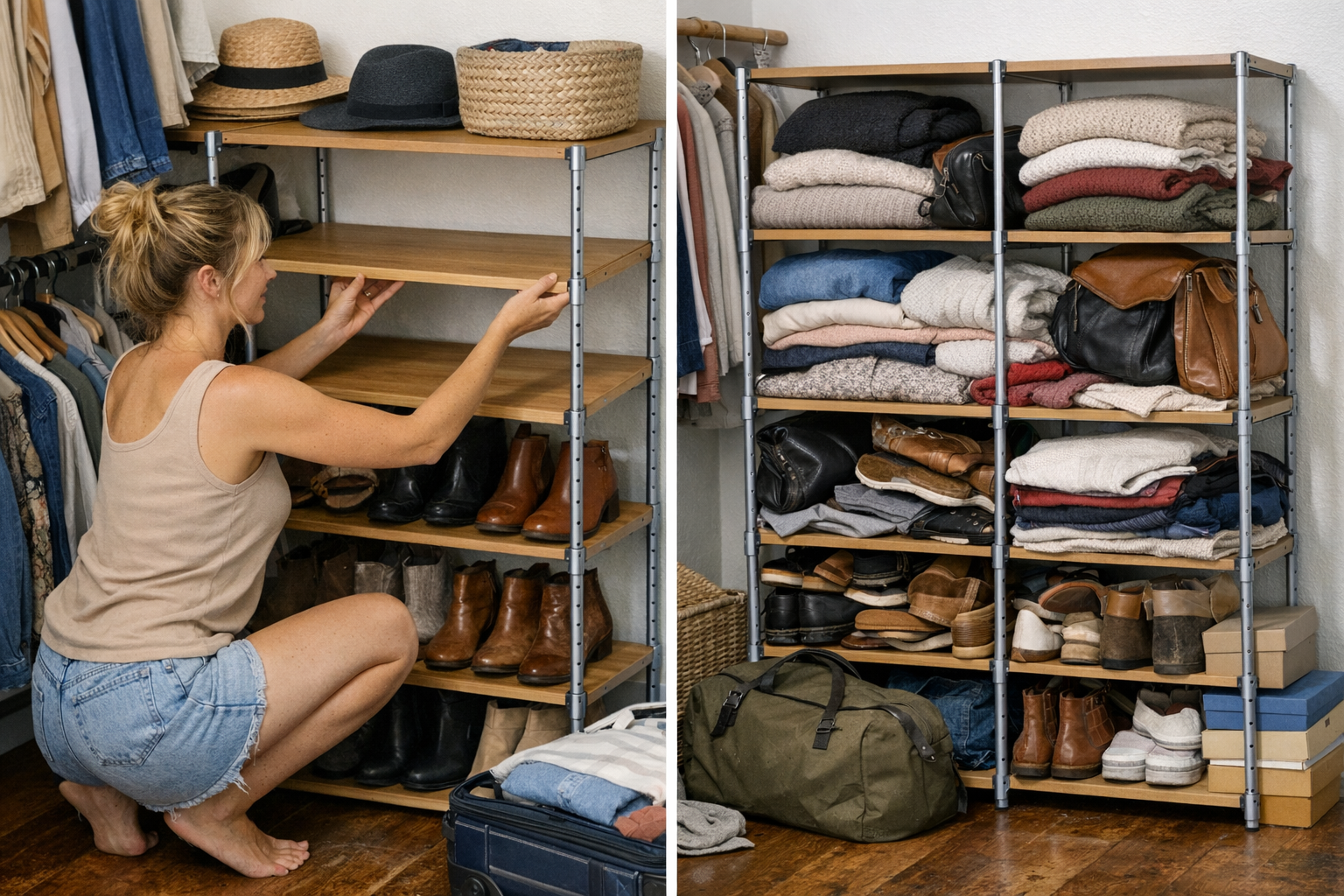
Closet frustration doesn’t usually start with chaos—it starts quietly, with routine snags you can’t quite ignore. It’s the moment you find your shoes stacked sideways because they’ve outgrown their original spot. It’s shelves that once looked perfect but now swallow your favorite hoodie behind a leaning pile of jeans. The difference between fixed shelves and adjustable ones isn’t just about construction—it’s about how your closet copes with your life’s shifting pace: winter boots replacing sandals, new work bags crowding out neat stacks, shared spaces blurring the boundaries between your morning and theirs. The tension isn’t visible in promo photos. You feel it when you’re pressed for time, when a shelf’s missed inch means rummaging, reshuffling, or watching clutter drift to the floor—over and over, day after day.
The Real Stakes: How Shelf Type Shapes Daily Use
On day one, whether you install fixed or adjustable shelves, the closet feels transformed—everything seems to have a home. But give it a few weeks of actual living, and the gaps show. The core challenge isn’t that one type is “better”—it’s that life, and wardrobes, don’t sit still for long. Today’s neatly folded sweaters become tomorrow’s toppling tower; the right shoe for the day is always under three others. With fixed shelves, the lines stay crisp but the system locks you into last year’s storage model. Too-tall stacks buckle, while unused air above thinner piles is wasted. Adjustable shelves tease you with flexibility—move one and suddenly your tall boots fit—but only if the reconfiguration matches your real habits and the system holds steady under load.
Where Closet Systems Get Tested: Ordinary Routines
Closet stress surfaces during the rush of actual use, not during setup. Shoes overflow onto the floor when a shelf turns into a catchall. Bags wedge themselves in awkward corners or teeter precariously on a too-shallow ledge. You reach for a folded T-shirt and half the stack flops forward—or worse, you tug out one sweater and topple two. In shared closets, someone’s gym shorts sneak into the workwear pile, and suddenly everyone’s searching. Fixed shelves with bad spacing breed overflow zones: baskets fill up, “temporary” piles become permanent, and what started orderly soon loses its structure. With adjustable shelves, the benefit is only real if an inch here or there lets you actually see, reach, and put things away at speed—put a shelf too high and your sweatshirts vanish into an unreachable alcove, too low and you’re stacking three deep just to make room.
Everyday Trouble Spots: The Scenes You Recognize
Picture an evening reset: hanging up your coat but having to nudge aside a wobbly pile of pants yet again. Shoes, once lined neatly, are now doubled up—because shelf spacing won’t allow side-by-side storage. You try stashing a new bag on the top shelf, only to yank half the stack with it when you need it next. Order dissolves in inches—a shirt half-off the edge, a bin caving in from one too many “just for now” items. These aren’t dramatic disasters; they’re the slow leaks of time and patience that make “organization” feel like an uphill battle.
Why Shelf Adjustments Change Everyday Function
One wrong shelf height can quietly sabotage an entire closet. With fixed shelves, workarounds multiply—spillover baskets, piles creeping onto open surfaces, resigning yourself to whatever the shelf dictates. Few people drill new holes or attempt permanent fixes; most just endure the friction. Adjustable shelving only pays off when you put it to use—and when changes actually bring order. Sloppy, uneven spacing just creates black holes where hangers get caught and folded things get lost. Unstable shelves collect “later” piles: heavy sweaters, odd-sized bags, or anything that doesn’t fit a designated space, quickly turning flexibility into quiet chaos.
Shelf Spacing: The Smallest Fix, The Biggest Curtain Reveal
Try never allowing the gap between adjustable shelves to be bigger than a shoebox. It’s a simple rule that pays off. Stacks stay stable, nothing topples, and you regain vertical space without the burden of balancing towers. Properly anchored shelves—no sag, no shifting—mean you can reach for a pair of jeans or a jacket without rebounding from a miniature avalanche. The visual calm isn’t surface-level; it’s faster resets, stacks that keep their shape, and daily searching reduced to a glance.
Telltale Signs Your Shelf Strategy Is Off
Problems don’t always announce themselves. More often, you notice it in the small ways: an extra move to fish out that one T-shirt, a shirtpile fanning out until it covers everything, or a row of bins that started neat but now mix shoes with scarves and batteries. If grabbing one thing routinely means moving two or three, or you lose five minutes a day re-tidying, something about your shelf strategy is quietly failing you.
Beyond the Closet: Entryways, Bath, and Daily Drop Zones
These lessons aren’t limited to bedroom closets. Entryway shelves too wide invite mail to drift, hats to mix with dog leashes, and keys to vanish under piles by Friday. In hallways and bathrooms, shelf spacing can turn towels into teetering stacks or hide everyday items behind a wall of toiletries. Fixed shelves bring symmetry but don’t forgive when categories multiply: you buy one extra basket, and the entire “system” clogs. Every reset takes longer, clutter never really leaves—it just migrates one shelf over, one corner deeper.
Stability Vs. Flexibility: What Matters Most When You Live With It
Fixed shelves deliver serious durability—indispensable for laundry rooms, utility spaces, or anywhere weight comes first. But in real, high-traffic closets, a well-built adjustable shelf can be just as sturdy if supported correctly and not overloaded. If you want flexibility without chaos, look for partly adjustable systems: enough tight anchoring for lasting stability, enough movement in the setup for actual daily adaptation. The best system isn’t strictly fixed or flexible—it’s the one that lets you reset in seconds, not minutes, and keeps the friction low when life gets busy.
Making Small Fixes That Actually Stick
Sometimes, a single shelf move is all it takes: anchor that wobbly tray, add just one more shelf to split a too-tall gap, or shift your most-used items to eye level. These are the details that transform “surviving the week” into “putting things away without thinking twice.” See if your space holds up after a busy weekend, not just after a fresh tidy-up—that’s the best proof you’ve landed on a real solution, instead of another short-lived arrangement.
For more storage ideas built for real, lived-in homes—not just spotless catalog pages—visit ClosetWorks.