
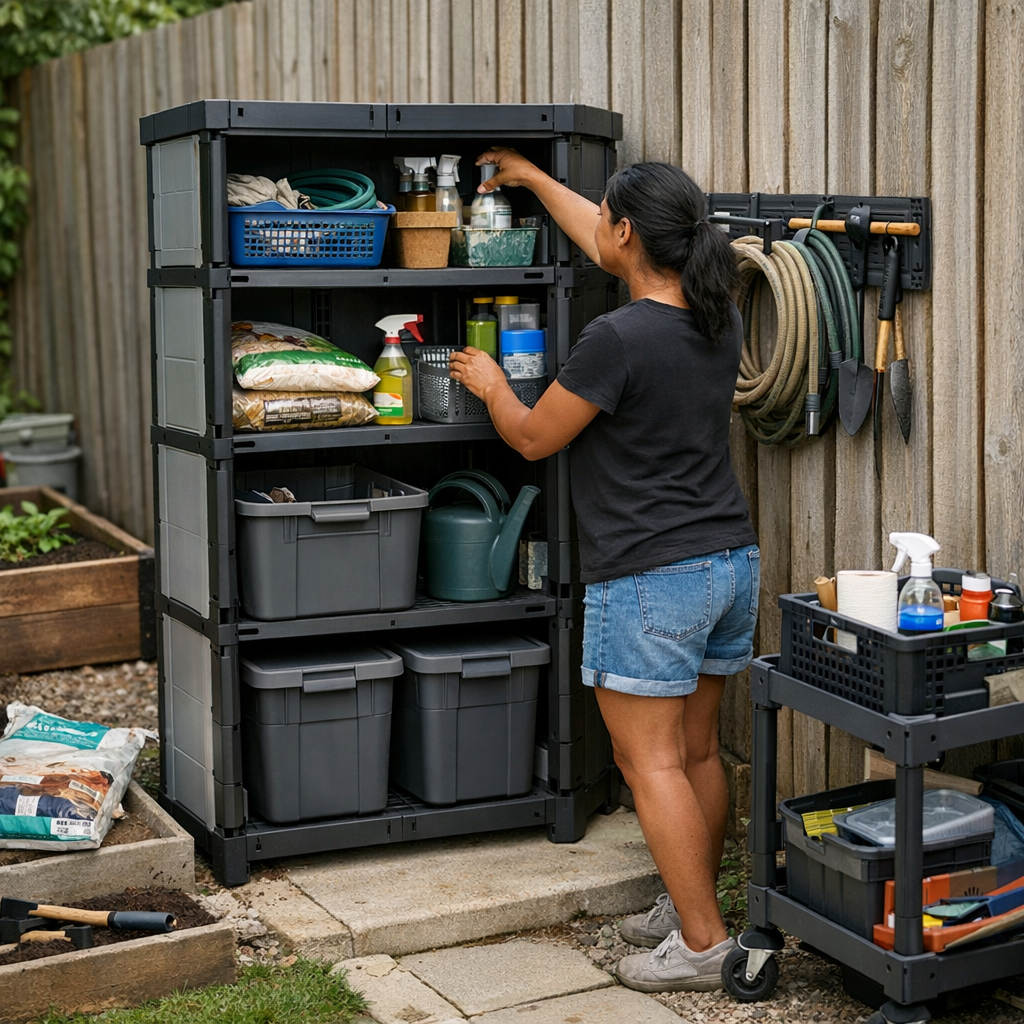
Every backyard looks organized on day one. The bins are lined up, hooks are empty, and the side yard finally feels open. But fast-forward three weeks, and you’re undoing your own setup just to get through another Saturday. A rake blocks the gate. The “overflow” bin is always full. What started as extra space quickly becomes an obstacle course—especially when daily routines chew up every shortcut. Photos capture the order, but routines reveal the real test: can you move, reset, and stash everything without the path closing in again?
The Disappearing Order: When Outdoor Setups Start to Drift
The trouble doesn’t announce itself. A pruner slides behind sports balls, a folding chair “temporarily” blocks the gate, the side strip narrows as shoes, hoses, and garden gloves pile up. Soon, every reset means squeezing past gear or making room for something else—sometimes just to get the recycling out. If you’re playing musical chairs with bins or wincing at the thought of another full reset, the setup isn’t pulling its weight.
It’s not just how much you can store, but how quickly you can return, grab, and move without a chain reaction. The right system never forces you to clear three things to put one back, or to shuffle gear just to keep the routine moving forward.
Wall-Mounted Storage: The Difference Between Open Paths and Clogged Ground
In stripped-down, high-traffic spaces—side-yard strips, patio edges, that two-foot gap beside the garage—wall storage isn’t cosmetic. Raising gear up changes everything. You stop tiptoeing around bags and garden gear, stop propping the gate with your shin, and stop mapping a safe path for pets around plastic totes left on the flagstones.
When wall systems are actually used for real routines:
- Floor space stays open from week to week.
- Frequently-used items—hose, gloves, loppers, folding seats—are always right where you reach, not buried or migrating toward the door.
- That slow spill of junk into the patio or driveway edge just…slows down, or even stops.
It’s the difference between a walkway you cross freely and one you constantly nudge things away from. Ever caught yourself kicking a shoe rack aside before mowing, or dragging a bin over gravel to get at a watering can? That’s the sign: the wall’s unused, the floor pays the price. One sturdy hook at the height you use, above a shoe tray or tool bin, can open a path and end the silent creep of gear that blocks basic movement.
Common Misstep: Wall Space That Looks Used, But Isn’t Useful
It’s tempting to stack wall racks with lodge-cast iron or off-season gear just to “fill it up.” But what you need is reach-and-return access for daily items: gloves, tools, pet leads, helmet hooks at kid level—always in the drop zone you actually use. If you notice the wall is busy but the ground is never clear, something’s off. Wall storage must earn its keep right where returns happen, not just display gear out of sight and out of mind.
Modular Structures: Utility or Just Another Block in the Road?
Modular storage pulls you in with promises: move it around, adapt with the seasons, mix and match—or so it seems. In real yards, it’s footprint, size, and how easily you can reset zones that separates the helpers from the headaches.
A functional modular setup lets you:
- Station gear by need—a compact shed for watering tools at the beds, a grill unit by the deck, winter bins under eaves.
- Shift parts fast when routines change (the school year, spring projects, season swaps).
- Contain overflow in a single spot, rather than spread it across every pathway.
But friction hits hard when the pieces are too large, too fixed, or clustered where nothing really fits. Maybe you bought a storage cube that seemed perfect—until the lid blocks the walkway, or its door jams against the shed’s. Or maybe retrieving planters from the modular “zone” always means first moving bulky overflow nobody ever wants to deal with. The worst setups demand a reshuffle every reset; by week three, the system is the new bottleneck.
Zone Resets Beat Yard-Wide Overhauls
The best modular setups break the job into bite-sized sections. Five minutes is enough to tidy the side gate, empty the garden bin, or clear the garage threshold—without the pressure to “organize everything.” That’s relief you feel at the end of a long day, not dread. If a unit keeps ballooning with odds and ends you don’t want to sort, it’s time to split or relocate before small piles snowball into another cross-yard dump zone.
Mobile Storage: When Movement Helps—and When It Breaks
Mobile storage sounds like freedom—especially before a party or when mowing time collides with a project spread across the whole yard. A rolling bin or rack should let you clear space fast without starting a new clutter pile elsewhere. But not all “mobile” systems survive the real terrain test.
Rolling setups only help if:
- They glide—not stall—across what you’ve actually got (flagstones, lumpy turf, uneven concrete).
- They park out of the way when not in use and don’t interrupt other traffic zones.
- The wheels aren’t just an afterthought—bad casters mean you’d rather lift than roll, and that’s when bins get abandoned mid-path.
Actual scenario: It’s Saturday, friends show up, and you need the patio open—now. If everything really rolls, you’re done in minutes. The path clears, the reset leaves no orphaned bins by the door. But if a wobbly wheel sticks at a stone or it takes two people to angle the unit through a gate, “temporary” clutter claims that corner for the next week.
Side-Yard and Garage-Edge: Where Clutter Settles When No One’s Looking
The highest friction isn’t always in the center; it skews to the edges. Side yards and garage thresholds see the most foot traffic and, ironically, the laziest “just for now” storage moments. Without a flow system, these spaces attract dumped shoes, muddy tools, umbrellas, and cast-off bins—all quietly edging closer to the main entry with every week.
What stops it? Short, vertical solutions: a trio of hooks for hoses, a grab-and-go shelf at hand height, or a boot bin beside the garage. Every minute untangling cords or stepping over muddy boots by the door is setup friction in action—repeat it often enough and the clutter wins. If one corner always fills first, that’s your signal. A seasonal bin next to the hooks, paired with a “clear it by Sunday” rule, keeps the area honest—and stops the spill before it marches inside.
Choose the Setup the Routine Actually Uses
Every yard is different, but every clutter problem repeats itself somewhere: bottleneck at the gate, bin that won’t stay empty, wall space that collects more dust than gear, or “modular” units that trap you into more moves than they save. Take ten minutes during a busy family day to watch what gets blocked, which zones need clearing (again), and where movement slows down most.
The difference is in what works after a real day outside, not when the setup is fresh or photo-ready. Wall-mounted systems clear pathways only when used for the right gear at the right moment. Modular units help only if you can reset a zone in minutes, not hours. Mobile systems only fix problems if they actually move, park, and reset with you. The right setup stops overflow before the routine slips, and the wrong one makes every return slower, messier, and more frustrating.
Find practical outdoor storage solutions designed for real routines at TidyYard.