
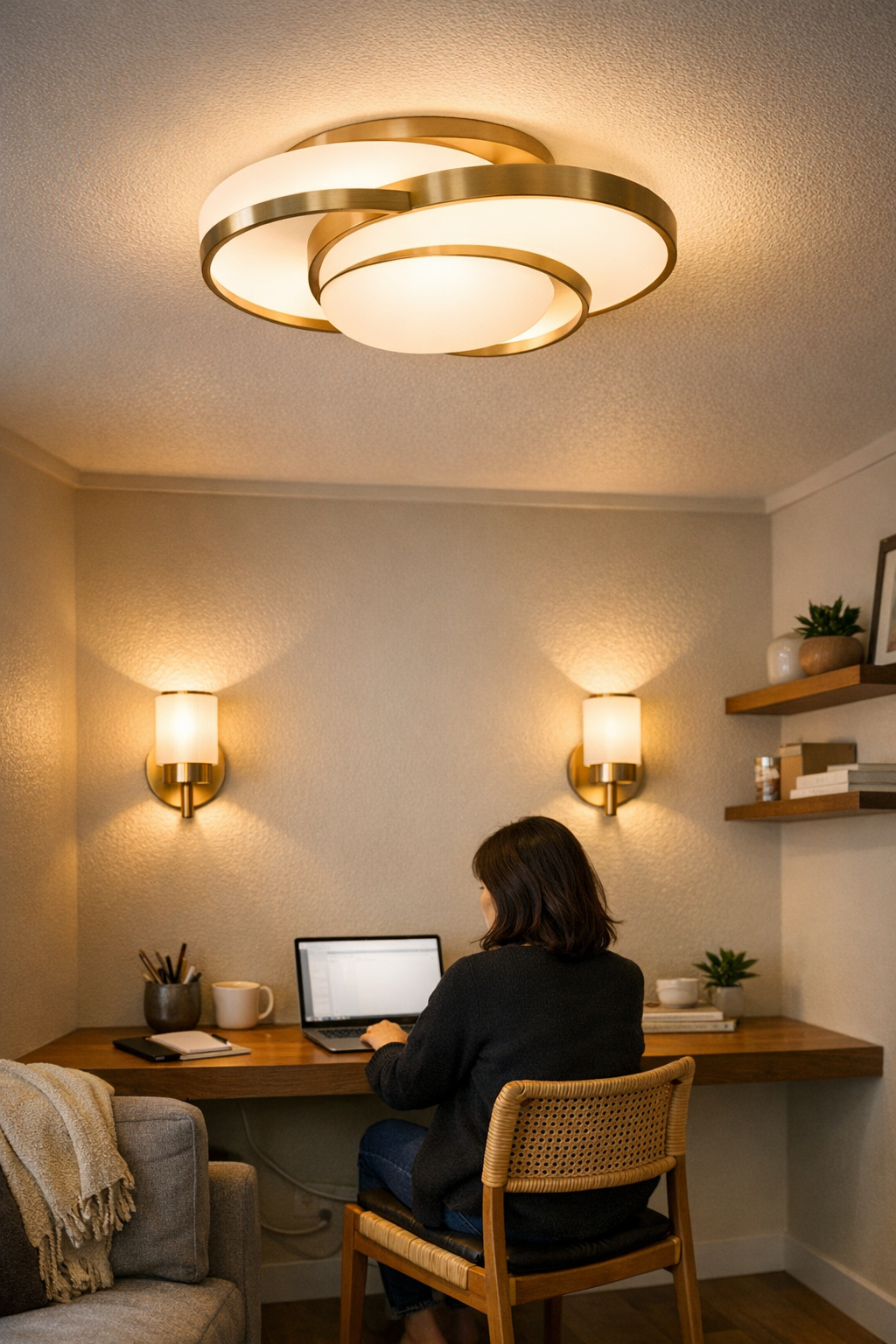
The most aggravating indoor lighting problems don’t show up until you actually start living with them. The desk that looked “finished” now casts a sharp shadow where you set your coffee mug. A reading corner with its sleek sconces feels oddly unsettled. Overhead glare swallows up the effect of wall lights, and the cable you thought you’d hidden becomes the first thing you notice when you sit down to use the space. What appears clean and resolved on setup becomes distracting and awkward in daily use, especially in small rooms or mixed-use corners where every lighting choice exposes its limitations again and again.
Why Ceiling and Wall Lights Clash More Than You Think
It’s easy to install a bright ceiling fixture and feel the job is done—until you notice it overpowering your wall sconces and flattening the room. Most setups start this way: one strong overhead panel, secondary sconces or desk lamps for “comfort.” But instead of layering smoothly, the ceiling throws blunt, uncontrolled light everywhere, killing off the subtle work wall fixtures are meant to do. Sconce beams become washed-out smudges. The space feels visually crowded by glare, and surfaces look uniform yet hard to use.
This isn’t about general brightness. The problem is ceiling light that bullies everything below it: its glare coats worktops and walls, erasing contrast and exposing every cable, bracket, or seam you hoped to keep hidden. Suddenly, hardware and wire runs become a distraction, and the whole layout feels constantly unsettled, as if nothing quite “sticks” in the visual structure—even after careful installation.
Looks Clean, Feels Awkward: When a Setup Fails Under Routine Use
From a distance, the room checks every technical box: modern LED panel, slim sconces at the right height, every cable tucked with care. But actually working or relaxing in the room exposes the flaws immediately:
- The front edge of your desk is swallowed in shadow, while the main surface is overexposed and tiring to scan.
- The supposed reading corner forces you to shift your seat, adjusting the lamp angle just to see a page clearly.
- Cables and brackets—painstakingly routed—become visible again, highlighted by cold ceiling spill or clashing lighting tones.
- Everyday actions—unpacking a bag, finding a document—somehow become more awkward, because your eyes keep tracking the lighting weaknesses, not the task.
This friction isn’t cosmetic. Broken cooperation between ceiling and wall lighting leads to practical slowdowns, cluttered surfaces, harsh edges, and the sense that something small is always getting in your way, no matter how organized it should feel.
Real Scene: The Lounge Desk That Never Quite Worked
Consider a narrow lounge with a floating desk: centered ceiling panel, matching wall sconces. Visually, it’s clean. But then the routine returns—a laptop open at the far end, a coffee mug at the corner, a quick evening call. The overhead panel drops a flat sheet of light that shoves hard-edged shadow across half the desk, killing sconce definition. Cables, run tight and flush, now catch every catch of light, turning minor supports into constant visual noise. And every task—a quick search, a note, grabbing your phone—stretches longer, simply because you can’t settle into the space comfortably.
This discomfort isn’t just a quirk of taste. It means you miss small items at the desk’s edge, fumble with cables that glare out against the wall, and find that “quick, low-effort” work always takes more attention than it should—purely due to unresolved lighting and support behavior.
Small Shifts, Big Relief: Breaking Out of Ceiling Light Dominance
Most flawed setups don’t need a total overhaul. In this lounge scene, two specific changes cut through the friction:
- The ceiling panel was reduced to roughly a third of its output and switched to a warmer tone. Instantly, harsh lines faded and wall sconces actually began to define their areas without glare interference.
- Sconce brackets, previously set at head height, were nudged above eye level—letting cable runs blend into the wall edge instead of spotlighting messy loops beneath.
The difference was immediate: Glare melted away from work edges, surfaces became calmer, and the view stopped jumping to cable clutter. The setup became quietly usable—no new hardware, just smarter interaction between the lights and their supports.
Often subtle tweaks—dimming the ceiling, narrowing a panel’s spread, re-mounting a bracket, or bundling cables into a wall’s shadow—have a dramatic impact on how a space works in practice. It’s the daily routines, not the first impressions, that feel lighter, easier, and less visually distracting.
How to Spot the Tell-Tale Signs of an Unbalanced Setup
Most rooms with clashing lighting and awkward cable exposure share the same signals:
- Desk and counter edges stay dim or shadowed, even if the overall space feels bright.
- Cable runs or bracket mounts are fresher in your eyesight than the work to be done, because glare or uneven color actually highlights them.
- You find yourself moving the lamp, your chair, or your work items just to “chase” decent visibility—even after you thought the room was finished.
- Support hardware—meant to blend in—stands out sharply, often thanks to a clash in shadow or color temperature.
If these hiccups repeat, resist the urge to just add another lamp. Instead, dial back or warm up the ceiling fixture, shift mounting heights, or contain cables tighter to their supports, and see whether your sconces or task light finally do what they’re supposed to: make the space work for you, not against you.
Temperature Clashes Make Everything Worse
The friction nobody plans for: mismatched color temperature. When overhead panels pour cool white onto walls meant for warmer sconce light, every cable run, bracket, and support detail is thrown into relief—not smoothed out. Even expensive fixtures can’t hide the chopped-up visual field this creates. The quick test? Flip off the ceiling, and see if your wall lighting alone keeps the area useable and visually steady. If yes, layer the ceiling back in gently; its job is coverage, not dominance.
Lighting and Support Routines That Actually Work
Perfect cable routing and designer fixtures don’t matter if the lighting fails every time you actually use the room. Watch for these tells:
- Your worktop is easy on the eyes in the evening but not in the morning—because ceiling and sconce temperatures are out of sync.
- The layout looks straight in photos but always requires you to swivel the lamp or slide your chair so your routine isn’t interrupted by glare or awkward shadows.
- Support pieces or cables vanish at first glance but crowd your focus in real use, lit up or outlined by harsh spillover.
More hardware rarely fixes these. Often, pulling glare back, shifting a bracket, or narrowing a light’s beam makes the space feel settled at last. Day-to-day comfort won’t ever come from a space that only looks organized—only from repeated use feeling truly easy, natural, and visually quiet. If you’re still wrestling with the setup—even a little—there are still gains to make.