
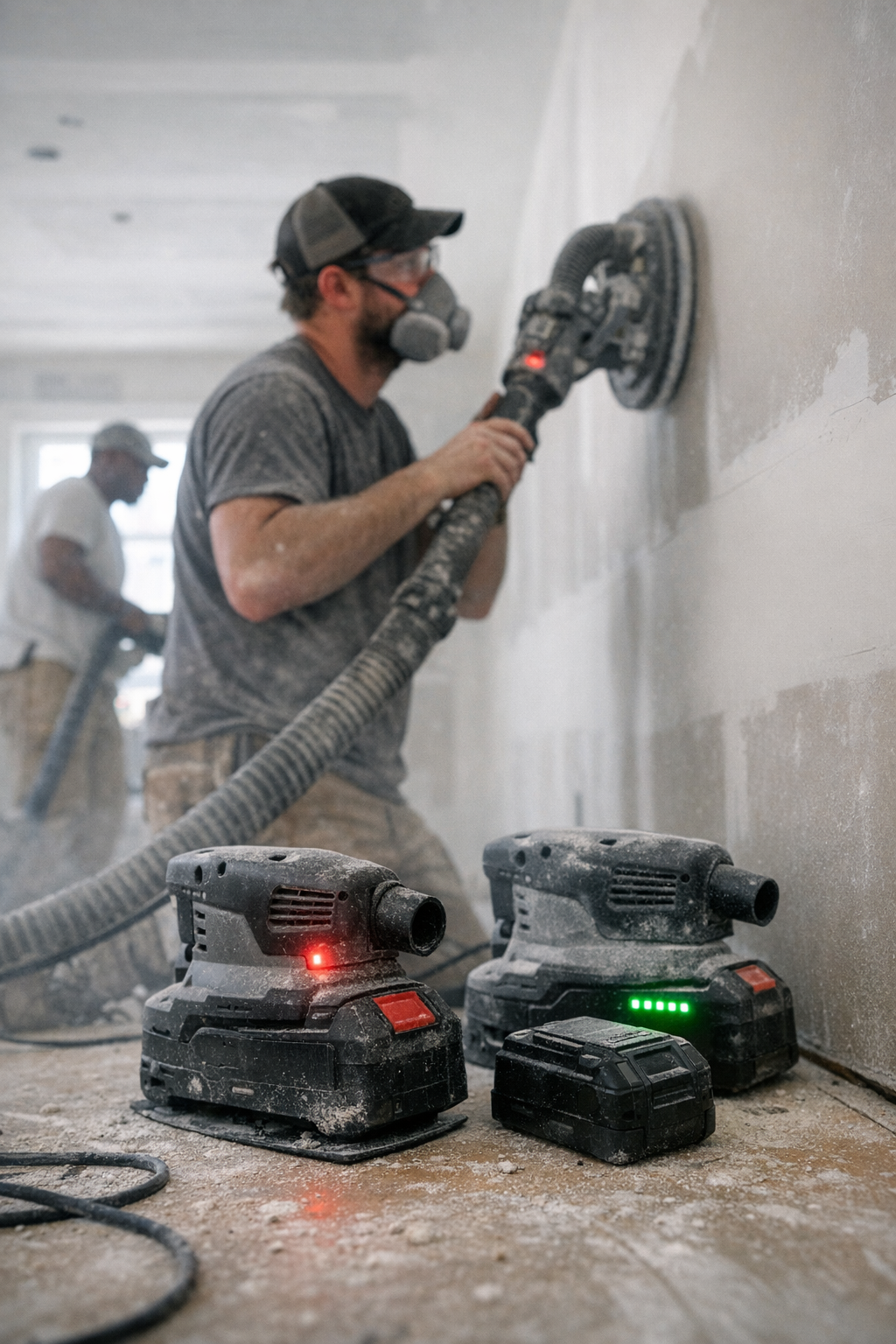
You don’t see battery fatigue coming—not when your workshop vacuum still screams at full strength or your air scrubber is kicking up fresh airflow with the first pass. The reality sets in much later: behind the whirr and the clean panels, it’s the battery that gets chewed up job after job, shift after shift. By the time you’re halfway through a messy drywall tear-out or mid-sanding run—with dust swirling and tools in constant motion—the small habits around battery swaps end up deciding whether your tools finish the day as strong as they started, or slowly grind themselves down until you’re left chasing lackluster results. It isn’t just shine that fades. It’s performance, and it’s reliability—right at the moment you can’t afford tool drift or missed debris.
Draining to Empty Always Feels Convenient—But the Downside Adds Up
Every worker knows the temptation: why stop early when that orange LED hasn’t started flashing? Squeeze out the last pass, let the tool run until auto cut-off, then swap batteries and move on. In theory, you’re stretching every cent of charge. In practice, each full drain chips away at your tool’s backbone. The signs don’t scream for attention. One day, a shop vac that used to yank dust clean in a single pull now takes two, then three. On a long fastening streak or a stubborn drilling sequence, the motor’s pitch changes—not louder, just thinner. Recharge time ticks upward, and the battery simply won’t rebound like it did last month. And you don’t see the difference until you’re five cycles deep into a real job week, where shortcuts show up as missed patches and slowdowns everywhere else.
When the Work Gets Long, Weak Batteries Work Against You
The real cost is clearest on tough, drawn-out jobs: after hours sanding out seams, when drywall residue is caked on every joint, or you’ve been carving out cut after cut and the grit is embedded in everything you touch. That first battery still feels strong—until you reach the last stretch. Now, your cleaner isn’t quite reaching into corners. The air’s moving, but somehow each pass pulls up less, and you’re double-backing over what should have been finished. Every extra minute you spend repeating a pass, every sweep that misses fine dust, you trace back to a battery that wasn’t built for this level of daily deep discharge.
Letting your cleaner or drill push all the way to shut-off doesn’t just mess with your end-of-day results—it wears the battery harder, and the tool starts running underpowered right when finish quality and control matter most. Instead of one clean, precise pass, you’re stuck cleaning up after the tool, which always means more fatigue in your arms, slower changeouts, and that constant itch that you could have done it faster.
Identical Tools, Different Outcomes—What Sets Them Apart?
Imagine two teams sanding panels side by side. Both start with the same make and model of air cleaner, same voltage, and the batteries are fresh from the charger. Five cycles in, one team is still making easy, single passes—sharp airflow, suction that clears every groove, no lag. The other? Their machine is dragging, motor straining to keep up, lower panels left dusty. No difference in skill or machine model—it’s just that one battery has been cycled to dead too often.
The difference is subtle at first—maybe a slight struggle to clear corners, maybe an odd drop in suction halfway through. But push through a busy week, and by Friday one crew has their results on the first pass while the other dreads the slowdown, swapping batteries mid-way, sometimes skipping finer cleanups just to stay on schedule. The output gap widens: one team trusts in a predictable, fully ready tool; the other compensates every day for a battery that’s lost its edge.
Simple Habit Shifts That Add Years to Tool Life
The smallest shift? You swap batteries at the first hint of fading muscle—when suction eases up, motor pitch drops, or airflow feels even slightly “off.” In a real shop, that might be an hour and a half in, just as you sense the edge going dull, well ahead of the shutoff click. The key: don’t wait for a dead stop.
This isn’t about being hyper–cautious. It’s about using your senses—listening for strained sounds, watching for the tool to hesitate on a dense seam, or noticing extra effort required for what used to be routine. When you pull the battery pre-emptively and pop in a fresh one, you keep the tool in its “sweet spot.” Performance stays steady: one-pass suction, consistent drilling torque, repeatable power for clean cuts. No doubling back. No saggy runs. No burn in your arms from fighting a tired tool.
Missing Signals Means More Work—And More Fatigue
If you ignore what your hands and ears are telling you—holding out for that final blink or power dip—every shift gets just a little bit longer. Recharge lags, batteries fail to hold their charge through the next cycle, and your tool’s responsiveness drops. By the end of a busy week, what started as a small shortcut adds up: tool control gets sloppy, there’s more bending and backtracking, and simple jobs drag out while the tool loses steam at the worst possible moment.
Practical Battery Management for Real Job Sites
Look for signals, not just failures. If you notice even a small shift in airflow strength, new mechanical noises, or you find yourself re-sweeping the same stretch, treat that as your cue to swap. Integrate battery changes into your workflow—when you pause for lunch, when switching between sanding and drilling, or at the end of a big batch, not after your tool dies in your hands. It keeps both batteries at moderate cycles, and all your passes stay tight and controlled.
This applies straight across the board—whether you’re cutting baseboards, running a dozen fasteners in quick succession, or just keeping a home workshop clean after a weekend project. Battery management isn’t about perfection or pampering. It’s about finishing strong every day, with less time lost to surprise malfunctions or faded-out runs.
Steady Power, Smoother Flow—Why It Matters When You’re Tired
You know the unique drain after you’ve redone a row of screws or skimmed the same floor twice because the power just wasn’t there. It isn’t just a few extra minutes lost. It’s the compounding fatigue—shoulders and back wearing down as you repeat slow, underpowered passes. Keeping batteries out of deep discharge cycles protects not just tool performance, but your rhythm on the job. The output stays level. You’re not fighting with your equipment. You’re focused on the cut, the cleanup, the next panel—work moves the way it should.
This isn’t about protecting battery life for its own sake. It’s about less grinding, more control, and tools that respond like they did on day one—even after dozens of rough, real-world jobs. That’s what turns a decent shift into a productive day and spares you from endless reruns purely because your battery bowed out long before your job was done.