Author: jaesoon_admin

  • How Wall Sconces Transform Shared Rooms with Balanced Night Lighting

    Shared room lighting looks solved until it hits real use after dark. That “clean blend” of ceiling fixture and desk lamp, perfect at noon or just after tidying, barely lasts one real evening routine. Once people start sitting down—reading, working, relaxing—the surface order unravels fast. Glare jumps straight off tablet screens and glossy pages, stings the eyes, or lands on a mug, making one seat unusable. Corners that seemed inviting by day turn into shadow pockets. Lamps dragged closer for comfort pull their cables back into view and threaten the room’s calm with every nightly adjustment. The more routines stress the setup, the more the cracks show: awkward glare, dim spots, cables loosening, and a tidy-looking plan that keeps interrupting comfort instead of supporting it.

    How Glare and Shadows Take Over Real-World Rooms

    Most living rooms start with one ceiling fixture overhead and table lamps scattered for tasks. Visually, that’s plenty. But under repeated use, the failings stack up immediately. Ceiling light floods everything equally—blunt, broad, and often useless in practice: too strong on the table, never enough in alcoves, and always bouncing hot off screens or shiny covers. The desk lamp saves one reader but casts fresh shadows for everyone else. People end up in a cycle:

    • Shifting seats whenever a thought is broken by a harsh, misdirected beam
    • Craning or hunched to escape a slice of glare
    • Chasing outlets as lamps are moved, cords trailing visibly every evening
    • Watching one half of the sofa become a dead zone just because the light doesn’t reach

    These aren’t rare problems—they’re baked into how weak setups quietly control the way a space gets used.

    Why Simple Setups Don’t Hold Up Under Repeated Use

    The promise of a minimal scheme—one fixture plus a smart desk light—dies fast in a genuine shared zone. The moment two people actually use the space together, friction replaces appearance. One person claims the lamp, the other endures uneven light, or fights to adjust the shade and cord yet again. “Tidy” vanishes as soon as lamps get re-angled, piles shift to shade the beam, or cables snake back over clean surfaces. Minor tweaks become nightly routine: stacking a book as a makeshift barrier, flipping a pillow upright to block the hot spot, or giving up on half the setup after a long day. Tasks that should be simple get interrupted by glare, poor coverage, or exposed hardware—every single night.

    Nighttime Friction: Small Problems That Add Up

    Lighting that measured up during a store demo rarely survives the test of real, repeated use. Instead, familiar problems quietly multiply:

    • Targeted glare shining off a tea mug or a photo frame where you want calm
    • Shadow traps swamping half the table, forcing everyone to adapt to leftover light
    • Cords on the move, always showing up after a quick adjustment or new device charge
    • Zones that seem composed but get skipped every night—unused, subtly avoided

    No matter how tidy the plan looked at 5pm, the late routine is always full of makeshift fixes and imperfect workarounds. The difference? Weak support lighting means adjusting your habits instead of the room ever working for you.

    The Shared Sofa Test: Lighting Mismatches in Plain Sight

    Picture a real setup: a corner sofa where one person reads and another scrolls on a tablet every night. Overhead, a basic flushmount erases nuance, flooding the space and missing all useful edges. Set a table lamp nearby—one person’s set. The other person leans forward or squints in a dim patch. Each night exposes the mismatch a little more:

    • A cushion is propped upright, not for comfort but as a glare shield
    • The person further from the lamp tilts, stretches, or gives up on reading
    • Lamps migrate to the floor, shift tables, and leave fresh cable tangles in their wake
    • Eventually, a whole section of sofa is abandoned after dusk—an area designed to be used, now resigned to darkness

    Every detail—lamp, cable, seat—is quietly shaped by lighting that looks neat but fails living-room reality during actual routines.

    What Wall Sconces Actually Change

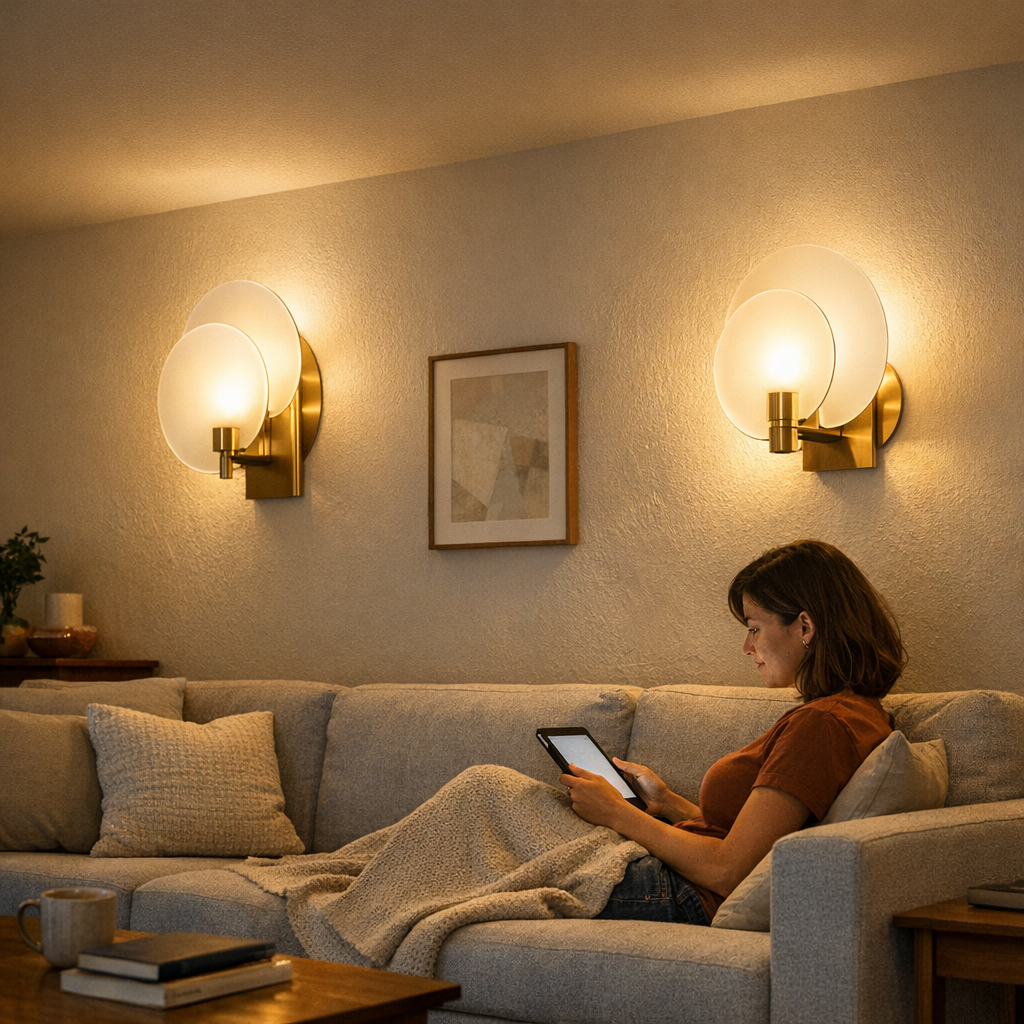
    Wall sconces aren’t a decorative afterthought—they’re how shared rooms stop falling apart from glare and cable overload every night. Mounted high and offset to the sides, sconces target the real zone: above and behind where people actually settle in. Unlike overheads or freestanding lamps, they throw indirect, usable light at the right angle—enough for both comfort and focus, without blinding beams or cable clutter underfoot.

    After weeks of shifting lamps around, mounting a pair of wall sconces just above shoulder height on each side of a sofa changes the math instantly. Suddenly:

    • The entire sofa becomes usable—no more dividing the good seat from the ghost zone
    • Glare on book pages stops, and tablet screens are comfortably readable without forced adjustments
    • No need to move cords or hardware—the lights stay fixed, the space stays open
    • No seat is claimed or lost; the setup finally supports two people equally, every night

    The room doesn’t look dramatically remodeled. It simply lets routines run without friction or daily sacrifices—making “shared” real instead of theoretical.

    Tip: Use Sconces with Soft Diffusers

    If possible, pick sconces with fabric or frosted glass diffusers. These soften and scatter the light, eliminating eye-level hot spots and reducing the risk of direct glare. Focused tasks and relaxed evenings both go smoother when no one’s fighting the beam or adapting awkwardly to the lighting.

    Signals That Your Room Needs Better Support Lighting

    The warnings show up in your routine before you ever admit a problem: seats skipped after dark, cables always drifting out, people stacking objects to redirect a beam, constant squinting or shifting away from glare, or surfaces that look “done” but invite frustration or avoidance every night.

    • Chairs that always sit empty in the evening
    • Lamps switched and re-switched, cords unraveling
    • Makeshift barriers cropping up: books, pillows, upturned baskets
    • People turning, stooping, or shifting—not for comfort, but to deal with routine lighting failure
    • Areas with permanent organization, but zero genuine comfort after 7pm

    These are the signs—daytime solutions that don’t withstand repeated use, setups that don’t scale to real life, and frustration that resets every evening. In most mixed-use rooms, wall sconces do more than update the look—they unlock the space you intended to use together, with no major overhaul or exposed hardware required. Lighting support isn’t about more brightness; it’s about the right structure in the right spots, finally making evening routines effortless instead of a ritual of compromise.
    LightSupport

  • Why Modular Storage Systems Need Space to Stay Functional Over Time

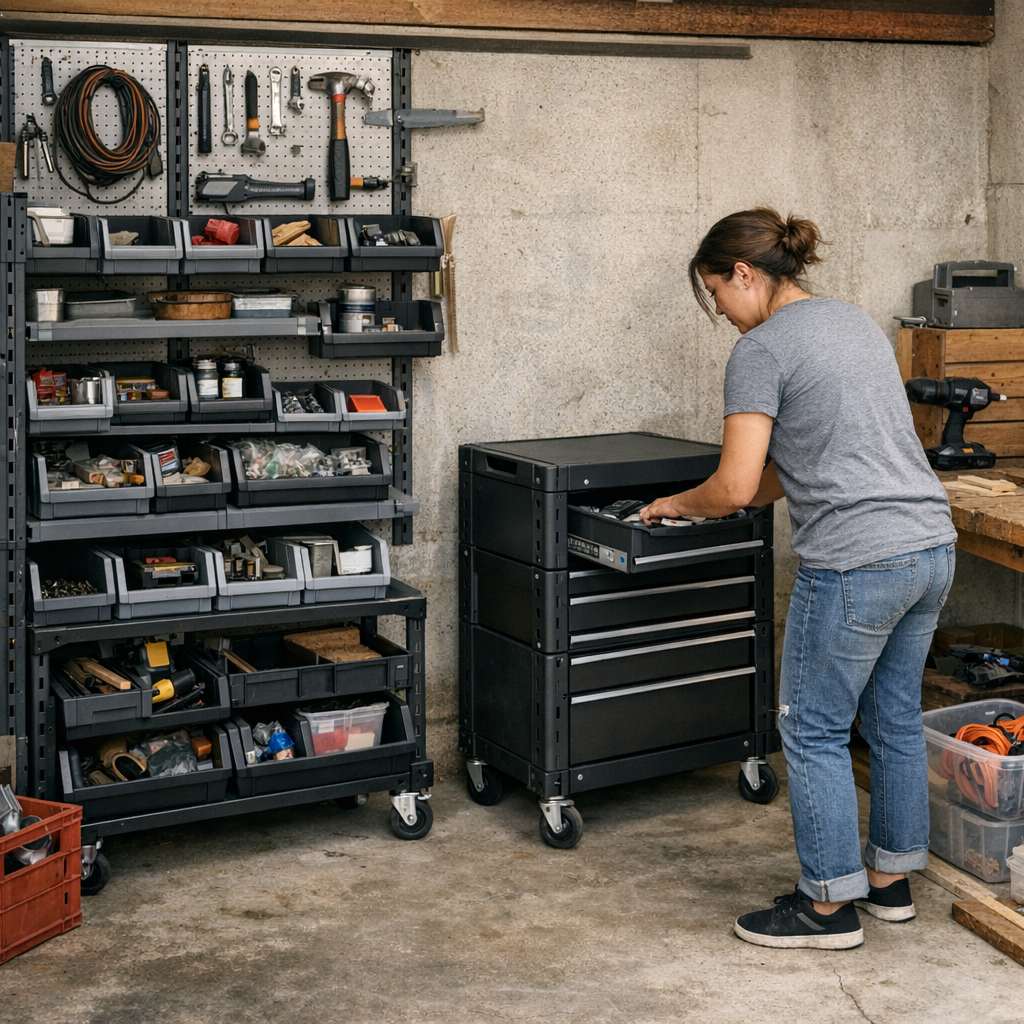
    The truth about “organized” spaces shows itself fast—usually the first time you try to get actual work done after installing a modular setup. Maybe you just hung a grid of wall panels, rolled in new bins, or filled up sleek shelving. For an afternoon, everything looks lined up and full of potential. But step into most workshops or garages a week later, and the honeymoon phase is over. Now you’re wheeling carts into tight corners, sidestepping an out-of-place bin, and reaching—again—for the same tool wedged awkwardly behind something else. The setup that seemed perfect on day one quietly reveals its limits as daily habits start to wear grooves right through the plan.

    The Mirage of Day-One Order

    Anyone can arrange bins in tidy rows and park carts flush up against each other to maximize open floor. When everything’s static, the layout holds. But routines pull the seams apart. The third day you roll your toolbox in, the cart snags because the “plenty of room” you measured is already down to an inch. The cabinet door only swings partway before bumping a shelf. A single corner becomes a go-to dumping spot because it’s the closest flat surface. Small misalignments feel minor—until they’ve turned every trip across the space into a contorted path between obstacles.

    It’s always something: a drawer that won’t close unless you shuffle what’s in front of it, a tool chest that creeps out of alignment every time you move it, or a rolling bin that’s technically mobile but has no easy way through the maze. Suddenly, what looked like maximum storage on install day becomes minimum maneuverability.

    When Every Inch Is Spoken For—But You Still Can’t Move

    The urge to fill every available space is powerful. A row of storage running from wall to door, bins pressed edge to edge, wall racks slotted into every stud—they all signal efficiency. But in use, those “gained” inches often cost you flexibility where it counts. A cart that fits only in one spot feels less like a solution and more like a barricade. If you have to juggle three things just to put one away, you’re not saving time—or your sanity.

    This problem isn’t just underfoot. On the walls, bins inch out of place with every grab, shelves flex under lopsided loads, and that one awkward tool winds up sandwiched at the wrong angle, hard to see and harder to retrieve. Wall space can be “used,” but if it’s not actually accessible, it becomes visual clutter—a background mural of things you keep meaning to reorganize. This kind of invisible drift is the enemy of easy returns and smooth routines.

    Overflow’s Favorite Hiding Places

    Most setups fail in the same quiet ways: a shelf end that turns into a magnet for misfit odds and ends, an underused tray that turns “temporary” into permanent, a mobile drawer that never quite returns to its slot and just keeps creeping out. The same corners collect wayward screws, forgotten gloves, and the things you “just set down for now.” Over time, these blind spots demand your attention but only reward you with the need for more reshuffling.

    Movement Obstructed—One Shuffle at a Time

    Start tracking how often you find yourself nudging, twisting, or sidestepping just to get where you’re going. Every time you have to slide a cart out of the way, reach awkwardly around a cabinet, or backtrack because a bin blocked a walkway, the setup is dictating your routine—not the other way around. These interruptions multiply: what starts as a minor delay becomes a constant slow-down, with frustration growing every time you ask yourself, “Didn’t I just fix this?”

    Micro-Shifts Add Up—And Reveal the Real Weakness

    No modular solution stays frozen as installed. Rails can loosen, bins drift from their spots, shelves sag, anchor brackets flex under real loads. The question isn’t if things will move—it’s whether your setup allows for it, or falls apart under the pressure. Sometimes the most productive gap is the one everyone else would tell you to close.

    One real-world proof: In a packed garage, leaving a six-inch space beside a main walkway looked inefficient—until the rolling cart zipped through cleanly every day, without scraping bins or catching wheels. The gain wasn’t storage; it was flow. There were fewer lost parts, fewer “just set this here for now” pileups, and less time spent yanking things back into place.

    If You’re Always Tinkering, It’s Not Working

    When you have to reset things after every project, or constantly scoot bins around just to move, the setup has failed the real test—not enough give for the way you actually use your space. Fixed units force consistency but can block new needs. Modular units promise flexibility, but if the pieces drift, tilt, or jam the minute you start moving, they become maintenance projects themselves.

    A shelf with no side support slowly skews. A rolling bin without real lanes gets wedged in wherever it fits. And an “overflow” zone that wasn’t given a real return function will keep overflowing—every week.

    Design for Routine, Not Just for Show

    The setups that last aren’t the ones with the most bins per square foot, but the ones with lanes left open for carts, real breathing room for quick returns, and landing zones for the things you’re always grabbing. Don’t trick yourself into cramming in “just one more” shelf or bin unless you’ve seen how the flow actually works.

    Pay attention to where clutter repeatedly accumulates. If one tray or corner always needs a reset, rework its purpose, not just the placement. Simulate a real workday: wheel out carts, recoil hoses, re-shelve tools at their actual pace. Fix anchors, brace shelves, and most importantly—leave functional gaps, even if they look like “empty” space.

    Small Tweaks, Outsized Results

    The relief often comes from fixing one snag: shifting a cart’s location so it never blocks a walkway; giving everyday tools their own return bin instead of squeezing them onto the nearest shelf; bracing a cabinet so the drawers always track straight. These behind-the-scenes adjustments carve out time and make routines less frantic, even if nobody else notices the difference.

    Bottom Line: Lasting Setups Make Room for Movement

    The best-organized spaces aren’t the ones that never look messy, but the ones that keep working when things are going full tilt—tools out, bins refilled, carts rolling, and new projects happening alongside old ones. If you’re constantly resetting, you’re just maintaining an image—not a routine. Build in lanes for return trips, anchor where drift keeps happening, and allow yourself some margin for mess in exchange for freedom to move.

    Leave space for your real habits, and your setup will earn its keep long after the “after” photo fades. Setup that tolerates real movement is the only kind worth building—and the only kind that actually lasts.

    http://stacknest.myshopify.com

  • Why Carry-On Organization Matters More Than Neatness Before Boarding

    The gap between a carry-on that looks organized and one that actually works in real airport flow becomes blindingly clear the moment you have to pull your passport from a packed bag while boarding is already moving. At home, sorting everything—cables, documents, small comforts—into neat compartments feels like control. But under real pressure, what seemed “ready” turns stubborn: you’re digging through hidden pouches, unzipping main compartments wedged between armrests, and finding the same charger stuck beneath yesterday’s careful order. Actual travel exposes the limitations of setups built for stillness, not movement.

    Where Order Cracks: The Hidden Friction of “Neat” Packing

    The friction starts small: sitting at the gate, you unzip what you thought was a smart setup only to find your wallet under a toiletries pouch or your boarding pass buried past an unnecessary layer. Each retrieval turns into a mild scramble. You shift organizers aside, shuffle a sweater to reach a document, and every touch means extra seconds—just as space shrinks and your focus splits between announcements and crowd movement. Neatness back home becomes shallow currency the moment you need something fast; every reach interrupts the supposed order and nudges you out of flow.

    These disruptions aren’t isolated. In busy terminals and between repeated checks, the seconds add up. Each time you dig past tightly stacked pouches or disrupt a “layered” compartment, bit by bit, the visual order you built collapses into a cycle of minor resets and new mess—just to get one thing out and back in without scattering contents across the airport floor.

    Reaching and Repacking: Where Most Setups Falter

    The repeated pattern quickly appears: every document pull, cord grab, or snack retrieval means reopening the same zipper, shifting at least one item out of the way, and fighting to put everything back without losing more time. The “orderly” look erodes after just two cycles: pouch stacks loosen, smaller items hide under bulkier ones, and the feeling of control gives way to uncertainty. If grabbing your wallet means lifting half your bag onto your lap, squeezing everything back into place, or propping the whole setup on your knee while others walk by, you’re living out a layout that values neatness over speed, and smooth airport movement pays the price.

    What was designed to look tidy soon becomes a repacking burden—every quick access produces another mini reset, until the structure no longer fits the real movement of airport life.

    Gate Pressure: Where Visual Order Fails Real Movement

    It’s during gate calls and seat entry that weak setups betray themselves. The line moves, you’re juggling your bag in one hand while your phone buzzes for an update, and now the “safe” storage choice—an inner sleeve or a too-deep pocket—raises the stakes. A simple boarding pass check becomes an awkward two-handed dig; a missing charging cable forces you to crack open the main compartment in a bottlenecked aisle, drawing impatient glances. What worked for a packing photo fails under shifting bodies, crammed seats, and a real need for immediate access.

    Even well-meaning “compact” designs backfire: the same tight layout that keeps the exterior clean now blocks your reach, forcing wide unzipping and extra balancing. The result is a recurring risk—contents slipping out, or your quick move stalling the line as you re-sort stray items. The setup that promised order exposes its limits as soon as you need real flexibility in crowded, time-sensitive moments.

    Quick-Access Pockets: Moving Retrieval to the Front Line

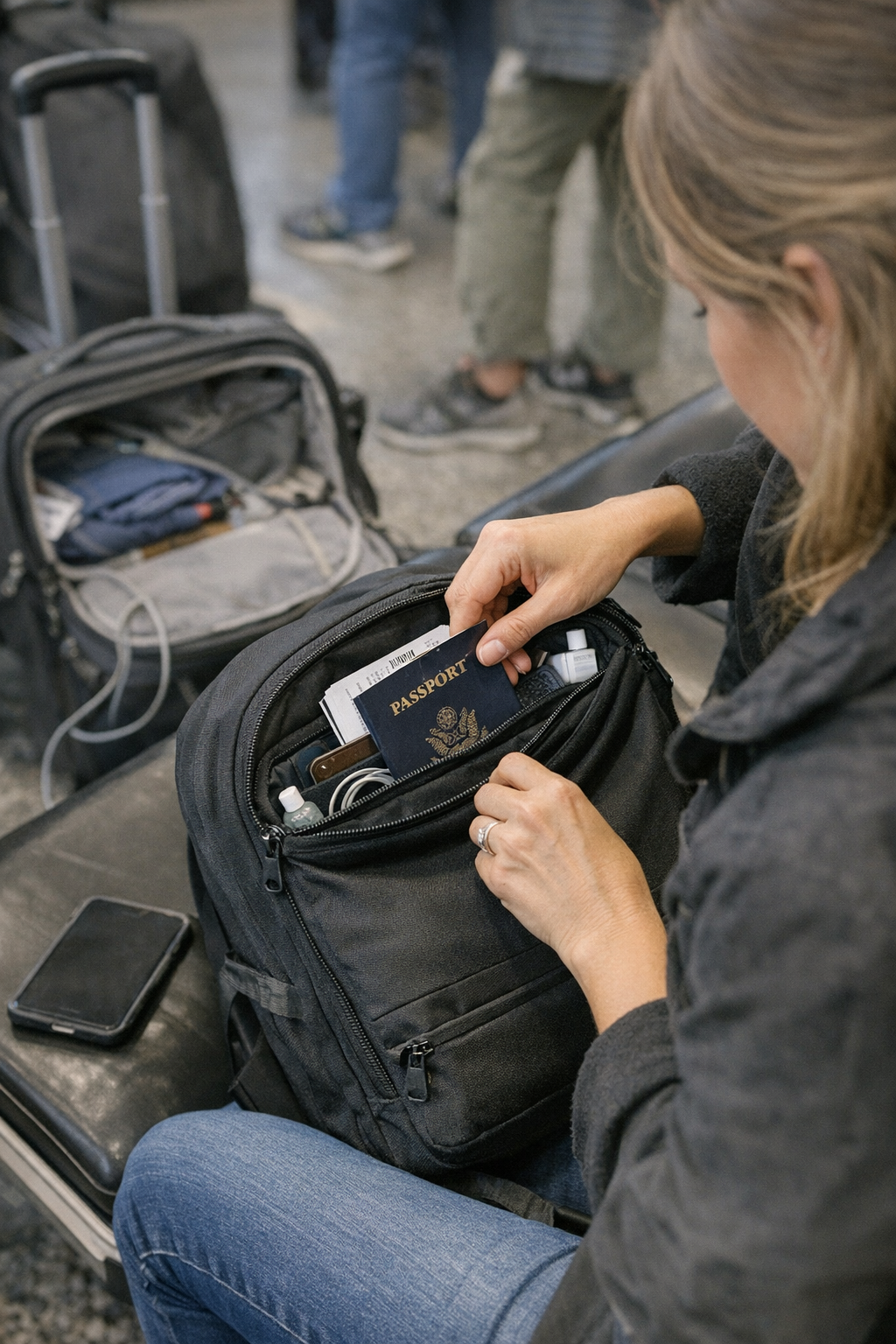
    The shift isn’t about packing less—it’s about where your essentials actually live. Placing your high-frequency items—passport, wallet, boarding pass, charger—into a single, quick-access pocket shifts your entire rhythm. Now, whenever you pause at a checkpoint, field a surprise request, or need to recharge, you open one zipper and solve the problem without touching the main compartment. There’s no chain reaction of shifting organizers around, no fear that pulling your phone will dump toiletries onto the seat or floor.

    This structure lives at the intersection of speed and control: the main pouch stays fully sealed and visually untouched; the quick-access zone handles the chaos of movement. Each retrieval returns the essentials pocket to readiness, instead of resetting the entire bag, shrinking stress and keeping you mobile. The system isn’t just neater, it’s structurally lighter in repeated use.

    Repeated Use: Where Efficiency Proves Itself

    Most carry-on setups fail not in the first hour, but after multiple cycles: security check, waiting zone, boarding, stowing, mid-flight retrieval, hotel arrival. Every time you reach for something vital and have to unpack or repack more than necessary, the inefficiency compounds. The warning sign is familiar—a five-step routine just to charge your phone at the gate, or another fumble through three layers to show a document at a checkpoint. Each repeated scramble is attention lost and comfort drained right when you need it most. Every extra moment spent reorganizing cable pouches during a tray transfer is time you don’t get to unwind or plan for the next leg.

    A structure that demands constant reordering wears on you—not because it looks messy, but because real movement always outpaces static design.

    Small Shifts, Big Improvement: Making Access Frictionless

    Most travelers don’t need a full makeover to avoid these frictions. Repurposing a front pocket as your essentials hub, adding a thin travel organizer, or simply moving key items out of layered storage to a dedicated top-access zone can completely change the flow. The move that matters is isolating frequent-use items—passports, chargers, documents—from the main cavity, and guarding this quick-access area from clutter. Now, even if you reach in five times in an hour, each retrieval feels fast, calm, and interruption-free. The bag’s outward order holds, but the internal flow now matches real airport movement, not just a tidy room photo. Forgotten tension fades each time you skip the old scramble, marking the shift from looking organized to moving with purpose.

    Discover more setup-focused travel tools and essentials at CarryOnSupply.

  • Why Daily Car Upkeep Beats Monthly Deep Cleaning Every Time

    The difference between a car that’s merely “tidy” and one that actually works for you shows up after the third quick stop, not on the first clean sweep. Charging cords loop under your bag again. The floor mat rides up to reveal grit where your heel lands, even though you squared it before leaving. On paper, your car’s setup passes the visual test. In practice—especially through a week’s worth of errands and re-entries—it turns into a slow, friction-filled sequence of fixes and mini-cleanups you can’t see coming until the aggravation builds.

    Friction You Don’t See Until the Routine Breaks Down

    Most car setups fail by Wednesday, not Wednesday next month. Charging lines look contained until a shoulder bag yanks them loose each morning. Coins and receipts lie flat until a single hard turn scatters them into odd corners, just as you reach for your coffee. A mat you adjusted before work creeps back under each shoe entry, so dirt grinds into newly exposed carpet midday—again. None of these feels major at first, but after a handful of stops and starts, the return-to-car moments become less automatic, and more about correcting the same annoyances on repeat.

    It’s never about one pile of visible mess. It’s how quickly “organized” slides into “now I have to fix this again.” A neat surface starts to unravel at the edge—trays that become spill zones, hooks that turn into tangle points, covers that shift just enough to matter without looking obviously wrong. The time you spend digging, untangling, or realigning adds up, making the entire drive feel heavier than the mess ever suggests.

    Why Most Setups Can’t Survive Repeated Errands

    Clutter returns so quickly because almost nothing stays anchored under routine pressure. Every loose charging cable is a slow booby trap; a sharp turn or an under-seat slide away from blocking you when you’re in a rush. Mats drift, seat protectors bunch, and “catch-all” organizers quietly overflow into dumping grounds that slow your retrieval of just one thing—keys, charger, sunglasses—when you actually need it. Flexible bins become mobility magnets: what was handy on Sunday turns into a fumble point by midweek, especially if the organizer you “added for convenience” is the very thing slowing down loading or unloading.

    This invisible friction isn’t just about more cleaning. It’s about setup structure failing to support real car use. If your car’s system lets slip anything—charging lines, cargo trays, door bins, emergency kits—the result isn’t just more mess: it’s lost time, cleanup that never quite ends, and a near-constant low-level frustration each time you restart your routine.

    Everyday Scenes Where Setup Weakness Quickly Shows

    It’s never “just one thing” slowing you down. Reaching back after a coffee run: receipts wedge under the seat. Multi-stop errands: a sweater or gym bag slides off the seat, landing in the footwell each time you brake. Shopping for groceries: handled bags press cables out of their dock, so your phone cord winds up tangled around bottle necks by the next stop. Trunks look compartmentalized—until a suitcase and a new package bump trays out of the way, exposing how easily loosely placed organizers turn into loading obstacles.

    The real weaknesses show up when routines overlap. Shared cars with family or pet gear? One person’s mat fix is undone by the next entry. Dog harness anchor blocks access to a charger. What seemed calm and under control on Sunday devolves by Friday—all because repeated, real-life movement reveals where the system breaks, bunches, or lets clutter drift straight back in.

    The Compounding Effect: Why Small Issues Become Routine Roadblocks

    Most cars aren’t sabotaged by one glaring mess—they’re undone by layers of minor slowdowns that stack up until the routine collapses. A mat that catches your heel forces a pause every time you get in. A phone cable you left “just so” ends up looped under the cupholder by day two. Storage bins collect rolling change or random paper, which slide into armrest access by Friday’s commute. The small pauses you take to fix or adjust just keep adding up, especially as each “quick fix” slips a little further out of alignment by the end of the week.

    This isn’t dramatizing small problems; it’s what actually happens to those initial “solutions” that aren’t truly anchored or well-placed. Each small friction point not only frustrates, but slowly creates more to clean, more to move aside, and more to reset—raising the overall maintenance cost of your routine until you start to dread the next drive.

    What Actually Makes Car Routines Easier?

    The only setups that hold their own against five days of errand loops and work runs aren’t necessarily the most minimal—they’re the ones designed for repeated impact and reset. Anchored phone cables using fixed dash clips mean you don’t fish around on the floor before every other drive. Shallow, seat-side bins (secured with Velcro or built-in anchors) keep coins, keys, and transit cards hand-ready instead of collecting at the bottom of a wobbly tray. Genuine flush-fit mats—with grips or anchors at threshold spots—stay in line even as shoes drag grit over them, stopping dirt before it cuts into exposed edges.

    High-contact points—where your heel lands, where your elbow reaches, where a passenger drops a bag—predict real friction. Accessories that lose position at these spots create the very drag you bought them to avoid. That’s why reliable setups always start by fixing what gets touched, kicked, or pressed the most, not just what “looks tidied up” to start.

    Daily Resets: The One-Minute Habit That Protects Your Flow

    Full overhauls take time. But one minute after a park or trip—clipping the cable, straightening the mat, tossing loose clutter into a stable bin—prevents friction from creeping back. The aim isn’t to keep it showroom clean, but to interrupt tiny slowdowns before they spread: keeping heel lines flush to the mat edge, securing the charger right where your hand will expect it, making sure item bins haven’t drifted from their spot. This habit turns a car from a catch-up zone into a workspace that’s ready, not always waiting for rescue.

    The difference is immediate: entry and exit clear up, access points remain open, and your go-to essentials are right where muscle memory expects—no sidelong glance or adjustment needed. Cleanup before the next drive takes seconds, not a full session with vacuum and wipes.

    How Anchored Solutions Quietly Outperform Quick Fixes

    Flexibility can feel like an asset—until the third or fourth trip jars everything loose. Loose cable, floating trays, and soft bins inevitably slide or flip, setting up small blockages that only show during real driving. In contrast, bin edges that grip, mats that lock, and cable channels that stay fixed all week deliver a subtle relief: you stop even noticing the setup, because nothing interrupts your move from park to drive and back again. That’s the real signal an accessory is earning its keep—not that it stays clean, but that it stops creating new problems in use.

    The payoff is cumulative. Anchored, well-designed routines become invisible partners. Every time you reach, load, charge, or re-enter and don’t have to un-knot, lift, or realign, it’s one more drive free of minor friction. Across a week, the car feels not just less messy, but more responsive—never asking you to reset the same loose tray or cable yet again.

    Organization Is About Repeated Comfort—Not Just First Impressions

    No setup is perfect, especially when the car gets shared, kids bring in new messes, or a dog harness gets added in the rush. Still, when mats, bins, organizers, and cable runs are set up to absorb the reality of repeated entry and crash, the result is less sudden interruption—less sprint cleaning, less hunting for what rolled away, less fighting the same spot over and over. The biggest benefit is a routine that functions, not just a cabin that “looks” passable at a distance.

    What’s left isn’t Instagram-tidy, but it is reliably ready for the next run, whether you’re reloading groceries on a rainy Tuesday or hustling everyone in after soccer. The setup endures because it’s built for the pressure that actually comes—setup that relieves you, not just the interior, from the cycle of messes returning by Friday.

    Explore anchored, repeat-use car accessories that stay put when real-life pressure hits at DriveWellSupply.

  • Why Multiple Cat Beds Ease Indoor Maintenance and Boost Comfort

    Setting up for an indoor cat usually starts with the idea of keeping things simple—one bed, one corner, neatly out of the way. But in real daily use, that “tidy solution” becomes the setup you step around every time you top off the water bowl or refill kibble, dodging a sleeping cat who’s always landed right where you need to reach. What looked organized quickly turns into a friction zone: fur concentrates, routine wipe-downs get skipped, and the “low-maintenance” spot becomes the place you resent having to handle again and again. This is where the quiet trade-off of indoor-cat comfort collides with actual home upkeep—the fault lines that StillWhisker aims to expose and solve.

    When “Simple” Setups Start Feeling Complicated

    A single cat bed seems like it should keep things streamlined. Fewer pet items, less clutter. But practical friction stacks up fast: try scooping litter and you’ll nudge a tail blocking the walkway, or step over that same patch of fur for the fourth refill in a week. The neat corner advertised as “easy” quietly steals more minutes than you notice:

    • Bed edges trap stray litter dust with every box trip.
    • Blanket corners rumple and fold, demanding smoothing well before the weekend.
    • Hair builds back within hours of vacuuming—always in the zone you walk most.

    None of these are disasters, but they add up, turning a “controlled” area into a silent repeat chore.

    The Routine Resets That Stack Up

    Minor inconveniences snowball: you put off wiping surfaces because you have to move your cat first, or let cleaning tools drift away from the spot they’re truly needed. Sunlight shifts and the “quiet” rest zone turns busy, pushing your cat—and your feet—into tighter overlap. Suddenly, your well-planned layout creates as many reroutes and resets as it solves.

    Picture a weekday morning. The path to the kitchen winds around a thick patch of fur and a dozing cat, pausing your flow every time you refill food or water. On cleanup days, a catch of stuck blanket delays laundry. By Friday, it’s not just the cat’s comfort that’s on your mind—it’s how much time and energy that out-of-the-way zone demands just to stay functional for everyone in the house.

    Why Fur and Foot Traffic Always Find Each Other

    Cats follow warmth, sunlight, and shifting activity. That means today’s sleepy spot might be tomorrow’s walkway obstacle, especially if there’s only one place to settle. Fur, foot traffic, and daily chores collide in a single area. Each pass kicks up more hair. Shoes and slippers bump bed corners. The “cat zone” starts leaking into the family zone, and keeping both looking guest-ready and usable at once becomes a chore—no matter how tidy the bed was on day one.

    This is the real tension: a setup that looks settled, but in practice interrupts human flow again and again. A calm-looking corner doesn’t erase the need to shake out dust, redirect your walk, or slow down for the same handful of cat hair every day.

    The Impact of Adding a Second or Third Rest Zone

    A new rest spot doesn’t need to be fancy—a simple washable mat by the window, or a small pad in a quiet nook, is enough to break up the pattern. Cats naturally rotate: morning stretches in the sun, afternoon naps farther from family bustle. This “rotation” means:

    • Fur spreads thinner—no more single spot matted with hair.
    • Each zone needs only light maintenance, not drastic cleanup.
    • Bed resets get faster—one quick shake or vacuum rather than a full overhaul.

    Instead of deep-cleaning the same problem area, you keep shifting tiny maintenance into your routine—it stops feeling like an extra job.

    Example: Quiet Window Pad vs. Hallway Pinch Point

    Take a layout where the primary bed sits right off the main entry. Every school run, grocery drop, or after-dinner clean funnels across that line. You’re dodging the cat and her fur daily. Now, add a lightweight pad beneath a sunny window. The cat divides her time: snoozing out of the way in the morning, returning to busier spots only when she wants company. Suddenly, fur no longer piles up at the pinch point. The “please move so I can work” routine is down to maybe once a week, not every morning. Even blanket resets shrink from multi-minute scrambles to a one-minute fix.

    Placement Matters: Mind the Overlap

    It’s not just about number, but where beds and mats sit. Avoid setups blocking human walkways, crowding entryways, or clustering beside feeding and litter spots. Beds jammed against food bowls or litter trays blend crumbs, fur, and dust—tripling cleanup without warning. Instead, position rest areas in sun patches, beside but not in front of windows, or tucked into quieter corners off routine traffic lines. Cats rotate naturally; your routine stops colliding with theirs.

    Combining nap space with feeding or litter areas rarely works long term—maintenance explodes as fur, crumbs, and dust cross-contaminate. The bigger the overlap, the more the “one tidy zone” turns into three separate headaches.

    The Real Routine: Minor Upkeep, Major Difference

    Two or three zones, spaced where both you and the cat tend to go, mean maintenance shifts from crisis resets to quick tidying. Shake or vacuum as you walk by, reroute yourself less, and if one corner becomes a fur-magnet, it’s easy to rotate pads, not rearrange the whole house. Compare to a solo bed: every major cleaning cycle includes it, and it’s nearly always in the way of something you need to do next—fetch a toy, mop a spill, reload a feeder. The difference shows up not in how a setup looks, but where your actual labor goes once routines stack up.

    Avoiding the “Looks Good, Works Bad” Trap

    Owners assume one neat bed keeps things contained. What happens instead: unplanned reroutes, fur drifting into high-traffic paths, more time spent nudging a cat or cleaning up than simply living alongside. “Simplicity” becomes the source of silent irritation.

    The goal isn’t piling on cat furniture—it’s creating enough variety that fur, comfort, and routine conflict all land in lighter cycles. A couple of light, low-profile rest bases in separated edges give your cat rotation, and your own upkeep stops feeling like a repeat obstacle course.

    Practical Setup Tweaks for Smoother Days

    Use repeat-use logic, not just décor:

    • Opt for pads and beds that shake out or toss in the wash easily—avoid thick, immovable cushions.
    • Place at least one rest area in a sunlit, away-from-foot-traffic spot, drawing your cat during your high-activity windows.
    • Keep several feet of “buffer” between nap, feed, and litter spots to prevent cleanup overlap.
    • If a spot becomes a fur-magnet or disrupts your routine, swap it—don’t wait for frustration to build before adjusting.

    Treat every time you shuffle a cat, wipe up surprise fur, or hesitate to clean as a prompt to reevaluate—not an inevitable part of cat life. Small directional tweaks nearly always cut accumulated annoyance and upkeep.

    The Practical Payoff: Less Cleanup, Fewer Interruptions

    A single bed gives the illusion of control, but overlaps with human routines become clear within a few weeks: blocked reach, slow resets, and dual-use areas that add cleanup instead of reducing effort. Rotating between a couple of rest zones interrupts these pressure points, lightens routine resets, and shrinks the conflict between your cat’s comfort and your own daily flow.

    The best indoor-cat setup isn’t the one that looks the calmest; it’s the one that keeps your cleanup fast, your access open, and your routine friction down, round after round.

    Visit StillWhisker for practical indoor-cat setup solutions.

  • Why Drawer Cabinets Transform Office Supply Storage and Daily Organization

    Desk organization rarely fails because of the first setup; it fails when the system can’t stand up to repeat use. By midweek, supplies meant to stay sorted—pens, chargers, stray envelopes—start bleeding across categories, choking up your work surface and slowing every grab-and-go moment. It isn’t about aesthetic order once: it’s about whether your storage actually lets you reset quickly, find what you need, and avoid the slow buildup of friction that leaves your desk unusable by Friday. The problem isn’t bad habits. It’s that most common desk storage—open bins, baskets, stacking trays—works against you after a few days. You move the same pile twice, hunt for a cord under a batch of mail, and realize “organized” only meant “temporarily forced into neatness.”

    When Storage Methods Fight Your Routine

    Open bins, baskets, and shelves promise easy access, but almost always create a new friction: it’s fast to toss things in, but it’s rarely fast to get them back out cleanly—let alone returned to the right category. The things you need most float to the top, blocks of unrelated stuff get nudged together, and suddenly the “stationary bin” is half cables and receipts. Retrieving one item means shifting several. Open shelves? Shift one folder, disrupt a whole row. With every cycle, your carefully sorted order slips further—until reaching for a specific pen is a mini excavation. What looked organized starts to feel more like a staging area for tomorrow’s mess.

    Open systems offer visibility but deliver constant shuffling. You never get advance warning when categories merge or overflow crowds the edge—the only signal is wasted time, quick frustration, and surfaces that grow messier by the hour. You don’t so much “organize” as repeatedly delay chaos, grooming the same piles until there’s no clean return path at all. When the system asks for constant attention just to stay usable, you end up working around it, not with it.

    What a Drawer Cabinet Changes in Daily Use

    Switching from open storage to a drawer cabinet inside your desk zone shifts the pattern entirely. This isn’t just about hiding clutter; it’s about controlling categories, keeping supplies in predictable lanes, and letting the surface recover with almost no effort after every session. The biggest difference isn’t seen in a “before and after” photo—it’s in the dozens of micro-decisions you stop noticing. Pens and notes find their way back to the same drawer. Chargers don’t drift between baskets and counters. That weird receipt doesn’t swallow your to-do list. What’s gone isn’t just the mess, but the repeated double-handling that ate up your Monday mornings and Thursday afternoons.

    Reducing Double-Handling and Decision Fatigue

    Drawer cabinets force a structure on your routine that open storage simply can’t. Each drawer acts as a line against category bleed: paper goods stay confined, tech charges return to their slot, overflow finally remains contained. The reset at the end of a day? Not a 10-minute sweep-and-scramble, but a one-minute routine where everything lands home in three movements. No jamming piles so boxes close, no shuffling items to hunt for a buried USB drive. The unwelcome surprise is gone; the return loop shrinks. You spend less energy deciding “where does this go?” and more time actually working—or just stopping for the evening without a looming mess waiting for next time.

    Stability Versus Sprawl

    Baskets and open shelves almost invite sprawl—new stacks on top, sideways piles, useful tools drifting to the “neutral zone” by default. Drawer units resist this drift. Separation gets enforced every day: open a drawer for stationary, nothing else moves; close it, no new pile is born. Over time, this means missing items stop lingering on the desk edge or under a loose document. The work surface stays functionally open, not just cosmetically clear for a moment. That orphaned highlighter or lost cable is contained, not adrift and slowing you down.

    Real Scenes from the Office Zone

    End of the day: your tray is buried, cords snake across notepads, new receipts pool over half-completed lists. With only open bins or shelf lines, “putting away” is usually just starting a fresh heap—one you’ll sift through again tomorrow. But a drawer cabinet interrupts that spiral. Chargers drop into their compartment; notes and loose pens in theirs; receipts where they won’t interrupt the next task. This one-minute reset turns what would be a growing disaster into a stable, almost invisible routine. You spend less time “tidying” and avoid starting every morning with a shrug.

    Need to grab a notebook or sticky notes before a call? In a mixed bin, you dig, disrupt, and maybe settle for what’s on top. In a drawer setup, each category remains isolated: open, take, close—nothing else slips out of place or crashes to the floor. The absence of inconvenience is what stands out: you stop noticing resets at all, because they barely register in your workflow.

    The Footprint and Flow Dilemma

    Even the best storage can work against you when it starts blocking movement or quietly growing into the room’s “prime real estate.” Floor baskets escape their corner, spreading as you reach for what’s wedged behind. Shelving units creep up the wall, but fill up with so many layers that the front row always blocks the back, slowing every search. Order might look intact, but the path through the space narrows, and you pay with time—not just in steps, but in micro-delays and awkward detours.

    Positioning a drawer cabinet directly beneath the desk—especially a rolling option—keeps storage anchored and minimizes accidental spread. The footprint remains tight; you open only what you need without skirting piles or shifting furniture. In tight spaces, claiming one reliable zone for storage (instead of letting bins multiply) keeps the room usable. Movement isn’t blocked by your own organizing attempts, and the “reset cost” never grows beyond reach.

    Making Resets Less Taxing

    The real test of any storage setup is the reset: how hard is it to bring order back after a messy, real day? In practice, magazine-perfect setups collapse because they can’t absorb everyday use. Drawer cabinets with deliberate zoning keep categories stable, so the return flow is frictionless even when you’re in a hurry. There’s less chance of stashing items in the wrong places, less likelihood that overflow clogs a usable surface, and fewer excuses to let entropy win.

    This isn’t about making the space perfect—it’s about building a setup that stays workable, even under pressure. Drawer units aren’t immune to overfill or lazy returns, but the system resists category slide and keeps daily slowdowns at bay. No more hunting for missing items or resigning yourself to an end-of-week “desk rescue.” The reset becomes so fast it barely interrupts your momentum, freeing up energy and time for actual work—rather than the never-ending drag of sorting through yesterday’s leftovers.

    Small Shifts with Real Impact

    “Organized” means little if it can’t survive daily churn. The value is in a system that matches real movement: things come in, things go out, but the categories and surfaces recover with minimal effort. A correctly placed drawer cabinet does more than contain clutter—it restores the work zone with almost no mental effort, session after session.

    Test it: move one chronic overflow—chargers, pens, whatever piles up first—into its own drawer and see if retrieval and return change. Does the surface stay clear longer? Can you find what you need without shuffling a buried pile? The answer reveals whether your storage is helping your day or just marking time until the next frustrating reset.

    Find storage solutions that work with your space and routine at Gridry.

  • Why Regular Junction Box Screw Checks Prevent Lighting Issues in Your Home

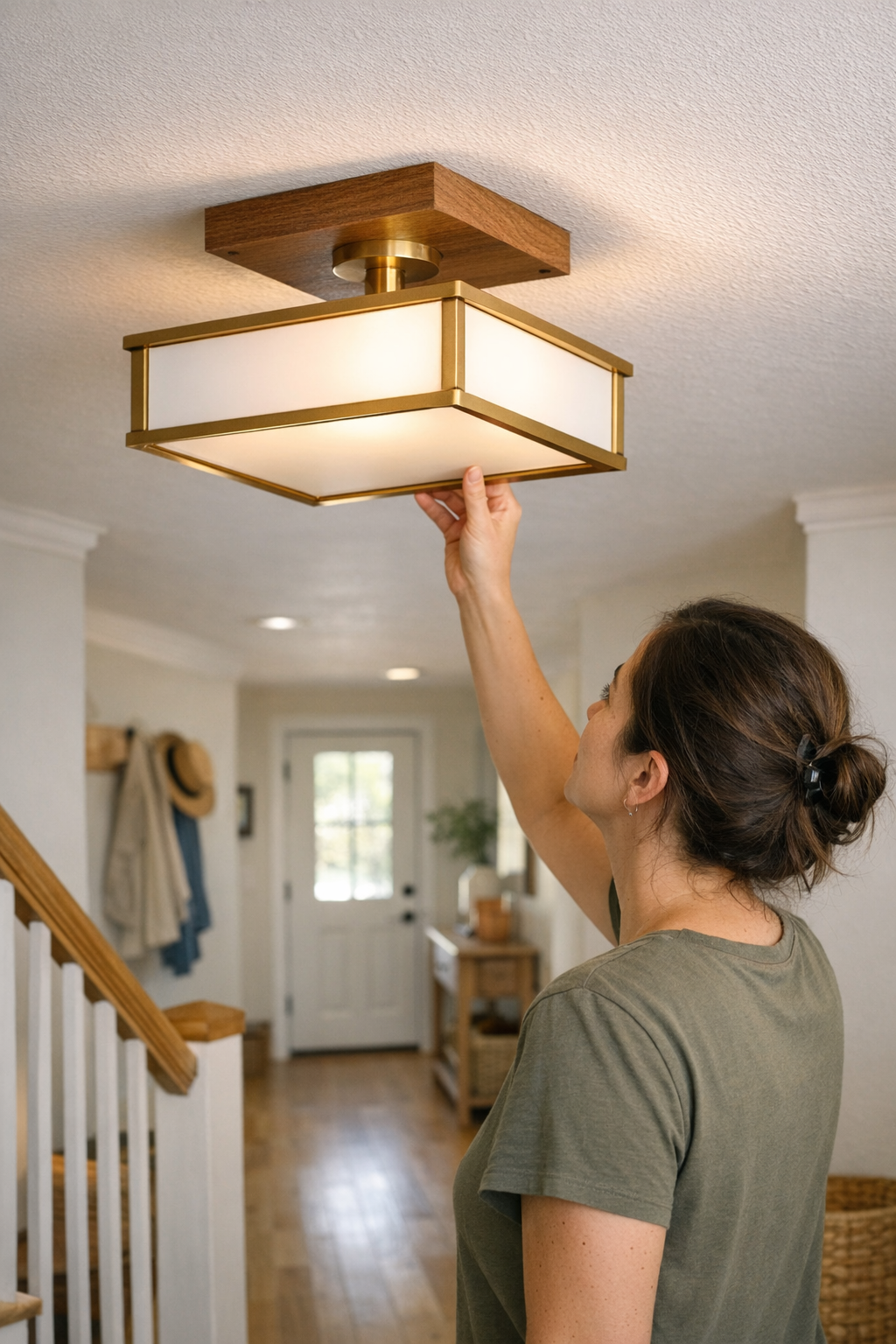
    If your hallway or stair light wobbles or shifts even slightly, that’s more than a minor annoyance—it’s the first sign your lighting setup might be quietly failing where it matters most: everyday movement and safety. Most people trust a flush-mount ceiling light or wall sconce just because it hugs tight and looks right on day one. Glance up after installation and you see clean lines, no visible flaws. But fast-forward a week: after dozens of door slams, late-night steps, and regular dusting, that “perfect” fixture begins to betray you. Edges tilt. A shadow stretches unevenly down the stairs. What once looked correct now interferes with each routine—reminding you that in high-traffic areas, a loose or overtightened box screw is more than a cosmetic detail. It’s the weak link behind every sudden flicker, shadow imbalance, or extra moment of caution at the landing.

    A Fixture Can Look Secure—and Still Cause Trouble

    Initial appearances don’t withstand repeated use. A flush-mount ceiling light installed in a busy entryway might seem solid. The lines align with the ceiling, the light feels bright—but only for the first quiet morning. Give it a week of real living, and small failures show through. Hallway and stairwell lights, in particular, absorb every bit of building vibration, every hurried footstep, every small collision on a narrow pass. It’s then that the screw tightness at the junction box—hidden, often ignored—starts to matter more than the bulb’s wattage or the fixture’s style.

    Imagine leaving for work: you shut the door behind you, sending a faint tremor down the hallway wall. The once-straight sconce now leans ever so slightly, adding a skewed shadow to your path. If you rely on steady illumination to spot a stair edge or keep a corridor clear, small mounting flaws escalate instantly from invisible to distracting to potentially dangerous.

    Small Mounting Errors Become Big, Repeated Problems

    The difference between rooms that look bright and those that truly feel safe or comfortable comes down to shadow control and mounting grip—not just brightness specs. In places like laundry nooks, mirror zones, and high-traffic corridors, every routine—turning the light on and off, brushing past, wiping dust—gives loose hardware the push it needs to go from subtle problem to full distraction.

    • You hit the stairs, arms full. Where you once saw each tread sharply lit, there’s now a dark band right where your foot lands—forcing you to slow down and hold the railing tighter.
    • Getting ready at the mirror, you lean in for a close shave. A subtle fixture tilt splits your face with uneven light, making you squint and second-guess the result.
    • Crossing a narrow hall, your sleeve nudges the sconce. It wobbles a fraction, just enough to raise the question: will it flicker, or even drop, the next time someone hurries by?

    In all these small moments, what seemed secure and seamless when new has drifted out of alignment with everyday needs—turning lighting from an invisible helper into a nagging overhead flaw.

    Why Screw Tightness Dictates Fixture Longevity

    Lighting that guides your steps—especially in corridors, stairs, bathrooms, and work zones—relies on hardware that handles repetition. If junction box screws are left loose, the fixture shifts with every small vibration or bump. Over-tightening has its own risks: stripped threads or cracked boxes that may look fine at first but set up future problems beneath the surface. The optimal grip isn’t just “tight”—it’s secure, without stressing the mount or risking silent breaks inside the wall or ceiling.

    The symptoms unfold bit by bit: a ceiling light that sags, a sconce whose shadow creeps off-center, a sudden new flicker near the entryway. Each change signals that structure is failing in step with your day-to-day routines, not just your design preferences.

    Building Routine Lighting Checks into Real Life

    Thirty seconds once a month—confirming both mounting screws are firmly but not forcefully set—prevents the shadow lines, flickers, and mounting drift that turn reliable fixtures into recurring frustrations. In the practical world of lived-in spaces, this habit is what keeps stair landings evenly lit, mirrors shadow-free, and busy corridors clear of distracting tilt or glare.

    Try this: after a month of consistent screw checks in a main hallway, shadow bands on the third stair disappeared. The landing stayed visible, no matter how much the door slammed or kids went running. You stop noticing the light because it simply works—bright enough, steady enough, no longer a cause for slowing down, squinting, or navigating around weird shadows.

    What to Watch For

    • Flickering or dimming lights—especially if they appear days after installation or regular use has begun.
    • Visible tilt or sag after minor cleaning, door vibration, or being brushed in a tight hallway.
    • Noticeable movement, noise, or shifting when the fixture or nearby structure is disturbed.

    Addressing screw tension before these symptoms grow means protecting both your nerves and your wiring. Most mounting flaws are still fixable if caught early—long before they become safety or repair projects.

    Small Fix, Big Impact: Staying Ahead of Hidden Lighting Stress

    Lighting isn’t just about looks—usability lives or dies by how well the fixture holds up under real use. A loose mount means shadows where you want clarity, distraction where you expect safety, and mounting headaches you can’t always see until a flaw interrupts your routine. These aren’t just annoyances—they shape how you move, work, and relax inside your home.

    Flush mounts and hardwired wall lights in stairways, corridor bottlenecks, or busy bathroom zones require a level of maintenance that matches their exposure. A simple monthly check delivers far more than just tidy lines: it preserves clear footing, balanced visibility, and the everyday ease you expect in well-lit indoor spaces. Don’t let mounting problems blend into the background—catch and fix them while your lighting still works for you, not against you.

    LightHelper Indoor Lighting Solutions

  • Why Hard Cases Outperform Sleeves for Reciprocating Saw Blade Storage

    The moment you realize your saw blade storage is holding you back isn’t usually dramatic—it’s subtle, and that makes it worse. The teeth bite slower. Cuts drag. Your gloves get sticky with dust and pitch you didn’t notice building up. What should be a five-minute cut turns into a ten-minute cleanup, all because you trusted a sleeve or pouch that quietly sanded the edge off your blades job after job. On a site where every wasted second piles up—whether you’re demoing a wall, slicing conduit, or rushing to make finish cuts—blade storage stops being trivial the first time a cut stutters or veers and you’re left wondering where your edge went.

    The Hidden Toll of Jobsite Storage

    If you spend any time in a real-world workshop or on a jobsite, you know dust settles everywhere—on everything. No matter if you’re drilling through studs or slotting plywood, airborne grit gets into your gear. Reciprocating saw blades are built for abuse, but fine scratches from dirt and constant contact can quietly dull even the toughest steel faster than you expect.

    When the pressure’s on, most tradespeople default to what’s fast and close: a flexible tool pouch or a cloth roll-up slung at the end of a saw bench. That “grab-and-go” mindset works well—right until you start noticing friction. Soft sleeves might seem nimble when you’re flying between demolition cuts, but every pull drags dust-laden fabric across the blade’s edge. Over a day, that fabric becomes a sandpaper trap, embedding grit on the toothline and prepping your next blade for a rougher ride.

    The Subtle Signs Your Blade Storage Is Failing

    It’s easy to miss how quickly tool performance shifts until you’re compensating for it. The blade struggles through a door jamb, or the saw starts to buck and whine midway through a flush cut. That vibration you feel in your wrist isn’t always the tool—it’s often a barely-there dullness, invisible until the finish splinters or the wood darkens where it should’ve been a clean slice.

    Try this for a week: bounce between dusty fabric sleeves and a hard, slotted case. Odds are, blades from the sleeve come out coated—sticky, gritty, and inconsistent. Glove after glove gets grimy. Cuts end rougher. Each small annoyance—the tightening jaw, the second pass over seams, the “why did this take so long?”—traces back to those silent abrasions in your pouch.

    Why Hard Cases Quietly Change the Game

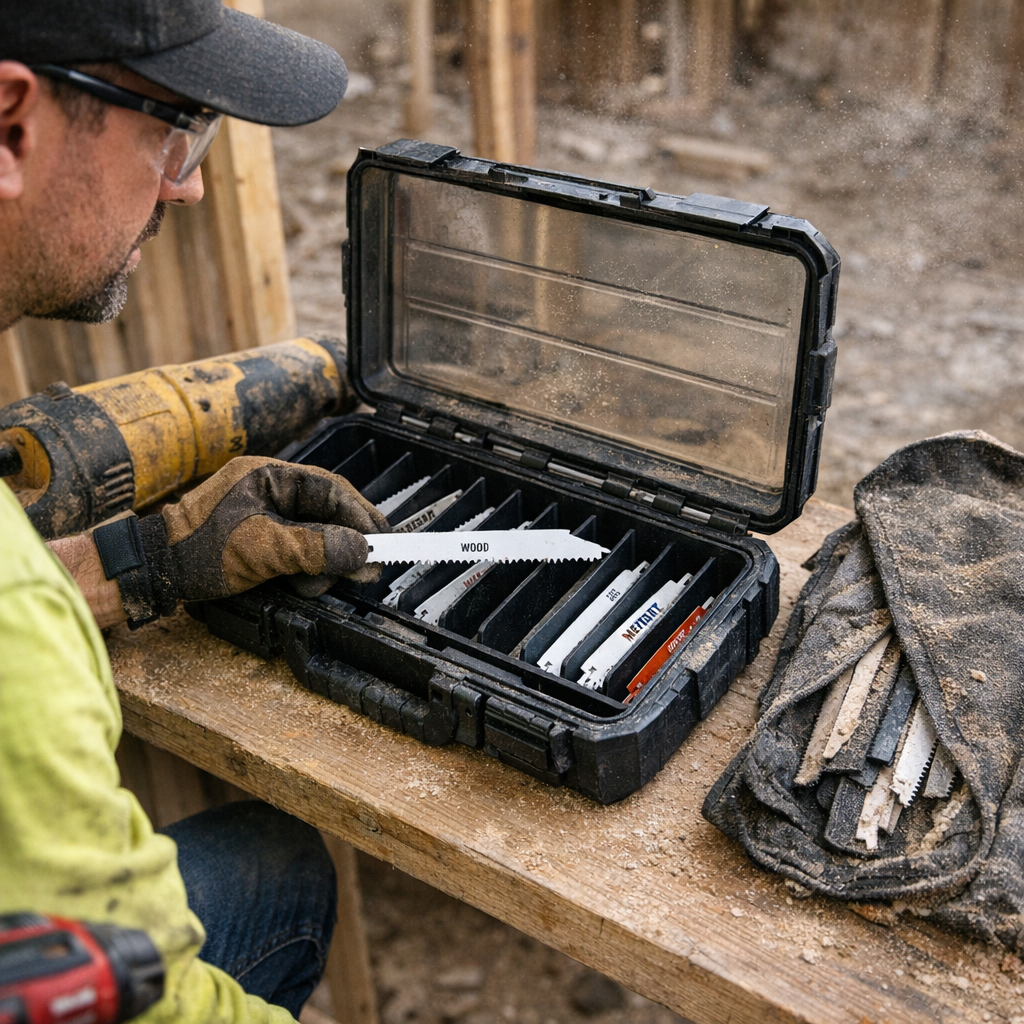
    A rigid, compartmentalized hard case isn’t flashy, but the difference is immediate if you pay attention to your workflow. Slots keep blades apart: no tooth-on-tooth grinding, no dust caked into edges, no mystery dullness halfway through a job.

    Imagine the riot of a busy day—dust swirling, hands already tired, and deadlines closing in. Grab a blade from a fabric pouch and you’re often scraping off residue before you even line up the saw. That nagging burnt smell on the first stroke? The blade picked it up in your storage, not your cut. Seconds slip by as you wipe and fidget, the line wavers, and tool control just isn’t crisp. Now try pulling a blade from a hard case: it’s cleaner, edges bite instantly, and you’re pushing through with no stall or ragged pull. The job doesn’t just speed up—you end it with less rework, less frustration, and cuts that look intentional, not salvaged.

    Measured: What You Actually Gain With Better Storage

    If you stack up real numbers, the gap widens. Side-by-side on mixed material runs—studs, PVC, composite—blades from slotted cases kept their cut quality for twice as many swaps. After two dozen cuts, those blades still worked sharp, while sleeve-stored blades started dragging after barely half as many uses. That’s the difference between swapping out for a fresh blade every hour or risking rough seams and extra sanding by day’s end. The time saved isn’t just in the cutting—it’s the headache you skip from not having to fix and fuss every few boards.

    Daily Storage Friction: Where It Adds Up

    No jobsite operates in a vacuum. There’s always drywall in the air, a battery recharge to track, and someone else’s debris settling wherever you stow your gear. “Just toss it in” makes sense—until repeated effort creeps in. Each pause to wipe a blade, each time you lose your grip on a sticky handle, every offcut that veers—blade storage is right behind those moments.

    These aren’t one-offs—they’re the rhythm of the workday. Reach for a blade and get a face full of grime. Pull out what you think is a sharp edge and find yourself babysitting the saw, nudging it slowly rather than letting the tool do the work. Even a few lost seconds or a single crooked plunge eats away at your pace and your patience.

    Controlling Cut Quality Without Overcomplicating

    Sort Blades By Life—And See the Difference Instantly

    A slotted hard case doesn’t just keep things cleaner—it builds in a workflow advantage. Fresh blades go in one row, retired ones in another. One glance, and you know what you’re working with. No confusion, no unplanned “test cuts” to check for sharpness. It’s a system that eliminates guesswork, so you don’t have to relive the frustration of realizing too late that you swapped in a spent blade in the middle of a crucial cut.

    The Small Switch That Pays for Itself Fast

    If blade swaps are rare, the payoff might seem minor. But in the middle of stacked routines—three projects at once, tools getting handed off, debris clouding everything—a hard case is a shift that locks in more performance than almost any new accessory. Your blades last. Your lines stay straight. And you quit wasting time bringing subpar cuts up to standard by hand.

    Details That Compound—And Matter Most When Time Is Tight

    The deeper you get into hands-on work, the clearer it is: the smallest changes aren’t just “nice to have”—they’re often what keeps entire projects moving. Saw blade storage isn’t glamorous. But neither is having to resaw or re-sand everything after a marathon cut session. Every hour lost to dull edges or unpredictable tool behavior is time—and money—down the chute.

    Switching to a better storage system won’t show up in your highlight reel, but it’s one of those “invisible upgrades” you feel at the end of the day: less fatigue, sharper control, fewer surprises. Small discipline at the bench or truck means cleaner work, faster turnarounds, and less second-guessing when it counts.

    See practical blade storage and workshop solutions at Gumboll.

  • How One Small Change Simplified My Daily Pet Care Routine

    Daily pet care rarely collapses from one major mistake—it wears you down with dozens of routine chokepoints that pile up in plain sight. A setup that seems fine in the morning turns clumsy by lunch: reaching for a water bowl wedged behind a bag, doubling back to fetch a refill bottle left in another room, hunting down the missing towel you meant to keep near the feeding spot. Every step looks simple on its own, but each small disruption adds more friction until the entire day feels scrambled by repeat detours. Left unchecked, these everyday interruptions turn the supposed basics—feed, water, quick clean—into recurring stutters that pull attention from everything else.

    When Small Steps Keep Interrupting the Day

    Picture a typical friction point: your dog’s water bowl sits by the kitchen entrance, but the top-up jug waits across the hall in the laundry. The urgency is low, so the extra movement becomes background noise. But each time you pause your work, walk the length of the house, and dodge yesterday’s laundry or your cat sprawled in the path, a ten-second refill becomes a mini obstacle course. The true cost isn’t the chore itself but the repeated micro-delays: lost momentum, tasks left half-done, the sense of the routine dragging at your afternoon.

    Then comes the quick sweep-up after feeding, only to discover the hand broom isn’t where you left it—it migrated to the entry during last night’s muddy-paw scramble. With the tool out of reach, stray hair drifts under cabinets or scatters from rushed “next time” promises, forcing extra cleanup passes just to get back to baseline.

    Basic Supplies: There, but Never Right When Needed

    Having the right tools but never at hand is a hidden drag on daily care. Cabinets and bins look organized for guests, but when cleanup means unstacking a food bag to grab a towel or squeezing your hand past other supplies just to get a wipe, fast resets stall. Instead of a quick towel for a water ring, you’re kneeling on a damp floor fishing through secondary storage—meanwhile, the spill seeps under the cabinets or into walkways.

    Even well-placed items can undermine themselves: a feeding mat that keeps splashes in check is less helpful if the bowl slides under a lip or drifts behind a table. Now, the contained mess hides inconveniently, meaning you’ll miss a spill or have to reach further later, turning a supposed fix into just another item to manage.

    How Placement Shapes Pet Care—Function Over Appearance

    Clean setups aren’t always functional. Hooks for leashes by the door mean after-walk gear is accessible, but if the wipes for muddy paws sit in the bathroom, you’re tracking grime farther inside for cleanup. Half the care flow is simplified, but the other half adds extra steps, undercutting the intent of the system.

    “Temporary” placements—grooming brushes on a window ledge, food scoops lost on a counter, wipes abandoned by the stairs—become repeat barriers. Every return to these items requires a fresh reset, and background clutter quietly spreads while you juggle other tasks. Resetting once never means reset for the day.

    Patterns That Quietly Slow Down Your Flow

    Over days, one pattern emerges: certain items always missing at the wrong time, or the same spot requiring double work. The water bowl runs empty before noon—again—because the refill bottle lives a room away. The brush for a quick fur sweep spends more time in the hallway than near feeding. You find yourself stepping over the same towel or detouring around a tangle of toys, all because there’s no stable, in-place “home” for resets.

    These friction points stay invisible in an area that looks tidy—or freshly “organized” for visitors—but a single recurring weak spot (bottle too far, towel never close, brush missing yet again) keeps the whole care process off-balance. Cleanup gets delayed; wipe-downs happen late or not at all; the space never quite stays as clear as it should.

    Simple Placement Changes, Real-Life Results

    Changing the location of a single supply—parking the water refill bottle next to the bowl or mounting a cleaning towel on a hook by the feeding mat—breaks the repeat-delay loop. Now a refill is a three-second detour, not a housewide shuffle. Water gets wiped before it spreads, not when it’s already soaked the path. Cleanup tools stored exactly where the mess appears turn resets into a single-step habit, instead of another pileup of extra movement and half-done fixes.

    After feeding, you sweep up crumbs because the broom lives within reach—not in another room, not under something else. When supplies match the real flow of care, you don’t leave routines “almost finished.” Instead, the area is actually in reset condition, genuinely ready for the next round rather than stuck in endless catch-up.

    Care That Feels Finished, Not On-Repeat

    The underlying gain isn’t the time “saved” on a chore—it’s freeing the entire daily flow from repetitive drag. When care steps are handled once, not revisited due to missing or misplaced basics, those routines stop interrupting your day. You’re no longer derailed by hunting for a brush or reacting late to a hidden spill. Pets get what they need, you keep your momentum, and the background effort required to maintain order finally drops.

    The line between surfaces that look managed and routines that actually run smooth? It starts with setups that keep every basic in true reach—not just “nearby,” but unmistakably ready mid-flow. Shifting placements to fit real-world usage—not just storage for show—cuts down the hidden friction that accumulates when ordinary pet care drags on repeat. Small changes matter most before the routine grinds, not after. Care stays on schedule, and every part of the job gets done—without the day’s pace being held hostage by misplaced gear or half-finished resets.

    For practical ways to simplify your setup, visit calmpetsupply.myshopify.com.

  • How Outdoor Storage Systems Can Adapt to Real-Life Yard Use Patterns

    When outdoor storage can’t keep pace with your real routine, it’s not subtle—it’s everywhere you look. You set up bins or wall racks with good intentions, but within a few weeks, the supposed order starts breaking down. Garden trowels wedge themselves along the footpath; half-deflated soccer balls and garden gloves end up stranded right by the patio door; every “quick return” turns into a small, silent argument with a pile you already dealt with. In the controlled mess of real outdoor use, things drift, pile, and double back—exposing the difference between setups that only look tidy and those that actually make moving through the space easier.

    The Creep Problem: When Storage Designs Fight the Way You Move

    Every backyard, side yard, or patio is an experiment in whether a storage zone can survive real habits. On day one, the fresh wall rack or lidded bench seems to answer every problem. Fast forward a few weekends: is your “solution” quietly jamming the return path or turning drop-offs into mini obstacle courses?

    Here’s where the friction sets in—the places design misses reality. A bin next to the fence looks convenient until you’re elbow-deep, hunting for a trowel buried under discarded dog toys. Hanging hooks along the walkway keep tools visible, but once the jackets and hoses take them over, you’re unhooking half the row just to free a garden fork. Suddenly, storage designed for efficiency is creating its own resistance, and resets slow down after every round of use.

    Wall Storage: Clear Floors, New Headaches

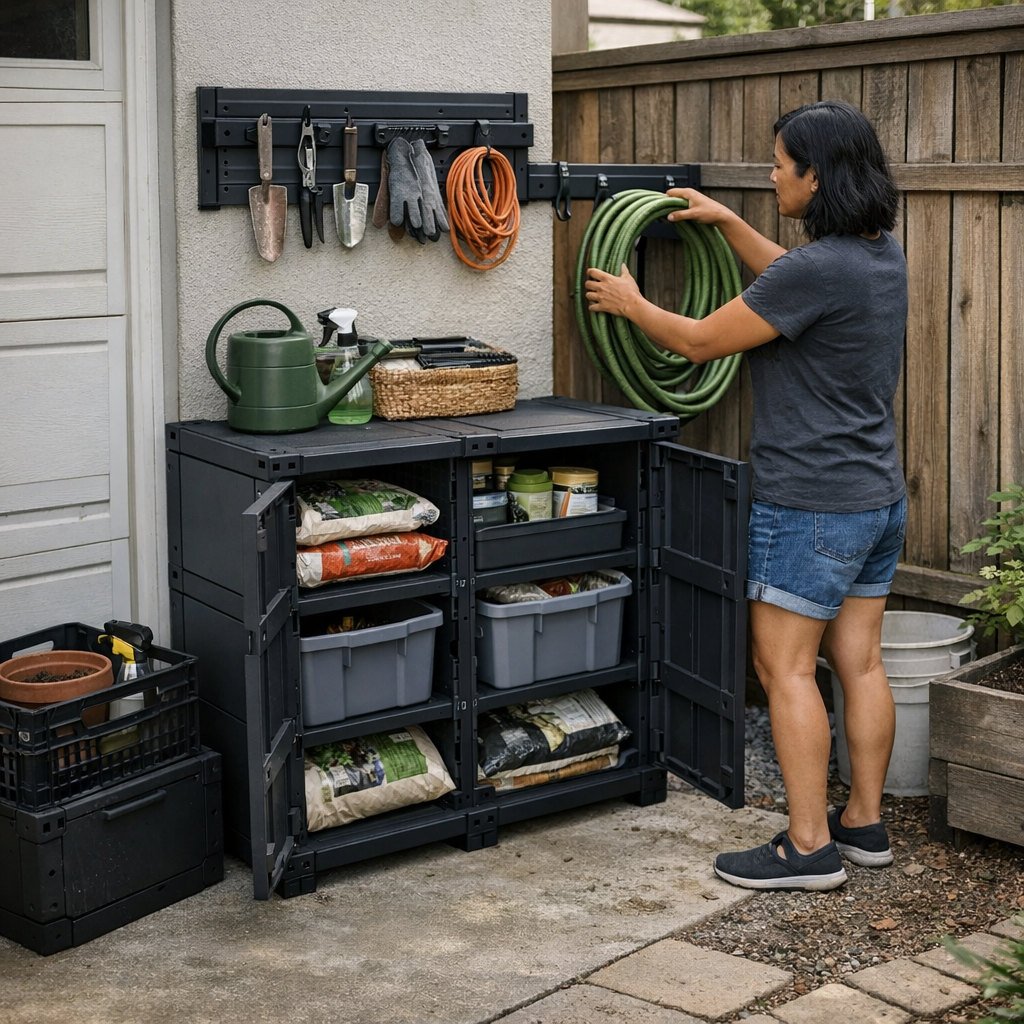
    Wall systems promise open floors and easy access. For the first few weeks, there’s a satisfying stretch of clear concrete and tools lining up in full view. But it’s rarely that simple. Racks spaced with optimism become a game of shuffling brooms, rakes, and loppers just to hang up one more tool after mowing. Narrow shelves display spray bottles while heavier gear—bags of soil, bulkier hoses—creep onto the ground anyway, forming a new, unplanned pile beneath the “organized” wall.

    Family members improvise; “designated” hooks lose their meaning. The return routine stalls: stowing a single cord or trowel becomes a juggling act when the wall’s already at capacity. If putting something away takes too long, it gets abandoned mid-reset—and the clear walkway degenerates into a maze of obstacles.

    The Trap of Closed Storage: Clean Outside, Chaos Inside

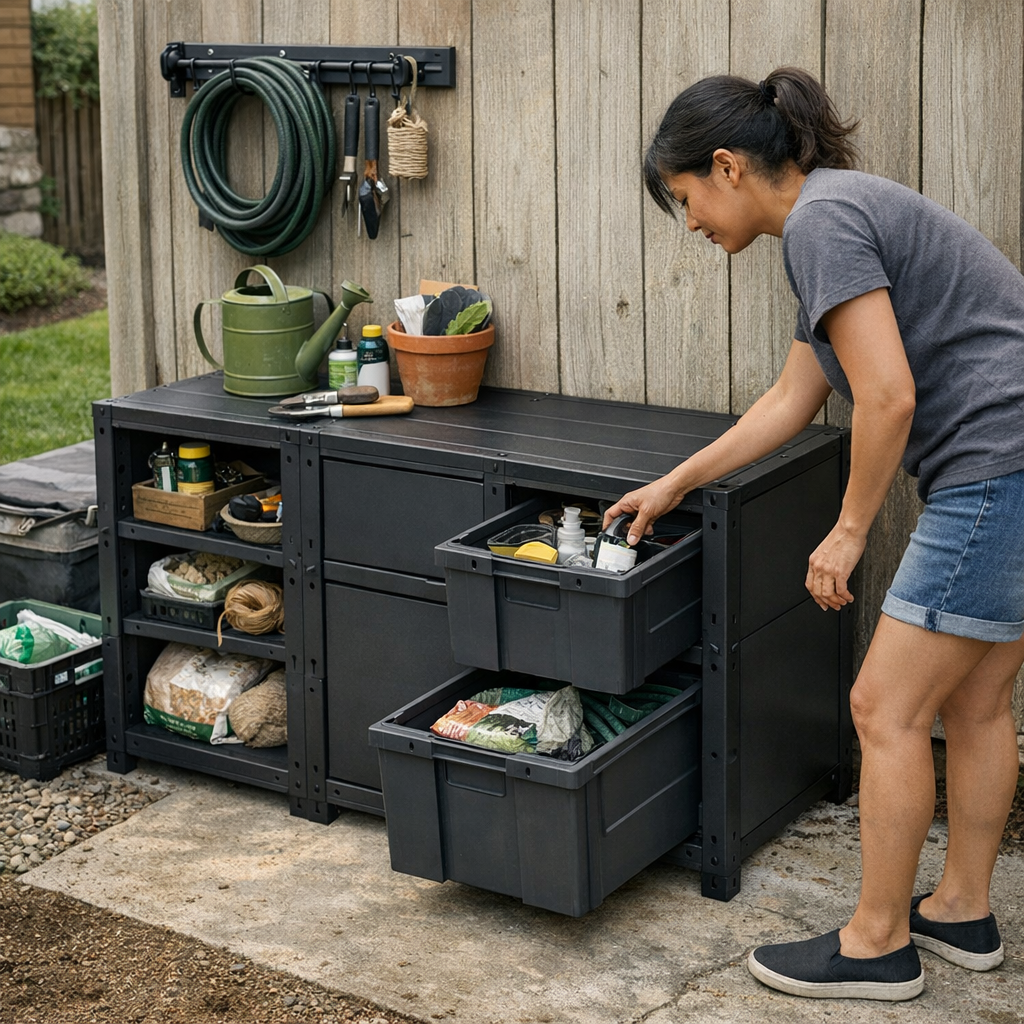
    Closed benches and modular storage units look like a win: clutter disappears with the swing of a lid. But inside, entropy rules. Certain slots overflow while others never fill, and one awkwardly shaped watering can means everything else gets dumped on top—masking, not solving, the actual mess. Every reset becomes a blind rummage, making you dig through cords, gloves, and broken tools just to find the one thing you need.

    The tension is clear: wall systems demand relentless tidiness, while closed bins swallow clutter at the cost of access. If the setup doesn’t match your natural return flow, neither holds up for long. Soon enough, piles re-form near gates and doorways, and each reset brings the familiar dance of stepping over spillover—no matter how much storage is on paper.

    Setup Under Pressure: Life in the Side Yard Corridor

    If you want to see a storage system’s fault lines, look at a cramped side yard that pulls double duty. In a 48-inch-wide passage, a wall rack offers a fresh start—rakes and hoses neatly hung, footpath open. But the first muddy boots or armful of sports gear throws off the balance. Hooks are just out of reach, bins are one step too far from where you enter, and suddenly the overflow gathers by the gate. That tidy bench at the far end? It attracts all the gloves and loose parts everyone is too impatient to walk across for.

    Now you’re shuffling bins just to fit the mower through, shifting sports balls to clear the path for the garbage cans, or pausing to relocate a planter box that always migrates to the footpath. The storage “solution” introduces new choke points at exactly the moment you need the space to work fast. Just moving one tool back means first clearing a detour you didn’t plan on—and day by day, the zone gets tighter, not looser.

    Overflow, Backlogs, and Slower Resets

    This is not a rare breakdown. One return brings a bulk bag of compost, but last week’s planter buckets are already blocking the storage corner. A coiled hose should hang on the wall, but the hooks are buried under jackets and extension cords, so it loops onto the ground, creating another tripping hazard. Want your trowel? Get ready to pull half the contents out of a deep bin while balancing on a stepping stone.

    Every time, it’s a micro-delay, a minor shuffle, a footwork adjustment—until the whole area signals that the layout fits in theory but not how you actually use it day to day.

    Small Shifts That Break the Cycle

    The difference-maker rarely comes from buying bigger bins or more hooks. It’s about small, practical shifts—matching the layout to your real path and sequence. In one side yard, simply swapping two shallow storage bins for a single deeper, covered unit chipped away at the perpetual overflow on the ground. But the breakthrough was moving a row of shoulder-high hooks right beside the entry point—no more reaching, no bending, just one flick of the wrist to drop gear as you come in.

    Clearing the main aisle didn’t mean less stuff got stored—it meant the stuff that came back most often had frictionless access, while overflow just couldn’t pile up without someone noticing. The system had a built-in brake: too many things on the hooks forced a rethink, not another pile by the footpath. Resets sped up. Blocked paths opened without drama. The storage finally started to pay back the space, instead of competing with it.

    Force Zone Limits—Not Overflow

    Here’s the simplest shift: don’t let any zone become a catch-all. Bins too deep or hooks too high become graveyards for rarely used stuff and drop-off points for anything you can’t be bothered to store properly. Instead, tailor the zone. Put high-touch items at elbow-level and in arm’s reach. Mark one hook as always clear and enforce it. Set up a shallow tray for gloves, pruners, or tennis balls—stuff that enters and exits daily—so nothing has to move three things just to add one more.

    Don’t wait for a space to get “full” before you rethink the setup. If the return path feels blocked or drop-offs are happening in the wrong spot, it’s time to shift the container, change the hook height, or slim down what stays outside.

    It Doesn’t Need to Be Perfect—Just Less in Your Way

    No outdoor system will send every stray glove or hose into perfect lines. The win is visible: faster resets, fewer detours, and a flow that works after a typical, messy afternoon. Storage that matches the real rhythm of your returns—whether in a tight side yard, along the garage, or at the edge of your backyard—makes the difference between feeling organized and actually moving through your day without repeat friction. The goal isn’t showroom order. It’s getting out the door, or back from the garden, with less to dodge every time.

    Explore practical outdoor storage options at TidyYard