Stashing the litter box out of sight usually means signing up for a harder cleanup routine. It’s quick to slide the tray under a shelf or cram it behind stacked bins just to keep the mess out of view, but that surface neatness collapses fast. The first sign isn’t strong odor—it’s trying to scoop from a cramped corner, finding a broom blocked by chairs, or squeezing a dustpan through bags you’ve meant to move all week. Out-of-sight becomes out-of-reach, and what started as a discreet solution turns every day into awkward workarounds just to keep an indoor-cat routine running.
Why Hiding the Litter Box Usually Backfires
It looks solved at first—those stashed setups behind cabinets, lined up next to baskets, or pinned beside seldom-used shoes. But the tradeoff hits back with every use. Picture the actual cycle: scooping means ducking under a table, bending your wrist around a bin, or shuffling household clutter out of your path before you can even reach the pan. Cleanup supplies migrate: not where you need them, but wherever there’s space left to stash them. What you gain in a calm sightline, you lose in constant detours, arms stretched at the wrong angle, and the slow creep of litter tracing up runners and baseboards. Even the best hiding spots don’t stay unseen—the evidence always tracks elsewhere.
What Actually Happens During Repeated Use?
Within days, the “tucked away” setup starts demanding more time than one in plain view. You handle a crusted trail behind a wobbly mat, spot a ridge of litter dust against trim, or notice your sweeping never reaches into that boxed-off nook. Instead of one reset, you repeat small fixes: nudging bins, extracting supplies buried behind storage, finessing scoops around side-table legs, lifting mats that never lie straight. The cost is daily: every pass becomes a double pass, every sweep is partial, and the routine builds up annoyances with nowhere else to hide.
The invisible “neatness” becomes the most obvious friction in your cleaning pattern—the price of keeping the box hidden is a cycle of small failures and delays.
Easy-to-Clean Zones Change the Day-to-Day Flow
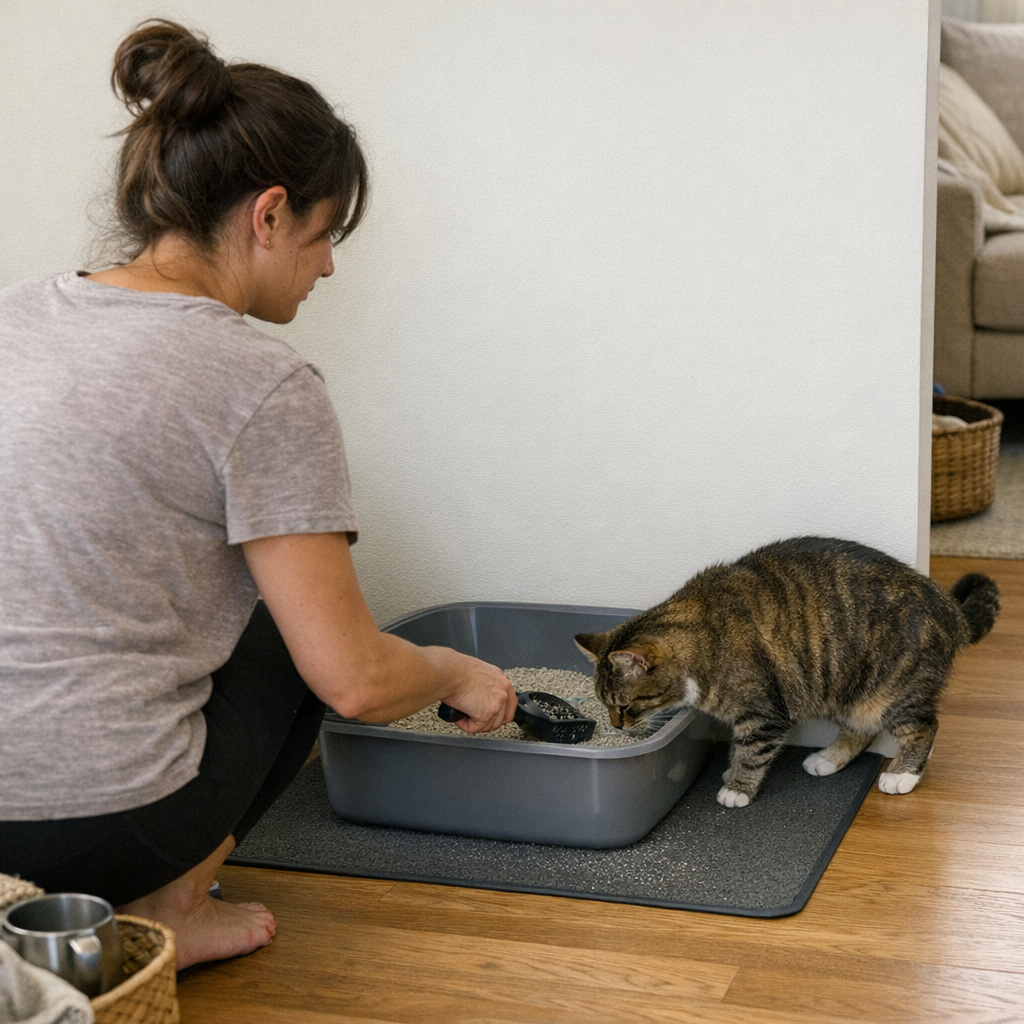
A setup built for access, not disguise, cuts the mess and the hassle at the same time. Slotting the litter box on continuous hard flooring with no furniture tight to the sides turns resets into single-step tasks. No wedged corners, no wriggling past obstacles, and granules actually stay where you want them—on a mat you can lift in one go or on flooring you can sweep clear without detours. Cleanup shifts from a chore you want to skip to a routine you barely notice.
How Open Placement Lowers the Reset Burden
- Sweeping is straightforward. No blocked passes, no skirting table legs—just clear floor and quick coverage.
- Both sides open—no more blind scooping. You can see, reach, and clean every corner instead of guessing or contorting.
- Debris stops spreading. Hard floors let you remove every trace—no bits packed into rug seams, no dust trapped between bins.
- The cycle becomes routine. Each reset fits into the day, not as a production but as a barely-noticed maintenance step.
The difference shows up quickly: after a few resets, missed mess almost disappears. The tradeoff—plain visibility for lower effort—unlocks time and prevents the kind of micro-messes that quietly multiply in hidden corners.
The Mistake of “Low Traffic” but Hard-to-Clean Nooks
Choosing low-traffic doesn’t always mean choosing easy-living. Squeezing the litter zone under a lamp, behind baskets, or beside deep shelving just replaces foot traffic with maintenance headaches. The dust doesn’t vanish—granules wedge under rugs, clinging unpredictably until you finally move everything for a proper clean. Out-of-the-way setups promise less disruption, but always collect hidden work you can’t ignore forever. Revealing the box was never the real problem; it was turning resets into minor construction projects.
When Does a Tidy-Looking Spot Make Life Harder?
It’s the repeated scrambles that mark a bad zone. Place a box near the closet, and stray litter clings to shoes and slaps against bags at every exit. Hide it behind a table, and every cleaning means a two-step: first a failed sweep, then fetching supplies you couldn’t leave nearby. Over a normal week, the toll piles up:
- Residue bunches up beneath edges, then resists quick removal—out of sight, but never gone.
- Blocked corners and odd angles stall sweeping—hand vacs become a requirement, not a backup.
- Mats curl, liners drift; every touch from a cat’s paw pushes mess into the seams rather than catching it on the surface.
A tidy look is a short-term win; the practical loss is all overhead. The more you shield the box from view, the more its weak points break your normal rhythm.
Shared Spaces & The Hallway Trap
Grabbing unused corners, sidewalls, or empty hallway ends can seem like smart territory—just distant enough, just subtle enough. But these are pathways, not destinations. Every time your cat walks out, grit skips the mat, joins the high-traffic run, and tracks dust up and down the main artery of your home. Mat edges clog with gray, and within days, every sweep starts from urgency but ends halfway—the mess just re-circulates with every step, never fully gone.
When Maintenance Outpaces the Mess
Even new paint and daily sweeping can’t keep up: stray litter clings to baseboards, lands in the cracks under doors, and mixes with other daily debris before you realize what’s leaked from the box. What felt orderly quickly turns into another cleaning loop—one that’s stitched into the space you move through constantly, not contained in a single part of the room.
Setting Up for Practicality—A Real-World Example
Not every home can spare a perfect nook, but a “good enough” adjustment will show visible results. The single change that cleared the biggest hurdle was moving the litter box to an open, blank wall section with hard flooring—no shelves, no mats curling into odd spaces, nothing crowding the sides. The mat pressed flat along the baseboard; shaking it out or sweeping the area took less than a minute. The improvement wasn’t about the look, but about eliminating the maze: no more dreading resets, fewer missed crumbs, and every cleaning was direct. Instead of patching up mess all day, routines ran smoothly—no more lost time doubling back for what the discreet spot failed to catch.
How to Select a Smarter Litter Box Zone
Effective zones match indoor cat routines with what you can actually reach and reset, not just what looks clean at a glance:
- Favor hard, unbroken flooring: tile, sealed wood, or laminate let you finish sweeping in a single pass and stop bits from hiding under seams.
- Leave room to work both sides. Full access for both hands means every cleaning goes faster, with less awkward bending or missed edges.
- Mind invisible blockades. If shelving, baskets, or doors clip the area, every sweep or scoop is a work-around, not a reset.
- Accept visibility for easier living. A visible box and mat are often a low price for a smoother routine—mess can’t accumulate where you can see and reach it every time.
Especially in tight apartments, prefer a box that’s “barely” visible but straightforward to handle over one no guest can spot—your future self will notice the lower burden. A mat cut flush to box width, no unnecessary layers, means nothing to un-bunch or re-align every day.
The Hidden Reality: Looks Are Cheating, Performance Matters
The right setup isn’t about making invisible lines—but making fewer obstacles between you and a normal day. An accessible box pays back: less micro-cleanup, lighter resets, and no more hidden crises under the rug. Durable routines start when every step is effortless, not when the box can’t be seen.
Managing the Cat’s Adjustment to a New Spot
Cats rarely get attached to the exact nook—what matters is calm, steady access and a surface that feels clean underfoot. If you’re shifting zones, bring along a familiar mat, let some scent remain, and expect only a brief, cautious check from your cat before they settle in. The surprising part: with less mess around the box and easier entry, most cats adapt before you do. Their preference for easy-in, easy-out matches yours for less frequent, less stressful resets.
Long-Term Wins—Where the Routine Stops Dragging
A solid litter box placement isn’t about today’s sweep or a fleeting tidy look—it’s about smoothing the rough edge from every future cycle. As friction drops, so does the mental