Author: jaesoon_admin

  • How Closed-Door Cabinets Reduce Clutter but Hide Hidden Storage Challenges

    Closed-door storage cabinets promise instant relief from visible clutter—but that sense of order is often an illusion that unravels under repeated, real-world use. Shut the doors on a kitchen mess or a hallway scramble, and surfaces snap back to calm. But the hidden friction doesn’t vanish; it shifts behind the panels, where every rushed search or missed category quietly strains your routine. In everyday zones like busy entryways, overstuffed kitchens, or shared family corners, the difference between looking organized and actually functioning well shows up fast: misfiled shoes block umbrellas, bread bins crowd out lunchboxes, and what appears “tidy” keeps disrupting the flow you need most.

    When Calm Surfaces Hide Everyday Friction

    The urge to “just close the door on it” runs strongest in the areas hit hardest by daily drop-offs—entryways thick with shifting piles, kitchens where small appliances and bags have no single home. From the outside, closed cabinets flatten the chaos, especially in tight apartments where any exposed item feels like clutter multiplying. But inside, closed storage turns new issues loose: blind zones, slow retrieval, and the quiet buildup of items nudging out of place. The cost isn’t just cosmetic—it’s measured in lost steps and interrupted escapes, like having to dig for a jacket buried behind grocery overflow, or scavenging beneath shoe piles for a charger you swore you returned yesterday.

    Picture the classic family entry zone: jackets and shoes tucked behind slim doors, backpacks upright—briefly. Real use blows past the initial system. Shoes drift sideways, mail clogs the path, one mitten slides behind gym bags and instantly blocks everything else. “Organized” at a glance means little when you’re already late and the cabinet demands a full search just to get out the door. Each closed-door rescue is paid back with extra reshuffling later, often making the next reset more exhausting than the mess you tried to avoid.

    Why Hidden Storage Can Slow You Down

    Closed cabinets exist to clear the view, but they do it by hiding movement and overflow signals you’d spot right away on open shelves or hooks. With doors in the way, category drift creeps forward—jackets on shoe space, gloves blending with shopping bags—until even the basics get lost in the shuffle. Overflow builds because you don’t see it until something jams. Retrieval turns slow and indirect: you open one cabinet for bags, then have to cross back to search another for a missing hat, all because the divided zones inside blur and blend until there’s no real shortcut left.

    You trade visible mess for hidden disorder: peaceful fronts, but insides wired for accidental sprawl. Shared or high-traffic spaces multiply these invisible costs. One person’s quick drop-off blocks another’s path; a guest jams in a new bag and the entire shelf buckles. With everything out of sight, minor buildup goes unchecked, and full resets become longer, rarer, and more dreaded. You don’t just lose items—you lose rhythm, with each blocked grab or awkward shuffle accumulating into daily friction.

    The Surprising Cost of “It Looks Tidy”

    Line a wall with closed cabinets and watch the illusion of control set in—until a normal routine “sticks” at the worst moment. The first hint is often a hiccup: reaching twice for the same lunch container, detouring around an overfilled section, or pulling open three doors just to get at what floated to the back. These movement bottlenecks slow everything down, especially where speed and repetition matter—entryways, kitchens, and mixed-use halls that need to clear daily volume, not just hide it.

    Overflow and Category Drift: The Invisible Enemies

    Open a closed cabinet a week after a big tidy, and the cracks show. One shelf is suddenly jammed, another hosts a jumble of oddball objects, and categories merge with no clear boundary. In pantries, pasta blends with gadgets; in hallway cabinets, scarves push shoes into blind corners. Moment of recognition: open the door expecting easy access, and hit a compressed tower of unrelated things—a mixed layer you need to pull apart, with each reach risking collapse or total reshuffling.

    The longer category drift and overflow go unchecked, the heavier the penalty: what should be a five-second grab turns into a full redo that kills momentum and morale. Instead of a quick shelf adjustment, you’re hauling everything out—vacuum, hiking boots, abandoned mail—just to restore basic function. For many households, that threshold is never met; items linger in the wrong spot for months, until even looking for them feels like a chore.

    Shared Spaces: When One Person’s Drop-Off Blocks Everyone Else

    Multi-user zones—front halls, shared closets, family bath cabinets—are especially susceptible to hidden drift. A gym bag lands, then groceries, then school supplies; the door closes but inside, categories compress. With walls hiding it, blending grows uninterrupted: cords tangle with gloves, boots swallow shelf space meant for towels, and one person’s “just for now” becomes a weeks-long block for everyone else. Unlike open organizers, where category creep is visible and little issues get fixed in passing, closed-storage slip-ups linger until someone finally empties and resets the whole system. Not surprisingly, that task slides down the priority list for as long as possible.

    What Actually Makes Cabinets Work: Internal Dividers and Bins

    Visual order on the outside doesn’t fix chaos on the inside—only structure does. The most powerful change? Breaking up closed cabinet space with removable bins and real boundaries. Dividers make insides use-specific: a shoe bin for five pairs flags crowding instantly, while a labeled tote for cleaning gear prevents lost mail or stacked coats from vanishing into the mix. Instead of having to dig across everything, search and resets stay sharply focused. When buildup happens, you fix the one zone that’s slipping, not the entire cabinet wall.

    Add defined zones, and closed storage moves from blind spot to early warning system: categories stay in their lanes, overflow gets caught while it’s still small, and resets shrink from half-day projects to matter-of-fact tweaks. Instead of dreading the next overhaul, you spot issues as they emerge—handling exceptions in real time, not letting them spiral until they undermine the whole setup.

    Tip: Choose Container Sizes That Fit Your Routine, Not Just the Shelf

    Bin size dictates system stability. Too big, and the boundaries disappear—everything gets lumped together, making resets grueling. Too small, and every load triggers overflow, annoying everyone involved. Match your bin or divider to the amount and access rhythm of each real-life category: lunchboxes one layer deep so nothing gets buried, cleaning bottles in a single, easy-out tote. Slide-out trays for tools instead of stacking multiple boxes where the bottom is never reached. The right container makes retrieval automatic and return flows reliable—avoiding the slow creep that sabotages the whole wall.

    Making Closed Storage an Ally, Not a Source of Hidden Stress

    Closed cabinets earn their spot in spaces overloaded by volume or visual noise—provided the inside matches your use. Their core weakness plays out over time: slow retrieval, blocked access, creeping resets, and hidden mess that turns up only when your routine already feels strained. Real relief doesn’t come from closing more doors, but from separating zones inside and catching drift before it cascades.

    If you’re trapped in repeat reshuffles or delayed resets, the solution isn’t just “more cabinets”—it’s a smarter, more visible structure inside the space you already have. When each category has a defined home and movement stays unblocked, closed storage supports the speed and flow real rooms demand—not just the look. That’s the shift from looking tidy to functioning fluently, especially in the rooms that test your storage the most.

    Visit Gridry for modular storage solutions that adapt to real-life use.
  • Why Fixed Storage Roles Outperform Flexible Systems in Busy Workshops

    Every new garage or workshop setup feels full of potential: bins neatly mounted, pegboards bristling with promise, carts gliding smoothly into empty corners. For a brief stretch, the whole area looks engineered for speed and efficiency. But then real work starts—pulling a few tools, stashing supplies in a rush, reaching for the cart you rolled aside last night. Almost overnight, that “modular flexibility” turns sideways. Quick grabs turn into mini scavenger hunts. Carts block the path you meant to keep clear. The system that looked right on day one quietly starts working against you when the pressure’s on and your hands are full.

    Where “Flexible” Turns Frustrating

    Walk into a freshly arranged space: open bins everywhere, a cart you can roll “wherever you need it,” peg hooks waiting to be reassigned. For a moment, it’s perfect. But stick around through a few project swaps, and the cracks appear. That mobile cart? Now wedged halfway across the room because you needed the work surface, blocking every pass to the other side. The bin for “miscellaneous” screws? Overflowing and stacked beneath a toolbox, impossible to sift through quickly. Every quick change or small reset means pausing, nudging, peeking, and second-guessing. The flexibility that sounded so empowering now soaks up your momentum in tiny, annoying ways.

    At the root of it all: When every slot and shelf is open to “whatever fits,” the mental load creeps up. Tools don’t flow naturally back to their homes—they just end up wherever’s easiest in the moment. You bend, detour, and hesitate—until a five-minute project leaves the space a little less sorted than before. The pattern keeps repeating: more time spent shuffling, less time actually working.

    Fixed Homes vs. Free-For-All: Where Real Use Draws the Line

    Flexible storage seems like the antidote to clutter. It promises adaptability, the power to change with your workflow. But spend a week in a garage or shop actually living with all that flexibility, and you start to see why it falls short when pressure mounts:

    • Overflow zones multiply. That empty shelf becomes a dumping ground for random fasteners, paint cans, or half-finished side projects. You lose sight of what’s intentional and what’s just “sitting there for now.”
    • Mobile pieces get in the way. The cart that started out neatly nested becomes a speed bump. Instead of freeing up space, it blocks the path between workbench and door.
    • The hunt extends. Favorite tools drift farther from their “usual” resting places after every session. You scan pegboards, move bins aside, crouch to check under the bench, all for one lost driver.

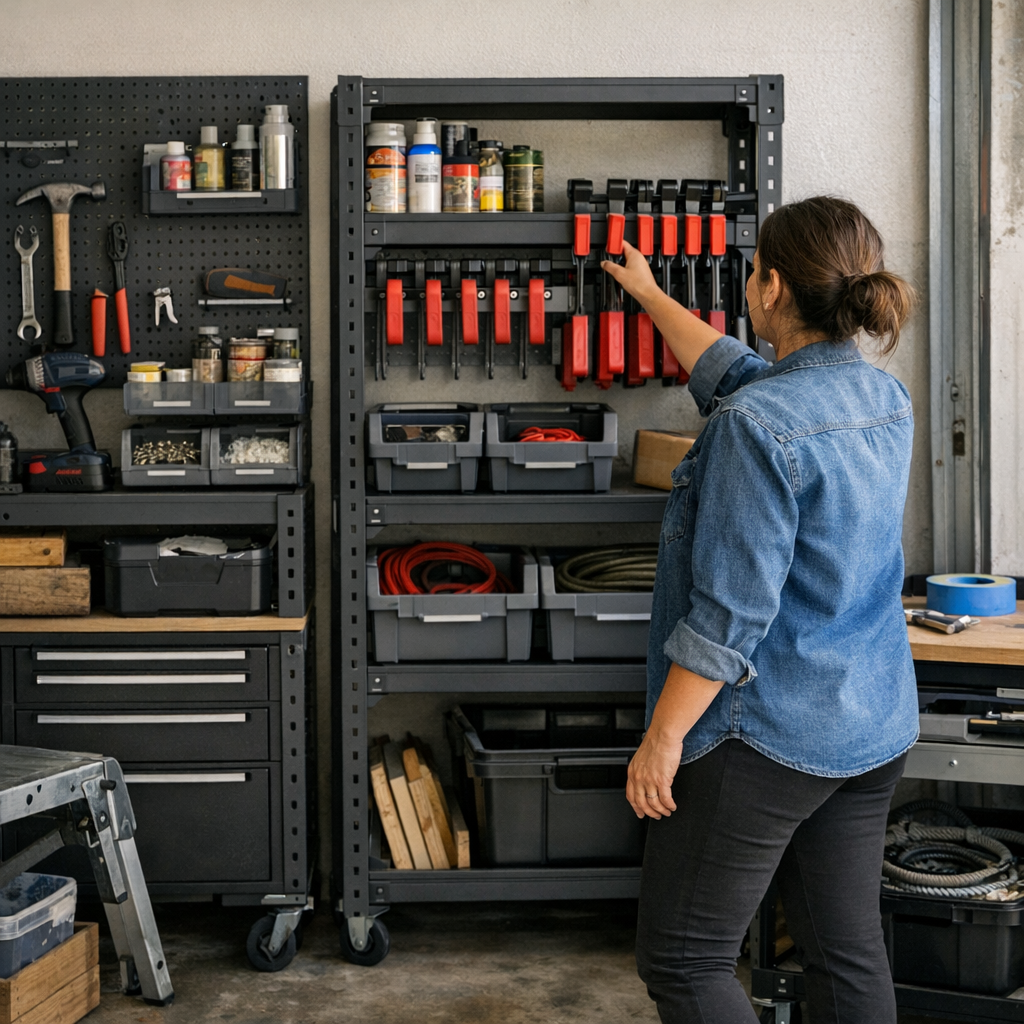
    Compare this to a fixed-role setup. Assign a wall rack—no exceptions—for drivers. Carve out a shelf labeled clamps, and never let anything else creep onto it. Suddenly, every end-of-task reset is quick, almost automatic. Tools land exactly where they belong, so next time you reach, they’re already within arm’s distance. Your workspace returns to “ready” with nothing to untangle or explain.

    Looking Organized vs. Working Smoothly

    This is the honest frustration: a garage can look orderly—bins lined up, hooks filled, no loose clutter in sight—but still work against you. Watch for a week and you’ll spot the cracks: a tape measure buried in a parts drawer, clamps scattered across three zones, the hardware bin absorbing loose washers, wire, and shims. Visual tidiness hides growing confusion, and every reset gets a little slower, a little less certain, as the lines between categories blur.

    Scene in Motion: The Anatomy of Setup Drift

    Imagine a real workbench routine: you’re sanding a frame, fixing an outdoor chair, sorting hardware for a quick fence repair—all in the same week. By Friday, the shelf for abrasives is half-filled with glue bottles. That dedicated spot for pliers now hosts a soldering iron. The rolling cart—meant to follow you—sits stuck by the back door, blocking the path because you wanted it “out of the way” yesterday. Overflow stacks up on the edges, brushes drift to the floor, and every time you reset, you have to scan the whole wall just to find the basics.

    This isn’t messy—yet—but it’s slow, awkward, and full of little workarounds. Each misplaced item means a pause, a rethink, or a detour. Over a month, it steals hours. More often, it chips away at your willingness to start a new project—who wants to spend fifteen minutes reshuffling just to clear a spot?

    Assigning Roles: Small Shifts, Real Relief

    The breakthrough often comes with a tiny change: labels on shelves, one definite hook per tool group, a strict “clamps go here, nothing else” rule. In real use, these fixed markers do what flexibility never can—reset routines turn mindless, tools flow predictably, and overflow stops collecting where it shouldn’t. Even after a flurry of repairs or a long build, clamps end up on their own shelf. Drills hang right back on the pegboard, no questions. There’s no guessing, no scanning the whole space—just a smooth, fast return before you head out the door.

    You haven’t added square footage. You haven’t covered every inch of wall. But the system works better, because your usual movements—grab, use, return—actually fit the setup instead of fighting it.

    Spotting Friction Points: Signs Your System is Slipping

    Keep an eye on your own space for a few days. Odds are you’ll spot these problem zones:

    • Carts stranded awkwardly in passageways, moved just because it’s easier than rethinking where they belong
    • One shelf or wall nook quietly ballooning with overflow—paints, gloves, mystery hardware—all “just for now” but never truly reset
    • Every tool return forcing you to scan three surfaces instead of going straight to one spot
    • Dead corners where bins gather dust and nothing you need is ever close at hand

    Each one signals a system out of sync with your actual habits. The space looks logical when empty, but it slows you down, nudges you off balance, and builds up silent inefficiencies you feel with every pass through the shop.

    Fixed Where It Matters—Flexible Where It Doesn’t

    Here’s the secret rhythm of a space that stays truly usable: high-use tools—drills, drivers, clamps—get unchanging homes, always visible and always accessible. That saves not just seconds but energy, making resets fast and return flow nearly automatic. Meanwhile, seasonal or low-frequency items—odd hardware, paint trays, rags—can float in open bins or flexible drawers. You don’t need perfection, just the critical routines anchored down so nothing slows you when you’re mid-project.

    Quick experiment: Instead of remaking every inch, just pick your most-used tool group. Assign it a fixed, unmistakable home and watch a week’s worth of routines. Most of the “Where did I…?” moments disappear overnight—and so does the creeping frustration that chokes off momentum.

    The Hidden Power of Stable Roles

    It feels counterintuitive to lock in floor or wall space for dedicated tools when you crave adaptability. But dependable setups win in the long run: the system quietly boosts clarity, the awkward dead zones disappear, and every tool is right where you expect, every single time. The penalty for blurring roles is clear—more piles, more blocked paths, more head-scratching, and less actual building or fixing.

    The setups that last—year in, year out—aren’t just tidy on install day. They stay smooth because routines have priority. Your movements rule the layout, not the other way around. Fixed roles for your core tools preserve zone clarity, harness every square inch, and make expansion or reconfiguration painless instead of overwhelming. The best spaces mix security where it counts with flexibility where it’s earned—leaving you free to get to work, not get bogged down by reset after reset.

    You can explore tools and modular systems designed to solve these everyday setup problems at StackNest.

  • Why Closet Systems That Require Less Daily Management Work Best

    The promise of a freshly organized closet feels real—for about a week. You step back from perfectly aligned stacks and color-coded baskets, satisfied. But daily life doesn’t care about your before-and-after photo. Within days, routines chip away at the system: clothing piles slump, shoes invade new territory, and baskets quietly collect whatever needs hiding. You catch yourself managing the setup more than it manages you—small nudges, quick reshuffles, a dull sense that order is always slipping just out of reach.

    How Daily Habits Undermine Early Order

    Chaos doesn’t crash in; it seeps. The morning rush tells the story: socks nowhere near the “sock shelf,” a stray running shoe blocking your jeans, last night’s hoodie perched on a basket meant for scarves. Putting things back becomes a question mark. Stacks that started out distinct quietly merge. Instead of grabbing an item and moving on, you pause—just long enough to acknowledge another reset is coming soon.

    These aren’t dramatic messes, just small, steady inconveniences. Every time you hesitate, reshuffle, or leave something out “for now,” the situation compounds. A closet that worked in week one fades by week three, slowly competing with your habits instead of supporting them.

    The Real Cost of Everyday Retrievals

    Visualize the entryway: three bins, neatly labeled for hats, gloves, and scarves. Day one: everything in place. Fast-forward through a week of comings and goings, and suddenly gloves drift into the hat bin, scarves catch loose mail, and school shoes perch on top. Grabbing winter gear means fishing through a muddle, returning it means guessing where to toss it. Resetting the system isn’t quick anymore—it’s a chore you put off.

    Bedroom shelves tell a similar story. Shoes start in a neat row, jeans folded crisp in a single stack. By Wednesday, shoes creep in front of the jeans, socks land wherever there’s space, and folded piles start to tilt. A simple grab turns into shifting stacks and a quiet sigh. These micro-interruptions add up, turning “organized” into “just manageable.”

    Where Storage Falls Short in Real Life

    Shelves and Bins That Don’t Match Your Moves

    Some storage “solutions” do more harm than good. Shallow shelves make everything spill and tangle; deep shelves swallow whatever drops behind the first row, so you forget those items exist. Tall baskets swallow categories, making you dig for what you want, while low ones can’t contain even the basics. Stacked bins seem smart, but pulling out the bottom one unravels the pile above—so you avoid it, and mess builds up.

    What looks neat on the surface starts to blur in practice. “Shirts here, socks there” erodes into a dump zone by the end of the week. The system stays pretty for guests, but every grab takes thought and effort—a clear sign it isn’t right-sized for your daily motions.

    Category Creep and Wasted Vertical Space

    Lack of definition lets clutter bleed across boundaries. Shoes sprawl into bag space, stacks get taller and less stable, and accessories migrate wherever a gap appears. Shelves jammed too close together force dangerously wobbly piles—one tug and the whole stack tumbles. Those extra inches above hanging rods or beside shelves? Wasted, simply because nothing’s designed to use them. Over time, the system’s lines fade, with every misplaced item speeding up the breakdown.

    The Hidden Toll: Reset Exhaustion

    From the outside, your closet may look fine—but you know the real story. If you’re re-stacking shirts every laundry day, digging for missing gloves in a jumbled bin, or routinely pushing aside overflow “for now,” that’s maintenance, not organization. These small repairs sneak into your morning routine and quietly sap time and energy. When resets become regular labor, your setup is working against you.

    Real Fixes: Shaping Storage for Actual Use

    There’s no magic furniture piece—just a few sharper choices. Make single-step access your default. Instead of double-stacking jeans, run a longer single row, even if it means fewer per shelf. Divide oversized bins into a few shallow trays so you can see what’s inside instantly. Adjust shelf heights to break long piles into easy, visible lines. Every choice should speed up putting away and grabbing—not just keep everything hidden.

    Watch for the trouble spots. If a shelf always needs reordering, it’s probably too deep or lacking a divider. If a bin always goes from sorted to mixed, lower the sides or add a dead-simple label—just enough to jog your memory. Focus on making the actions you repeat daily—like returning shoes or putting away scarves—so easy that you do them almost without thinking. That’s what actually preserves order.

    How Better Storage Feels Over Time

    You’ll notice it not in how your closet looks, but in how fast you move. Laundry put-away becomes a non-event. You reach, grab, and go—no shuffling items, no silent frustration. Shoes land in their spot on the first try, and a shelf that used to collapse under pressure holds steady all week. You don’t win perfect order forever, but you stop losing five minutes to petty resets. Your storage finally fits the rhythms of your actual life, not just someone’s organizational ideal.

    In these moments—a quick reach, piles that hold their shape, bins that stay sorted—your space stops demanding attention. The biggest improvement isn’t what you see. It’s the friction you stop feeling.

    See more thoughtful storage ideas at ClosetWorks.

  • Choosing the Right Pressure Washer Hose Storage to Prevent Damage

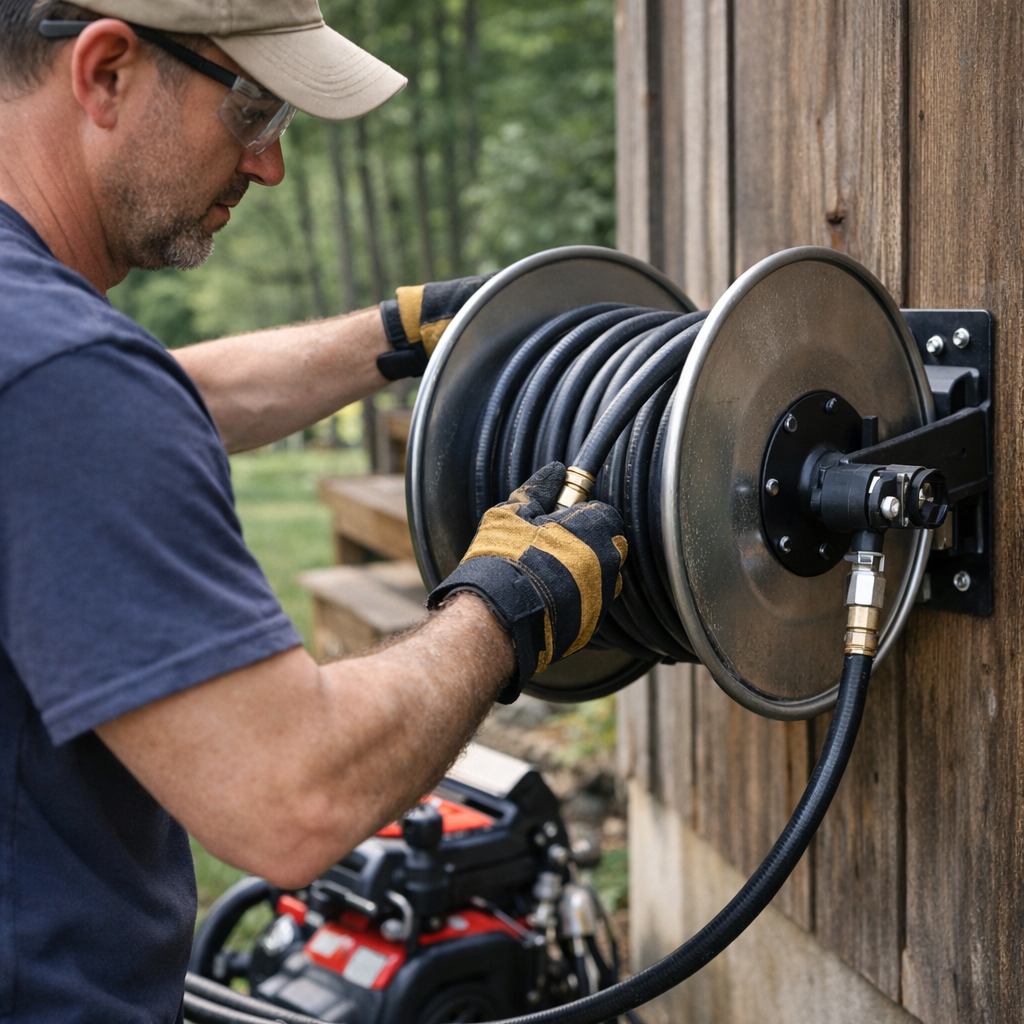
    No one thinks about hose storage—right up until a twisted, stubborn hose brings your cleanup to a crawl just as you’re packing away tools. If you spend your weekends rinsing post-sanding dust from decks, blasting concrete slabs clean, or washing the grit off drills and fasteners at the end of a job, you already know the difference the hose makes. You need a line that feeds smoothly, drops exactly where you need it, and lets you finish the work, not fight the equipment. But what happens between uses—where and how you store the hose—decides whether tomorrow’s job starts smooth or snarls from the first pull.

    Hose Storage: Where Shortcuts Backfire Fast

    At first glance, every reel and wall hook looks ready to take years of abuse—chunky welds, “heavy-duty” stickers, and claimed capacity to match your hose’s length. But those claims fade in real use. Store a pressure washer hose on a narrow reel for a few weeks, and the consequences start to bite. Maybe it’s kinks that flat-out refuse to straighten after yesterday’s job. Or it’s tight “memory” coils that spring right back the moment you unroll, forcing a wrestling match before you’ve even pulled out the battery for a swap.

    This isn’t a mild nuisance at the end of a long project. It’s the final insult after hauling saws, tucking away bits, pushing through fatigue—just to lose another chunk of time untangling or, worse, discovering a cracked hose where it bends. A shortcut in storage adds up to a real leak in your workflow. More than once, all that’s needed to spoil a finish prep is a hose that simply refuses to cooperate.

    Reel Width: The Detail That Makes or Breaks Workflow

    The make-or-break detail is hiding in plain sight—a reel’s core diameter. Ignore that number, and you’re left with tight coils that choke your work, even if the hose “fits.” A rack or hook just a few inches too narrow will stress every section it contacts, teaching the hose to twist back against you the next time you circle a sawhorse or duck under scaffolding. What looked “close enough” on the shelf winds up costing you more in effort and hose replacements, week after week.

    Oversized reels aren’t a luxury—they’re mandatory for anyone who wants speed and durability. Run the job with a wider loop, and those little friction points vanish. The hose glides past piles of scrap, curves easily under benches, and stays supple through repeated use, no matter how many tools you swap out or batteries you burn through in a day. That means less risk of kinks at the fittings—no need to pause and baby the line or police every bend as you adjust your working position. Over a season of real work, the hours saved are impossible to ignore.

    Real-World Scene: The Hidden Time Drain of Poor Storage

    Imagine you’re losing daylight, hustling to rinse sawdust after fast cuts or clear debris so a finish coat can go down before weather moves in. With a rack that’s sized for the hose, your routine feels clean—no tangles at your boots, no snagging on sawhorse legs, no lost time as you swing the nozzle behind stacks of lumber. But swap in a hose trained by tight storage, and control vanishes fast. Suddenly, you’re double-backing to unhook coils, feet catching on springy loops, pressure drops flicker as the hose pulls against itself, and the battery you just swapped in is already draining.

    If the hose loops tight every time, frustration builds with each uncoil, costing you more minutes than you want to admit. Missed patches dry too soon. What should’ve been a smooth takedown session turns into manual wrestling just to get the hose back on the rack. Eventually, you spot those callused, splitting ends at the connectors—signs you’re headed for another premature replacement. All because of a shortcut at storage.

    Leveling Up: The Payoff from Smarter Hose Racks

    The fix isn’t glamorous—but it’s one of those upgrades you feel by the end of the first week. Swapping a narrow hook for a wider rack (12-inch loop or more) means your hose releases in seconds, rolls flat on the worksite, and doesn’t waste your arm strength trying to “remember” those old tight coils. Takedown becomes a rhythm: wind, stow, move on. No tiptoeing around the hose or wasting time coaxing it straight. A practical rule? Stick to a reel that’s at least double your hose’s required bend radius—for most, that’s a simple, high-impact adjustment.

    And don’t discount those time savings. Ten seconds per deploy, two or three deploys a week—across months of sanding, drilling, or prepping, you’re gaining back whole afternoons you’d otherwise lose untangling kinks. That difference is real: less fatigue, more focus on cutting, fastening, and finishing, and less dread when pulling the line for the next setup.

    Frequently Asked Hose Storage Questions (From Actual Users)

    Can I use any hose reel if my pressure washer hose physically fits?

    No—fit isn’t the same as function. If the reel or hook is tighter than your hose’s specified minimum bend radius, you’re laying the groundwork for constant frustration. Those small bends work against the hose’s inner structure, degrading it with every wind and unwind. Don’t trust “universal” unless specs back it up with bend radius numbers.

    Why does my hose keep coiling up or kinking, no matter what I do?

    Most of the time, the issue starts at storage. Every time your hose rests on a hook or reel that’s undersized, it holds onto that curve. By the time you notice the resistance, you’ve reinforced that shape for dozens of cycles. The fix is straightforward: go bigger on the rack, give the hose room, and see the kinking subside with regular use.

    Does hose material actually change how much storage matters?

    It matters—just not as much as most think. Polyurethane hoses take abuse better than rubber, but neither escapes the impact of tight storage. Even the most “kink-resistant” material suffers long-term if it’s always bent too sharp. Treat every hose to a spacious rack, and you’ll stretch both its lifespan and its day-to-day performance—especially when site work is rough on every other tool, too.

    Simple Shifts, Tangible Payoffs

    This isn’t about chasing the most expensive reel or over-complicating your setup. It’s about treating your hose as the tool it is—with the right storage for real work conditions. Double the minimum bend radius for your hose, check that against your storage, and don’t hesitate to upsize. The footprint you give up on the wall or trailer is nothing compared to fewer cracks, smoother flow, and less downtime resetting your gear.

    Don’t let the final task of the day—coiling the hose—be the place you invite problems for the next project. Protect your tools, your time, and the ease of every cleanup job by storing smarter. Over months of drilling, cutting, sanding, and washer use, that’s the kind of efficiency that genuinely pays off—and leaves you ready for real work, not another tangled hassle.

    For practical tools and gear that work as hard as you do, visit Gumboll.

  • Choosing Wall Storage for Small Yards That Stands Up to Daily Use

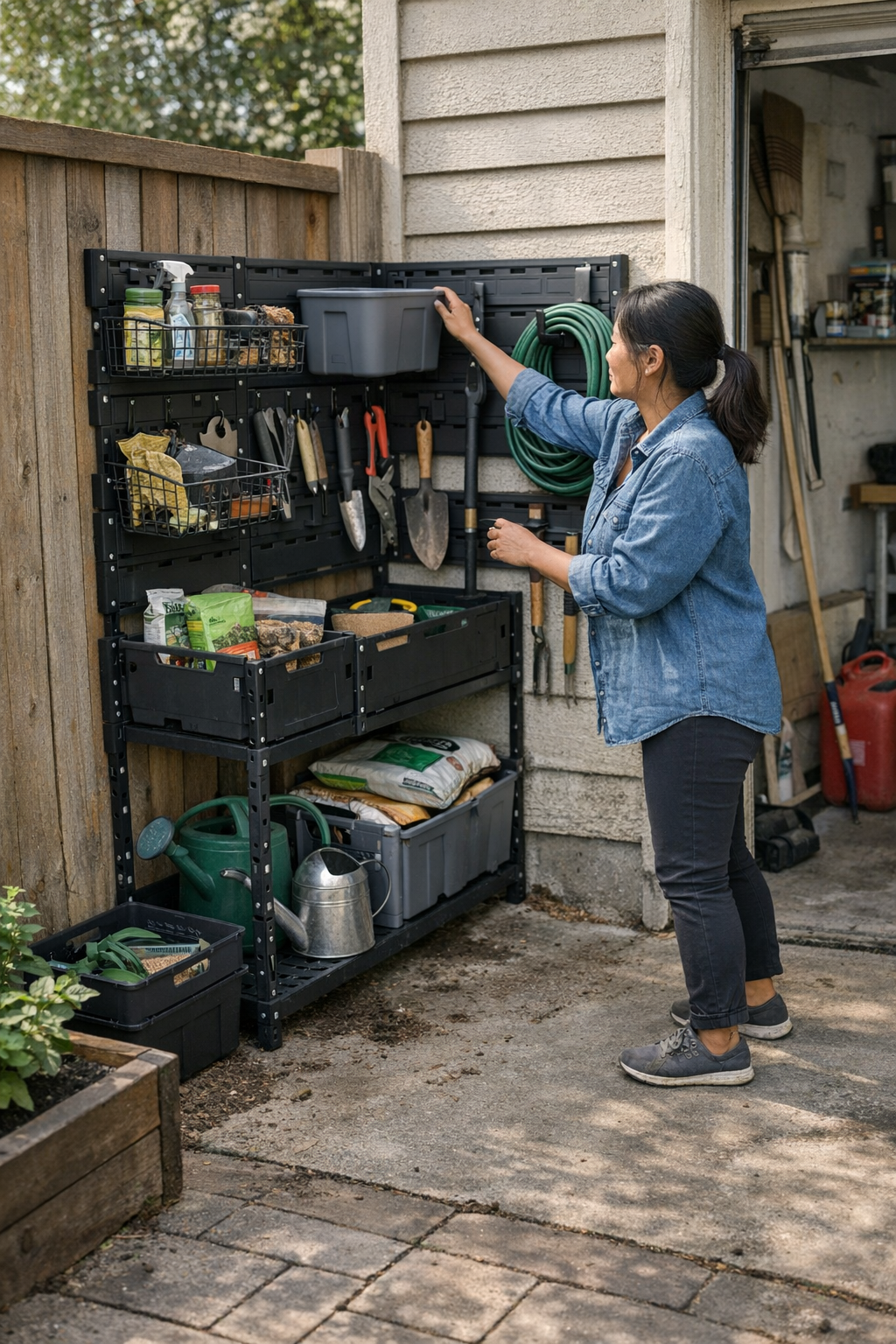
    Every small-yard owner has felt it: the relief that comes the day a new wall system goes up—hooks filled, bins stacked, a tidy edge carved out of the chaos by the garage or fence. For one weekend, everything stands where it’s supposed to, and you can finally wheel the mower through without tripping. But two weeks in, order starts slipping. The same hooks that looked smart now snag your jacket as you slide past, the bikes you hung to save space end up squeezing the gate, and a muddy soccer ball finds its new home exactly where you step. What first felt like a win now presses in, trip after trip—a wall storage setup that fits the space, but still interrupts the routine.

    When “Organized” Doesn’t Mean Usable

    Saturday arrives. Kids drag out toys, tools get borrowed, something always comes back muddy or awkward. By evening, the clean lineup has warped: a trowel jams up the rake, hoses twist down from the wall, and garden gloves end up somewhere no hook planned for. Often you’re nudging a hanging lawn chair or shifting a storage rack just to reach what you really need. The return flow—actually putting things back—is now full of small negotiations, and you start leaving items “for later” because getting it right means undoing half the setup.

    This is where setups start to work against you: the wall system technically fits, but now you’re holding your breath just to navigate the side yard. Paths tighten, gear bunches up, and one quick grab for shears means accidentally toppling the shovel—another shuffle, another delay. What worked on day one is now a reason you hesitate to go out for something simple.

    Fixed Systems vs. Modular: Where the Strain Appears

    Fixed storage systems flatter at the start—hooks spaced just so, shelves aligned, imagining every spot set for every item. But everyday use exposes weak points: tall handles obscure smaller hooks; a bulky mower, once hung neat, suddenly blocks everything behind it. Rigid shelving collects whatever happens to land—boots migrate from hooks to floor to corner pile. Eventually, the tidy wall turns back into ground-level clutter, only differently arranged.

    Modular setups—rails, panels, snap-in baskets—play by different rules. After a muddy weekend or a new sports haul, you can unclip a crowded shelf higher, bump a hook over for longer tools, and open a wider path without emptying everything or fumbling for tools. A quick adjustment after a busy day can keep overflow out of the walking zone and keep the reset feeling manageable, not like a project you dread all week.

    Reset Speed: What Breaks Down First

    Test it: after yard work or a birthday, can you restore order in five minutes, or are you moving three things just to put one back? With a modular rail you slide things to fit, the floor stays clearer, and the next trip to the composter or the bikes doesn’t demand a workaround. With a fixed rack, every “quick fix” is a compromise—returns build up in the easiest spot, edges collect piles that were meant for hooks, and before long, the system blocks more than it helps. That’s when the weekend reset starts to feel like work you’d rather avoid.

    Real-Life Friction: Where Small Yards Trap You

    • Returning a long-handled lopper after trimming— but the shovel is already in the way, so the lopper ends up propped in a corner, starting another mini-pile in your narrow strip.
    • Reaching for the broom— but it’s buried behind two hooks that have migrated lower, forcing an awkward unhooking chain just to sweep up after the dog.
    • Trying to drag the garden cart through— but last week’s attempt to tidy bikes and bins onto the wall has pinched the route, leading to a string of off-ground plans that ignore how gear drifts when you’re in a hurry.
    • Overflow at the garage edge— the further from your entry point, the more “for now” items jam onto the wall rack, snowballing into visible clutter and a tighter squeeze every trip.

    If you keep noticing one corner swallowing more spillover, or the “organized” wall needs more sidestepping now than before, the mismatch is real. Resetting becomes its own mini-burden, routine movements get blocked, and shortcuts turn into permanent mess.

    Reconfiguration Is the Real Test

    Outdoor storage has to adjust with real life: seasons flip, tools rotate in and out, kids outgrow scooters, garden projects take over, and the “hot spot” for activity shifts with the month. Even in a simple yard, new habits create their own clutter. A setup that lets you slide shelves lower when shorter tools become daily grabs, or move a basket when the pile grows, keeps you moving. Rigid walls just turn the small stuff into new work.

    Try this test: Time your reset after a normal Saturday. Does returning everything take more rerouting or fiddling than it used to? If the routine grows slower, or “temporary” piles keep growing, it’s the system—not you—that needs to flex.

    Small Yard Flow: The Visible Difference

    The best storage wall isn’t judged by the first-day photo, but by how little you have to think about it after a muddy kid, a late haul of patio cushions, or an unexpected spring project. When movement feels natural—when you wheel something through without untangling or sidestepping—you gain usable space instead of fighting for inches. That’s the difference: fewer slowdowns, fewer end-of-week resets, and less energy wasted on figuring out where overflow should go.

    Choose outdoor storage that adapts as you do. When your narrow strips or garage edges remain open and passable, the yard actually works for you—week after week. If the setup always makes you pause or redo, it’s only pretending to be organized. In outdoor spaces where every corner and pathway counts, the right storage system is the one that holds up to real life, not just the day you install it.

    To see how practical organization can make your outdoor space easier to use—and less of a chore to reset—visit TidyYard.

  • How Small Changes Can Smooth Out Your Dog’s Morning Routine

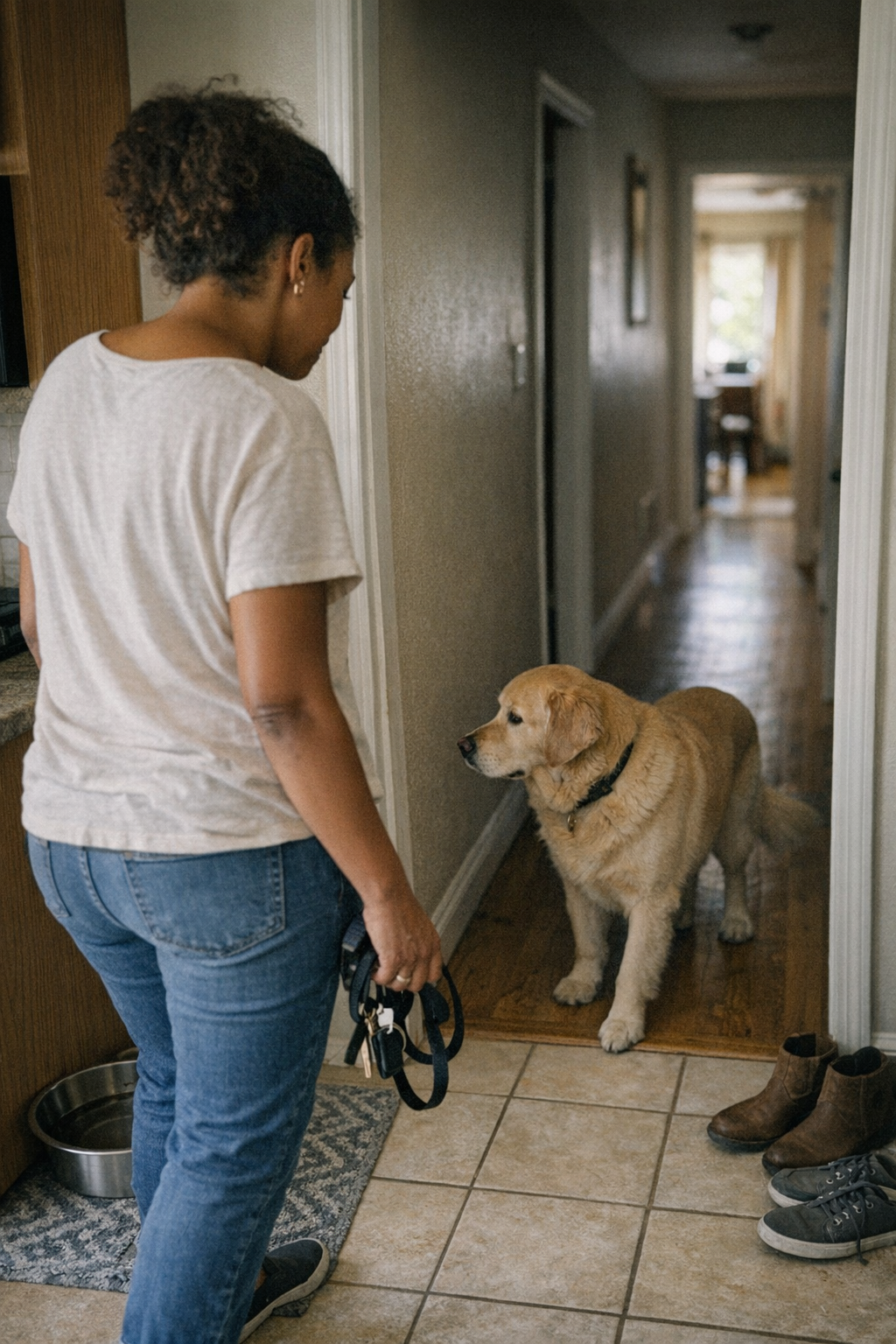
    Most dog routines don’t collapse because of giant disasters. They grind down one small block at a time—the tipped-over bowl in the walkway, the towel you can never grab when you actually need it, the leash that somehow ends up under a chair just as you reach for the door. It’s this hidden, repeated inconvenience that keeps walk after walk feeling slower and a little more chaotic. If you’ve ever juggled keys, leash, and treat pouch only to find your dog planted at the doorway—waiting, hesitating, or circling in a blocked hall—then you’ve met the everyday friction that makes or breaks a dog-friendly setup.

    The Hidden Cost of Everyday Thresholds

    Think about your last ordinary morning. Breakfast ends, the water bowl sits in its usual spot, and you both head for the door—until the pause. Your dog stops with one paw forward and the rest of the body angled back, as if unsure about crossing into the next room. It isn’t dramatic, but the seconds stack up: three beats for a cautious look, a sidestep to avoid the bowl, maybe a loop back to check if you’re following. What looks like a minor stall starts dragging out the transition, making each step toward the walk feel heavier and less coordinated.

    This kind of micro-delay isn’t an isolated quirk—it becomes its own routine. By the third or fourth day, you’re preemptively calling, reaching, nudging, or shifting things just to keep things moving. The smooth handoff from inside to outside is lost to repeated interruptions: slow steps, leash detours, adjusting the towel you don’t actually have in your hand yet. Day after day, routine friction compounds until even the simplest walk or cleanup feels off-schedule.

    Micro-Frictions Multiply: Why Small Pauses Matter

    One slow exit doesn’t change much. But when the same snag resurfaces every morning—hesitation at a threshold, a bowl blocking the exit, tangled leashes on the doorknob—it exposes a deeper issue: setup friction. These pauses are less about your dog’s quirks and more about what you’re bumping into, stepping over, or reaching past every day.

    The cost isn’t just lost seconds. Owners start every outing by sidestepping a misplaced mat, bending around a pile of towels, or shifting a bowl that keeps sliding back into the same old spot. The small workarounds—nudge, step, repeat—bleed the energy out of your day before it even starts. Sometimes you cue your dog, sometimes you just grab whatever’s blocking the way too late, but the drag stays. The routine gets chunkier, less automatic, less calm for everyone involved.

    The Cluttered Exit: When Setup Gets in the Way

    Placing bowls and towels for easy cleaning seems practical, until it means reaching past your dog every morning or shuffling gear in the only open doorway. Hooks at the wrong height or tucked-away grab bags turn quick exits into a shuffle zone. Even a space that “looks” organized at a glance often hides physical blockers—mats that slide when paws hurry over them, or beds that spill into the path and require repeated straightening. The difference between theory and daily reality shows up right at the choke points: doors, thresholds, hallway bends.

    How Small Adjustments Change the Whole Morning

    The difference between a routine that looks tidy and one that actually flows is simple: routines fail or succeed in motion. The setup can be visually spotless and still force delay if it blocks or interrupts you at the busiest moments.

    Picture it: your dog hovers in the doorway, uncertain, while you’re juggling keys and trying not to drop the leash that somehow migrated under yesterday’s mail again. The bowl’s edge is just far enough into the walkway that your dog detours. You reset, your dog stalls, momentum drops. Morning walks start edgier; your energy flags before you even leave the house. The real damage isn’t visual—it’s how the repeated stutter throws off everyone’s balance, day after day.

    But fixing it often comes down to a single move. Slide the bowl a foot away from the high-traffic zone. Rehang the towel so it’s actually beside the door, not above or across the room. Clear the mat just after breakfast instead of letting it sit until noon. These tweaks don’t make the routine perfect—they just remove the speed bumps. Dogs cross thresholds without pausing, owners reach what they need in one try, and suddenly the whole morning moves faster. In practice, even shaving a minute off a repeated snag changes the rest of your day.

    Recognizing Patterns: Is It Disobedience or a Setup Issue?

    If your dog always pauses at the same spot, don’t just chalk it up to stubbornness. Watch what happens: does it follow every meal, post-walk return, or water break? Every time the dog changes rooms and hesitates, odds are strong there’s something physical in the way that only shows up during real movement—not during still moments when the space looks fine.

    When routines repeat, setup problems reveal themselves. Owners often spend weeks stepping around a half-rolled mat or bumping the same bowl, treating the interruption as normal—but these micro-frictions aren’t random. Maybe the towel is always just out of reach after a muddy walk, or the spray sits too far away for real cleanup. The delay becomes a pattern, and the pattern points straight to what needs shifting.

    Visual Order vs. Real Flow

    Neatness in static space is not the same as daily function. You can hang every leash, tuck every bowl, and fold every bed, but if doing that blocks smooth movement, the price is paid in slower, jerkier transitions. A space can be perfectly staged for a photo and still force you into detours, bending, and last-minute reshuffling with every walk or cleaning routine.

    Working Through Real Friction: Everyday Scenes

    • Leash Hunt: You’re ready at the door, but every morning the leash is under a pile of toys, or caught around a bowl you have to move first. Instead of grabbing and going, you’re pausing and untangling—while your dog gears up to bolt.
    • Post-Walk Wipe Delay: Muddy paws arrive, but the towel is across the room or buried under jackets. By the time you dig it out, there’s already a new trail to deal with.
    • Bowl Blockade: For convenience, you leave the bowl where feeding’s easy—but in practice, it blocks the path to the door. The dog slows and side-eyes, you nudge and shuffle. Same awkward route every day.
    • Looks Clean, Moves Messy: The room is tidy on Sunday, but by Wednesday, you’re repeatedly moving beds, shifting toys, and clearing mats just to cross the floor, especially when time is tight.

    From Stagnant Setups to Smoother Mornings

    Permanent change rarely means a big overhaul—it’s about noticing what keeps interrupting the day and fixing the real problem spots first. Instead of blaming the dog or hoping the next new organizer will fix everything, focus on what actually gets in the way at key points. Do you have to step over the same bed, reach behind the same stack of bowls, or unhook leashes from a spot that’s always just out of reach?

    Direct resets work best:

    • Relocate food/water bowls immediately after use. Even a small shift away from doorways or main walkways clears routine traffic jams.
    • Hang leashes and cleanup bags at real grab height. If you have to move shoes or sift through a shelf to find them, the system isn’t working.
    • Keep towels or wipes where muddy paws actually land, not in another room.
    • Clear walking corridors of beds, toys, mats—every day, not just on organized weekends.

    Refreshing the Routine Without Starting Over

    You probably don’t need a total redesign. The right changes—a bowl moved out of the walkway, a bed relocated, a towel finally stored where it needs to be—show immediate payoff in daily use. Each friction point erased makes routines feel less strained and more intuitive. The “improvement” isn’t about perfection, but about matching the home to the actual pattern of daily resets, cleanups, and transitions between activities. In the long run, spaces that move with you—not just look good—win out, even if an outside observer doesn’t see the full difference on a tidy morning.

    What to Watch For Going Forward

    Fixing one choke point may uncover others. Take a critical look after every change: did a crate door just become the next new obstacle? Did moving a bowl clear the hall but crowd the feeding corner? Everyday dog life is a feedback loop, so expect new pinch points to crop up as routines flex and spaces shift. That’s normal. The real win is staying alert to these micro-frictions—and adjusting before small hurdles turn into daily slowdowns.

    Don’t wait until things feel out of hand

    Dog

  • How Assigning Specific Roles to Car Pockets Transforms Daily Driving Efficiency

    The real car clutter problem isn’t just what you see—it’s how often you have to reach, shift, or dig for the same thing again and again. You rush back to your car after errands. The interior looks tidy enough, but your phone charger’s tangled with coins and gum wrappers—so you’re already slowed down before you get in gear. It’s not that you’re careless. It’s that most car setups ignore how fast routines break the initial order: grab, park, toss, repeat. DriveWellSupply centers—phone mounts, organizers, chargers—exist because even a “neat” car keeps tripping you up when daily use exposes where the setup falls short.

    Why ‘Looks Neat’ Isn’t the Same as ‘Works Smoothly’

    Every new organizer or car caddy feels promising for about two days. You drop your phone, sanitizer, and wallet into a center console that starts out organized. But by mid-week—one grocery run, one passenger, three charger swaps—it’s back to the same scenario: looking for one item, hands bumping into others, cables catching on pen ends, and receipts buried in forgotten compartments. What takes seconds on Monday drags by Friday; the “tidy” setup isn’t speeding things up, just shifting the mess until you need something in a rush.

    Here’s what the friction looks like in practice:

    • Phone charger tangled with old receipts—again.
    • Hand sanitizer buried beneath coins—again.
    • Sunglasses case blocking your reach for a single pen—again.

    None of these moments seem like a big deal alone. But stack them over five quick stops, and every routine exit and entry becomes a series of small, annoying interruptions.

    The Cumulative Cost of Mixed Car Pockets

    It’s easy to excuse the first tangle—“I’ll fix it later.” But when errands pile up, child seats migrate, or you share the car with another driver, chaos ramps up fast. Picture a busy parking lot: hands full of takeout, battery at 2%, you reach for your charger—only to go digging through sunglasses, dry wipes, and two snack bar wrappers stuck in the same slot. You’re muttering, unplugging the adapter with one hand while your food tips over with the other. The longer routines pile up, the harder it is to spot what you need the first time; each grab becomes guesswork, sometimes with a dropped cable or another item sliding under the seat.

    The minor, persistent interference—charger in the wrong pocket, sanitizer buried under mail, coins rolling to unreachable corners—adds seconds you don’t have and stress you never budget for. Multiply this by shared rides: new hands stash things randomly, and everyone loses track of where their essentials ended up. Every stop runs slower, and the sense of “organized” turns into a memory game you’re losing.

    Assigning Each Pocket a Job: Less Drift, More Flow

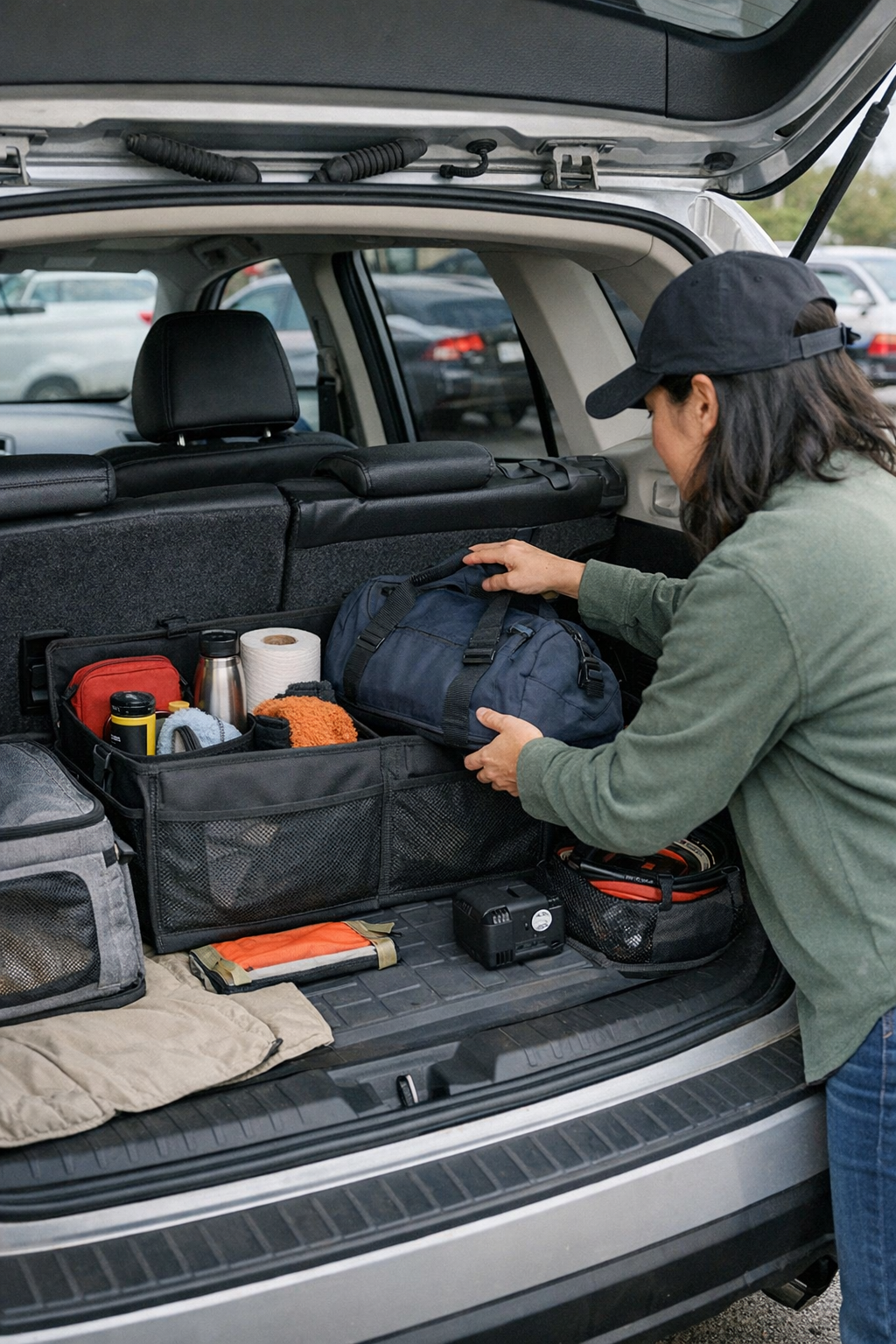
    One practical change actually sticks: assign a single job to every storage zone—no mixing allowed. Charging? Only cords and adapters belong in that slot. Daily grab items? Dedicated area. Documents or insurance? One tight spot, not two. By keeping cables out of coin pockets and snacks away from paperwork, every reach is a matter of habit, not hunting. If a DriveWellSupply organizer or seat gap filler fits your car, use the shape to reinforce only one kind of item per place. The difference isn’t cosmetic—it’s that you quit resetting the same mess after every drive.

    How it looks in real traffic:

    • Passenger door pocket: Cables and nothing else; charger stays untangled and reachable even on a full grocery unload.
    • Center console: Wallet, sanitizer, and sunglasses in dividers—never mixing with mail or snack bars.
    • Under-seat section: Only paperwork; no charger adapters or lost pens floating around.

    This structure turns retrieval into muscle memory. The more you stick to single-job zones, the less you pause, sort, or grumble on routine in-and-outs. The payoff is less time wasted before every start—your setup works without you having to “reset” it every couple of days.

    Busy Routines, Dense Driving: Where This Matters Most

    Single-purpose pockets really matter when the routine is at its most crowded. During errand loops or school drop-off, you don’t have time to sort before each stop. Here’s where mixed storage fails first:

    • Errand stacking: Three fast stops, each demanding a different card or receipt. Mixed pockets bury what you need behind trash from yesterday—slowing exit and re-entry on repeat.
    • Shared vehicles: Carpool drivers or family members drop items wherever there’s space. By midday, chargers shift, sanitizer goes missing, and keys drift to impossible spots. There’s no shared logic, so retrieval is slower for everyone.
    • Packed cargo days: Trunk overloaded, back seats blocked. Everyday essentials can’t be shuffled to fallback spots; if pockets are already mixed, the stuff you need for the next stop gets lost or requires a two-hand, two-minute search.

    Clearly defined zones—strengthened by trays, gap organizers, or door-mount pockets—keep these friction points from spiraling. Movement becomes automatic because every grab has only one possible place to go.

    Tricky Tradeoffs: When a ‘Solution’ Makes Something Else Harder

    Plenty of car accessories backfire—an organizer that forces pens, coins, and cables into one cramped bin fixes the “messy look,” but now you wedge your hand in every morning, brushing sanitizer just to fish out your key. A seat cover promises spill protection but bunches at the edge, making every console reach require another push aside. You fixed one problem, replaced it with two new slowdowns.

    This is where the single-job thinking matters most: it’s not about “looking organized,” but about setups that don’t block, drag, squeeze, or bunch after five days of real use. Any zone or add-on forcing category overlap will look fine new and then make your routine clumsy fast. A setup only reveals its strength or weakness during the motions: reach, grab, stash, return—over and over.

    Keep It Unmixed: Practical Methods and Real-World Tweaks

    Some built-in spaces have to flex, but a few tweaks bring more order:

    • Divided organizers: Use DriveWellSupply-style trays or gap fillers that clearly block mix-ups—cables can’t entangle keys, sanitizer tops stay upright and instantly findable.
    • Texture cues: Felt, silicone, or rubber mats make separation tactile—without looking, your hand feels “where cables end, docs begin.”
    • Front/back logic: Daily grabs reserved for front-most zones. If you rarely need it, bury it; for repeated use, keep it predictably closest.
    • Trip-end resets: Five seconds to check (not sort) before locking up: if categories stay separate, drift is stopped before it starts.

    The goal isn’t pretty bins for their own sake—it’s putting what slows you down right back in reach, with zero daily effort. Unmixed zones mean your car lets you move, not stop to fix the same pile twice before lunch.

    When Order Looks Fine—But Still Trips You Up

    A “clean” car is easy—until you actually use it. You open the door and everything looks sharp, but one grab for your phone means moving a case, untangling a charging cable, and scraping against a sanitizer bottle you left in front. Time lost, mood dented, all before you’ve left the curb. Appearances mislead; live usability is the true test. The real signal? If you keep unmixing the same two items every trip, your system isn’t working—no matter how “together” it looks.

    Single-job storage doesn’t mean spotless. It means you aren’t fighting your own habits. Want less anxiety on busy mornings? Keep pockets defined, categories simple, and never let a two-second grab become a two-minute scramble—no matter who drove last.

    The Real Payoff: A Car That Works the Way You Actually Use It

    You don’t need a full interior overhaul—just boundaries that survive a week’s worth of drive, park, and return. The upside is concrete: fewer forgotten chargers, less repeated cleanup, and faster recovery when you lose track. A real-world setup—reinforced by proper organizers, textured mats, or even a habit of five-second checks—lets you get in, get what you need, and get out, with less reset and less drift. For cables, cleaning tools, pet barriers, or trunk organizers, rely on products that force categories to stay unmixed, making routines almost frictionless.

    Spot the difference next time you park: does a single grab slow you down, or is your car actually making daily motion

  • How Simple Floor Cleanup Transforms Your Daily Pet Feeding Routine

    Why Pet Area Cleanliness Breaks Down

    Pet feeding spots don’t fall apart after a major spill—they break down in the quiet, repeated misses: the water that drips when you refill, the crumbs that slide past the food mat, the sticky spot you promise to wipe later but forget. The kitchen floor under the bowls is always where mess accumulates fastest, even in homes that look tidy at first glance. Skip just one wipe, and the reset drags out next time—cleaning shifts from a 10-second swipe into a multi-step chore. The difference between a calm, workable pet area and an everyday hassle is almost never dramatic, but you feel it each round: bowls that stick, mats that slide crooked, dust tracked into shared space.

    Over time, minor shortcuts backfire—one dried kibble, one patch of missed water, one reach for the bowl where your sleeve gets dirty. With every small delay, you’re forced to work through more buildup. The “clean” version of the area becomes harder to reach and even harder to keep.

    Everyday Friction: What Actually Happens

    Most cleaning friction hides in the daily basics: the floor under feeding bowls catches every drop and stray crunch, no matter how careful you are. Even a well-placed mat falls short—a few meals in, kibble bounces over the edge and water finds its way underneath. Moving the mat reveals a crust of residue and crumbs jammed against the baseboard.

    Postponing the cleanup, telling yourself you’ll get to it after work, means the floor turns sticky, crumbs harden, and hair or litter clings before you even get to the main mess. The moment a quick reset becomes a project, the routine breaks pace. Suddenly, every feeding means moving supplies, sweeping aside clutter, or scrubbing more stubborn spots.

    When Setup Hurts More Than it Helps

    Some fixes seem clever but cause new headaches. The mat you chose for spill protection? It catches crumbs but demands lifting, shaking, and cleaning underneath in addition to around. The “easy” cleaning spray or towel is across the kitchen or buried behind other supplies. Each layer to protect the floor adds new steps to your evening routine—what was meant to control mess ends up making resets longer and less likely to happen in the moment.

    Friction leaks in from every angle: the mat blocks the cabinet you need, the water bowl sticks against a mat edge and spills, cleanup supplies migrate into shared space for easier reach, and your kitchen now permanently hosts out-of-place tools and stray pet items. Instead of handling care faster, your setup crowds everyday movement and makes every part of the routine slightly less smooth.

    The Ripple Effect: When Delays Take Over

    Ignore one patch after breakfast, and by midweek, you’re chasing mess all over: crumbs trail past feeding spots, wet pawprints reach the sofa, rings of dried food form at corners, and stray hair piles up in new places. The failed reset doesn’t stay hidden—mess migrates, adding steps to your day and forcing late-night or early-morning catchup.

    Suddenly, every small routine—letting the dog out, picking up toys, swapping water—requires clearing a trail or circling back to fix what you skipped. Delayed cleanup stops being background and starts shaping how—and when—you can move through your own space.

    The Smallest Change: What Actually Solves It

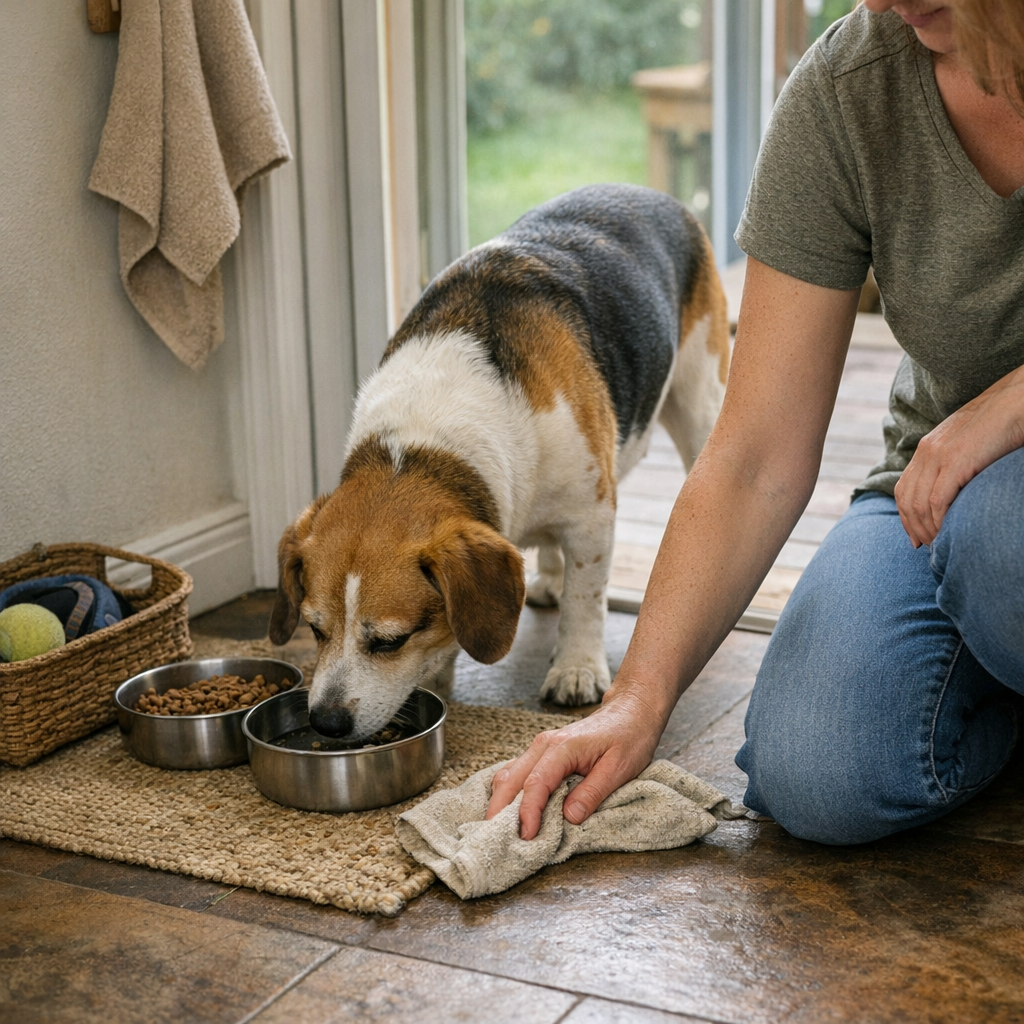
    The most effective fix is never complicated: keep a basic, absorbent towel hanging within arm’s reach of the feeding area. Not hidden in a closet, not across the kitchen—right there, every time. After each feeding, a quick swipe catches spills before they harden or spread. No sprays, no scrubbing, just a single pass before mess becomes build-up. Reset feels part of feeding, not a dreaded chore.

    This single step—done when you’re already at the bowls—saves minutes daily and keeps small problems from turning into full resets. Cleanup stops piling up. The area actually functions from one round to the next: not just neater, but easier to keep that way. The routine never drifts into project territory, and the floor is always ready for life to continue without repeated interruptions.

    Practical Cleanup Guidance—FAQ

    How do I prevent pet food mess from sticking to the floor?
    Wipe under and around the bowls immediately after feeding—using a towel that’s always on hand, not stored away. The sooner you handle spills and crumbs, the less any mess lingers or becomes stubborn work later.

    Is a mat enough to keep the feeding area clean?
    No—every mat only helps partially. Kibble and water slide past the edges after a few uses, and what’s meant to protect ends up hiding mess until it’s worse. Plan to lift and wipe under mats often; don’t trust a single “solution” to do all the work.

    Why does cleanup get harder over time?
    Each missed or delayed wipe-down hardens crumbs and lets water marks set, making every reset after that take longer and feel heavier—especially once extra mess spreads into other rooms and routines.

    From Looks to Function: What Actually Matters

    A pet area that appears clean after a reset doesn’t mean the care routine is friction-free. Mess you can’t see—blending into corners or under mats—still drags on the next round, and small missed steps add up. If your towel or cleanup tool isn’t always within easy reach, you’ll keep pushing off that last swipe, and setup that once looked organized quickly slows down as real use exposes what’s missing.

    Design your spot for actual daily use: hang a towel right by the bowls, cut the reset to a wipe, and keep cleanup basic and easy to put back. Whether it’s after meals, refills, walks, or bedtime checks, the right small step keeps everything running—no overhaul, no buildup, just daily flow you can count on.

    See CalmPetSupply’s collection for more practical solutions

  • Prevent Lighting Installation Failures with a Simple Ladder Parts Cup

    Most lighting installations don’t fail with sparks or shattered glass—they fail by degrees, in the small, invisible ways that keep showing up every time you cross the room. Miss one screw or drop a vital clip during a ceiling or wall fixture swap, and what feels like minor lost time on the ladder turns into a chain of daily annoyances. Anyone balancing awkwardly on a ladder, wedged beside the washer or squeezed between hallway walls, knows the friction: reach for the next fastener, realize it’s vanished, and now you’re juggling brackets, shuffling hardware on top of an unsteady light, improvising a fix that never quite sits right. The job looks finished from below—but the minute someone slams a door or you grab the stair railing, the fixture wobbles just enough to make the whole upgrade feel questionable.

    The Real Cost of Lost Parts in Lighting Installs

    The hidden enemy of reliable lighting isn’t slow work—it’s the shortcuts and compromises forced by missing parts. Screw up a flush-mount install in a narrow hallway or a wall sconce beside the bathroom mirror by losing just one small connector, and you’re left with more than lost time. That fixture sways after every closing door, its mount loosens with regular vibration, or it flickers unpredictably. The light looks okay at first, but days later, shadows creep across the stairs, mirror edges show uneven glare, and you find yourself re-torquing screws that should never need another turn. All from one dropped washer or mislaid clip.

    Every shortcut here ripples outward—turning “good enough” light into new blind spots, unreliable movement on stairs, or the sense you should keep tools handy for another round of fixing. A bright hallway becomes a nothing-special zone. Uneven glare at the bathroom mirror reduces usable space. That feeling of trust in a room’s light begins to fade, replaced by small doubts: when will this fixture need to be patched up again?

    Practical Setup: The Small Parts Cup That Changes Everything

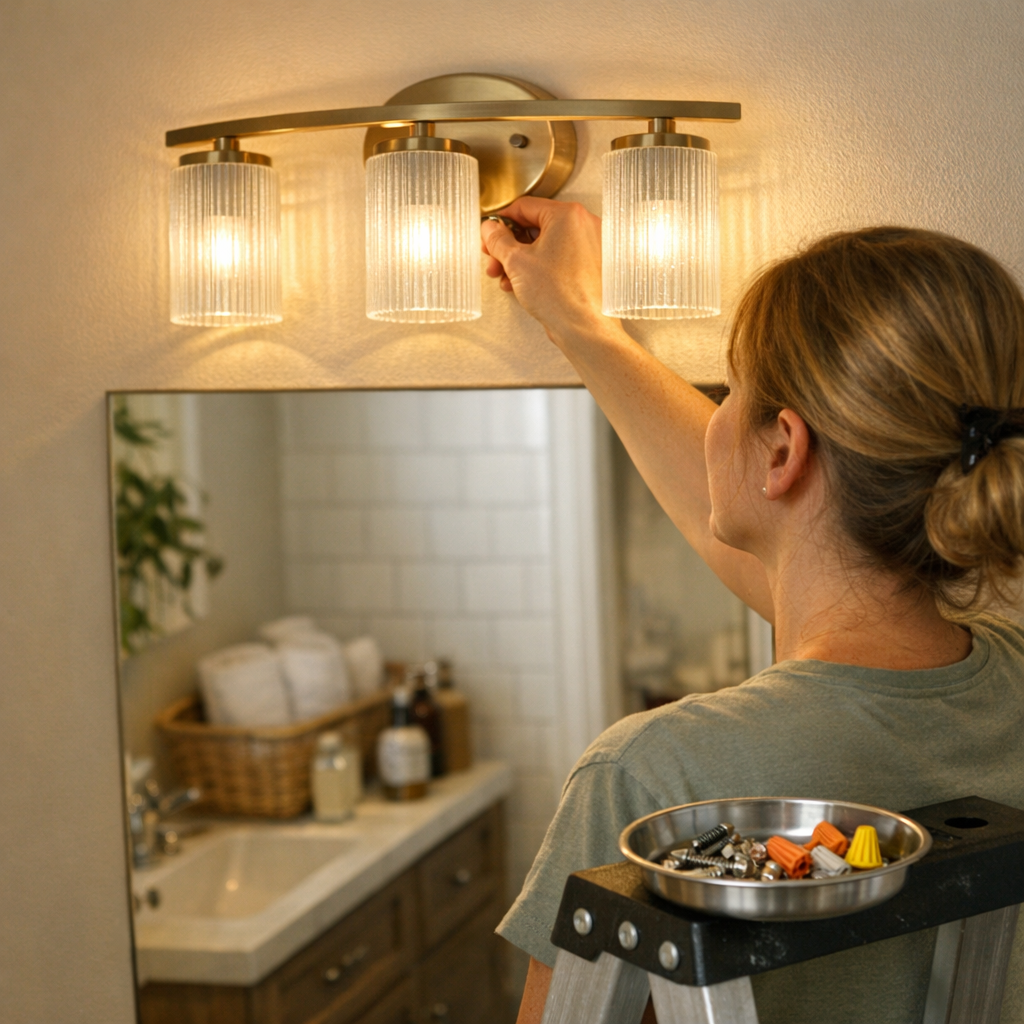
    Veteran installers don’t trust luck—they keep a small parts cup fixed to the ladder before even unpacking the fixture. It isn’t elegant, but it prevents nearly every “vanished fastener” scenario that derails the job. On a metal ladder, a magnetic cup locks in. For fiberglass, a clipped or hooked tool cup does the same work—keeps nuts, screws, and clips in grabbing range no matter how much you’re twisting over a stair turn or tight laundry alcove.

    Why is this non-negotiable in lived-in rooms? Areas like stair landings, behind stacked units, or tight hallway corners multiply the odds of dropped parts. One lost screw can turn a routine install into a half-hour of searching crevices, or worse, an unfinished fixture you have to work around for days. A parts cup—magnetic, clipped, or even just zip-tied to a rung—locks down routine chaos. It means each step from prep to finish goes without the awkward slowdowns that allow subtle failures to creep in.

    Fewer Interruptions, Fewer Quiet Failures

    Consider the flush-mount ceiling light in a corridor: with every piece at your fingertips, there’s no shuffling down and up, no lost energy hunting for a screw that’s wedged by the baseboard. The install clicks along—and so does the long-term stability. Skip the parts cup, and you invite the silent kind of breakdown: a bracket left loose so the fixture drifts, subtle shadows that creep along the wall, a mounting screw missing that lets the whole light vibrate itself loose after a week of foot traffic.

    • No half-attached brackets: Fixtures hold tight, avoiding slow sags and sideways drift after daily use.
    • Shadow stays controlled: Proper mounting keeps light spreads even, so you’re not shifting at the mirror to dodge a glare line or dark edge.
    • Vibration becomes irrelevant: All fasteners in place means regular door slams or hurrying feet won’t knock the fixture off level.

    Recognizable Fixes in Everyday Spaces

    Walk through your actual routine—mirror at the sink, edge of the laundry counter, tread at the stair turn. Miss a spacer or bracket in these setups and the flaw turns up fast. That vanity light looks fine first night, but shifting screw tension twists the spread after a few days, misdirecting light or casting new, unflattering shadows across your face.

    Hallways reveal the difference clearest: a properly finished ceiling mount feels stable long after install, but shortcut the process and every set of footsteps risks a rattle or a tick—a constant reminder of what didn’t get done right overhead. On a stair landing, unfinished work shows itself with every grab at the rail—small fixture flex means the nagging fear that something’s always a little loose, a little uncertain. Tight laundry rooms expose any missed step; a missing clip forces you to patch, prop, or live with skewed light on the folding surface until you can try again.

    Real-World Repeats: Where Friction Builds, Not Fades

    Unlike a decorative fixture in a guest room, core lighting gets tested in cycles: morning movement, after-dark trips, every quick mirror check. Repeat use in these key spots amplifies any install oversight. A hallway sconce that loosens means more interruptions—and, sometimes, more real risk. Shadows nudge into the wrong place, routine movement slows to avoid a dark step or glare patch, and what started as a 30-second stumble for a dropped screw now disrupts your schedule week after week.

    One Simple Habit: Reducing Lighting Frustration for Good

    Regularly fixing a small parts cup to the ladder before every lighting change cuts straight through these minor disasters. The difference gets sharpest at mirror wall lights: no more lost fasteners behind the sink, no more off-center drift or glare pattern you have to “live with” because the hardware’s now inaccessible. You don’t win by perfection—you win by default, with every fastener exactly where it belongs and no need to second-guess a shaky fixture during daily routines.

    If you use a non-magnetic ladder: Grab a fabric or silicone tool cup with a stout clip and clamp it to the top tray or side rail—just keep it within reach. Even the most basic zip-tied dish beats crawling for a runaway part behind appliances or inside cabinet runs.

    Better Lighting Begins With Strong Structure—Not Just More Bulbs

    Consistent indoor lighting isn’t about maxing out lumens or spending on fancy fixtures. The real payoff—stability, safety, light where it’s truly needed—lives in the install details you don’t see from the floor: how tight the base sits, whether every screw holds, if the mount will stay level after a month of commotion. Secure structure stops glare lines, blocks random shadow streaks, keeps the room usable for movement and routine tasks long after the “new fixture” effect fades.

    A lighting job that starts with every part accounted for and every connection solid becomes a room you barely think about: no more last-minute tightening, sidestepping dark patches, or bracing for a rattle each time someone rushes past. That’s the line between a space that simply “looks new” and one that actually works right for all your lived-in routines.

    Visit LightHelper for practical indoor lighting solutions.

  • Why Brushing Cats After Naps Simplifies Grooming and Reduces Fur Spread

    Every indoor-cat owner will recognize the pattern: you set out for a quick grooming session, only to realize fur has drifted under the dining chairs, the brush is missing again, and what looked like a two-minute job has become a scattered, ongoing mess. Brushing “whenever you remember”—in the middle of checking the water bowl, or right after you’ve tidied the food area—sounds practical but never simplifies the routine. Instead, the room keeps collecting stray hair, tools go wandering, and you find yourself repeating cleanups you thought you’d already handled. In daily home use, the invisible cost of sloppy timing and wandering tools isn’t just the visible fur—it’s the slow drag on your ability to reset, keep shared spaces usable, and avoid those corners of the room that keep turning up debris.

    When Good Grooming Habits Go Wrong

    The “just fit it in anywhere” mindset falls apart fast once friction begins stacking up. Brushing your cat on the move—by the kitchen counter, at the edge of a shared sofa, or while squeezing past their favorite resting chair—feels efficient until you realize:

    • Fur has drifted beyond control: Hairs show up under tables, along hallway edges, behind the litter mat—forcing extra sweeps in areas you use most.
    • Cleanup gets disjointed: That “fast” brush sparks a chase for the vacuum or dustpan, and fur escapes the original spot, triggering a string of unexpected wipes and resets.
    • Tools keep vanishing: The brush is on the window ledge today, under a cushion tomorrow, or lost behind the TV by the weekend—wasting minutes each time you try to stick to a routine.
    • Each session feels heavier: Mats slip, blankets need a full reset, surfaces catch more debris than expected, and the room never really stays “done.”

    Over a few days, these small inefficiencies multiply. Instead of a single contained reset, you’re chasing the same mess through different rooms—never sure why it always returns, even when things seem under control. That’s when home order starts to feel fake: every area looks managed after each cleaning sprint, but hidden fur and stray tools quietly restart the cycle.

    Why Post-Nap Brushing Shifts the Tone

    Most indoor cats revert to favorite nap corners—sun patches on the couch, cushions by a window, or a tucked-away mat. After a nap, your cat’s energy drops, her urge to escape or dash off is muted, and she’s slow to transition. This post-nap pause is the short window when fur, tools, and containment finally line up—and you can shape the room’s mess boundaries without fighting the daily current.

    The Daily Flow Change You Can Feel

    After just a week of brushing only after naps, a new pattern sets in:

    • Fur collects almost entirely on a dedicated mat, blanket, or patch—corralling hair into one spot rather than scattering it behind every chair leg.
    • The surface you actually need to clean is predictable—no more awkward stretches under the fridge or food shelves.
    • Your cat stays grounded—less likely to squirm, leap, or thread hair through a trail of toys, since she’s emerged groggy instead of wound up.

    The difference isn’t perfection; it’s control. With the right timing and a single setup zone, cleanup shrinks to one shake-out or quick fold—rather than piecemeal retracing through the house, vacuum in hand.

    The Cost of Brushing as Afterthought

    Multitasking grooming—grabbing the brush during morning coffee, or while folding laundry in a busy room—feels clever in theory but breeds chaos in practice:

    • Cats, in play-mode, eject fur far faster—twisting, wriggling, and tracking loose hair into food lanes, water mats, or even straight onto your lap.
    • Loose fur now lands directly where it’s hardest to keep clean: around bowls and litter setups, in shared walking paths, or right at a room’s entrance.
    • The “quick job” fragments: the brush loses its home, feeding setups need a full wipe, and what started as time-saving ends as double effort.

    This invisible buildup isn’t just cosmetic: the next day, you’ll feel fur prick under bare feet, spot it beside the water bowl, or find your own mood turned sideways by yet another unfinished corner. Instead of routines clicking into place, they keep interrupting each other—and you retrace the same corrections on repeat.

    Small Shifts, Noticeable Wins: Where, When, and How You Store the Tools

    You don’t need a new gadget—just a focused setup. The biggest gains come not from what you brush with, but where you store the brush and when you use it.

    Give Your Tools a Home, Not a Hiding Spot

    Find your cat’s best-loved nap zone—the sunny corner, the window seat, the armchair fleece. Place the brush within arm’s reach of that spot, not banished to a drawer or floating across three rooms.

    • If the napping surface has its own mat, fleece, or towel, use it as your fur boundary: it’s easier to shake one piece outdoors than to chase single hairs from every edge of the room.
    • A tucked-away brush, slipped beneath a cushion or stowed behind a rest mat, stays findable—but only if you always return it here after use.

    Boundaries Over Perfectionism

    No setup eliminates shedding, but boundary brushing works sooner than endless sweeping. One soft mat, folded throw, or tucked towel—paired with immediate after-nap use—protects the shared spaces from overflow. Debris lands where you expect it, and a quick shake or swap resets the routine before it spreads. Even low-tech solutions gain power when they stop the problem’s path at the edge of the nap zone, not once it’s underfoot in every other room.

    When Routine Shifts, What Really Gets Easier?

    The win isn’t in skipping effort, but controlling it. When you pair brushing with your cat’s nap schedule—not a gap in your own—it means:

    • There’s no stray fur leaping onto counters or into water bowls; no detour to vacuum a food mat after the fact.
    • The brush isn’t lost to laundry baskets or bathroom shelves. It waits where you need it, not “somewhere” in the apartment.
    • Resets shrink to seconds—a shake, a swipe, a folded-up throw—because mess never gets momentum.
    • Your cat senses the pattern too: she tolerates brushing as a predictable, low-energy moment, rather than darting off with the first comb’s pass.
    • The feeling of catching up overtakes the headache of always being slightly behind.

    That said, friction still lingers. Mats still gather hair, laundry piles still come, and the occasional tuft escapes under the nearest chair. Every home has its blind spots: fur sticks to clothes, or clings between couch cushions. But the old pattern—resetting every space every day—gives way to a calmer pace, fewer corrections, and a room that feels as manageable as it looks.

    Indoor Cat Life as It’s Actually Lived: Mess Boundaries and Relentless Return

    Real routines aren’t polished. Tools wander, fur gathers, and the same pinch points resurface unless you reset the structure itself. If you manage work-from-home, tight shared rooms, or frequent movement between cat spaces and people spaces, you notice immediately when your system works—or quietly falls apart. The benefit of tying brushing to nap times and designating tool storage is measurable in shorter resets, less trailing debris, and a room that interrupts your day less often.

    One Week In: A Room that Finally Holds Together

    Midweek, with the brush stored under the window seat, improvement shows not in big change but in smaller interruptions: hair lifts easily with the blanket, fur doesn’t tumble out on every step, and refilling the water bowl or resetting a feeding mat skips the extra wipe. Instead of a home that looks staged but falls apart by the afternoon, your setup now stays one step ahead of the mess cycle.

    Bringing It Home: Building Smarter Grooming Into the Routine

    Storing the grooming tool within arm’s reach of your cat’s nap spot and brushing during low-energy wakeups is less about “doing it right” and more about dodging a chain of small, repeated inconveniences. Containing the mess early means the room becomes easier to reset, not just cleaner on the surface. Most indoor-cat setups are only as good as their weakest point—usually wherever tools wander or routines slip. Shifting storage and timing isn’t a cure-all, but it’s the quickest way to keep fur from taking over the rest of your week. For practical tools and boundary setups that fit