Author: jaesoon_admin

  • Why Router Base Plate Flatness Is Crucial for Consistent Cuts

    The difference between a flawless routed edge and a botched one is rarely dramatic—until you’re the one re-sanding for the third time in a cloud of dust. That moment when your arms ache, your patience thins, and a tiny, almost invisible problem—a warped router base plate—wrecks what should have been a clean, fast job. The longer you work, the worse it gets. One minor deviation at the router base turns into seams that won’t sit flush, edges that look “off,” and finish quality you just can’t rescue. You catch yourself thinking, “Wasn’t this supposed to be a simple run?” Only then does the true cost of a bad base plate come into focus.

    Where Flatness Fails You: The Trouble Isn’t at Setup—It’s in the Real Run

    On the assembly bench, every tool looks ready. The router base is snug, the screws sit flush, nothing obvious dips or bows. The first test passes—usually on forgiving pine or plywood—give no sign of trouble. The catch comes later, midway through a serious job. Working a full-length maple slab, you notice an uneven drag. The router dips slightly, pressure shifts. By the end, a gentle wave shows up along joints that were supposed to stay dead-on flat. Suddenly, the line between professional-grade output and amateur repair work is as thin as the base plate gap you missed.

    What makes this friction even sharper: you don’t see it coming. At first, it’s an oddly stubborn patch of resistance or a barely visible dip. Soon enough, it shows up as steps at seams, faint burn marks where pressure dropped, wavy profiles where your edge should stay crisp. Sanding hides some of it, but repeat the run a few times—on doors, on fascia, on the face frames where details matter—and the flaws multiply. Flatness isn’t a theoretical spec; it sets the standard for whether you trust the next pass, or grit your teeth and reach for the filler.

    Small Warp, Big Consequences: How Wear Snowballs Mid-Project

    No shop tool stays factory-perfect. A slight curve in the router base—a gap thinner than a business card—doesn’t announce itself boldly. But every pass forces you to chase the correct angle, adapt your grip, and work against the grain of your own muscle memory. After hours on a big build, that 0.2mm warp shows up in the fit of every seam and the hours lost to rework. What starts as subtle “grabbing” and odd chatter becomes a pattern: the first door edge looks decent, but consistency breaks down, and your final pieces look like they swapped hands halfway through production.

    It isn’t just pride at stake—those incremental misalignments mean more returns to the sanding bench, eating shop time you needed for the next job. Worst case, a ruined edge means tossing a finished panel and burning both material and profit. What should be routine control turns into an exhausting guessing game, just to keep corners square.

    Why Router Base Plates Warp: Shop Realities, Not Just Bad Luck

    The lifecycle of a router base is brutal. Hands constantly torque screws tighter, plates take bumps from benchtop drops, and heat cycles swell and shrink edges over time. Plastic bases start to arc around screw holes after a few dropped tools; cheaper aluminum plates can bend beyond recall with one wrong knock. The visual check offers false security—the plate looks clean and the screws are tight, but the next time you route, the tool rocks ever so slightly, rhythm breaks, and shallow cuts deepen unpredictably. By the time you discover the fault, it’s usually too late—the seam is split, or a deep burn has chewed through your maple edge grain.

    Field Test: When Subtle Defects Show Themselves Under Pressure

    Consider running a 3/8” round-over across a thick maple countertop. Initially, both your go-to router and a cheap backup feel identical—until a few feet in, and suddenly a tiny ridge appears near the midpoint. On closer inspection, the suspect base plate still looks fine. The evidence is only in the cut—a lip that no amount of pressure smooths out, and sanding can barely disguise. Multiply that by a set of cabinets, and you realize you’re sanding more, working slower, and still not matching the reliable results your best base always produced.

    The Straightedge Habit: A Shop Check That Actually Matters

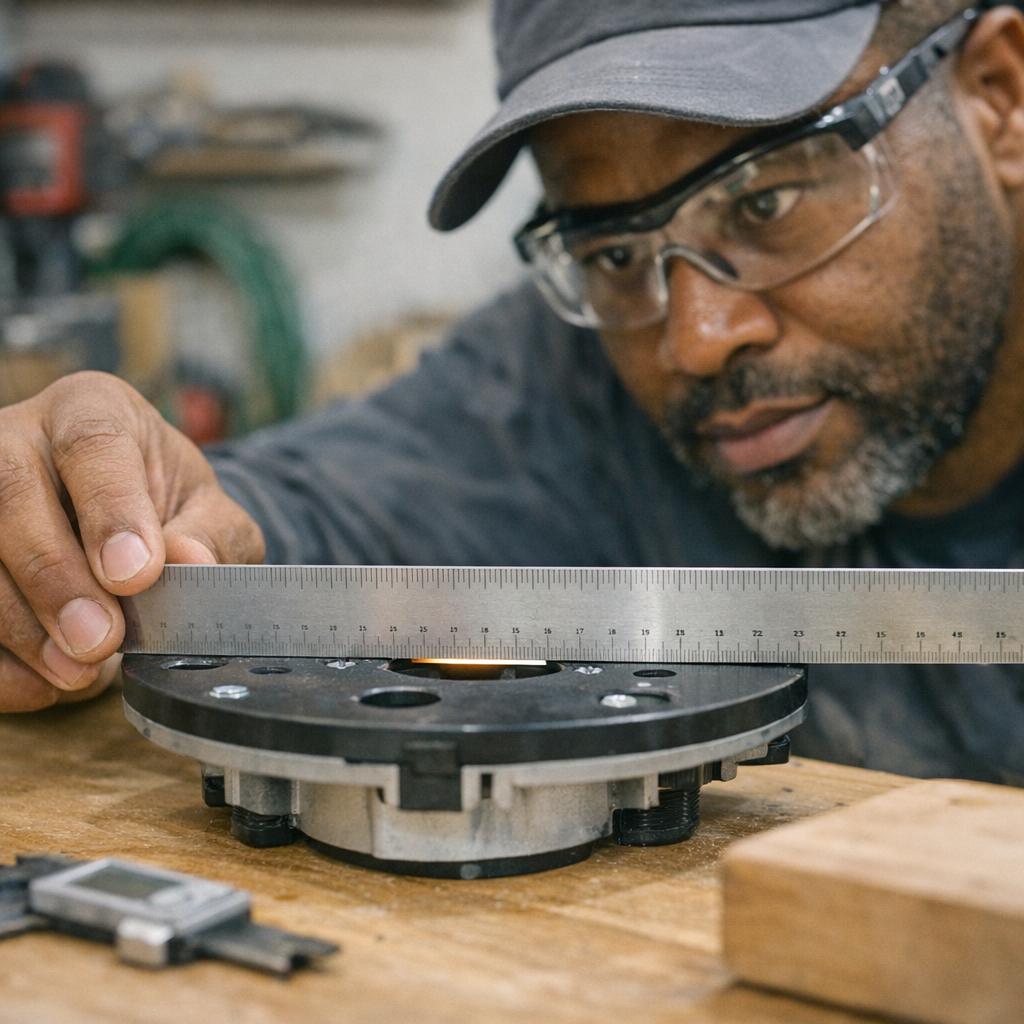
    The single most practical shift: check your router base with a straightedge before each big job—or after any drop, overtightening, or sudden stall. Lay the base plate on a dead-flat surface—the cast iron saw table, a scrap of thick glass—and sweep a metal straightedge across its corners. If you see daylight, especially more than 0.2mm, take action. Swap the plate, or set it aside for rough work. This isn’t fastidiousness; it’s a method to prevent unpredictable, costly rework, especially when deadlines and finish quality count.

    Shop-Worn Advice: Spend Small to Save Big

    Swapping a $25–$40 base plate stings less when you compare it to hours spent dressing seams on $100+ hardwood panels. Over months of production, the minutes recovered add up—less sanding, fewer rejected edges, more consistency across batches. In straightforward terms: a cheap base costs more in late-night rework and wasted materials than a replacement plate ever will.

    Saving Perfection for Where It Counts—But Never Ignoring Flatness

    If you’re doing demolition, quick rough-outs, or router work that’ll be buried under trim, a minor dip in the plate won’t ruin your week. But run architectural mouldings for repeat builds, or dress visible cabinet faces, and base flatness is non-negotiable. Smart shops keep a “runner” plate for finish jobs and a scratched, slightly warped spare for construction-phase mess. The distinction between the two? Visible results, not a clean spec sheet.

    Trouble Signs That Signal It’s Time to Inspect

    • Edges that suddenly dip or gouge during a run that started clean
    • Needing extra arm pressure to keep the router tracking true
    • Unexpected chatter, burn marks, or “catch and release” stalls
    • Panels that refuse to mate flush, despite careful fitting

    Especially in shared shops or high-traffic benches, a base plate’s true condition can change overnight—loosed screws, a single drop, or a tool that “walked” across a vibrating table. A two-minute check spares hours spent hunting the root cause of unpredictable, blunted results.

    The Payoff: Fewer Surprises, Smoother Workflow, Cleaner Results

    Achieving repeatable, professional work isn’t about chasing perfection on every tool or spec. But treating base plate flatness as essential—right alongside sharp bits and steady feed rates—can avert most headaches before they start. An extra glance with a straightedge lands you more predictable cuts, less fatigue from over-correction, and the sort of workflow where mistakes aren’t revealed at the finish line. It’s not a glamorous habit, but it’s one of the few that pays itself forward on every single job.

    Find more practical gear for router setups and shop work at Gumboll.
  • How Small Interruptions Disrupt Your Dog Care Routine and What to Fix

    How Small Disruptions Turn Daily Pet Care into a Chore

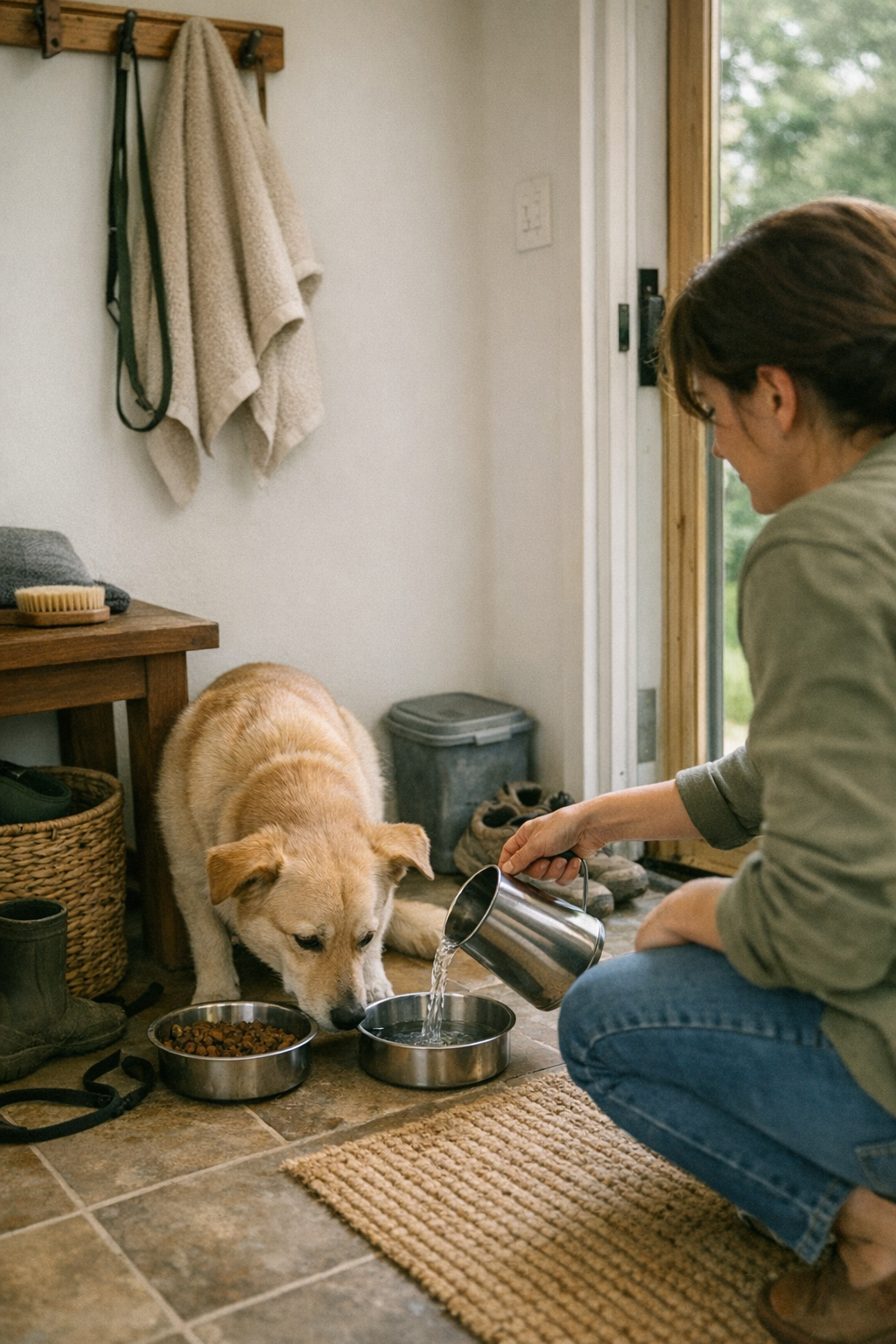
    Daily pet care routines break down fast when basic tools drift out of place. Reaching for a dog bowl at feeding time and finding only an empty spot—or grabbing for a towel after a muddy walk and realizing it got left in the laundry—costs momentum you don’t get back. Each missing piece turns an ordinary step into a pause, forcing search, reshuffling, or last-minute substitution. The result isn’t just one lost minute; it’s a routine that takes more effort, with small annoyances stacking up until daily care feels like a string of minor setbacks rather than a smooth, ordinary reset. Even when a space looks tidy, these gaps keep calm out of reach.

    Unlike an obvious mess that motivates a full clean, small disruptions stay hidden and keep repeating. You tidy the kitchen or corral dog gear with the right intent, but if the water bowl gets left to air-dry on the counter, or if wipes are buried behind other supplies, you’re running an obstacle course every time. The friction isn’t just about one missing item. It’s the way routines stretch, resetting in slow motion as you track down basics, repeat trips, and get interrupted by your own system.

    Everyday Scenarios Where Pet Care Slows Down

    Most routine drag shows up during basic transitions. After a walk, with leash and keys in one hand and your dog halfway through the door, the search for a towel adds visible stress. Do you drop everything and go looking, or let muddy paws trail across the floor? The same scramble happens during feeding if the bowl’s not back in its slot—meal prep stalls, and the easy automatic loop turns into a stop-and-start shuffle. The intention might be order, but if your storage habit means clean wipes are always in the third drawer or a grooming brush is blocked by yesterday’s shoes, “organized” isn’t much help.

    Even small layout flaws repeat their cost. A wipe packet just out of arm’s reach, a brush stored for looks instead of reach, or hooks so high you have to stretch every evening—these all slow you down, forcing small workarounds you start to dread. Over time, the daily reset turns from a two-minute check to a five-minute wander, with friction hiding inside ordinary moments.

    Hidden Delays Add Up Over the Week

    One lost towel or bowl feels forgettable—until you realize the same snag returns nearly every day. After walks, late-night water top-offs, or a quick brush before guests, the same gaps delay you. Each time, you make a mental “fix it later” note, but the fix rarely sticks if the system doesn’t change. As days stack up, these little inefficiencies grow, weighing down the routine you meant to keep simple and quick.

    Shared spaces make drift worse. Pet gear wanders between the entryway, kitchen, and living room as everyone moves things for convenience, but no one locks in a true anchor point. Soon, it looks tidy but functions slow: a towel always needing rescue, a bowl never on standby, a grooming tool that ends up everywhere except where it’s needed first.

    Why Tidy Doesn’t Always Mean Efficient

    A neat space can hide a cumbersome routine. Folded towels inside a closet look orderly but stall every walk with an extra trip. Bowls stacked by the sink look clean but force a detour before every meal if not proactively returned. What seems like calm is often just delay in disguise. In pet care setups, a system that “looks good” but breaks at the core action—the grab, the refill, the wipe—is a slow routine in disguise.

    Making Routines Resilient with Simple Resets

    The strongest setups let action flow, not just the look of order. Anchoring a towel by the door, not tucked away, means muddy paw problems get solved instantly and don’t trail through the house. A bowl returned to its counter spot right after washing means meal prep never starts with an empty search. Essential tools earn a daily-use place—in reach, at transition points. Even a basic reset at night, checking that towel, bowl, and wipes are realigned for tomorrow, prevents most friction from repeating.

    A five-minute reset at logical pauses—after the last walk or before bed—closes the loop, so the following return feels ready, not chaotic. That’s the difference between pet care feeling manageable and pet care feeling like another round of catch-up.

    Consistent Placement = Consistent Calm

    Consistency, not just tidiness, is what lifts hidden pressure from daily care. When a hook always has its towel, when basics always return to anchor points—not just wherever there’s a gap—interruptions dissolve. Over the week, steady return wins out over appearances. Real calm shows up not when the mess is hidden from sight, but when a routine delivers without last-minute improvisation or unintended scavenger hunts.

    In everyday pet care, it’s the steady rhythm—not the one-off deep clean—that makes homes easier to live in. Each time a basic reset lands a tool or bowl back in place, it cancels tomorrow’s friction and keeps the system working. The payoff isn’t just control, but a lighter, more workable daily flow that doesn’t fall apart when life runs busy.

    Learn more about simplifying pet care at CalmPetSupply.

  • Why Your Dog’s Repeated Exhale Changes Every Walk’s Flow

    Right before you reach the last corner on your dog walk, there’s a small, stubborn pattern: your dog lets out a deep exhale—same spot, same time. You barely notice. You hold a tangled leash, a clunky treat pouch brushing your hip, already thinking about the next stop. But that exhale is not random. Ignore it, and the rest of your walk turns from smooth to jerky, with more leash pulls, awkward redirections, and mounting friction that makes every return home feel heavier. Finding and handling these routine pressure points signals the difference between managing daily chaos and actually resetting both you and your dog—no matter how organized your entryway looks.

    Small Signals with Big Consequences: The Overlooked Dog Exhale

    Repeat the same loop enough times, and your dog’s pattern becomes obvious: leash slack near Mrs. Bailey’s fence, a pause at that weed-patch, the almost involuntary sigh just before the last block. You might explain it away as boredom, or shrug and walk faster. But if that sigh always shows up at the same place, it’s no coincidence. It’s a warning: friction builds here, and it quietly increases every outing.

    You see it less when juggling your own routine. Your leash hand is already twisted, the treat pouch tips off its hook, and your brain skips ahead to errands. Missing the exhale cue might seem harmless, but it’s the trigger point for the walk’s unraveling—little disruptions that don’t just vanish after a few steps.

    Friction Builds When Patterns Are Ignored

    The fallout is rarely dramatic at first. Maybe you grip the leash tighter, power ahead, tell yourself your dog “just needs a faster pace.” Instead, within a block, things get rougher: the leash tugs too early, redirection gets clumsy, every curb takes more attention. The easy, fluid rhythm of your best walks turns patchy. Repeat this for a few days, and every exit feels like starting over, with more mini-standoffs and less confidence you’ll finish with a calm dog.

    This is real-world friction: not just one big problem, but a slow build of micro-struggles. The leash doesn’t glide, your dog checks out and lags or bolts in tiny bursts, and every five seconds becomes a new decision point—none disastrous, all draining. The routine stiffens, not from mess but from a pattern that quietly takes over if ignored.

    The Feedback Loop of a Skipped Pause

    Skip your dog’s routine reset—like hurrying past the exhale marker—and you pay for it immediately: weaving around parked bikes becomes more reactive; the next “quick” pause spirals into a drawn-out sniff-and stall. By home, the outing is sliced into awkward segments instead of smooth progress. It’s not one big argument, but a dozen small stumbles that stack up and leave the routine feeling crowded and tiring instead of settled.

    It’s not about a single mistake. Miss enough of these micro-moments, and you’re caught in a loop of false starts and mounting friction—a walk that quietly wears both of you out, even when the distance is short.

    Why That Landmark Exhale Means More Than You Think

    Your dog isn’t sighing at that spot for no reason. The repeated exhale marks real boundaries: the edge of the habit zone, a trigger of anticipation, or the start of new distractions. It’s grounding—a dog’s way of bracing for the next stretch, whether that means meeting the neighbor’s dog at the fence or leaving the safety of familiar blocks. Miss it, and you lose your shot at a smooth reset right when it matters most.

    For owners, this signal is practical: push past it, and tension climbs. Pause—even briefly—and you watch your dog steady themselves. The choice is not between “training” and “indulgence,” but between compounding friction and quieting it before it spreads through the whole outing.

    Redefining Walk Flow—One Five-Second Pause at a Time

    You don’t need new gear or a major reset. Allowing a counted five-second pause at your dog’s “exhale landmark”—long enough for a sniff or a brief survey—immediately changes walk rhythm. Actually count it out, let the leash go slack, and give your dog a real moment to reset. Watch what happens next: leash tension drops, redirections get easier, and your walk stops devolving into a stop-and-go grind on the way home.

    This isn’t a lifehack; it’s repeatable cause-and-effect. Skip the pause and find the routine clogs up fast. Build it into most walks, and the downstream debris—tension, leash fumbles, mini-tugs, over-alertness at home—begins to clear. It’s imperfect, but so is dog life. The five seconds don’t solve every mess, but they break up the chain of friction that makes you dread everyday routines.

    The Difference Between “Looking Done” and “Feeling Smooth”

    The difference shows as soon as you leave your house: the setup looks tidy, but during a real exit, clutter finds you anyway. Leashes are “organized” but caught behind a basket. Treat bags are visible but require bending or shuffling. Steps are blocked by piled shoes or that one pool of toys spreading into walk space again. Everything seems in order until you actually need it, in the moment when you’re also supposed to notice your dog’s reset cue.

    This is the gap: a setup looks organized, but use falls short. Outside, the same thing happens—ignore your dog’s exhale-point and your walk seems fine for a minute, but stutters with accumulating tension. These frictions only rarely explode into big problems, but they quietly slow, clutter, and interrupt your routines every time.

    Where Setup and Routine Collide

    Even after you tidy up, friction returns: reorganized leash station or not, if the exit path means shuffling past the shoe bin or moving the crate to get to wipes, the routine will keep snagging. It mirrors the walk outside—prepping perfectly at home but blasting through your dog’s pause leads to the same result: pieced-together routines with bits of tension floating through the next transition.

    Practical Adjustments That Actually Change Your Walk

    Dog owners don’t want a complete overhaul every time daily routines feel off. The fix you’ll actually use—one you can repeat without extra drag—is the deliberate pause at those predictable exhale spots. Why does this small change work when others don’t?

    • It’s easy to spot when you start watching for it, and it’s the same place on every walk.
    • No guesswork or new supplies—the pattern is visible and repeatable.
    • You avoid importing friction into other parts of your routine—no extra gear shuffle or setup bloat.
    • Downstream mess, both literal (muddy paws, toy scatter) and behavioral (hectic re-entry, grabby water bowl attacks), fades without demanding a rigid, spotless system.
    • You can skip the pause on truly rushed days, but when built into the baseline, the benefit compounds.

    The goal shifts from extinguishing fires to restoring flow—reducing constant owner correction and allowing routines to hum along with less drag. Respond to the repeating signals, and the micro-fights shrink back, making walks (and reset moments) less of a struggle and more dependable, walk after walk.

    Going Beyond the Walk: How Small Signals Impact the Rest of Your Routine

    The effect travels home with you. A choppy, friction-filled outing means a wound-up dog, racing out of the leash into a spilled water bowl, flinging toys across hallways, or finding that towel you need for a muddy paw is behind a door you just closed. Every scramble at the walk’s weak point finds its echo as the day continues: feeding area gets disordered, grooming rhythm is interrupted, or crate time starts with extra resistance. The original missed pause sets off a chain of minor, avoidable resets.

    Addressing the walk’s repeating friction—by pausing and actually noticing your dog’s signal—means a smoother homecoming. The leash comes off with less drama, water and food stations stay in normal range, wipes or towels are reachable, and the next segment of your routine isn’t defined by more clutter and correction.

    What About Health Concerns? When to Look Closer

    In almost every case, a dog’s repeated, predictable sigh at one point on a walk is a behavioral signal, not a medical flag. If you spot sudden new patterns—real pain, persistent limp, or serious distress—always check with your vet. But the ordinary routine exhale is your dog’s attempt to manage and settle their own comfort zone during a walk they generally trust, not a sign you need to worry.

    Real Setup, Real Routine, Real Results

    What looks fixed on the surface doesn’t always hold up in real, repeat use. Organized leash pegs don’t matter if you can’t grab what you need without unblocking the path first. A perfect gear station can’t replace five seconds spent responding to your dog’s own signals. The setups and routines that actually work aren’t always the neat

  • How Routine-Based Bathroom Organizers Keep Skincare Counters Tidy and Efficient

    Bathroom counters rarely fail on day one. They fail after the third rushed morning, when your hand stalls in front of a wall of bottles—serum lost behind a larger cleanser, SPF nudging out of the lineup, half of your routine slowed by a micro-reshuffle. The surface might look “organized” after a fresh setup, but in real use, order gives way to daily friction: things migrate, overlap, block, and slow you down. If your storage isn’t mapped to the way you actually move through your routine, even the prettiest tray turns into an obstacle course by Wednesday.

    When “Organized” Isn’t the Same as Easy to Use

    The first night after reset, everything’s crisp—lined by height, brand, or color. But with two rushed routines, the system slides. Bottles crowd the front edge, smaller jars get pressed behind taller ones, and your evening treatment hides until you dig. In this clutter, steps blur: you’re reaching twice for a cleanser lost behind SPF, opening the wrong drawer to fish out a moisturizer, or shuffling three containers in and out just to reach the toner. “Organized” on the surface doesn’t stop the shuffle: cosmetics, creams, and tools drift faster than you expect—especially on shared counters or anywhere new items join midweek.

    Flat containers and open trays can’t hold the line. Even a simple bin loses shape once one item is out of sequence: SPF migrates to the night section, serums get blocked, and overflow collects at the one spot you use most. Under real-life pressure, visual alignment crumbles. The result: slower mornings, more resets, and a counter that demands maintenance simply to stay usable.

    The Real Friction: Routine Order vs. Visual Order

    Most storage solutions deliver “calm” at a glance, but not consistent clarity under pressure. The problem is structure: if storage doesn’t match the real sequence of your steps, retrieval slips. You grab for what was up front only to find it hidden, then have to double back, knocking other bottles aside. If you share the area, your return order interacts—morning routines blend into night routines, and soon the whole system is off track. Every “quick” reach becomes a minor delay. These aren’t just messy moments—they slow movement, break your flow, and replace small wins with repeated corrections.

    You can see it happening: you reach for your serum, find it behind a mask, nudge three tubes to get to moisturizer, or realize that your sunscreen drifted behind hair products. Sometimes you open a cabinet just to avoid a logjam at the counter. These micro-frictions are the warning signs—visible disorder pulling time and focus from your routine, making resets feel constant instead of occasional.

    Lived-In Chaos: Why Open Trays and Bins Slip

    Flat, open setups look fine on day one but fail the return flow test. Trays and bins trap order only when nothing moves out of line, which never lasts more than a few uses. With no built-in divisions, tall bottles lean and trap smaller items; small jars collect at the back, and the everyday shuffle collapses any logic you set. The result is a “sorted” surface broken by friction at every step: retrieval slows, resets multiply, and even simple categories become hard to keep apart. Under repeated use, showy neatness offers little defense against new clutter.

    Anchoring to Routine: What Really Keeps Order Under Pressure

    The setups that last map storage directly to your personal sequence: cleanse, treat, moisturize, protect. Divided organizers—with true sub-zones for each step—build in friction-proofing. When you reach, you grab the exact product, not just a random bottle from a grouped lineup. Sliding items back is almost automatic, since every spot is tuned to a repeated action. Shared zones hold up because the structure absorbs overlap: two people, different routines, same logic—each step protected from drift by its own division.

    This isn’t about looking organized; it’s about preventing drift before it happens. Over a week, you notice it: no pileups at the front, no digging for SPF at night, no wasted time re-clearing the path every day. Instead of a fake sense of order (that collapses on contact), you get tangible, real-world stability. Surfaces stay open for movement, even as products change or new routines join the flow.

    Real-World Example: Routine Flow vs. Return Chaos

    Picture sprinting through your routine, late again. You want to hit every step—cleanse to SPF—without doubling back once. A divided organizer lets your hand move left-to-right, item by item, with no jammed corners or blocked bottles. Returning each piece is almost mindless: you drop the tube back in its slot, not just wherever there’s room. No stack slides forward to block the faucet. No quick “I’ll reset this later”—because the reset’s built in. If you’ve watched your setup collapse from “sorted” to “fog of bottles” in four days, you know the cost: lost time, extra cleanup, and routines that feel heavier by Friday.

    Choosing Setups That Defend Against Drift

    Look for storage with actual divisions—adjustable slots, tiered trays, or modular compartments that fit your routine, not just your bottle count. Tall bottles won’t tip if their zones keep them upright. Short jars don’t get boxed in if dividers actually fit their footprint. Avoid relying on single trays: unless you rebuild the order every round, drift wins. Internal structure turns random drop-offs into predictable returns—even in the half-second put-backs that kill most systems. If your current organizer floods with overflow or never seems to keep categories straight, try simple inserts or small divider boxes: they create new boundaries for even the least disciplined return.

    A small upgrade—like adding subtle dividers or inserts—makes a real difference: less reset time, less frustration, more flow during repeat rush.

    Working with Shared and High-Use Counters

    Shared counters multiply the drift: what starts as a grouped back row quickly becomes a lumpy, double-stacked blockade around the sink. When people overlap—one putting items away, the other grabbing first-step products—category lines bleed, retrieval slows, and resets fall behind. Real defense comes from structure that absorbs overlap: mapped sequences and smaller, step-sized compartments mean one person’s mess can’t swallow the whole counter. If you always notice overflow at a specific section or find products gathering at the same trouble spot, it’s a sign: the zone’s too vague, or the layout doesn’t match the real pattern of use.

    The Line Between “Sorted” and “Stays Usable”

    Most counters pass the post-clean test. The real challenge comes four days in: can you find every item at first reach or do you have to chase down a toner that’s migrated or dig out an SPF buried under hair products? A setup built for actual habits—tuned to return flow, real retrieval, and shared pressure—doesn’t just look tidy, it holds up. Resets shrink from overhauls to a quick straighten. Movement through the area feels normal, not crowded out by drift or double-stacking. The payoff is real: more routine, less rescue, and a counter that actually fits the way you live.

    Gridry – practical storage for spaces you actually use

  • How Small Carry-On Changes Can Speed Up Airport Travel

    If organizing your carry-on only works until you hit the first airport line, you’re not alone. Most “packed neat” setups break down fast: the passport you stacked up front ends up under a layer of cables; the tidy pouch system translates to extra zippers to open at the tray; and what looked efficient at home turns into delays with every document check, repacking motion, and in-flight grab. When a bag’s order slows you down just as pressure builds—security, boarding, seat entry—you start noticing the gap between what looks organized and what actually runs smooth.

    When “Packed Neat” Isn’t “Ready to Use”

    A carry-on can look flawless on your bed—document sleeve placed “just so,” chargers wound tight, and all the right pockets zipped. But travel isn’t a static scene. The moment you start moving—bumping through a terminal, rerouting at security, switching trays—your carefully built order starts to get in your way. You unzip one pocket for your passport, but it’s wedged under your headphones. You grab a charger, but you drag out paperwork and coins with it. That top layer you planned for “quick access” quickly becomes a mixed jumble. Each layer means another pause—a fast process in theory, a slower one every time you repeat it under a deadline.

    The friction isn’t in visible clutter—it’s in reach and reset speed. Layering your ID under a pouch or letting travel docs share space with cables creates a hunt-and-peck routine. Each required item triggers a mini-scramble, and every “convenient outer pocket” turns unpredictable as soon as one access resets the order you thought you built.

    Real Carry-On Friction: Scenes That Repeat Themselves

    The Airport Security Stall

    Security is a display of just how fast an organized carry-on can come undone. You’re next in line, sure you left your passport right on top—until your hand closes on a charger first, and a charger tangle brings the whole contents closer to spilling into the tray. The zipper barely closes. Toiletries, meant for the top, have slipped toward the middle. That “system” that looked ready at home now exposes you at the checkpoint—retrieval isn’t instant, and behind you, the shuffle builds. The more you try to move fast, the more items migrate under pressure.

    The Boarding Lane Shuffle

    Boarding time. Your compartment for documents now hosts sanitizer, receipts, and a power cable that wasn’t there five minutes ago. Instead of a quick reach, you fumble—hand half-blocking the aisle, bag half-open, aware of the line waiting for you to finish. Even if nothing spills, you sense the layout just got messier. The next access will be slower unless you reset everything on the spot—or live with the growing backlog.

    Crammed Overhead and Compounding Repack

    Now at your seat, juggling overhead space, you face a choice: overstuff your “grab zone” pocket so everything is close (but jammed and friction-prone), or risk stashing crucial items out of reach—guaranteeing you’ll have to stand and retrieve, then repack, mid-cabin. Grabbing one item shifts the rest, making the compartment a puzzle to close again. The packed-tight strategy that saved space is the same one that multiplies annoyance every time you repack during connections, takeoff, or arrival. By day’s end, the structure returns visually, but function lags with every small reset. The bag looks in order but feels slower with use.

    The Subtle Slowdown of Overlapping Setups

    Most travel friction isn’t a disaster; it’s a sequence of access delays that pile up, raising the drag of every routine move:

    • Pouches drift and bury your travel wallet under bulkier items.
    • A “top-level” document pouch now sits wedged below headphones or became wedged sideways in the shuffle.
    • Cables slide out of designated slots, trailing from “overflow” sections every time you reach.
    • You pause, trying to reconstruct which zip pocket got your phone this time.

    Each of these slowdowns feels minor, but the weight is cumulative. You end up shouldering not just your bag, but the mental load of re-sorting, remembering, and correcting. The common theme: travel smoothness gets blocked because overlap and multi-purpose pockets pull your setup apart in pieces with every use.

    Outsmarting Slow Access: Small Tweaks That Change Flow

    The answer isn’t just repacking tighter or stacking more things together; it’s about separating the actions that matter most. Assign each high-frequency item—passport, boarding pass, phone, charger—its own outside-facing pocket or pouch, with zero overlap. No doubling-up with snacks or coins, no cross-function pockets. What looks less engineered for symmetry suddenly works for speed.

    For example, a slim outer zip holds only travel documents—nothing that moves, nothing with a cable. The charger sits in its own mini sleeve inside a side pocket, not shared with pens or chewing gum. Security becomes a direct move: passport out, tray done, passport back before the next shuffle. Boarding is a single quick reach, not a rearrange-the-bag event. The crucial point—each retrieval resets only what you touched, instead of shuffling the whole pack. Stress is cut not by discipline, but by structure.

    Why “Easy to Reset” Beats “Perfectly Packed”

    It won’t win for appearance—outer pockets and minor bulges might look unstyled—but ease of reset pays off again and again. Every layout that avoids overlap keeps you from returning to square one at each checkpoint. Less fixing, less remembering, more flow. One concrete sign: you no longer second-guess where things are as you roll between gates or re-board the train. The travel guesswork vanishes because the bag interior stops moving around on you.

    Signs Your Carry-On Needs a Reset

    If any of these show up in your routine, your carry-on setup is exposing its real limit:

    • You wonder what will tumble out before you unzip a front pocket.
    • The same cable slips, tangles, and reappears where you don’t expect it.
    • Your documents hide behind new obstacles every time, even though you “put them on top.”
    • Each minor repack pushes must-have items deeper until you lose the order entirely.
    • The boarding line stalls behind you—and the problem isn’t slow hands, but layout-induced scramble.

    The difference after one structural change: Partition each must-reach item into its own consistently returned pocket or pouch, and regular airport routines stop grinding. No repeated unzipping, no search-and-recover, no multiplying “just a second” apologies with every move.

    Practical Setup: What Works Repeatedly

    The setups that hold up through actual travel are the ones designed for repetition, not just for first-glance order. That usually means outer pockets that only ever hold travel documents and are cleared of everything else; quick-reach pouches that never double as cable bins; tech and chargers kept distinct from paperwork and receipts. The point isn’t perfection—it’s an arrangement you don’t have to rethink each time you pass through a terminal, switch seats, or stand up for another gate change.

    The real payoff is mid-trip, not pre-departure: fewer micro-fixes, less escalating drag, and a bag that gives you the same easy access at your connecting gate as it did at your first. You won’t banish every travel delay, but you will avoid compounding the slowdown—and in airport terms, that’s the kind of order that keeps you moving.

    See practical carry-on tools, pouches, and travel access accessories at CarryOnSupply.

  • Creating Seamless Storage: How Closed Loop Systems Transform Mudroom Organization

    Mudroom Storage Frustrations: When “Organized” Isn’t Enough

    Walk through the door, arms full—your keys, the dog leash, at least one bag slipping. The mudroom bench, lined with crisp baskets, promises calm. But it’s a promise with holes. By the third day, the baskets start sticking, stray shoes wedge themselves sideways, and every “quick reset” becomes a juggling act. Each extra step—pulling out an overloaded bin, scooting boots that never quite fit back underneath, rescuing lost gloves mashed beneath a bag—chips away at your patience. Over time, the setup isn’t helping you; it’s just a new source of stress, camouflaged as “order.” The mudroom that should smooth out the chaos of family life quietly becomes another friction point—a spot where you dodge clutter instead of corralling it.

    The Closed Loop Advantage: Storage That Actually Stays in Sync

    A real “closed loop” storage setup doesn’t make you think. You grab what you need in a single step. You put things back just as easily, without clearing a path first. No puzzles, no wrestling baskets or shifting a mountain of winter boots to shove your work bag into place. In real life, any system that makes you rearrange, stack, or hunt simply falls apart. The mudroom can’t reset in a hurry—and the mess seeps out, spreading to hallways and kitchen counters.

    Friction in Action: Where the Mudroom Slows You Down

    The routine glitches are small, but relentless. Your sneakers are behind three pairs you don’t wear, so you reach, knock a stack sideways, and promise yourself to “fix it later.” Kids empty backpacks onto whatever surface is easiest, because opening (or even finding) the “right” bin takes too many steps. You spend more time moving things out of the way to get to your actual shoes than you do walking out the door. Over days, the storage looks managed—but it never actually functions the way you need.

    Mudroom Benches: The Real Test of Cubbies vs. Bins

    Bins seem like tidy magic—until you use them daily. Pull-out bins look organized, but with hands full or boots dripping, the extra motions are a dealbreaker. You need both hands. You have to set things down to open the bin. If there’s a traffic jam—basket blocked by a pile of shoes, or a bin too tight against another—all momentum is lost. The hidden mess gets shifted, not solved: shoes pile on benches, soggy gear gets abandoned anywhere flat, and after a week the “perfect” setup is undone by a handful of small, repeated hassles.

    Open cubbies fix some of that. You can toss shoes in without breaking stride and grab them on your way out. But nothing really stays separated. Dirt is in plain view, shoe pairs go missing, and sandals migrate to the “work shoes” zone by Wednesday. In reality, both bins and cubbies unravel if the design doesn’t match your daily move-grab-return rhythm.

    Scene From a Rainy Week: The Mudroom Bottleneck

    Picture this: you come home soaked, balancing groceries and a laptop bag. The entry is already choked with shoes left askew, that “easy to access” bin is wedged in place, and you have no spare hand to wrestle it out, so your wet shoes end up on top of whatever’s nearest. Flip this scene for every after-school drop, every muddy soccer gear dump, every time the laundry basket detours through the mudroom. You don’t need dozens of examples. Just one routine interruption, repeated every day, is enough to turn “organized” into yet another ongoing headache.

    It’s always the smallest resistance—a stuck bin, a shelf just out of reach—that kills the habit of putting things back.

    Flow Over Perfection: A Storage Shift That Actually Helps

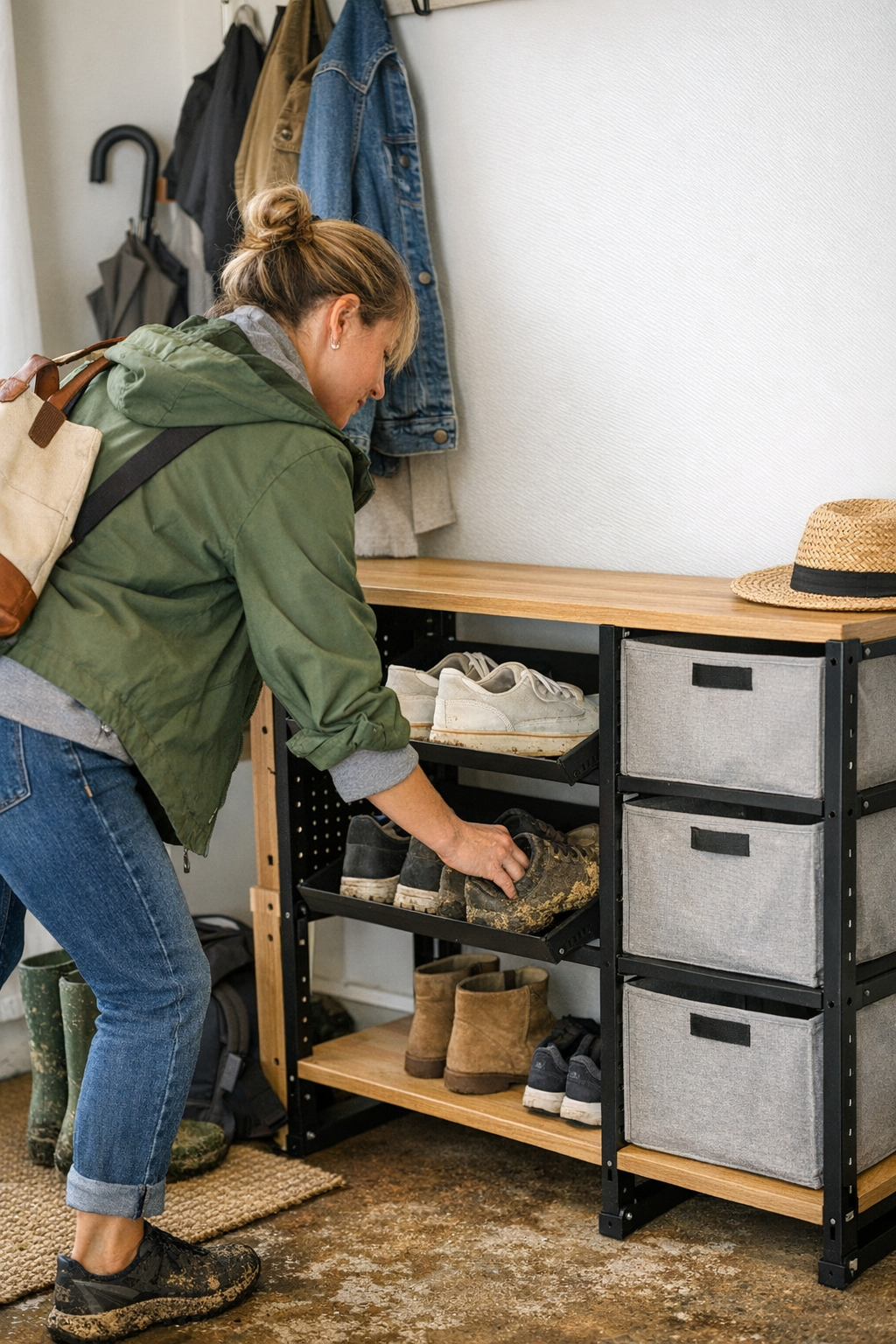
    Here’s the real upgrade: swap those deep bins for angled shelves or open, shallow cubbies. Suddenly, access is direct. Shoes slide in and out—no scavenger hunt, no multiple hands, no bending or stacking. Designated spots emerge naturally; cleats and boots aren’t creeping into slipper territory. Every pair stays visible, so three-minute resets stay three minutes, not thirty. The result isn’t picture-perfect, but it is fast— and that’s what actually keeps the space under control.

    Ease Drives Real Habits—Not Just Neatness

    Forget aiming for the showroom look. The best system is the one that works on a Monday morning just as well as Sunday night. When putting something away is consistently easier than leaving it out, clutter fails to get traction. If it takes another step or a spare hand to reset, you’ll skip it. The real test isn’t appearance, but whether the right spot feels obvious even during the daily rush.

    Is Your Storage Setup Working—or Getting in the Way?

    If your mudroom feels like a battle zone, check for these friction points:

    • You have to move shoes or bags just to return something to its “spot.”
    • Shoes gather around bins, never quite inside them (or bins are always half-open).
    • Piles reform overnight, no matter how many times you organize.
    • Return paths are crowded—every surface attracts stacks instead of staying clear.

    Each extra motion is a sign you’re fighting the setup—not being supported by it. Over time, any excuse to skip resetting becomes the new routine.

    Cubbies or Bins: Which Survives Real-Life Use?

    Bins hide mess and hold grit at bay, but only if you can reset them in seconds. If you’re frequently in a hurry, bins become one more thing to move or reposition—and lose their appeal fast. Open shelves or angled cubbies make resets nearly automatic, even if they reveal a little more daily chaos. The goal isn’t showroom order: it’s a mudroom where things return to their place between uses, instead of migrating into the rest of the house.

    The Cost of Small Obstacles: How Tiny Hassles Become Big Clutter

    The cracks always start small—a bin off track, a shelf that’s too deep, a pile that never fits quite right. Soon, whole zones lose definition, categories mix, and putting something back becomes a workaround. Instead of discipline, you get improvisation. Shoes go wherever, bags stack in corners, and the mudroom shifts from organized to overwhelmed, one semi-blocked return at a time.

    Long-lasting organization isn’t about perfect lines—it’s about setups that survive repeated, messy, real use. If resetting isn’t easy, the system won’t last past the first week.

    Noticing Trouble Before It Spreads

    Overflowing bins and scattered shoes are only the final warning. The first clue is slower resets: you sigh before organizing, or leave one item undone every day. Certain surfaces become magnets for clutter—no matter your hopes. These are the signals that your storage design is getting in the way of daily life. Instead of blaming motivation, look for where things stick—literally or figuratively—and experiment with removing just one obstacle. Often, it’s that simple shift that keeps the rest of the room from caving in.

    A Real-World Tweak: Keep the Put-Back Path Open

    Want to fix almost any storage pain point? Focus on the return route. If there’s something to move—another bin, a fallen boot, a shelf too crowded—no one resets as they go. Make the direct path to “put it back” totally clear, even if that means rearranging shelf heights, ditching a bulky basket, or swapping in a row of hooks. When the return is always obvious and nothing’s blocking the way, the odds of staying organized skyrocket—especially when life gets busy.

    Storage That Works Because You Actually Use It

    No mudroom holds perfection, and no storage solution stays pristine. What matters is steady, low-friction resets: you grab, you use, you return, and the space recovers—again and again. The right setup shrinks the steps, removes hesitation, and adapts to the real chaos of daily life. That’s the only kind of “order” that lasts, even as seasons and routines change.

    See practical storage options at ClosetWorks

  • How Thoughtful Pet Travel Setup Eases Repeated Stops and Rest

    Your pet travel bag may look prepared when you leave, but the first real stop usually exposes the flaws. In the driveway, everything seems “set”: leash coiled, treats zipped, wipes and water bowl wedged into assigned spots. Fast forward to the first parking lot break—suddenly, the leash is snagged under a shifted water bottle, the treats are buried beneath wipes you just used, and you’re fumbling through mesh pockets with one hand while steadying your pet with the other. What started out as “organized” quickly turns into a routine of digging, untangling, and reshuffling. If your pet setup makes you hunt or disrupt the bag after every minor stop, those frictions keep stacking up, dragging down even short trips and making quick restarts more stressful on both you and your pet. This is the split between what looks tidy and what actually holds up—an everyday fail point that signals why structure matters more than a clean-zip start.

    Why “Neat and Ready” Isn’t Always Enough

    A travel bag that looks sorted is rarely ready for repeated use. After the first or second stop, the gaps in your system surface: a leash hidden under bedding, a half-collapsed bowl locked in by a seat, wipes shoved deeper after a rushed cleanup. A setup that takes even ten extra seconds to access adds up fast—each interruption throws off your flow, your focus, and your pet’s calm. By the third shuffle, the “organized” feeling is gone, replaced by a low-level annoyance that leaves both hands busier than they should be.

    Packed doesn’t mean functional. Neat cubes, zipped pouches, and matched sets can stall when you actually need a single piece in a hurry. Under pressure, the flaws in organization become obvious—especially when each stop looks simple, but the restart routine keeps growing messier with every round.

    Real Friction: Where the Setup Stumbles

    Access Delays Creep In

    The first stop tests your plan. Maybe you reach the treats or wipes with no effort. But by the next use, small changes derail the system: the leash falls deeper into a bag corner, the wipes slide out of view, essentials are pinched between blankets or crowded by your own items. Good organization breaks down not with dramatic accidents, but with repeat access—turning brief pauses into knotted searches and awkward, one-handed contortions while your pet circles and waits.

    Blocked Quick Access in Real Use

    Consider that water bowl you stashed in a side mesh pocket—fine at home, but now wedged against the center console, impossible to reach without pulling half the bag out of its place. Or treats intended for quick rewards buried two compartments deep, so every stop means one hand rummaging while the other holds a leash. It’s not mess, but misplacement—pockets and sections that seem clever until repeated shuffling turns the bag into a slow-motion puzzle.

    The Hidden Cost of Overlapping Items

    Most “sorted” setups hide a problem: owner and pet items overlap, forcing constant reshuffling. A leash sits under wipes, treats migrate behind your wallet, your phone sits next to the waste bags. Every time you open the bag, you’re greeted by a previous move, now out of place. Rather than one-time inconvenience, it’s a cycle—repacking the same section after every routine action. What was “in its place” now feels like a restless tray, always being rearranged instead of ready to move.

    Compounded Strain Across Multiple Stops

    The pain point grows with each restart. You plan for a quick leash clip and wipe grab—then find the leash migrated under your jacket, the treats are deep in a pouch, and you’re juggling bag, bowl, and impatient pet while trying not to spill your own stuff. Rarely is the strain visible from outside; you just feel focus draining and the routine stretching, with your pet reading every second of delay. That’s when a “neat” bag finally unravels: it’s not the storage that breaks down, but the ability to keep your hands moving smoothly from stop to restart, again and again.

    By stop five, you know: nice arrangement didn’t make up for slow access. The moment requires more work, more handling, more micro-adjustments. The bag is not a mess, but you’re still fighting it—and so is your pet, who now reacts to every extra step you didn’t expect.

    What Actually Fixes the Routine

    The difference isn’t better packing—it’s setup that keeps essentials isolated and instantly reachable, even on repeat. Moving wipes and treats out of mesh pockets and into a dedicated, top-access compartment ends the multi-step dig. Swapping hidden leash rings for a genuine exterior loop lets you grab and attach or detach on the fly, without shifting the whole carrier. The trick: single-move grab zones for whatever you touch most, structured outside the main jam of shared space. Clean-up, comfort, and control each get their own spot—so you don’t have to hunt.

    This is not about achieving a perfect look, but about a system that stays fast and stable by the fourth stop as well as the first. It’s a small but real reduction in handling time: less grasping, fewer resets, and a routine that favors one-step movement, not repeated fidgeting. What holds up isn’t tidiness, but return-to-motion speed—even when the car is packed, your pet is restless, or the pit stop cuts into your planned timing.

    Seeing the Difference: Real-World Examples

    Scenario: Pulling Over for a Fast Cleanup

    You hear the scrape of a tipped water bowl. Wipes are somewhere—are they under the blanket or next to the carrier wall? If their pouch is hidden, you’re halfway through the bag, waving your pet aside and dragging out blankets, losing the window for a calm reset. But with a single-exposure pocket right up top, the wipes are out in seconds, mess is handled, and you’re back in motion before your dog gets jumpy or your own patience wears thin.

    Scenario: Repeated Reach for the Same Item

    Each time you stop to reward your dog, treats are harder to reach. First time, easy grab. By stop three, they’re blocked by a sliding bowl or pressed under owner gear. Constant rummaging distracts you and interrupts the reward. Shift those treats forward—into a solo grab-and-go section instead of a crowded mesh or combo area—and the rhythm changes. You get to reward, reset, and move without friction, and your dog quickly recognizes new stops as reliable, not uncertain.

    Small Adjustments, Big Returns Over Time

    The setups that work aren’t just tidy—they’re built for constant, friction-free repetition. When quick-use items are on their own turf and flows match real routines (open, grab, clean, restart), even minor stops feel controlled. You minimize the overlap between your things and your pet’s—so there’s less backtracking and fewer mistakes every round. The change isn’t in a visual upgrade, but in movement: fewer hands lost to sorting, less pet restlessness, and less second-guessing at every stop.

    By your tenth trip, a setup designed for repeat reach and one-handed control beats appearance every time—especially when each stop can either grind or glide, depending on what your bag actually lets you do. Mess can be managed anywhere; access and flow decide if travel is really easier on you and your animal.

    Find travel setups that handle real movement at PawGoTravel.

  • How Small Car Clutter Creates Driving Distractions and How to Fix It

    Looks can fool even the most experienced driver. On Sunday, a cleaned-out car feels ready—every cable neat, every bin in place, nothing cluttered. But midweek, that same car turns into a silent stubborn opponent: phone cables snake back into the footwell, storage bins slide at every turn, and tissues migrate until they’re wedged out of reach. The “organized” look means little when every entry or exit triggers the same micro-battles. The real problem isn’t dust or visible mess; it’s setups that fall apart the minute you put your car through normal weekday routines. For anyone who wants their drive to run smoother, these friction points—hidden until you use the car repeatedly—signal the difference between cosmetic order and function that holds up. The difference sets the tone for what DriveWellSupply solves every day.

    Why a Tidy Look Doesn’t Mean a Seamless Drive

    It’s easy to celebrate an interior that looks settled after five minutes of tidying—until your routine exposes what’s missing. Monday: cords tucked, bins balanced, tissues where you swear you’ll reach them. By Thursday, the same charger blocks pedal access, pens vanish under the seat, and you’re stretching for tissues that slid across the cabin after only one turn. The signs are all physical: that tug when you unhook a cable caught around your shoe, small containers edging across the floor, groceries or backpacks shoving essentials out of position. What started as “organized” becomes a reset loop—especially if your week stacks up with errands, kids, or quick work stops.

    The Hidden Cost of Drifting Essentials and Loose Cables

    Your real setup weakness doesn’t show at first. First drive after cleaning: every cable routed clear, floor mats lined up, quick-grab items right where you want them. By midweek, routine pressure tells the truth—charging cords wander, bins nudge into new territory, and a simple backpack drop creates tangles or sends gear underfoot. Each return to the car means shifting cables (again), sweeping hands for that tiny item now out of sight, sliding mats back by a few inches, reclaiming sunglasses from impossible gaps. Anything unanchored keeps moving. Over several stops—school pickup, groceries, routine parking—what mattered most on Sunday was supposed control. What matters by Friday is how much annoying rework your system causes.

    When “Organized” Slows You Down

    Most people accept some version of a sensible setup: organizer bin up front, charger lines tucked, daily items within reach. But practicality dissolves under normal driving. Inside a week:

    • Storage bins that don’t grip drift toward feet and pedals, scattering their contents or causing slowdowns as you reach down mid-parking.
    • Loose phone cables and mounts cross into your bag drop zone, snagging every tote, lunch bag, or coat tossed onto the seat.
    • “Contained” trash or small items slip loose, so wrappers and coins roll out somewhere you can’t reach quickly enough.

    Even after cleaning, exits run slower: cable slack snags around a purse, bottles wedge onto floor mats, small bins need adjusting—often before you can even start the engine, let alone hurry off.

    How Recurring Friction Sneaks In

    One missed detail returns with every loop. Maybe it’s a tissue box that won’t stay put, a coffee cup on a permanent migration under the seat, or a cable that circles back to the floor after every drive. None are dramatic, but each steals your focus just long enough to interrupt flow. You realize: the car isn’t truly “in order,” because each trip you do the same quick fixes. The more you rely on the vehicle—work commute, family errands, repeat stops—the more those tiny obstacles stack up. Instead of seamless transitions, it’s ongoing mental and physical drag—reset, reposition, dig out, unplug, retuck. An interior can look neat and still produce low-grade annoyance every time you need to get moving fast.

    Putting Structure Where It Actually Matters

    Real improvement only starts when your setup answers repeated-use pressure. Choosing “organizers” by look alone misses the point; what you need is stability when your schedule gets busy and your hands are full. Long-lasting setups take shape around physical anchors and thoughtful structure.

    Real-World Tweaks That Make a Difference

    • Weighted edge organizers with cable guides stop liners and wires from drifting into hazardous or inconvenient spots—so when you reach for your phone, nothing catches, uncoils, or slides underfoot.
    • Non-slip bins with raised edges lock against seat bases for actual containment. Stops and corners no longer launch essentials across the floor, and cleanup drops from minutes to seconds.
    • Clip-based or slotted cable routing keeps charger lines accessible but never in the way, dodging snags on gear shifts or bag drops—removing that daily negotiation with your own charging setup.

    The winning pattern isn’t “more features,” but direct blocking of every little drift, tangle, or clutter your routine keeps exposing—a realistic answer that stands up to repeated entry, not just staged photos.

    The Real Test: Does the Setup Hold Up to Daily Life?

    Forget launches and labels—how long before you’re fixing the same mess? That’s the real test. Switch to a weighted organizer, lock down cable sprawl, use bins that stay put, and after a week you’ll see: sunglasses still within reach, cords never need wrangling, and the ritual scavenger hunt fades. More critically, your mind is on work or dinner pickup, not on untangling your own car before every drive. The space no longer resists: nothing slows you down, switches get hit, bags unload fast, and you spend zero time staging a return to comfort.

    From Visually Managed to Actively Easier

    Sharp interiors don’t guarantee an easy drive—sliding organizers, tangled chargers, or bins that refuse to stay in place turn “tidy” into tedious. The difference is friction: does your protection or containment block problems, or just pause them? Choose structure over appearance. Secure the hazards, anchor the distractions, and your car stops being almost-ready for use. Suddenly, even after a dozen short hops or a rush-hour dash, every return is smooth and non-eventful. That’s the proof that a better setup is less about having a clean look and more about always being ready to go—no matter how full, fast, or unpredictable your week gets.

    Find practical car-use solutions at DriveWellSupply

  • How Thoughtful Lighting Choices Solve Everyday Home Visibility Challenges

    The right indoor lighting is less about what draws compliments—and more about what stops you from stumbling, squinting, or second-guessing every time you pass through a room. Look at the hallway you rush down ten times a day, the bathroom mirror where your face always looks off on one side, or the spot in the laundry where no matter how much you clean, a shadow masks missed dust. For most people, the gaps don’t show up until a light fixture turns routine movement into a minor obstacle—hesitation on the stair turn, double-checking the counter edge, or nudging closer to a too-dim mirror. It isn’t the wattage, or the style. It’s whether lighting actually covers what you need— and stops hiding weak spots that slow you down or make you adjust how you move.

    Recognizing Small Lighting Setbacks in Real Life

    Poor lighting doesn’t always scream for attention; it just quietly interrupts. Maybe you pause at a stair turn because the bottom step blends into darkness. Maybe you lean at an awkward angle to see your chin in the mirror. Maybe you wipe a countertop twice because the side nearest the fridge sits in shadow. These aren’t dramatic breakdowns—they’re the friction points that keep cropping up because the fixture isn’t built for this room, this routine.

    Even a new fixture can backfire. That “bright” flush mount at the center of your hallway may look balanced at first, but cross the threshold at night and the walls near the door still blur out. Carry a bulky basket down the stairs, and suddenly the lower steps dip into gloom, making the trip feel like a risk—especially when your hands are full. Style and brightness can’t compensate for spread that misses key zones or for shadows that get sharper over time.

    Why Brightness Alone Doesn’t Solve the Problem

    Rooms can look bright on paper and still leave you struggling in daily use. Step into a hallway: the middle glows, but each end fades after dark. Overhead lighting in a bathroom turns your reflection into an uneven study—face washed on one side, shadowed on the other, and skin detail guessing in the gloom. In laundry or mudrooms, a strong ceiling light gets fogged up by humidity or steam, leaving you hunting for corners and refolding clothes you thought were sorted.

    Then there’s glare— the quietly aggressive mistake. A fixture at the wrong height tosses harsh light straight into your eyes at every pass, especially on stairs or in narrow corridors. Movement slows; you find yourself looking away from the steps, not at them. Instead of making you feel confident, the space throws tiny jabs of uncertainty every hour.

    Repeated Routines Reveal Lighting Weaknesses

    The wrong lighting doesn’t just fail once—it makes its presence known every day. Each routine exposes the unresolved edge:

    • Crossing the hallway: The center’s bright, but open the door and your eyes strain to catch the shadowed edge.
    • Stair use: A single fixture centers the glow, but the last step blurs at dusk—making you slow down or pat with your foot.
    • Mirror use: Light drops off on either cheek, so you tilt and shift, searching for evenness in reflection.
    • Laundry: Steamy air dulls the bulb and you end up missing lint piles or struggling to see if a sock matches the rest.

    Each friction is small—none are deal-breakers. But that’s what makes them costly: they don’t demand a fix, so you just work around them, and the irritation compounds until you find yourself dreading a part of the house that should be automatic.

    Smart Upgrades: What Actually Helps in Daily Use

    Lighting upgrades that stick aren’t about chasing trends or cranking up the wattage—they’re about matching light spread, placement, and fixture build to the room’s demand. Practical clarity beats out aesthetics in every real test: how it feels after weeks of traffic, not just for the first “wow” after installation.

    Hallways and Stairs: Filling Gaps, Not Just the Middle

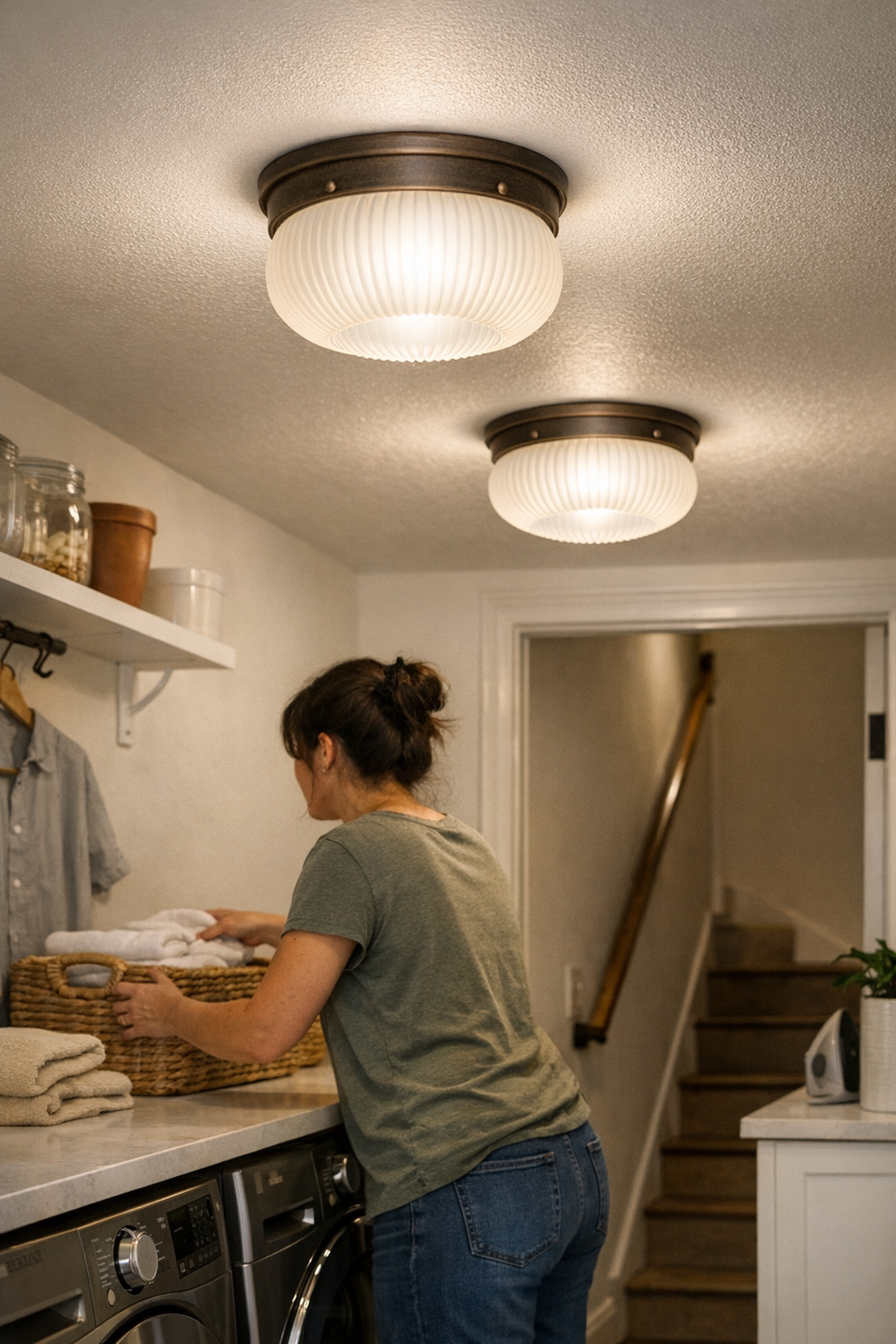
    The most visible fix in long or turning hallways is distributing light so movement feels automatic, not careful. Shifting from a single central flush mount to a staggered pair of damp-rated ceiling fixtures fills the dead zones—eliminating dim corners, making each rise and run obvious (even when your arms are full or rain clouds darken the space). That hesitation at the stair turn vanishes; people walk without slowing, and it’s easier to land shoes where they belong instead of tripping over what you can’t see.

    Bathroom Mirrors: Even Reflection Wins Over Watts

    A single overhead bar turns grooming into a guessing game, with clean light in the middle and darkness at the cheeks. Adding sconces or side-mounted mirror lights brings both halves of your face into the same clarity—suddenly, you’re not craning your neck or shuffling side to side to get a true reflection. The payoff isn’t luxury; it’s reliability—shaving or makeup is straightforward, and the bathroom mirror stops being a source of doubt.

    Laundry and Utility Spaces: Battling Humidity and Glare

    Standard ceiling bulbs in laundry rooms lose the war against heat and humidity by midweek. A damp-rated panel fixture, built for steamy air, throws steady, diffused light across the counter—no glare on the appliance lids, no faded corners, and no more squinting to tell if a shirt is actually clean. Things look even and sorted, even under the worst conditions.

    Tips for Making Lighting Work for You

    • Check visibility in all conditions: Don’t rely on that first impression. Walk through at dusk, after a shower, and on grey days—weakness appears at different times.
    • Map fixtures to habits, not just to the plan: Watch how you cross, reach, or turn in the space. Place lighting to support those exact moves (especially for stair ends, mirror sides, and far counter edges).
    • Don’t risk cheap fixtures anywhere humidity lingers: Even non-bathroom spaces need damp-rated options if fog, steam, or laundry heat ever build up; ordinary bulbs degrade and shadow new spots.
    • Lead light away from eyes, not against them: Adjust direction and placement to avoid glare, especially where you walk straight toward a light (end of hallways, stair turns, utility sinks).

    When a Lighting Fix Sticks—What That Actually Feels Like

    The best lighting is the setup you notice only when it’s gone—the steps that are clearly visible even with your arms loaded, the mirror that’s never a guessing game, the counter that stays obvious edge to edge after a full round of chores. Frustration fades, movement becomes automatic, and small compensations you didn’t realize you were making simply disappear.

    Well-chosen fixtures don’t call attention to themselves, but their benefit shows up every time you cross the space or stand under them—not at installation, but after the routines that real lighting is built for.

    Explore more practical lighting solutions for everyday spaces at LightHelper.

  • Flexible Plug-In Lighting Solutions for Dynamic Indoor Spaces

    That “clean” ceiling or wall light you wired in for a perfect look? Once you start actually using the room—moving a desk, adjusting a monitor, or sharing the space—its limits show up fast. Fixed fixtures and smooth surfaces may look resolved, but each small change exposes an awkward reality: your lighting is locked in place, while your routines keep moving. You can sweep away cable clutter, but not the hassle of chasing usable light once the setup no longer fits the way you work or live.

    The Invisible Hassle Behind the “Clean” Lighting Setup

    Hardwired ceiling lights and sconces promise a cable-free, uncluttered surface. They look decided—no adapters hanging, no cords trailing anywhere. But the real test isn’t the photo; it’s what happens after the first month. Angle your desk to dodge late-afternoon screen glare, try reaching the far edge under a shallow shelf, or let a new stack of books block the beam: suddenly, you’re left with dim corners, glare lines you can’t escape, or work areas that stay in shadow. Shared desk spaces turn the problem up—every routine shift means someone’s forced to make do in subpar light, or just stop moving things altogether. The “fixed” calm begins to feel like hidden friction every time your habits change, even if only slightly.

    Plug-In Lighting: Flexibility Gains and the Trade-Offs That Follow

    Plug-in desk lamps and LED strips cut installation to the basics—plug, position, adjust. You skip drilling holes, you sidestep rewiring, you dodge wall damage every time you need a fresh angle. The catch is immediately visible: cords snake along the table, adapters surface near outlets, mounting brackets sometimes sit in plain sight even when you want them to disappear. It’s a trade—visual clutter for functional relief.

    But if you’re actually shifting seats, sharing a table, or flipping between tasks, this kind of adaptability quickly pushes ahead of any downside. The light moves with you, not against you. You slide a lamp toward a meeting spot, drag an under-shelf strip to brighten last-minute paperwork, or tip a shade for a new camera angle—in seconds, not with tools or disruption. With fixed lighting, those small pivots would mean living with always-off-point beams, or endless hesitation before actually using the space for something new. Flexibility trumps tidiness when routines aren’t static and every small job needs its own light geometry.

    Real Scenes: When Setup Friction Overrides Visual Calm

    Picture three people orbiting one long desk with shelf lighting above. One is note-taking and needs just enough brightness, another scrambles for a video call, needing soft, even face light, while the third stacks gear that blocks the beam. If the only source is a wall-mounted LED—no adjustability, no extra support—every user gets a different compromise: one bends to dodge glare, another leans into a persistent shadow, a third just accepts dim edges as normal. No cable in sight, but the routine keeps breaking against the limits of a setup that won’t adapt.

    Add a plug-in strip with a slide bracket or a clamp lamp, and suddenly, light follows need: the strip slides further along the shelf, the lamp pivots to clear a box, or the bracket unclips and moves to a new anchor point in seconds. Yes, the cable is visible, and the mounting bracket isn’t showroom-invisible—but each adjustment restores usability to another work zone. The space becomes flexible, not visually staged at the cost of everyday comfort.

    The Cable Factor: Managing Visual Distraction Without Losing Adaptability

    Plug-in setups put cables and brackets on display, and the visual mess is real—at first. But most of the clutter can be outsmarted once it’s a daily irritant: slim cords pressed flat along desk or shelf lines, adhesive clips keeping the run tight, or careful routing behind furniture edges. Each cable you manage is one less distraction—until something loosens or gets snagged mid-week. The fix then is a low-stakes routine: a quick reclip or mount, not a day of rewiring. Visible cords become background noise as long as supports actually stay put and don’t demand repeated repair. The moment a mounting fails, you spot it, snap it back, and keep working—no system shutdown or call for help.

    Day-to-Day Shifts: Little Annoyances That Add Up

    Even polished setups grind your patience if you keep reaching for the edge only to find the light always misses, or if glare returns every afternoon like clockwork. A lamp that moves means reclaiming five minutes each shift, a task strip that slides lets you share desk zones without shadow battles. With fixed lights, all those inconveniences compound—small, constant reminders that looking right doesn’t mean working right. Plug-in accessories accept routine change: you angle or move a lamp, scoot a strip across a shelf, or pull an adapter into reach when needed. Over months, the stress dropped by each tweak adds up. Go back to “perfect” hardwired stillness after living with adaptivity, and the underlying rigidity stands out all over again.

    Improving Plug-In Setups: Small Tactics, Noticeable Results

    Decent cable management is non-negotiable. Always start with the shortest cable that covers your reach. Choose cords that can disappear against the room’s main lines—hugging back edges, desk lips, or shelf runs. Use low-profile clips or compact runners to keep everything tight and avoid routine snags across work surfaces. If a power outlet is just too awkward for smooth positioning, add a slim plug-in extender as close to the main work spot as possible—20–30 cm is usually enough to shrink visible cable and restore flexibility.

    For lighting that really needs to move, lightweight slide brackets or clamp mounts let you shift position quickly without scraping up furniture. You’ll still see the support points, but the irritation fades: the setup proves, day after day, that adaptivity beats a minor mark on the desk or shelf.

    When Appearance and Function Collide: Making the Right Lighting Choice

    Every setup walks the line between how finished a space looks and what it’s like to actually use it. If your task is fixed—one chair, one activity, one lighting angle—hardwired might work. But for most shared, multipurpose, or rearranged zones, plug-in flexibility is the difference between daily friction and a space that serves the work, not the look. A line or bracket left visible may never vanish, but the drag of a rigid, one-shape-fits-all fixture interrupts routines far more. The perfect “clean” look is hollow if your lighting forces compromise at every turn.

    Prioritize lighting setups that can keep up with your habits, not just your design plan. If your routines adjust, overlap, or expand, well-managed plug-in lighting delivers a workspace or shelf that adapts in real time—making each day’s layout headache disappear before it builds. Over time, the difference between looking resolved and feeling genuinely comfortable is what keeps people coming back to a flexible, support-aware setup.

    LightSupport