
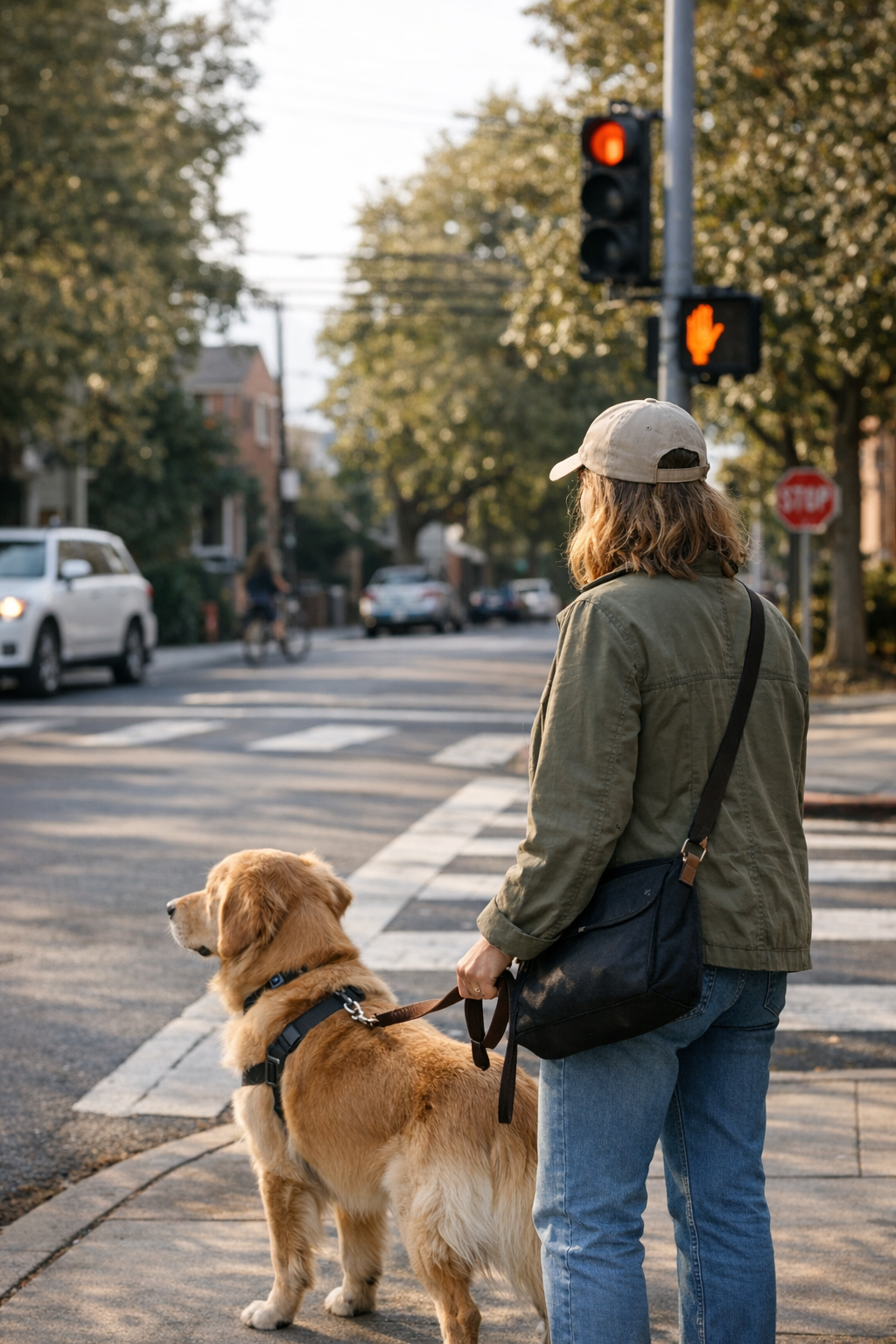
There’s a sharp interruption creeping into ordinary dog walks: You’re moving at your usual pace, leash light in your hand, and then the crossing beeps hammer out—jolting your dog into a full stop, ear cocked, routine snapped. What used to be a single, forgettable moment now repeats every other block. If your routes have picked up new signalized crossings, those beeps keep stacking up: another pause, another leash check, another jag in the rhythm. Before long, what felt like a smooth, predictable walk now gets carved up by friction points both you and your dog can’t ignore. Even before you’re home, you’re already feeling that pinched hold on the leash and the cost of another awkward disconnect in your routine. That’s DogPile territory—where friction in one daily dog task doesn’t stay isolated, but keeps bleeding into the next.
How Crosswalk Beeps Disrupt the Real Everyday Walk
Crossing signals read as just “background noise” until they don’t— not on paper, but the way they wedge into actual movement with a sharper spike than you expect. A dog used to walking with steady confidence hits the beep and balks, leash tension flicking at the wrong second. Maybe you first think it’s a stray distraction. Squirrel? Footprint? But it’s not a one-off: your dog’s ears flatten at the next intersection, your own hand tightens on approach, and what was an easy glide turns into a subtle battle. Three crossings in, the “walk” now has a stutter built right in: silent blocks fractured repeatedly by noise, hesitation, and owner correction—walking turns into micro-negotiation. The old, loose leash is missed each time you’re forced to pause or drag forward, yet the beeps are locked into your new routine.
Spotting the Build-Up: Why “Minor” Beeps Start to Undermine the Routine
This isn’t meltdown drama— It’s the accumulation of split-second stalls. Instead of refusing to move, your dog just half-pauses—barely noticeable until the leash goes taut. You’re pressed to make a choice you didn’t have before: force it, wait, try to coax. The flow of the route starts to break down quietly; what should feel automatic now needs you reset again and again. Crowds and other dogs pass, and you’re stuck wrestling timing and attention because of an invisible stutter on every main corner.
By midweek, you’ve unconsciously started building extra margin into the walk: expecting pauses, anticipating the beep, bracing every approach. Even your dog—usually the picture of routine—looks to you for signals, feeding off your hesitation. Each repetition reinforces the new pattern: your joint confidence underscored by small setbacks, the routine shredded not by major events, but by the drip-drip of interruptions you can’t quite work around.
Routine Hesitation: How You Notice When the Setup Fails
Every micro-pause at a noisy crossing chips away at what used to be automatic. Description isn’t distraction—it’s erosion: you notice earlier leash tension, more frequent glances, a growing sense of “restart” at each curb. After a week, the busy-beep route feels heavier, less “walk” and more slog—identical on a map, but far slower and clumsier in every attempt to keep up the old flow you took for granted. The misfit is practical and immediate, not just theoretical.
Why Noisy Crossings Hit Dogs Harder Than You Expect
Most dogs track pattern disruptions long before humans catch on: the overlapping beeps aren’t just sound—they signal “something new is about to happen.” On streets peppered with two, three, or four signalized corners, a dog that once breezed by now slows or digs in. Suddenly you’re alternating between slack and tight leash—never smooth, never predictable. Owners often hope the friction will fade, and sometimes it does, but just as often the edge stays sharp: tension lingers, everyone braces for the next awkward beat, and the stroll you counted on downgrades to a series of forced resets.
Cumulative Walk Stress: More Than a Mood Shift
Hesitation, dropped tail, extra glances, arms sore from steering—it creeps up steadily. Instead of flowing from block to block, you move defensively, prepping for the next interruption. The change is measurable in time lost, corrections made, emotional wear. The routes you once handled on autopilot now demand your full attention just to keep things together, and every extra beep or stall spreads through the rest of your dog-life pattern.
How Walk Friction Seeps Into Every Other Dog Routine
The chaos never stops at the sidewalk—it trails through the door: You finish a disrupted walk, and the fallout keeps echoing. Leash and gear get dumped in random spots, towels and wipes you used to keep handy are now misplaced, and cleanup grinds to a halt as you try to regroup. Your dog—caught between tension and uncertainty—hovers in the entryway, not sure whether to settle or stay alert for the next command.
This disorganization ricochets: next outing, you reach for the leash and yank up something else first. Water bowls stay shoved to quieter corners—not always where they need to be for drinking, but wherever your dog feels off-balance and wants cover. Toys migrate into the walk path, leftover from earlier, less-settled energy. Even once you’ve picked up, smoothed things over, and restored surface order, handling stays slower—friction renews itself, gear clogs movement space, and that same weak point keeps resurfacing behind what looks “clean.”
Route Swaps: The Small Fix with Outsized Impact on Routines
Real improvement rarely means a total reboot. For many, the first real win comes from the simplest swap: detour to quieter blocks, sidestep the clusters of noisy crossings. Even if the route is longer or awkward, you gain instant contrast: three or four signalized stalls traded for a stretch of smooth movement. The leash hangs loose again—and just as quickly, a day built around interruption shifts back into one where you and your dog flow without anticipation or micro-management. Those quieter blocks buy back routine: less leash bracing, less tension, less dog clutter scattered blindly during the post-walk reset.
The physical cues flip: instead of a dog hyper-focused on every roadside beep, you see heads up, ears relaxed, steady progress that follows your lead. Your own movements recover—you grab the leash, drop gear where it actually belongs, and catch yourself not bracing for trouble. The route may curve now, but the difference is visible the moment you return home: loose leash stays loose, towels and wipes actually ready when needed, and feeding or cleanup regains its pace rather than lagging behind yesterday’s tension.
Beating Friction by Reworking the Setup, Not Just the Walk
What slows you at the curb drags the whole routine, if you let it. Owners willing to keep tolerating crosswalk beeps as “just one more inconvenience” keep dragging out the same slowdowns every day. A better setup comes not from re-organizing for looks, but by snipping away at friction points—rerouting, reaching for gear faster, setting supplies within actual arm’s reach and not just stacked neatly. The payoff is subtle—never picture-perfect—but you’ll feel it in less gear underfoot, a neater leash drop, supplies ready at the moment they matter, and a routine less jammed by repeated weak spots.
Measuring Real Routine Recovery: What to Watch For
- Pause shrinkage at trouble-streets: Is that three-second curb stall now a barely-there hitch?
- Leash slack: Is the leash actually loose over more of the walk, or do you keep correcting?
- Cleanup and reset efficiency: Are wipes and towels close at hand—or still just “somewhere” after every walk?
- Pre- and post-walk friction: Are you spending less time fighting the setup and more time letting routines run?
- Return to baseline: Are you and your dog settling sooner, not just after the walk but as the day goes on?
The difference doesn’t show up in big gestures, but in how seamlessly you manage the ordinary: reaching for what you need without shuffling piles, cleanups that start as soon as you open the door, leashes and toys staying put instead of tripping you on the way to feed. When you trim the friction at street level, every other reset gets quicker—your day spends less time circling the same weak point.
Dog-Life That Actually Works: No Fairy Tales, Just Less Grind
DogPile is built for the routines that actually make up dog-life—not the glossy snapshots, but the annoying parts you want to sand down. Crosswalk beeps are just one example of a small signal mutating into a major routine problem. Fixing these weak spots isn’t about a spotless “after” photo; it’s about winding up with a looser leash, a faster reset, and a home where