
You don’t really see a lighting problem the first hour a new fixture goes up—you feel it every morning when a stair edge vanishes in shadow, or when a bathroom mirror turns your shave into a guessing game. The disappointment isn’t in the bright look of a room, but in the daily friction: stumbling steps, squinting at glare, task corners that stay murky no matter how “upgraded” your fixture claims to be. Good indoor lighting isn’t about how much you see, but about how reliably you can move, work, and notice details right where the routine calls for them. The cracks only really show with use—when a room that looked brilliant at install keeps tripping you up in small, stubborn ways.
Where “Bright” Isn’t Enough: Seeing Past First Impressions
Flick the switch on a new ceiling light or wall sconce, and the room appears fully lit. But walk through it at night, bend to the bathroom sink, or try to find something on a shelf, and the limits appear. A flush mount may spotlight the center but leave aisles and edges vague. The reflection at your mirror looks vivid until half your face falls into gloom just by tilting your head. The letdown isn’t about total brightness—it’s the uneven sweep, the patchy glare, the corners that stay stubbornly dim even in “finished” rooms.
This mismatch between how a space appears and how it actually works is hard to ignore, especially when you spot the same trouble spots every time you move or look closer. A hallway lined with what looks like powerful fixtures may still have alcoves and turns that trigger hesitation, proving visible light isn’t the same as usable light.
Hallways, Stairs, and Edges: Trouble in the Transitions
Movement reveals the weak spots fast. Stand at the top of a stairway or halfway down a hallway—often, the light feels strong overhead, but leave the landing and each step seems to fade into gray. On stairs, this means not just slowing down but adjusting your stride, hands reaching out “just in case,” especially in early mornings or late evenings. When arms are full, your margin for error shrinks. Even a small blind patch or dim corridor corner creates a pause. Over days and weeks, these moments stack up: more caution, less flow, small delays that grind against the rush of morning departures or quick turns at night.
Mirror Zones and Grooming Spaces: More Than Just Glare
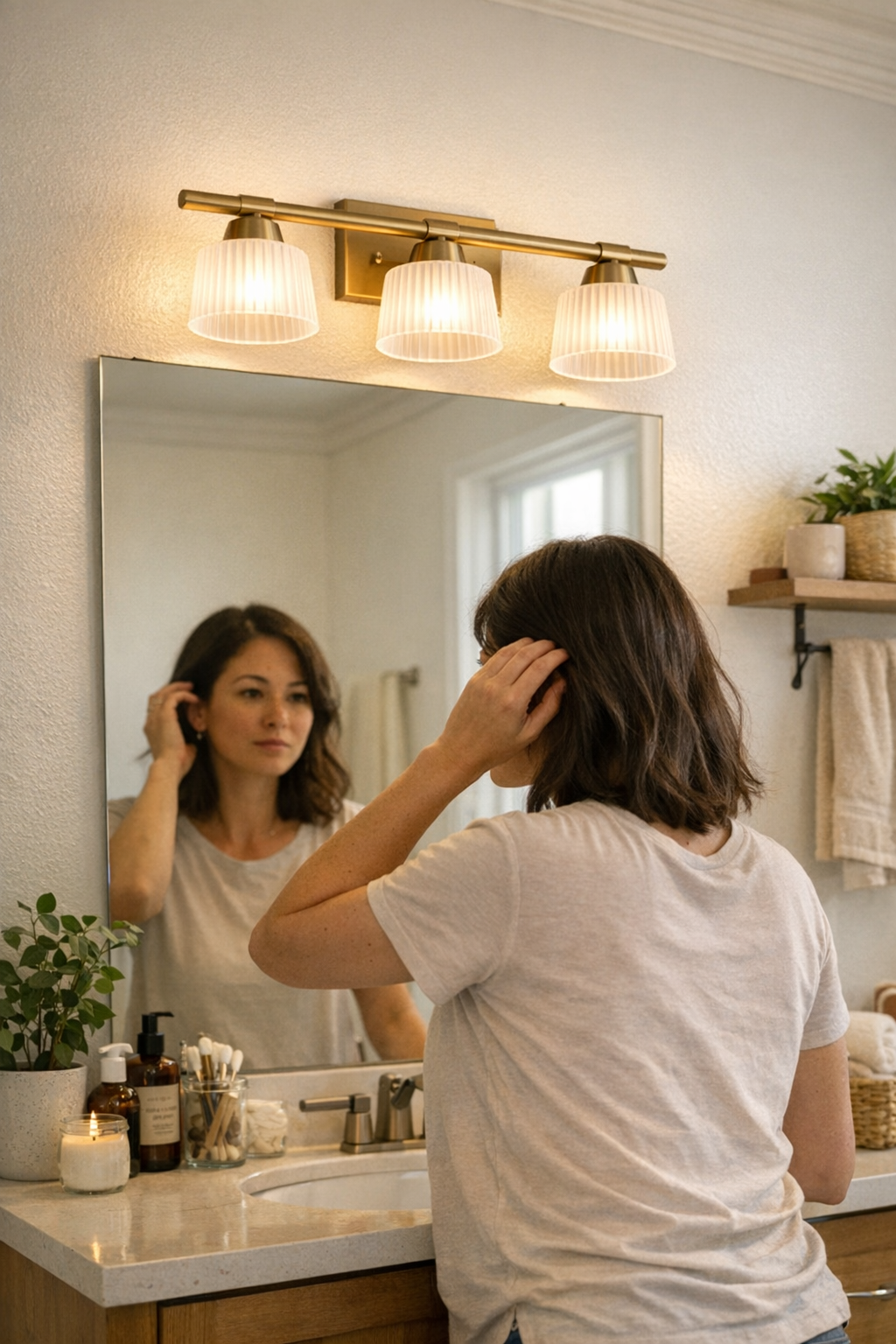
Bathrooms are where lighting trouble feels personal. Overhead bulbs promise a “bright” zone, but real use tells another story—chin in shadow, browline washed out. Move closer to shave or apply makeup, and you catch yourself shifting left or right, trading one shadow for another. It’s not a question of style or overall power: it’s about whether the lighting setup lets both sides of your face appear clearly, or if a wall sconce throws light so narrowly that one half always needs a second try. If you’re constantly changing position at the mirror, the light is working against you, not with you.
Laundry Corners and Work Surfaces: Useful Tasks Require Useful Light
Laundry rooms and utility counters rarely get lighting that actually helps. Most get a ceiling fixture that blankets the room but doesn’t address the source of the problem—the disappearing front edge of the washing machine or the folding counter that loses detail when you need to spot a stain. Work surfaces live in the shadow zone. Instead of adding another ceiling bulb, targeted under-cabinet lighting or a focused hardwired wall light can turn a half-lit zone into a fully functional space. Otherwise, you end up working around the dim spots: dragging a lamp over, leaning closer, or just guessing if the job is really done.
How Problems Add Up Over Time
The real cost of poor indoor lighting comes with repetition. A dull shadow near the top step or one persistent dark slant at your mirror feels minor the first week. But after months, those little delays add up: double-checked steps, extra squinting, habits bent around invisible obstacles. You adapt without thinking—tilting your head, repeating movement, running your hand along a wall—tiny compensations that slowly erode the confidence and efficiency of the whole space.
Simple Shifts That Open Up the Space
You don’t have to gut your setup for big gains. Try replacing a glare-heavy overhead with a semi-flush mount that softens but expands the spread—making stair turns fully visible, not just the middle landing. Wall lights placed level with your face at the mirror (not above, but to the side) tamp down shadows, giving a true reflection instead of a guessing-game silhouette. In utility spaces, a run of under-cabinet fixtures does more for folding, sorting, and cleaning tasks than even the brightest ceiling mount ever could.
Put new lighting to the test: observe shadow lines and glare at your real-use times—before dawn or after dusk reveals issues midday can hide. Adjusting light placement even slightly can make cluttered corners or tricky edges actually usable, not just bright-looking. Pay attention to surface clarity and coverage, not just if the whole room “reads” as lit.
Testing for Real Coverage: Everyday Checks
Day-to-day patterns reveal lighting strength or failure. Watch for dark bands under cabinets, faded stair treads, hallway spots you avoid, or work surfaces that flip between visible and veiled with every step. If you’re drawn toward bright patches and avoid certain angles, it’s not just a decor flaw—it’s a setup problem. The living test is: do you find yourself squinting, hesitating, or shifting behavior in the same places, again and again?
The Problem with “Inherited” Fixture Placement
Lighting trouble is often a legacy problem: ceiling boxes land where the builder found easiest, not where you need light most. Relying on existing fixture spots means you inherit their blind spots too—shadow trails, awkward glare, work zones that never get addressed. The better measure isn’t just “where does this fixture fit?” but “does this actually create visibility where the routine demands it?” Sometimes a hardwired wall light, under-cabinet panel, or switched-up sconce is what it takes to break the pattern of chronic, baked-in dimness or glare.
Moisture and Durability: Don’t Skip Damp-Rated Fixtures
In laundry rooms, shower areas, or anywhere steam creeps in, using an ordinary light is quietly risky. Damp-rated fixtures aren’t just legal checks—they’re peace-of-mind for the long haul, holding up against corrosion and short-lived bulbs where humidity wears everything down. Skipping this step doesn’t show until it fails: rusty hardware, flickering performance, or full breakdown long before you expected it. In high-usage, moisture-prone rooms, durability isn’t a bonus feature—it’s the minimum for lighting that doesn’t let you down after the first season.
Making Light Work With You—Not Against You
The sign of good indoor lighting isn’t the initial “wow,” but spaces that keep up. Corridors read clearly underfoot, mirrors give honest feedback, and those small, stubborn slowdowns—hesitant steps, repeated squints—finally fade. The best fixture choice isn’t about chasing lumens or trend shots, but about daily clarity: does light keep pace when your hands are full, or when routines call for speed and accuracy? Don’t just count bulbs—watch for the moments that still frustrate. Fixing the right pain point can do more for daily movement than any claim of “room-filling brightness.” Living with friction isn’t inevitable.