
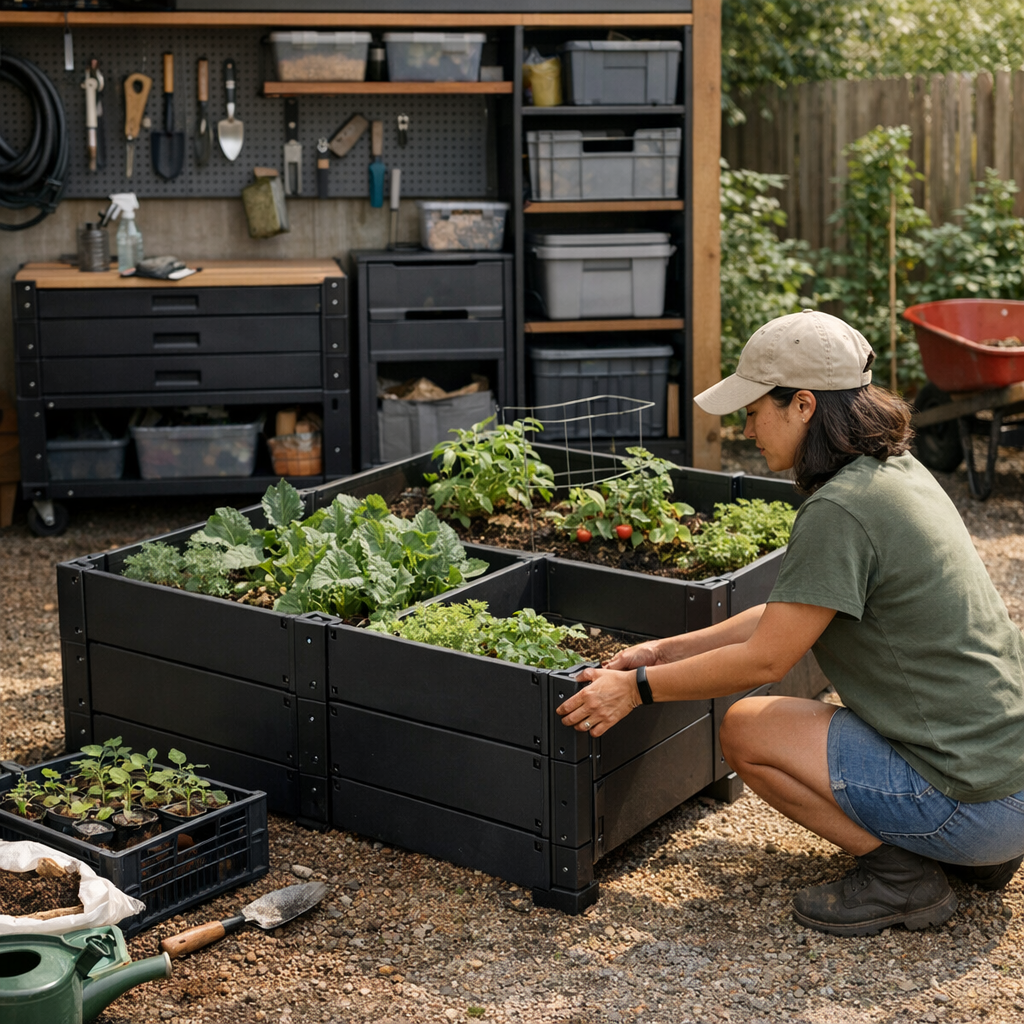
The promise of perfectly organized raised beds fades the first time your real routine collides with their rigid shape. On setup day, the geometry is crisp: neat rows, defined corners, a sense of lasting order. But as soon as you start actually using the space, cracks appear. Swap out a planting plan, bring home unexpected seedlings, or just try to clear up at the end of a long afternoon—suddenly, what felt tidy turns cumbersome. One blocked path or unreachable corner, and you’re left zigzagging through your own setup, working around the very order you created.
When Fixed Beds Turn Efficiency Into Obstacles
No backyard, garden, or workspace runs on a single, unchanging routine. My first fixed-bed layout looked logical on the drawing board but unraveled halfway through the season. Rearranging plants demanded awkward over-the-bed stretches. What used to be a path now funneled every trip—hose, wheelbarrow, compost bucket—through a shoulder-width bottleneck. Corners disappeared under stray tools. Cleaning up felt like untangling a maze: dragging a full cart around dead-ends, squeezing sideways just to reach a forgotten rake, doubling back to escape from behind an unmoving wall of wood and soil.
The same pain points recurred, week after week:
- That stubborn bed forcing you to navigate around it instead of through it
- The unreachable side filling with scattered tools and clutter
- Pathways closing in until even a hand truck struggles to pass
- Entire wall zones wasted, hidden behind barriers that refuse to shift
Much of what looks ordered on day one quietly morphs into lost space and repeated detours. Fixed systems mask these scraps of inaccessibility as “structure” while locking your workflow into unhelpful patterns.
Modular Beds: Layout That Adjusts to How You Actually Use Space
This is why modular raised beds aren’t just a trend—they solve the friction that fixed designs create. Modular setups accept that routines, plans, and even moods change. The path that worked in April might be a headache in July. Instead of resigning yourself to workaround after workaround, you can shift beds to create a shortcut, open up a tight area, or reclaim a corner that’s devolved into storage—all without dismantling your entire garden or workspace.
The difference isn’t subtle: modular means resetting your space in minutes, not losing a whole afternoon battling a stubborn layout.
Moving From Static Rows to Usable Flow
Visual order can be deceiving—fixed and modular beds both start out tidy. The contrast is in day-to-day use. Last season, when compost delivery ran late, I needed to snake a cart down the main aisle. With modular beds, I unlatched two side panels, widened the route, and cut straight through. Resetting afterward took seconds. The fixed-bed section, though? It forced a three-point turn through flowerpots and corners—if the cart fit at all, it barely made it without scattering soil everywhere.
It’s not just a once-a-year inconvenience. By midseason, those “just put it here for now” moments accumulate: tangled hoses stuck in blocked zones, overflow piling up in one hard-to-reach patch, every reset dragging out as you maneuver around an unyielding footprint. Flexibility doesn’t just save time—it keeps your setup from turning against your own routine.
Routine Obstacles: Why Layout Matters More Than Looks
Real friction shows up during ordinary tasks. Storm clouds build, and you’ve got two minutes to rescue seedlings near the back fence. But with fixed beds fencing off the straight route, your only option is a slow detour—dodging corners, risking a dropped tray. Modular designs let you snap open a panel and create a direct line, saving your plants and your nerves.
Reach for the hose or a tool mid-summer, and you’re forced to pick your way around beds that were only supposed to organize the space. That “unused” zone in the corner? With a fixed layout, it’s condemned to become a dumping ground for overflow. Modular beds let you expose and reclaim dead corners, reshaping work zones before they devolve into chaos after every big project.
The Problem Goes Beyond Gardening
The same kind of setup friction plagues garages, sheds, and workshops. An inflexible bench or storage box pins down rolling carts, forcing awkward shuffles every time you need to clear space. Modular layouts—whether beds in the yard or cabinets in the garage—make the difference between clearing a path in seconds or juggling heavy objects just to get through.
What Makes a Modular Setup Actually Work
Of course, the benefit isn’t automatic—it depends on doing modular right. Early on with my own beds, I hit a snag: heavy rain loosened a few connectors, leaving panels skewed and gaps that trapped debris. Quick fix? Upgraded edge supports and tighter hardware. After that, moving and relocking panels was solid and easy, even after repeated changes. No more creeping misalignment or wasted energy realigning every week.
Some lessons for a frustration-free modular routine:
- Don’t rush square corners or skip level checks. Those shortcuts show up as headaches every time you shift the layout or roll a cart down the line.
- Prioritize connector strength, not just speed. Fast-to-assemble, flimsy links can loosen fast. Durable hardware pays off in reliability and smoother resets.
- Keep the foundation level and stable. Modular beds that teeter or open gaps drain time fixing later—especially if your routine means moving heavy loads or carts through the area.
Living With a Setup That Works Backwards
Over time, the “perfect” first-day layout loses its shine. It isn’t the place that’s never out of line by the end of summer—it’s the one you can reset quickly and use without dread. A modular approach means fewer blocked paths, less scavenging through spillover piles in corners, and a real sense of flow that sticks around after a big cleanup or the next planting binge.
The best setup turns invisible. When you can move, access, and reset without second-guessing your own space, you finally get to focus on work—without fighting the system meant to help you. Visual order can come and go, but a layout that flexes with your actual routine will always feel more functional, less frustrating, and more genuinely yours.
Ready to trade a setup that stalls for one that actually works with you? See modular raised beds and storage solutions at StackNest.