
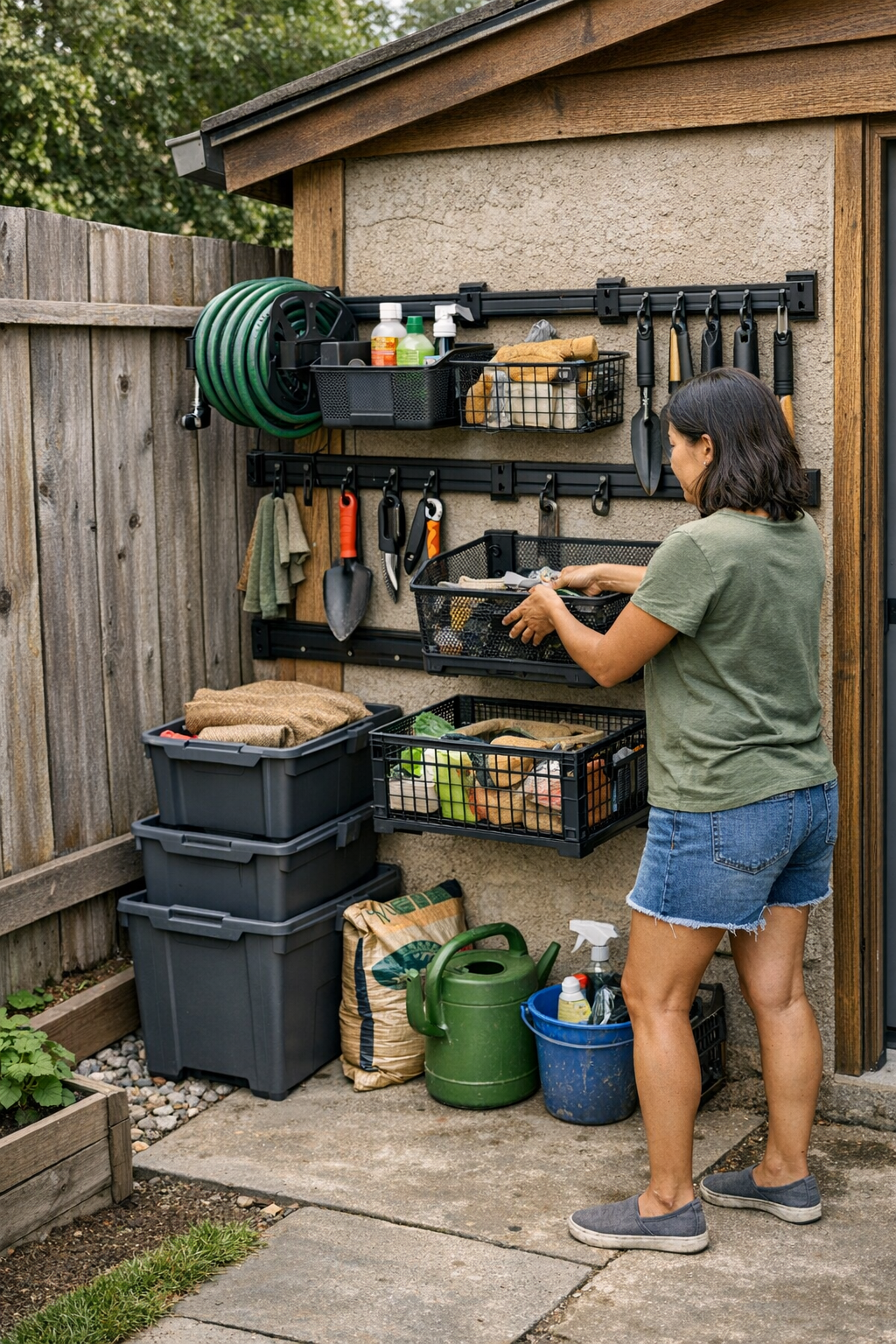
Every outdoor setup promises order—until routine use exposes the shortcuts. The most obvious sign your backyard storage is failing: you’re shifting the same tools, hoses, or bins out of your own way again and again, just to walk a clear path. What starts as a clean setup turns into a slow-motion obstacle course: you stack, nudge, and reshuffle, but each pass steals more space. Five minutes to clean up turns into ten. Even returning a single trowel becomes a puzzle. The setup that once looked “organized” now drags against daily movement—reminding you, with every delayed reset, that ‘good enough’ storage only works until real life crowds in.
When Good Floor Bins Go Stale
At first, floor bins and deck chests feel straightforward—pile in your yard gear, shut the lid, and move on. But outdoor routines never hold still. Projects shift, weather swings, someone needs a last-minute cleanup, and what you need most keeps crawling to the top—or worse, sliding to the bottom. Suddenly, the only way to grab your main tool is rooting through whatever you tossed in last. Every retrieval becomes a disturbance: to unearth one thing, you push everything else aside, burying what comes next.
The pattern is predictable. You dig for the hose, but hand tools wedge in the gap, and now the bucket you used last week is blocking the only walkway. You tidy a chest, but by next Saturday, the birdseed, pool toys, and trimmer line have re-shuffled themselves under the weight of “just for now” decisions. No chaos, just a daily tax: each step requires two more. The friction builds—quiet at first, then relentless—and before you notice, even minor resets are a chore.
The Wall-Mounted Reset: Clearing Floors, Trapping Clutter
The first time you lift everything off the ground with a wall-mounted system, the shift is immediate and visible: the path reappears, nothing blocks the doors, and every tool has its place in plain sight. Rows of hooks and rails along your fence or siding claim zero floor space, and even the clumsy items—rakes, hoses, fold-up chairs—hang in reach, not in the way. The biggest difference? You don’t have to hunt to see what’s missing. An empty hook, an off-balance basket, a loose shovel—all stand out on your next pass.
This isn’t just about gaining square footage: with wall storage, there’s nowhere for messes to hide. Leave a trowel dangling or a hose debate unresolved, and you notice. That brief discomfort rewires your habits. There’s no “I’ll fix that later” pile swallowing your slip-ups; there’s now an unavoidable nudge to put things back in the only place they fit. Resets get faster because you either do them mid-stride—or they stare at you, waiting.
Everyday Use Pressures the Setup—For Better or Worse
For garages, side-yard strips, and patio-edges that double as work zones, repeated use reveals weaknesses instantly. The test isn’t whether things fit once; it’s whether they work without daily re-stacking. Say your side gate hosts both pet gear and yard tools, or the patio edge flexes between toy storage and pre-party cleanup. The line between “organizes” and “interrupts” shows up fast.
Pushed for time? The floor bin setup fails under pressure: you move a bin to grab a broom, now the hose tangles, and the only free corner is jammed with what you used yesterday. Delay your reset and spillover increases—movement slows, clutter lingers, and it’s easier to just leave things out. Stress rises every time the setup turns a five-second return into a pileup.
Wall-mounted layouts, especially modular rails with varied hooks and baskets, flip this scenario. Each tool is always just one reach away, and returning it takes as long as walking past. No lids to open, no stacks to disturb. Heavy, awkward gear gets a lower hook; lighter, frequent-use items go up top. If something’s missing or misplaced, you know immediately—and fixing it takes seconds, not another round of reshuffling.
Footprint Reality: Floor Storage Pinches, Wall Storage Frees You
True space feels bigger when you stop protecting every step. The overlooked win of wall-mounted storage is the preserved walkway: a side-yard that stays passable, a small patio that doesn’t shrink under its own organization. Floor bins and deck chests sprawl outward as gear piles up; corners fill, buckets get marooned, and you end up with a dead zone that only grows as the weather shifts. Overflow becomes easy to overlook until it blocks the door—or your next project.
Get the setup right, and you break the cycle: no more shifting two things just to return a third, or unstacking in reverse every time you need the hand shears. Wall storage keeps each item accessible and out of the traffic flow. Now, resets are intuitive—one-out, one-back, glance and move—never a rebuild from scratch. No corners forgotten, no routes blocked, no creeping mound that swallows half your Saturday morning.
Seen in Use: Real Outdoor Corners, Not Showroom Floors
Think dailies: dog leash, grit scoop, or trash pickers hung low by the back gate—never trampled, never lost in a bin behind rakes and gasoline cans. Sunscreen, gloves, and yard towels live on an open basket; power tools, by contrast, migrate to the garage wall, not the party zone. With everything visible, resets are measured in seconds and the temptation to “just drop it for now” nearly vanishes. Gear comes off the wall, goes back, and unused items don’t drift toward trouble spots.
But real setups aren’t flawless. Wall systems make every slip-up visible—and that’s healthy for your routine: a basket fills with odds and ends? You notice by Tuesday, not next month. A bulky tarp lands on the wrong hook? It’s out of place, not buried and forgotten. Instead of a crisis purge, you spot mess creep as it happens. Tweaking for season or function becomes natural—the setup reflects how your yard gets used, not just how it looked the morning after assembly.
Reset Speed: The Real Test of a Working System
Clutter never explodes overnight—it accumulates with a hundred tiny hesitations. Skip the reset and the next search takes longer. Floor bins mostly “look” organized, but the reality is a paper-thin order that shreds with actual use. By contrast, wall mounts drive immediate feedback: miss a return and it’s glaring. Every minor mess becomes a nudge, not a project deferred to some mythical future when there’s “more time.”
Still, the best systems flex. Sudden rain or an unexpected yard project might mean a tool lands back on the wrong hook, or a basket acts as a catch-all for a day. But these mistakes surface quickly—they don’t crawl under the lid or vanish until next season. Fixing a slip is a matter of seconds, not sorting layers deep in a bin nobody wants to open.
Practical Adjustments: Wall Storage Wins in Tight Quarters
If your outdoor zone is half walkway, half storage, a few habits keep flow strong and friction low:
- Lower hooks for heft: Heavy stuff—shovels, hoses, or spade forks—hang low so they aren’t falling into upper spaces and don’t turn the floor into a dumping ground.
- Seasonal shifts matter: As weather changes, rotate what gets prime access. Summer’s soccer balls shouldn’t take up winter’s high-traffic hooks.
- Designate a temp basket: One small bin as a “waystation” for overflow lets you corral midweek chaos without it spreading. As long as you clear it each week, the slow pileup never claims the whole system.
The Noticeable Change: Mess in Plain Sight, Not Hidden
The deepest shift isn’t just what you see—it’s what you do. Outdoor wall storage gives you nowhere to stash clutter where it won’t bother you. That’s the entire advantage. There’s no liberty to let “just for now” piles morph into permanent obstacles. Reset time really does shrink, blocked paths evaporate, and the dread of weekend overhauls fades. The system works because it refuses to hide your habits: you spot what’s off and fix it while you pass, not weeks later in damage control mode.
Instead of a setup that goes out of style with the first busy month, you get storage that matches the pulse of your real outdoor life. That’s the break in the old cycle: space that actually works instead of pretending to, no matter what a day throws at it.
See more practical solutions for real outdoor spaces at TidyYard.