
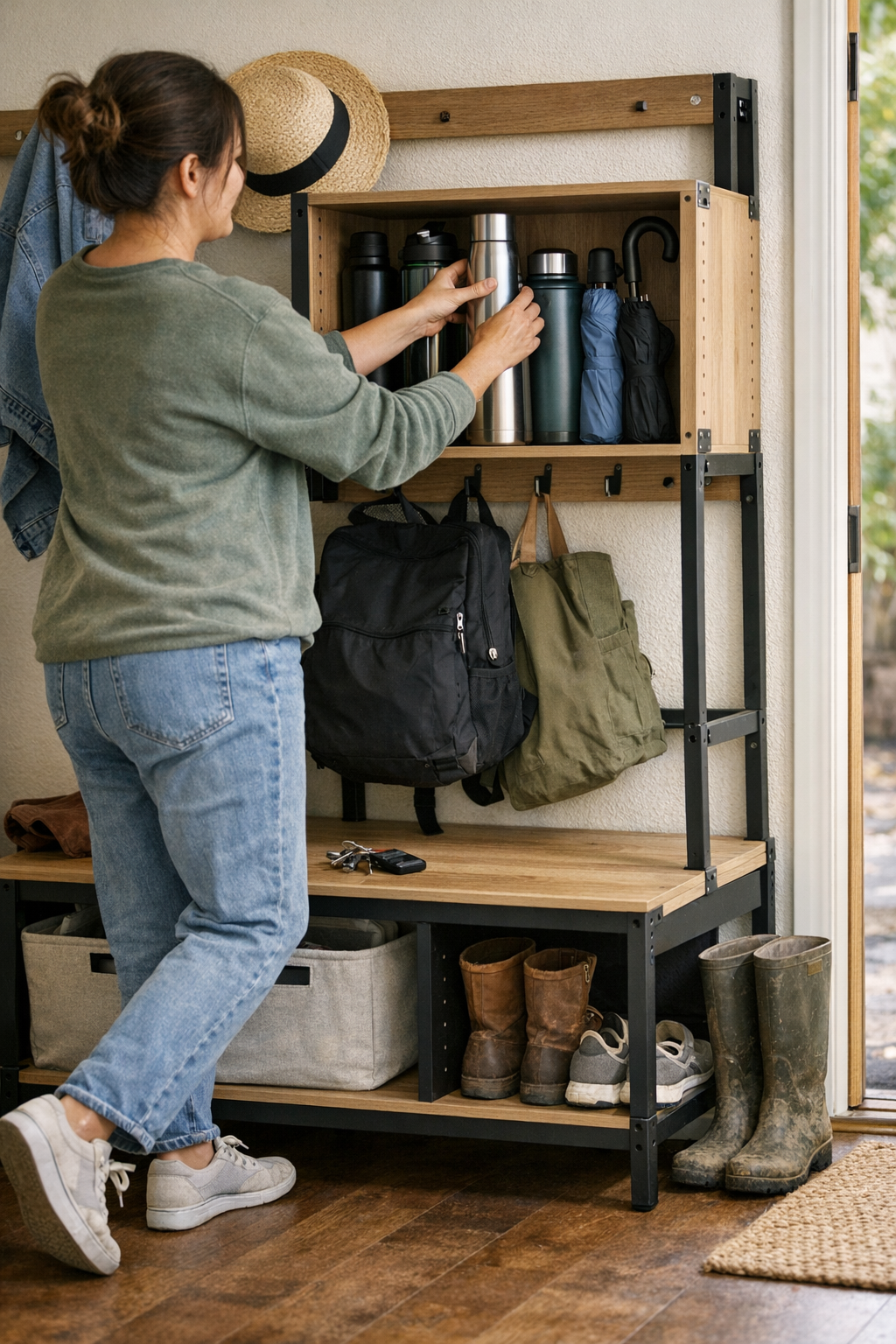
Stand in any real entryway and it’s instantly clear: one tall bottle left sideways, and the “organized” zone collapses. You line up shoes, slot bags, hang a jacket—then a reusable thermos or umbrella lands with nowhere to go. The bench turns into a bottle parking lot. A cubby meant for shoes only half-contains a rain boot, which spills into the walkway. Each pass through the threshold—especially with other people trying to get out the door—becomes a shuffle, a pause, a quick decision to drop items wherever they’ll balance. What looked “neat” on move-in day turns unpredictable after a single morning in motion. The promise of a reset fades: one tall item pushes everything back out.
When Vertical Clearance Turns Into Daily Friction
Most entry benches and cubby racks claim to “catch it all”—until you actually use them with real gear. Watch it happen: you return home, drop your bag, and find your hands full with a tall bottle that won’t fit upright. The storage space that seemed generous on paper becomes a design mismatch—a half-inch too short means bottles fall sideways or get left balancing on the bench, inviting the next pass to knock them loose. You spot the signs: water bottles tilted, umbrellas at an angle, a sideways boot nudging into the path. The zone didn’t fill up; it got blocked. Every repeated attempt to tuck things away leads to floor overflow or a slow domino of “temporary” placements. The entry’s efficiency isn’t lost to one big mess, but to an unending series of micro-corrections: shifting, restacking, picking up what slid out of place.
Real Scenarios: Daily Movement Reveals the Weak Point
The limits of a setup show up fastest when routines collide. Picture these repeated-use standoffs, each exposing where vertical clearance falls short:
- Two departures at once: A lunch bottle, taller than the shelf, sits on the only sitting spot. Now anyone tying shoes or grabbing a bag gets boxed in—one awkward bottle dictating the order of movement.
- Returning at night: From a distance, the space looks put away. Up close, you see the truth: bottles propped, umbrellas wedged between baskets, a rain boot sticking out. Everyone sidesteps a pile that technically has a “home,” but only if you jam items in at an angle—and no one does, because it takes too much fiddling in real time.
- Threshold squeeze: A stroller interrupts a tight entry path, and because a water bottle won’t store upright, it rolls into the gap. The walking line gets hacked down to a sideways shuffle. A little height mismatch, multiplied by shared routines, turns a wide entry into a bottleneck after a single busy run.
Small failures become systemic: high-use items overflow into the walkway, clog resets, and spark tiny negotiations—does this bottle go back on the bench, onto the wall rack, or just get left by the door again? What seems like laziness is usually a setup that can’t handle tall, repeat-use items alongside the usual entry haul.
Why “Looks Organized” Isn’t Enough in Transition Zones
Entry storage that looks perfect after a deep clean rarely faces real traffic. Actual transition spaces flex with routine: kids drop muddy boots, someone brings home an oversized thermos, rain gear lingers after a storm. If the cubby or bench isn’t built for the tallest items, mess is secondary. The space simply doesn’t match the lived flow—forcing awkward splits, sideways placements, backtracking to get everything clear. The first clue isn’t always visible chaos, but a cascade of small, inefficient moves: a bottle left half-off a shelf, a bag wedging a boot, an umbrella always on the floor. In shared use, those double-handled routines add up fast—and what looked like storage becomes a daily puzzle to “fit” things instead of actually clearing the threshold.
One Small Change: Building Enough Height for Tall Items
The fixing principle is blunt but effective: match your vertical clearance to your tallest, most frequent threshold item—not just shoes. In one crammed household, removing a low shelf and adding a single 14-inch cubby for bottles and umbrellas snapped the space back into alignment. No more tilting, stacking, or pausing to play bottle Tetris. Routine return—two people, mixed gear—changed instantly: upright storage, one-motion resets, and no bottleneck at the bench edge. That slim margin of height absorbed real life: summer bottles, winter boots, umbrella grips. Side clutter shrank; the visual scramble disappeared. It wasn’t a transformation you notice once—it was the friction that stopped happening every single day.
Small Real-World Tips for Smoother Return Flow
- Check your fit before redesigning: Size vertical storage for the tallest bottle, umbrella, or boot you use weekly. Storing for “average” size repeats the same friction loop.
- Build for “overflow” peaks: Extra height works as a buffer for seasonal gear—bigger bottles in summer, umbrellas during wet weeks, taller boots after snow. Underestimating peak use equals daily corrections.
- Test with real rushes: Simulate two people moving through at once. If items snag, need to be angled, or interrupt the path, tweak the setup—not the routine.
From “Looks Neat” to “Works On Repeat”
Long-term function isn’t about picture-perfect staging. In every used threshold, the true test is how easily tall, odd-shaped repeat items actually flow back into place. The cost of poor clearance isn’t just visible mess, but the drag of constant course-corrections—tilting bottles, re-stacking gear, stepping around edge clutter—built into daily entry and exits. A system that absorbs tall everyday items in a single, upright movement makes the whole zone “feel” right, with less thought, less delay, and fewer complaints. That’s what makes organization stick—not one big change, but the little frictions you no longer deal with every day.
Explore more transition-smart storage for real entryways at Betweenry.