
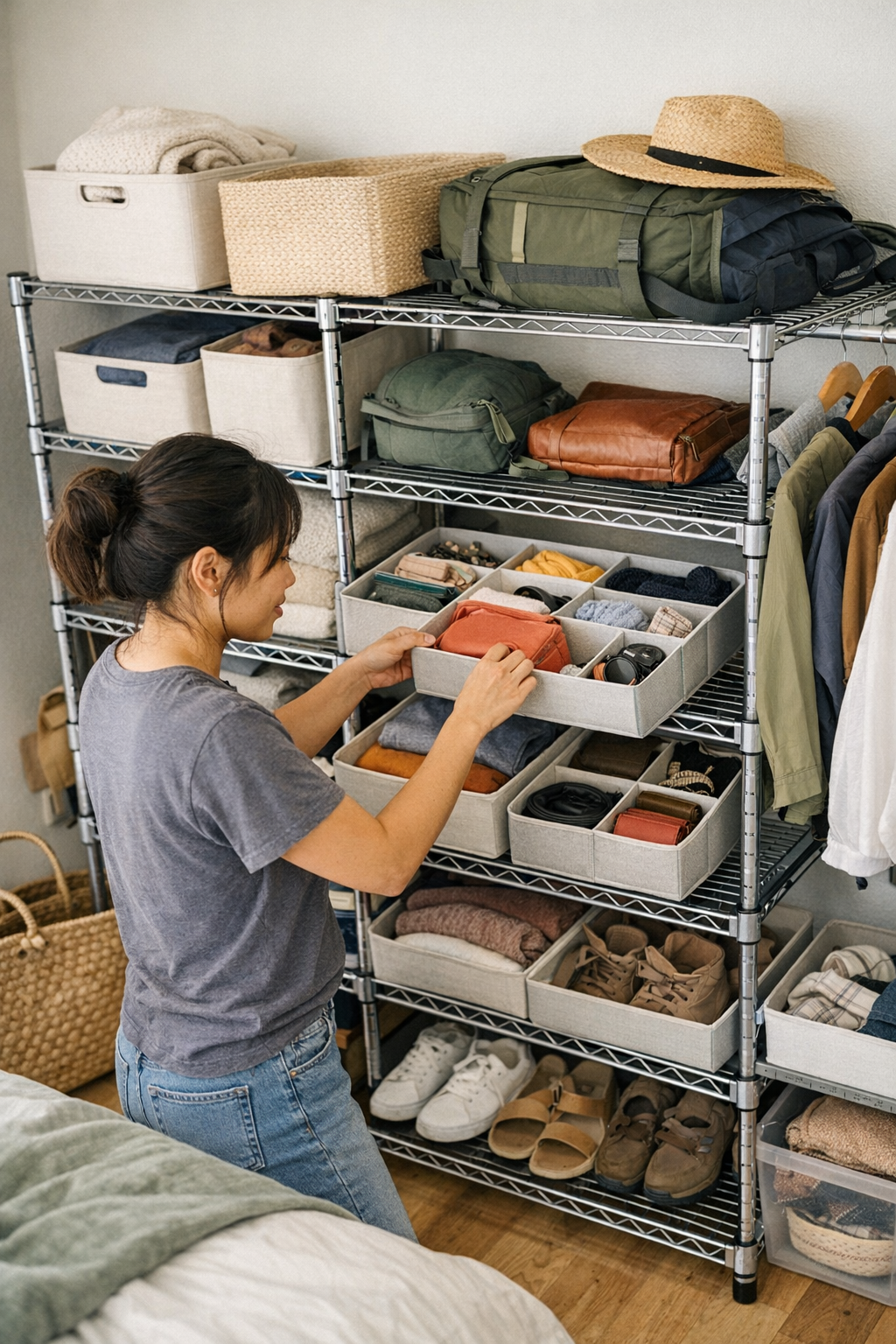
The False Start of Tidy Storage — You know the sequence: Sunday’s overhaul leaves your closet looking like a catalog shoot—shirts in crisp stacks, baskets squared off, everything in its lane. But this isn’t your first round. By Wednesday, those neat rows are tilting, categories bleed together, and the bins meant to simplify things quietly morph into black holes. Socks, belts, a balled-up t-shirt—all thrown together in the same catch-all container. By Friday, the system frays. Now every quick reach or rushed search pulls you into a low-level guessing game: Where did that shirt go? Why are the gym shorts under a winter scarf? The longer you use it, the more daily friction creeps in, slowing you down and undoing all that Saturday work.
Where Storage Setups Really Break: Daily Routines
The true test of a closet, shelf, or entryway isn’t how sharp it looks right after sorting. It’s in those everyday drills: grabbing a sweater before work, rifling for a missing glove, sliding aside a pile for just one item at the back. Shared closets amplify the problem—two people, one small space, and a constant shuffle just to find what you need. Every tug, every over-ambitious pile, exposes the weaknesses that don’t show up in organizing videos. It’s never just about how things look—it’s about whether your system can take a hit and reset, or if it quietly falls apart under routine pressure.
When Order Blurs: Blending Categories and Overflow
Visual order vanishes at the first sign of hurry. Stacks start straight and strong but bend as soon as anyone grabs from the middle. That small disruption—snagging a t-shirt midweek—topples the tower, and next time, the gym shorts and undershirts get stashed in the same pile. Flat surfaces get colonized by whatever lands there next: a coat that didn’t get hung, last night’s laundry, the bag you swore you’d empty later. Each overflow blurs what belongs where, until there’s no real logic beyond “what fits right now.”
Baskets and bins, if left unchecked, become a muddle. What starts as designated space for accessories blurs into a pile-up of mismatched socks, flyers, wallets, and whatever was easiest to stash out of sight. Without real separation inside the bin—or a habit of regular resets—what’s supposed to be convenient only sets you up for more work later.
Deep Bins: The Quickest Path to Lost and Mixed-Up Items
Deep storage doesn’t equal better storage. Deep bins seem practical—great for bulky items or seasonal swaps. But in daily use, they become the land of the lost. You toss things in “just for now,” but months later, good luck finding the scarf or backup towel you meant to keep handy. Worse, every new addition presses into the layer cake below, mixing unrelated things into forgotten territory. What began as a backup solution becomes yet another mess you’ll have to unpack and re-sort.
This plays out all over the house: hallway cubbies that eat umbrellas and shoes until you find only mismatched pairs, or laundry areas where every clean wash ends up in the one overlarge basket, blending socks, towels, dish cloths into one heap that resists every reset.
Reshuffle Fatigue: When Storage Asks Too Much
When every retrieval feels like two steps forward, one step back, something’s off. The telltale signs: you’re restacking piles just to get what you need; you’re playing sliding tower to avoid a landslide; you’re fishing for lost socks at the bottom of a bin that was only ever meant for hats. If you waste minutes resetting what should be ready to go, your storage isn’t keeping up with real life. Over a week, a minor inefficiency multiplies—what should be a one-motion fix becomes a daily irritation you have to work around.
Scene: The Shared Closet Crunch
You and your partner reach for clothes in the morning. The front row looks tidy, but anything past that—half-zipped hoodies, off-season gear, the last-minute “where does this go?” items—sits half-buried in the back. The basket for belts is now a free-for-all: wallet, keys, a single glove. Every morning turns into a mini-reshuffle just to start your day. The original organization has turned into a puzzle box where the solution gets harder each round.
Storage that Works: Anchoring Categories and Streamlining Access
The leap from “looks organized” to “stays organized” comes from really dialing in how you separate, see, and retrieve what you need. Shallow bins with clear dividers stop the domino effect. Each type of item gets a defined slot—no rooting around, no upending a whole basket for one belt, no blind guessing. Categories stay visible and honest. You can use, return, and move on without breaking the setup; the shelf edge stays neat and nothing slips backward to be lost.
The simple upgrade: Save deep bins for things you touch rarely—extra bedding, winter boots, those bulk-pack towels you never need in a rush. Reserve prime space for shallow, segmented containers, right where you need them. Label if you want, but the bigger win is making category lines so clear you don’t accidentally cross them during a hectic week.
High-Traffic Trouble Spots: Entryways and Utility Zones
Storage congestion isn’t only a closet problem. Entryways pull in their own circus: baskets for hats become the drop zone for whatever’s in your hands—mail, keys, reusable bags. By Friday, you’re digging through a mixed pile just to find the gloves you need for the morning commute. The fix: tighten the function. Use dividers or separate bins for each high-use item—one for mail, one for gloves, another for scarves or sunglasses. That focused separation means less spreading out, less “I’ll deal with it later,” and fewer last-minute delays while you hunt for something obviously out of place.
Laundry rooms show the same tension. One giant bin might look efficient, but in practice, spills into other surfaces as soon as someone’s in a hurry. Smaller, labeled bins or trays for detergents and supplies mean you can restock or wipe up without constant rearranging. The end result: a daily reset in a couple of minutes—not a mini-project every weekend.
Is Your Storage Setup Failing Your Routine? Key Warning Signs
- Piles that sag, spill, or lean—never holding shape through the week
- Bins that become a jumble—everything mixed, nothing clear
- Overflow creeping onto the floor or spare surfaces
- Needing more than one step to find your daily essentials
- Locked in a weekly loop of sorting, shuffling, and starting over
If these sound familiar, your storage isn’t keeping pace with real habits—it’s hiding extra work behind a surface-level reset, letting clutter regroup behind the scenes.
Small Tweaks, Real Daily Difference
Take fifteen minutes to map out your friction points: which surfaces collect clutter fastest, which shelves collapse by midweek, which bins you dread opening. Trade deep catch-alls for shallow, sectional storage in the high-traffic zones. Label only if it helps, but trust that real separation—physical dividers, distinct slots—matters more than a pretty tag. Sometimes just one divided bin transforms the daily grind—you grab what you need, things stay put, and the end-of-day tidy is almost automatic.
The best storage doesn’t just look good on Sunday—it survives Monday’s rush and Thursday’s overflow with barely a reset. When you can access, use, and return each item in a single step, messes don’t pile up and “organizing” stops feeling like a never-ending redo.