
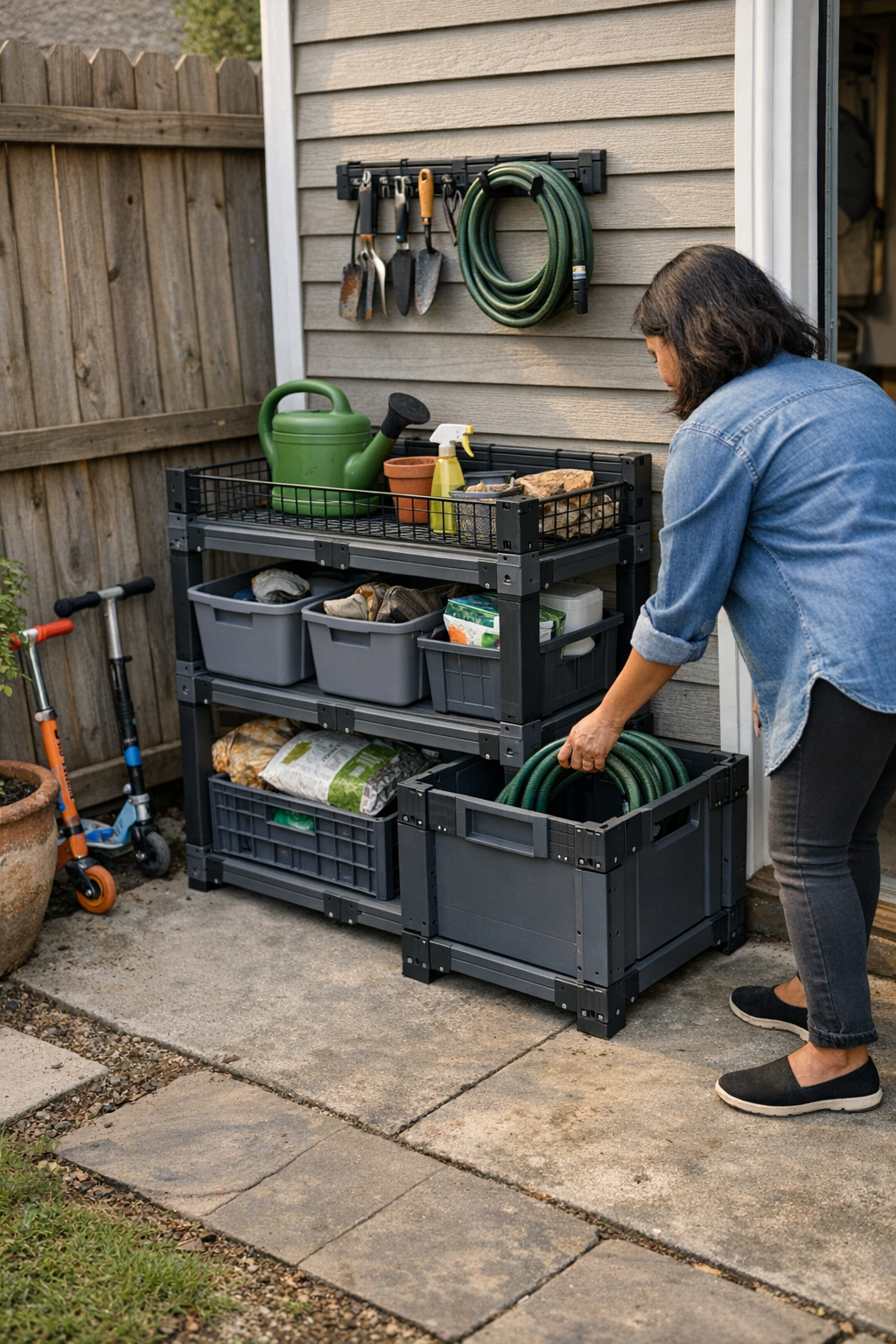
Here’s how most outdoor storage setups really get tested: it’s not storms, not big projects, just the daily shuffle of gloves, tools, balls, and chores streaming out and back through the main door—on repeat, week after week. You grab a trowel before coffee, stash muddy gloves “just for now,” step past your kid’s bike helmet, and promise yourself you’ll put it all back after one more trip. By sunset, what started as clear turns crowded—the threshold jammed, paths shrinking, and a setup that once looked organized quietly devolving into a bottleneck you can’t ignore.
How the Outdoor Door Becomes Clutter’s Landing Zone
You’ve seen it before: stand in your side yard or at the back step and realize another pile showed up while you weren’t looking. Spare seed packets, faded garden gloves, a shovel caked with last week’s dirt—all gather at ground level, inches from the door. Not because you’re out of storage, but because the nearest bin or rack sits just far enough away that “later” keeps winning. Each rushed return breeds the next one, until temporary drop-offs settle in like they belong there.
This isn’t just mess—it’s routine drag. With storage shoved to the fence or buried at the garage edge, the return path feels like a detour. You weigh every trip: is it worth the full trek, or should you just leave it for the next round? Without a spot right there, the flow breaks. Reset fatigue sets in fast, grinding down your good intentions into a collection of almost-finished cleanups.
When the Return Zone is Out of Place
Two yards might look equally neat from a distance: bins squared off behind the shed, cabinets lining the garage. But spend a day moving in and out, and one difference gets loud. Stores-at-a-distance setups ask for back-and-forth journeys every time you finish a job or retrieve a toy. In practice, that means armfuls get set down “for a second,” stray boots jam the walkway, a soccer cone multiplies into an end-of-day trip hazard. Yesterday’s clean stretch fills up by lunchtime, then clogs entirely by dinner.
Move a simple crate or open rack within arm’s reach of the door and the pattern snaps. Suddenly, it’s hand-off, toss, done. Garden gloves drop into the bin, wayward balls land without fuss. The loop tightens: every reset shorter, every pass-through smoother. What felt like a series of little chores fades into instinct—and the exit zone stays open without feeling like one more task to dread.
The Hidden Cost of Distance: Chores Get Stickier, Movement Gets Blocked
Picture a weekend morning: the pruning shears get left by the fence, skateboard helmets line up against the garage, and stray buckets pile up by the gate. Storage that made sense on paper—a big tub tucked “out of the way”—makes routine cleanup harder. Instead of a direct path inside, it’s detours around furniture, shuffling gear just to get a clear stretch. Midday, you’re threading through laundry baskets and tarp rolls that should have gone somewhere else. By evening, it’s a tangle—resetting means pausing, picking up after someone else, losing track of what’s out or put away.
Flip it: add one rack, open tote, or bench right at the main crossing and watch reset friction drop. Suddenly, gear lands where you’re already walking. Tools, gloves, sports junk—all get returned in the right direction without a detour. The path to the house stays open; quick drop-offs replace long cleanup.
One Small Shift = A Faster Reset, Less Crowding
Here’s a real test: leave a crate just two steps from your main threshold instead of tucking it behind a utility cabinet. Instantly, pickups get faster; end-of-day sweep is a single motion, not a multi-stop runaround. Even in a cramped entry zone, swapping a closed box for an open rack means no lifting lids, no weird stacking—just toss and move on. Faster in, faster out, less stuff stuck in the way.
These fixes don’t call for massive storage—just a handoff point that fits your route. Now, putting things away isn’t an ideal to aim for; it’s the default, even if everyone’s busy or distracted. The payoff comes in small wins: Saturday chaos doesn’t block the entry, weekday routines don’t grind to a halt. “Neat” stops being a one-day event and becomes the background, not the project.
Skip the Shortcut Return—Pay the Daily Cost
You know the look: piles pressed to the doorframe, pathways reduced to slaloms, little things sucking up more time than they should. Resetting the area becomes a background job you never quite finish. No clear handoff spot? The blur between “in use” and “put away” gets wider, and the daily drain gets heavier—one zigzag exit at a time.
Floor vs. Overhead: Why Quick-Return Storage Wins Low
No contest—open bins and low racks beat overhead shelves for outdoor handoff zones. When you’re moving fast, storage above eye level means friction—no one wants to lift a muddy tool or wet glove overhead. No surprise: gear that should be out of the way just piles up below, eating floor space, making resets clunkier, and hiding the “order” you thought you built in. Wall hooks, floor-level bins, and grab-and-go racks almost always work better where the return loop stays short.
What Changes in Tight Setups—Side Yards, Garage Edges, Narrow Zones
Space gets tight, movement matters more. Along a garage, squeezed behind a gate, or running the length of a thin side-yard strip, a well-placed return point is the difference between gliding through and getting stuck. Miss the drop zone by just a step, and every entry piles up: a rake blocks the hose, a bucket eats the last walkable strip, a corner becomes a slow spillover graveyard. It’s not more storage that fixes this—it’s moving the return spot to where the flow actually runs, so resets are part of the routine instead of their own event.
Real Routine Change: Closer, Smarter Returns, Less Daily Grind
Adding a return point close to your main outdoor door won’t double your storage, but it quietly chops away at the friction points that kill real-world routines. Garages and yard strips run longer without bursting with overflow. Full cleanups shrink to a few direct sweeps instead of an hour of backtracking. You get less shuffling, less resentment, less “it looks organized but still trips us up.” Smart, near-door handoff zones make the whole area feel functional again—so you use the space, not dodge around it.
See more practical outdoor reset solutions at TidyYard.