
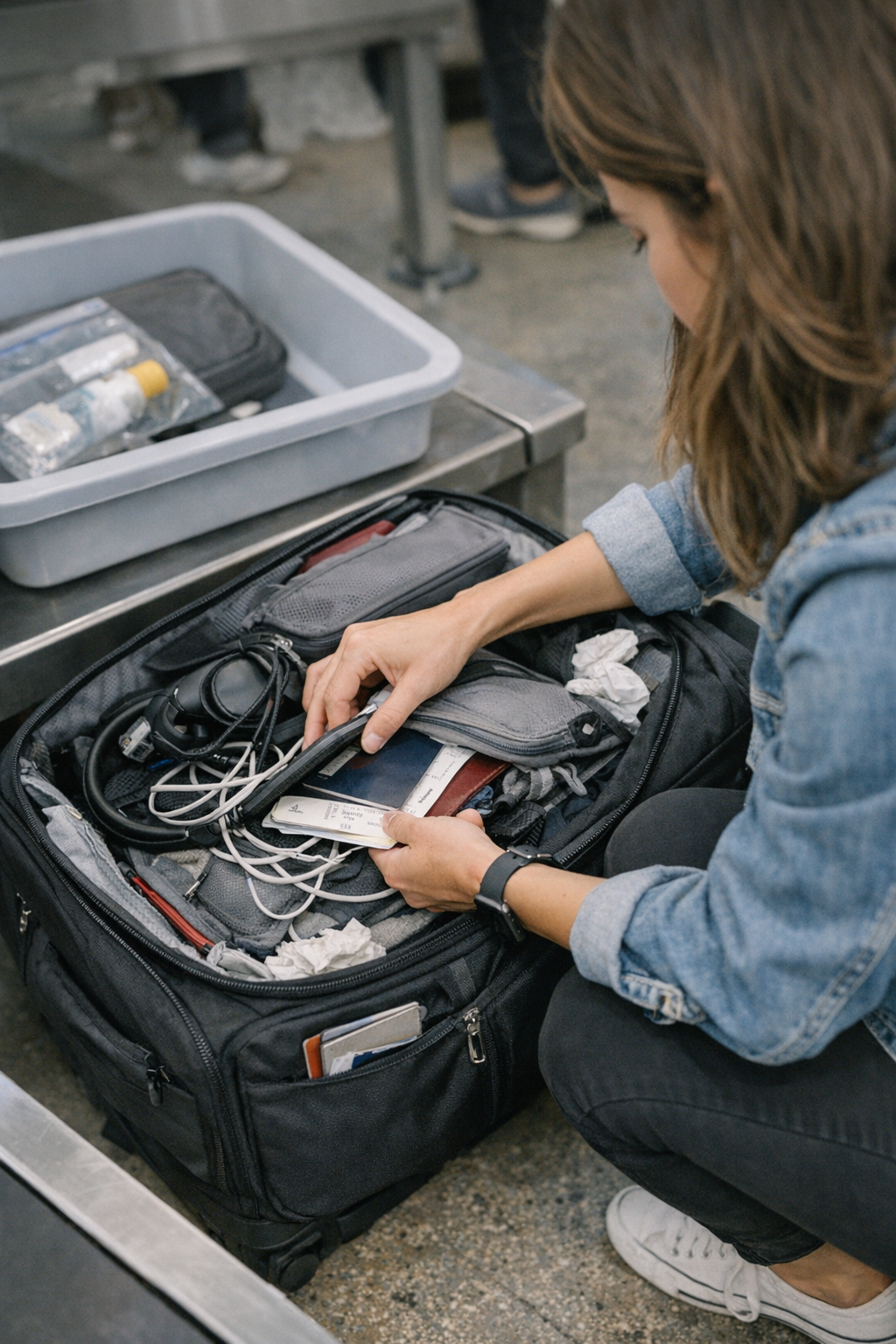
Most carry-ons look organized before leaving home—but inside an airport, tidiness can become the problem. That outer-pocket you packed so precisely jams your hand the moment you need your passport in a moving security line. That neat stack of organizers forces you to shift pouches and unzip main compartments just to pull out your boarding pass. Out on your kitchen table, everything appeared sorted. In real travel, what starts as an orderly system turns into a series of micro-obstacles: blocked retrieval, awkward reach, too many zippers, and a creeping sense that your “organized” bag is slowing you down when you need to move fast.
Small Delays Start to Add Up in Real Transit
On your first reach for an ID or charging cable, your setup feels solid. But by the fourth checkpoint, the cost of small design flaws shows up. That document sleeve you buried under electronics has now trapped your passport beneath cords, and the outer pocket you expected to grab on the fly feels overstuffed, squeezing your fingers. These delays are subtle: each time you pause to dig, rearrange, zip, and confirm, you lose seconds that stack up. Even a “good” packing strategy can create a drip-feed of slowdowns, turning a short trip into a simmering frustration loop.
Retrieving, relocating, repacking—on repeat: The sting isn’t in one hard stop. It’s the six-second shuffle at each ID check, the tug-of-war with a stretched pocket, and the disruption each time you return something “to its place”—and realize your careful order just turned into another round of digging.
Why Visual Order Doesn’t Equal Smooth Movement
The calm of a neat layout is skin-deep. Those perfect lines and stacked organizers photograph well, but they don’t move well. The moment airport pressure hits—security trays, boarding pass grabs, overhead-bin shuffles—your visually sorted setup starts to get in its own way. When a tech pouch blocks your main passport slot, or your document holder sits below every other pouch, the linear order combusts into a routine scramble.
Mid-trip, repeated obstacles become hard to ignore: pause to restash cables after a plug check, fumble for documents buried under “just-in-case” items, wait behind as others step ahead. For every item you fetch, three more get shifted. The more you chase order, the more you get stuck in a cycle of shifting, searching, and wondering why a “clean” bag keeps failing at speed.
Recognizing Repeated Problem Moments
Blocked Access at Security
The security tray reaches your spot. Your hand stops: passport wedged beneath your charger, laptop sleeve pinning it flat. You’re forced to juggle, repack, and rezip while the line breathes down your neck. A setup that doesn’t keep essentials truly at hand turns every checkpoint into a slow, energy-sapping restart.
Boarding Pass Buried in the Rush
The boarding line is moving. You reach for your pass—but a wallet or pouch has shifted in transit, burying exactly what you need. You pause and shuffle your bag mid-queue, feeling the pace behind you tense up. The access that seemed easy at home now invites a visible bottleneck exactly when you want to blend in and breeze through.
In-Transit Pockets vs. Real-World Retrieval
Travel guides preach pockets and compartments for order. But if your main pouch is layered behind lesser-used organizers, fast-reach items get demoted and blocked. Crossing concourses, you fish for lip balm but dig through a stack meant for hotel downtime. Each mis-sequenced pouch pushes you a notch closer to frustration—and missed cues in real movement.
The Real Source of Carry-On Friction
It’s not the mess you see—it’s the mismatch between what looks tidy and what actually stays accessible when you’re moving. Every forced reach, every extra unzip, every time a mesh pouch “secures” something you now can’t get without disturbing the rest—that’s friction. Maybe your tech organizer keeps cables neat but parks itself right in front of your passport or boarding pass. Maybe a rigid case “impresses” in the hotel room, but blocks you in the aisle under pressure.
Structure matters most when the same access is demanded again and again, at speed. It’s not about the first use—it’s about that late-night reach, the security crunch, the snaking boarding line, or the repack with no place to sit. Those are the moments when carry-on layout is proven or undermined.
Practical Adjustments That Reduce Travel Drag
Promote High-Use Items to Outer, Standalone Access
Reduce grinding friction by giving your top essentials—passport, boarding pass, ID—a dedicated, unshared outer pocket. No pouches piled on top. No trapeze act at the checkpoint. The improvement is immediate: reach, grab, done—even in back-to-back lineups. This one adjustment turns repeated retrieval from a scramble into a single, repeatable gesture.
Real travel scenario: Relocating travel docs to a slim exterior sleeve eliminated full-bag unzips for two straight security checks. Instead of hunting through layers, your hand lands on the right item every time—no midline panic, no last-second fumbles, no “Did I drop it?” check.
Let Infrequent Items Sink to the Bottom
Stuff you rarely need—spare chargers, backup toiletries, extra cords—should be corralled in internal pouches, deep in the carry-on. Keep them out of your main movement pathway so fast-retrieve items stay right where you need them. This lets you keep order without paying an access penalty for urgent grabs.
Think in Motions, Not Just in Layers
The best layout isn’t about color-coded lines or “maximizing” every inch. Watch how you actually reach, repack, and retrieve on the move. Which pocket gets checked five times in an hour? Which one stalls you during a rush? Favor accessible pathways and “return to ready” setups over layered cleverness—the difference shows the more you move.
What Consistent, Reliable Carry-On Setup Looks Like in Real Use
No setup sidesteps every tangle, but the right structure means the same item is always instantly at hand—even in chaos. You no longer need to upend your bag just to repeat a standard transit rhythm. Over one trip, these micro-adjustments stack up: instead of “Now where is it?” moments, your muscle memory takes over, and you spend more time flowing, less time sorting.
Don’t chase airbrushed perfection—chase a setup that keeps up when it’s the tenth grab that matters, not the first.
Shifting Your Carry-On to Work with You—Every Trip
Carry-on friction never arrives in one big failure. It’s the familiar clumsy reach, the repeated slow reset, the missing passport under a tech pouch—surfacing again and again, until you tune your setup for repetition, not appearance. The right structure builds trust and predictability, making every retrieval and repack automatic, no matter how many times the sequence repeats.