
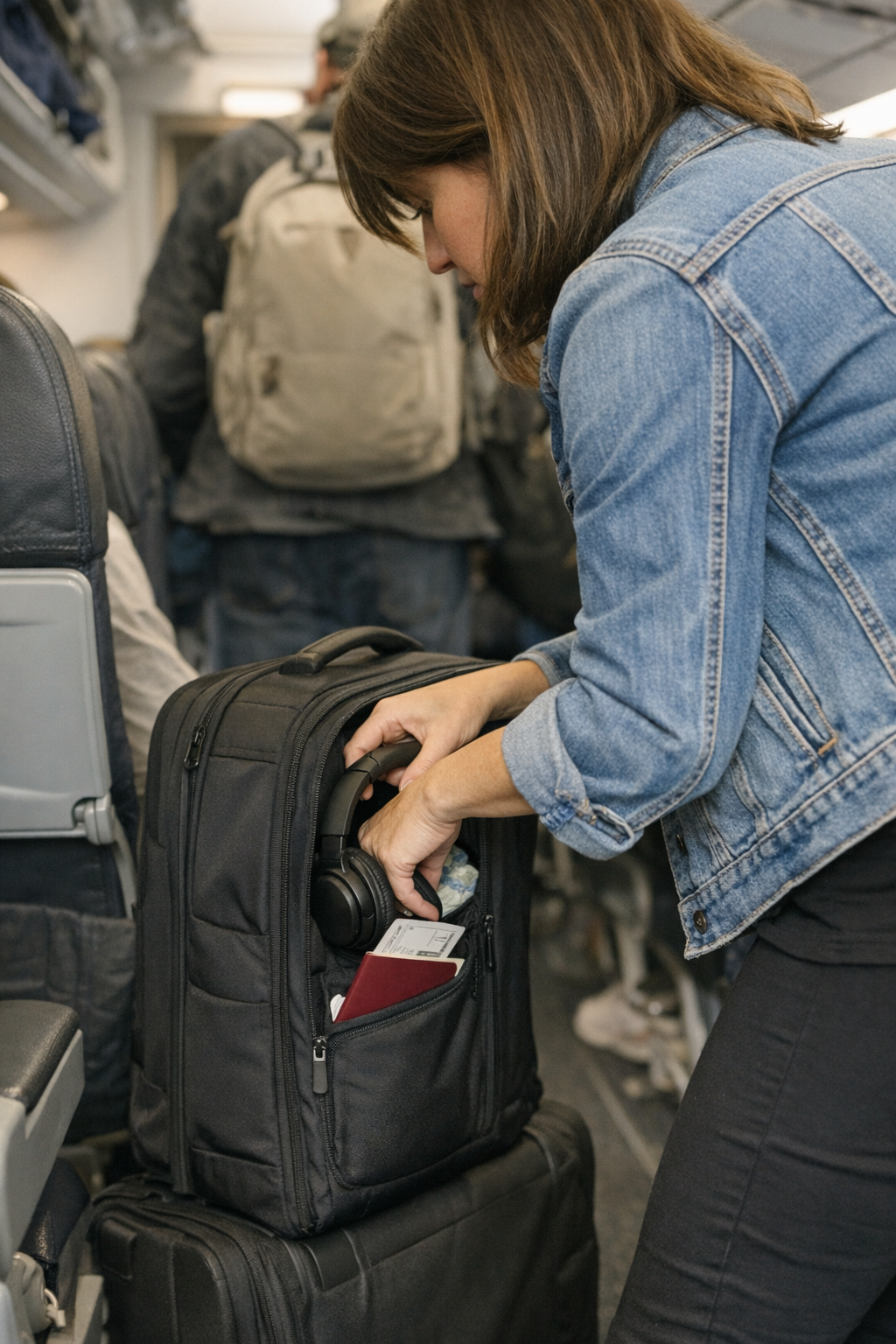
The weakest point in any carry-on setup isn’t mess—it’s the sudden interruption when you actually need something fast. The line lurches forward at airport security or a boarding gate, and the “organized” structure you praised at home turns sluggish: a document stuck behind a cable, a charger blocking your passport, headphones wedged too deep, a pouch that adds steps instead of reducing them. The drag isn’t visual clutter. It’s the real-world lag between reaching and retrieving—small, repeated, and costly when every second counts and lines don’t pause for you.
The Illusion of Organization: When Tidy Packing Turns Against You
At home, any system feels impressive. Pouches stack up in neat rows, cables are tied, and documents have their assigned spot. But at the checkpoint—elbows pressed, shoes in one hand, ID in the other—this planned order is tested and often fails. What looked like a “time-saving” setup turns into an awkward re-sorting scramble. A boarding pass hides behind adapters, a charging cable stops you from sliding your passport free, tech essentials blend into non-essentials. You end up rifling through organizers you meant to streamline, turning every retrieval into a two-step delay instead of a quick grab.
This isn’t a cosmetic annoyance. It’s an ongoing slowdown, one that repeats at every checkpoint, every boarding call, every gate transfer. You misjudge which pouch holds which cable, open the wrong pocket for your pen, dig past snacks to find earphones, and quickly lose trust in your original packing logic. Travel flow stalls with every overlapping zone.
Security, Boarding, and In-Transit: Where Structure Fails First
Travel exposes friction early and relentlessly. At security, trays move out of reach before you finish sorting. A bag that looked “locked in” at home lets documents slip into unreachable zones, tech organizers tangle at the wrong moment, and visual tidiness means nothing when the scanner line is live. Order deteriorates not in catastrophe, but as a string of small retrievals—each leaving the layout less certain for the next use.
Picture the ordinary breakdown: You dig for your boarding pass, realize the pouch doubled as a tech kit, and fumble as the line builds. The item comes free, but the neat grid you set up is scattered and in need of repacking—while space, time, and patience are running out just to move another step forward.
Looking Packed Well vs. Moving Without Delay
The sharpest contrast comes when a system that “looked” perfect—tightly packed, every slot filled—delivers friction instead of freedom when the conditions shift. Five color-coded pouches mean nothing if you still hesitate each time you need a passport. Tech sleeves built for desktop order resist quick access in a crowded aisle. Something as basic as a stuck zipper (because layers cross over the teeth) turns into a real delay. A “main essentials” pouch that requires a full unzip to reach a single pen loses you momentum.
Routine frictions hit faster than you expect: Having to remove the bag halfway from an overhead bin just to get one necessary item. Unzipping three compartments to find a snack. Confirming and reconfirming which pouch hides your charging cable—each instance saps your sense of control and increases repacking time mid-journey.
When One Zone Does Too Much: The Hidden Tangle
The “everything together” convenience of a multipurpose pouch sinks under repeated use. Inside, cables and papers coil around each other, headphones knot with pens, and what felt efficient at home turns maze-like on the move. Each time you unzip, the structure degrades—more overlapping, more hunting and rearranging. By the time you reach your destination, the single “organization hub” holds chaos, not order, making every needed item harder and slower to grab.
The Case for Single-Purpose Zones
The real upgrade in movement comes from separation—not more layers, but more intention. One dedicated, unshared pocket—especially vertical, along the side or on the outer shell—turns a stressful retrieval into muscle memory. One zipper, one motion, always the same spot. Your hand finds documents or essentials instantly, even with the carry-on squeezed under a seat or wedged into an overhead. The fumble and re-sort are gone; essentials return to the right spot after each use rather than drifting deeper into the stack.
How Packing Choices Echo at Every Travel Stage
Speed isn’t just about a single retrieval, but echoing consequences at every phase. During arrival, at the gate, boarding, or seat drop, structure choices either strengthen or sabotage your flow. The wrong overlap forces you to pull out half your bag for a passport. Zippers overlap and confuse, so the act of “quick access” now means scanning every pull tab or label. Outside pockets promising fast reach often become too crowded, turning into a slower bottleneck than the main compartment ever was.
Across a trip, what first felt “organized” gradually exposes its failure: Repacking after each checkpoint takes longer, not less. “Quick-grab” pockets are now slow to sort. The time lost in split seconds at every use adds up, quietly draining energy and mood as the journey unfolds.
Practical Steps for More Reliable Carry-On Structure
The fix isn’t more pouches or labels, but changing how zones work under stress:
- Designate a pocket or slot for travel documents and comfort essentials only—never mingle them with cables or chargers.
- Prioritize a direct-access pocket that stays easy to reach in an aisle or cramped seat (vertical or edge-side beats hidden interior).
- Keep tech, snacks, and bulkier items isolated further inside so vital retrieval isn’t blocked by low-urgency gear or cluttered overlap.
Every time you grab your boarding pass or passport without hunting, without shuffling, without even looking—these moments add up. Travel friction seeps out of the process, and you reclaim both time and focus every time pressure spikes and space tightens unexpectedly.
Access Over Appearance: The Test of Real Travel
Actual travel isn’t a photo—it pits your setup against urgency, tight space, and uneven flow. A visually tidy carry-on can backfire when jammed into an overhead or navigated with one hand while the line squeezes forward. Access is what counts, not just order. Every change—boarding, security, seat drop—proves how your setup holds up, or how it slows you down when every second is shared with strangers and moving trays.
The bag you actually trust isn’t the prettiest or most color-matched, but the one you can open, grab, and close, over and over, without a second thought. No backtracking, no “wait, which pocket?” hesitation, no last-second juggling. When retrieval becomes automatic, stress drops, lines move, and your trip feels lighter. That’s the difference between a setup that quietly accelerates your trip and one that quietly sabotages it, one unpredictable pocket at a time.
Visit CarryOnSupply for practical tools that help your carry-on keep pace with real travel.