
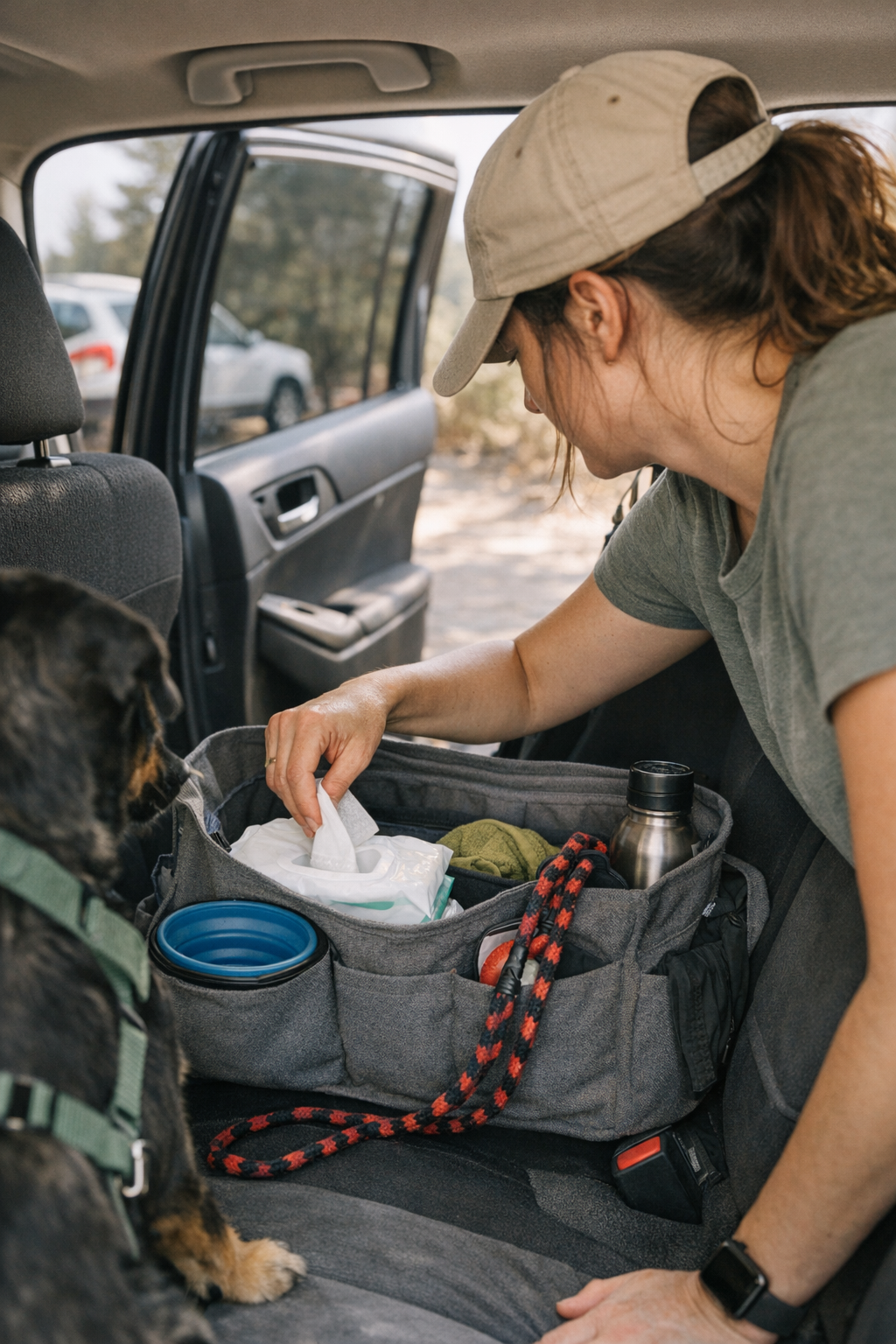
Pet travel setups rarely fail in theory—they fail at the first real stop. That “perfectly organized” bag or carrier doesn’t feel clever when you’re pulled over, one hand on a leash, the other frantically unzipping compartments just to get at a wipe or bowl. Water dish jammed beneath a folded blanket. Treats tucked away beside owner keys. Wipes missing in motion, “organized” out of reach by that third leg of the trip. The real friction isn’t what you forget—it’s what you can’t get to quickly when handling and cleanup are no longer theoretical. A setup that seems calm and dialed in on the driveway can slow you down at seat-side, right when movement needs to resume. This is the pressure point that shapes regular travel with pets, and PawGoTravel builds around these repeated, lived interruptions.
When “Ready to Go” Gear Chokes in Real Movement
Most pet travel friction doesn’t surface when packing, but when you try to grab a single item mid-trip—after real stops, with a restless pet, and no margin for slow access. On paper, every leash, wipe, treat, and bowl is allegedly “right where it belongs.” But pull over twice, handle a spill, and the pattern shows up: what looked arranged is now hidden by layers or blocked by comfort items. Fumbling for wipes, you sift through towels and your own keys. The bowl slides under gear you thought was for calm but now just delays you. The day’s routine pulls apart—not from missing supplies, but from setups that trap your essentials beneath their own structure.
Repeated interruption, not one-time chaos, kills flow. Dense pockets and tight organizers slow you most during the critical seconds between stops, not at the start. Every unnecessary zip or shuffle at seat-side means another delayed restart—and a few seconds lost every time add up fast across a trip.
When Organization Backfires: The Downside of Layered Kits
Too many compartments, deep-zip bags, or “ultra-secure” carriers seem smart but hog seconds when your pet is squirming or you’re holding a leash and coffee. Seat-side, the structure that gave you confidence morphs into a barrier: you’re leaning in, balancing bags, reaching for items buried one layer too deep.
Picture the loop: Quick stop for a five-minute water and cleanup break, only to spend two minutes rummaging for a bowl that migrated under the blanket, or for wipes sealed inside the “organized” compartment. One hand holds the leash, the other is left juggling zippers, shifting gear, losing patience. The same kit that looked optimal at home reveals a flaw—repeated stalls, each one bleeding out focus and keeping you parked longer than planned. Frustration isn’t a one-off; it’s a predictable cycle at every stop where organization becomes the drag.
Repeat Friction: The Weak Spots Don’t Go Away
The same snag reappears trip after trip. Seat-side “quick access” often gets blocked by the very comfort items you brought to calm your dog. A favorite toy soothes until it blocks the front pocket where wipes live. Bowls gravitate to the wrong end of the main bag. Every routine restart forces the same work: one awkward hand clears the way while the other tries not to drop something crucial. The setup isn’t chaotic, it’s just structured to work best only at rest—not in motion, not when speed counts.
Comfort and calm are vital, but not when they make it harder to grab what you need. A setup meant for stability can turn into an obstacle course if quick access isn’t right at the top layer—or if every retrieval becomes a negotiation between calm and speed.
Single-Reach Essentials Beat Over-Designed Organization
What solves these daily-use stalls? Not color-matched pouches or the “most pockets”—but visible, easy-to-grab essentials that don’t require two hands, deep unzipping, or guesswork. Specifically:
- Wipe pouch with a single-flap top, always outermost, never buried
- Collapsible water bowl clipped to the carrier’s exterior—grab with three fingers, not a full unpack
- Seat-facing open pockets for leash, keys, or waste bags—no need to reshuffle or pause
Sometimes, the most practical setups won’t look showroom-ready. A slightly “untidy” outer pocket, an open tote edge, or a bowl clipped outside might not appear perfect—but under repeat stress, these quick-access zones let you fix, reset, and move in seconds. Ask yourself: When handling a spill or leash snag, do you stall reshuffling layers, or just reach, clean, and continue?
Triggered by Reality: The Fourth Stop Test
By the fourth stop, weaknesses stand out. Door open, dog half out, muddy paws on the seat, water at risk of spilling—this isn’t the moment for a double-zip pouch or reach-under-everything retrieval. A wipe at the very front means you can clean, reload, and buckle up before the energy drains from the trip. Bowl goes in the exterior mesh, no stacking or balancing act required. It’s not a miracle, just a structure that reduces unnecessary reaches—and cuts the cycle of small hang-ups.
Small Shifts—Big Impact: Resetting the Routine
The smallest adjustment—separating go-to travel must-haves by actual frequency of use, and making them instant-access—dwarfs all packing cleverness. After just one high-frustration trip juggling densely zipped pockets, the logic is inescapable: frontload wipes and water, stuff the rest second. Now, the leash stays in one hand, cleanup in the other, and you’re not paused, unzipping, or fumbling mid-move. The day stops feeling like an obstacle course and starts to flow again—one second per motion, not three.
The endgame isn’t a sparse bag or a “minimalist” kit. It’s a routine that matches your actual travel rhythm—organized so you move with the trip, not against your own layers. Every second not wasted on repeat restarts or deep searches pays off—especially with energetic dogs and trips built on frequent, short stops.
When Pet Gear and Owner Gear Collide
One overlooked frustration: owner items tangled with pet gear. Searching for a treat but pulling out your phone; scooping up waste bags but snagging your charger. This overlap adds delay as you pick through the pile, and the pause isn’t solved with more dividers. Instead, give must-have pet items a protected, owner-proof “quick zone”—separate, unblocked, always within reach—so your own wallet never hides a leash or wipes. That single habit breaks the pattern of low-level gridlock, letting every transition feel smoother instead of heavier with each stop.
Don’t Trust Looks—Test Real Access
Organizers and carriers can sell you on visible order, but the true test is in the pressure of small, repeated travel tasks. Before your next trip, pick a must-have: wipes, bowl, leash. Time the reach, the return, the pocket reset—are you moving in one motion, or stuck shifting layers and re-zipping at every step? If each “grab” drags past a second or two, expect friction to set in by the end of the day. The access penalty adds up—not as chaos but as a routine delay you feel by the third or fourth stop.
The setups that feel right in real travel are built for movement, not put-together looks or packing perfection. Long-lasting routines aren’t neat—they’re friction-proof enough to outlast the cycle of seat-side fumbles and repeated restarts. That’s the shift you feel—and it makes the next trip less about pausing for your setup and more about getting back on the road.