
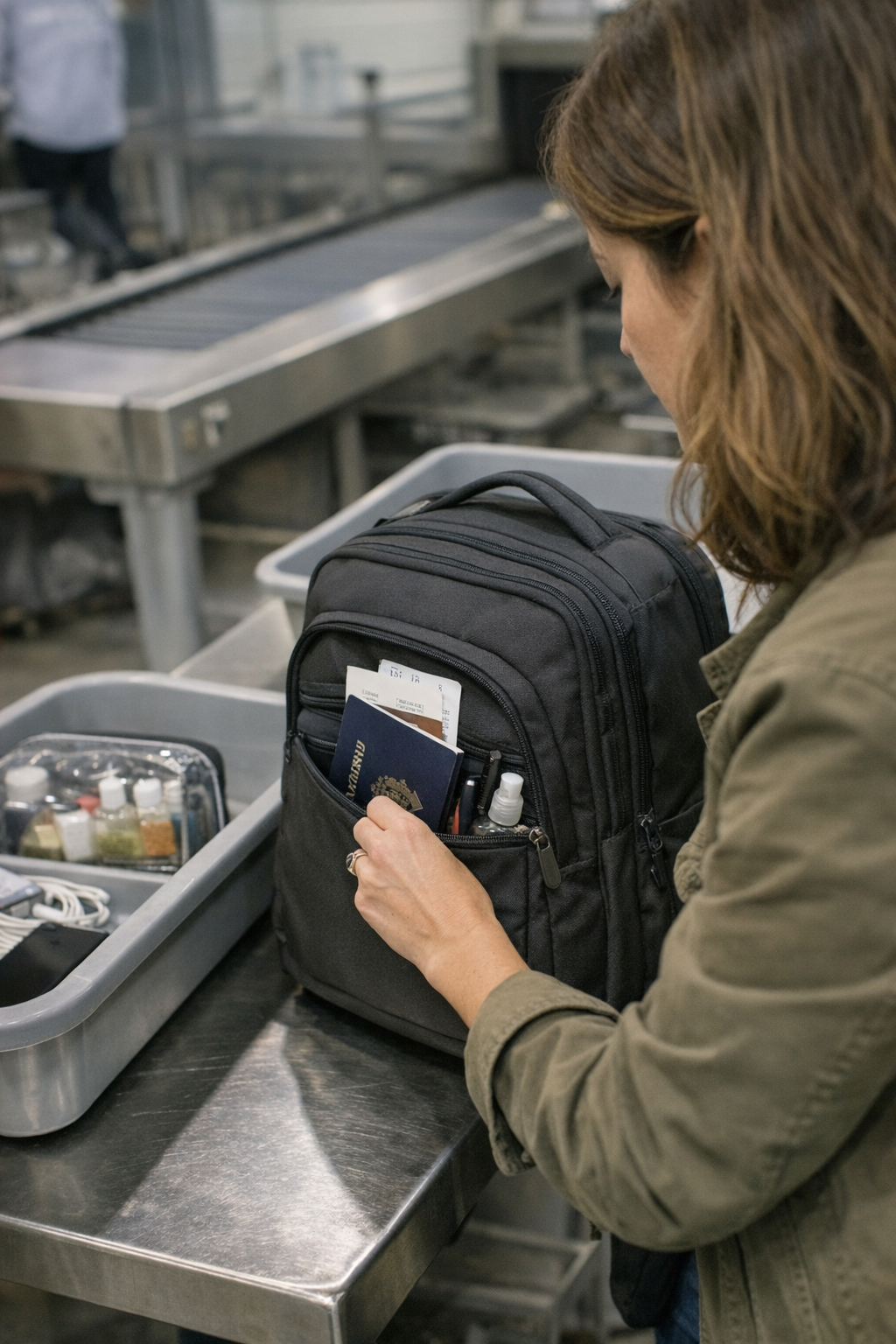
The moment your carry-on leaves the hotel room, neat packing starts losing its advantage. You join the security line. Someone behind you sighs while you crouch at the tray, rifling past two stacked chargers for a travel-size lotion buried in a pouch. At the gate, you’re blocking the aisle, stuck unzipping and pawing through “organized” pockets just to free your ID. The design that looked perfect on the bed turns clumsy at the checkpoint—every retrieval becomes a full stop, every must-grab item comes with an interruption. A well-packed bag at rest often turns into an obstacle course as soon as you need to move.
When “Organized” Isn’t Usable: The Hidden Trap of Neat Packing
Most travelers over-focus on appearance: pouches stacked, cords wound, compartments zipped. But every extra layer, every nested wallet, each tightly arranged pouch—these details show their true cost when you try to retrieve something mid-trip. Common patterns emerge:
- Your careful document stack forces you to handle every ticket, note, or bill just to get your passport out—for every single check.
- Charging cables look sorted, but when you need one before takeoff, it’s trapped under three other things and a tangle waits.
- The sanitizer and pen slide to the farthest corner of a deep organizer pocket, vanishing in the exact moment you’re up for customs.
Travel isn’t static. Every time the airport flow speeds up, that “order” quickly becomes slow-moving friction. Looks neat on the surface, but each new transit reveals where the setup drags.
Real-World Carry-On Moments: Repeated Interruptions That Add Up
Security Check: The Quick-Access Bottleneck
The X-ray line is where real carry-on design gets exposed. Nested pouches make for slow, awkward document digs. Now you’re fishing deeper, under pressure—then fumbling it all back as the trays stack up. Rush the repack, and it’s too easy to misplace something or leave behind a tucked-in device. The deeper your items, the more you reset in public.
Boarding and Aisle Traffic: When Every Inch Matters
Overhead-bin space is tight, the aisle is even tighter. You find your slim carry-on—then realize your passport is under two zipped layers, half-blocked by another pouch. Your top-down layout that looked so streamlined now traps small essentials behind everything else—forcing you to block the aisle and dig under pressure, just as the rest of the plane stacks up behind you.
Tray and Pouch Trouble: Packing Choices That Loop Back
“Deep organization” causes instant regret at the security tray. Suddenly you’re unzipping both a toiletry bag and a tech pouch, all for a toothpaste tube you thought was accessible. When travelers behind you rush forward, re-assembling your careful system mid-belt means something gets jammed or left out of place. The more nested your packing, the more fragile it becomes under pressure.
Why Certain Packing Decisions Slow You Down
The “Instagram-ready” bag hides a real problem: unzipping, detaching, digging, and reconstructing just to grab one high-use item. Boarding passes, tablets, snacks, and chargers pile up steps—each layered pouch or clever pocket multiplies reach and repack time. Tight spaces magnify every flaw. Crowded gates, shuttle jumps, busy transfer zones—here, every move you need to make in motion makes a packed-away item a liability, not an asset.
In real travel, the only “order” that matters is the one you can use—quickly and without drama. Repeated access is the only useful measure.
The Difference Between Tidy Packing and Instant Access
Visual control fools most travelers. If your setup can’t deliver essentials directly—passport, charger, snack, sanitizer—you’ll end up breaking down your whole bag just for one thing. Key questions for real travel:
- Can you pull your passport without shedding tickets or small bills all over the aisle?
- Can you reach a charger or pen in seconds, or are you lifting pouches and squinting at zippers?
- Is your repack at security a single, obvious motion—or a guessing game every time?
- Do high-frequency items actually return to their “home,” or are you rebuilding your layout at every checkpoint?
Most people only spot the cracks after their third flight or mid-transfer panic. A design that trims clutter at rest often underperforms where speed and access matter most—at the gate, in the seat, or when the line’s moving ahead.
Reducing Carry-On Drag: Small Adjustments, Real Results
More pockets don’t fix slow retrieval—less resistance between you and essentials does. The real improvement isn’t just another organizer, but finding the exact “lane” where the highest-frequency items always live. Example: group passport, travel docs, pen, sanitizer, and main cards in one shallow outer pocket with a smooth zipper path. Now, you bypass the main compartment for every high-pressure moment—ID check, ticket scan, customs—no more upending your bag or stacking items on the tray. Habits stabilize—the items always land in the same place, reset after use, and repacking shrinks from ten scattered moves to a single return.
Instead of digging under-seat or blocking a busy boarding line, you move with the flow: open, retrieve, close, keep going. Repeatable, not fragile. The drag, mess, and delay fade—because your carry-on finally matches real travel speed.
Recognizing (and Fixing) Carry-On Weak Points
There’s always a stubborn trouble spot—passport lost in a black-hole pocket, tech charger buried under a secondary kit, or a pouch system that collapses with one wrong move. These are more than minor annoyances. They’re the signs your bag’s structure isn’t tuned for the pressure of repeated, in-motion use. The right setup becomes invisible under real conditions: key items stop needing a search party, reset paths become intuitive, and every needed object returns to its spot. If you keep repeating the same awkward zip or pouch shuffle, it’s time for a smarter reset, not just another “organizer” share.
Travel-Ready Means Ready for Movement
What looks “organized” in a lobby photo rarely survives real trip motion. A bag’s true value isn’t how untouched it sits for a quick snapshot—it’s how quickly you can grab what matters mid-line, mid-seat, or mid-transfer, often without even looking. If your setup cracks the third time you need the same document before takeoff, or stalls every aisle move, it’s not built for real flow.
Getting there takes trial, judgment, and sometimes just one critical shift—a smarter pocket, a clearer outer slot, or a fixed path where high-use items never get buried. A functional carry-on turns trip chaos into flow you can trust—even through airport friction, cramped shuttle crowds, or trailing at the end of a long departure line.
Find practical carry-on solutions at CarryOnSupply.