
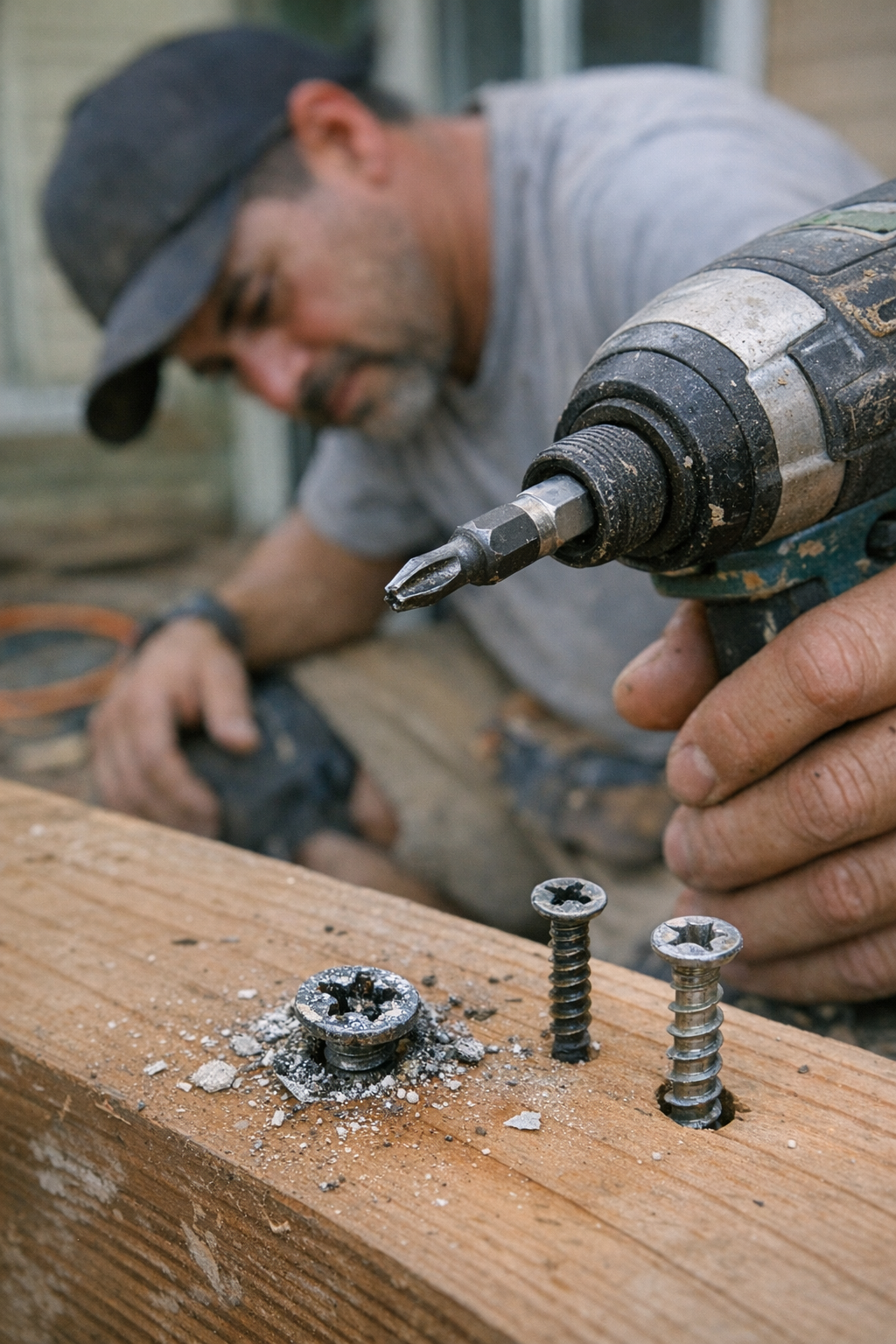
You feel it before you see it: the bit stutters, the screw head chews out, and suddenly a smooth drive is replaced by grinding resistance and ugly scars around the fastener. This isn’t the rookie mistake of the first screw—this is what happens as the hours stack up, as repetition exposes the difference between “good enough” tool pairing and the small mismatches that can sabotage your finish. On deck builds, subfloors, framing runs—when the pace matters and consistency pays the bills—a mismatched driver bit isn’t just an annoyance. It’s what slows you down, wrecks your lines, and, an hour in, turns tool confidence into tool fatigue.
Why “Close Enough” Isn’t: Real Consequences of Bit-Screw Mismatch
Spread out a pocketful of crosshead screws—Phillips, Pozidriv, even JIS—and they all blur together. When you’re behind schedule or working in low light, it’s easy to grab the “almost right” bit and push on. For the first few screws, there’s a false sense of security: the fit seems tight; the screws bite. Fast-forward fifty screws, though, and the cost starts tallying up. Cam-out lines snake across the heads. You get screws proud of the surface, seams you have to wrangle back together, driver bits that start to feel like they’ve got a mind of their own. That tiny slop at the bit tip multiplies—joint after joint, panel after panel—until proud heads and unsightly chips become not just cosmetic issues but real structural annoyances. More time sanding, more time re-aligning, more patchwork just to make things look finished.
How Bit Problems Multiply Over the Day
What starts as a barely-there wobble turns into a pattern. Especially with near-identical bits—Phillips, Pozidriv—the difference hides until you’re deep in a board run. As the torque ramps up (fastening subfloor, finishing drywall, pinning decking), you hear the grinding skip. The driver jumps, leaving those silvery trails, and then you’re wrestling half-driven screws or scraping knuckles on the joists prying out mistakes.
The problem is relentless with impact drivers. Under speed, every mismatch is magnified—sometimes you get a perfect drive, more often there’s a slip or a flare just as the joint tightens. You lose the steady rhythm, and so does the work.
On Site: Why “It Fits” Can’t Cut It
Tool tests don’t stop at a handful of screws. Real jobs look like full sheets, long rows—one after another for hours. Whether you’re running fasteners through treated lumber or pre-drilled metal, your bit is in the wood as long as your hands are. If you reach for “close enough,” bit-to-head slop quickly blooms into bigger problems: cam-outs multiply, screw heads collapse, and once-tight seams drift as tension gets lost mid-run. Suddenly, you’re pulling fasteners back out, re-setting panels, burning minutes on fixes you wouldn’t need if each drive actually counted.
Fatigue: Not Just Physical
The real grind of cam-out isn’t just how it slows your hands. Every time the driver skips and the bit smears, you’re forced to double down—more pressure on the trigger, more micro-adjustments, more minutes lost swapping bits or chasing a “good enough” fit. The wrist takes the hits, but so does your focus. Rework interrupts the flow, turning straightforward tasks into stop-and-start marathons.
Where Small Details Change Everything: Phillips, Pozidriv, Torx, and Square
What looks identical in the toolbox rarely acts identical under stress. Phillips and Pozidriv—even the most practiced eyes can confuse them, but their performance tells the truth after a few dozen screws. A true match lets you cruise: reliable grip, predictable depth, zero hesitation between fastenings. But a lookalike bit? Suddenly you’re finding metal dust on the tip, feeling the bite go soft, watching screws stall halfway through the board.
The stakes go up with harder wood and high-torque drivers. Perfectly matched sets—Torx for Torx, Square for Robertson, Phillips for Phillips—turn what used to be guesswork into muscle memory. Each screw seats cleanly, rows pull flush, and the only time you pause is to reload the driver. Over a full workday, that predictability keeps projects moving: less rework, fewer strip-outs, and smoother transitions panel to panel. The contrast is real—the day’s effort goes further, the finish looks sharper, and the whole job feels less of a grind.
Fasten Smarter: Habits That Save Projects
Swap bits at the first sign of trouble. Don’t settle for “almost works”—replace worn or dirty bits before they force costly fixes. Keep your bit sets organized and within immediate reach, especially for high-turnover tasks. Spot metal shavings early? Bit skips even once? Better to change now than to dig out ruined screws later.
When loading up for high-speed fastening, take three extra seconds: check not just the size, but the actual pattern. A Torx bit that’s even slightly off won’t hold up under torque; a Phillips or Pozidriv that doesn’t fit true is an invitation for cam-out chaos. If the bit rattles inside the screw, swap it. That hesitation is your warning; don’t ignore it. Every swap is cheaper than a half-day spent hiding torn-out fasteners.
Field Habit: Run the “Last-Check” Test
Before tackling a row—be it framing, drywall, or trim—run two test screws. Listen for the click, feel for immediate slop, and actually look: is the screw sitting flush, is the drive clean, is the bit quiet? If a test run shows trouble, fix the pairing now. Catching small mismatches here means fewer surprises mid-job and less strain at the finish line.
Warning Signs: Don’t Ignore These Bit-Head Clues
- Driver skips or slips under steady pressure
- Metal or paint dust gathering at the screw head
- Screws that never seat flush—no matter the pressure
- Tiny gaps showing up after you finish a panel
- Bits and screw heads feeling loose, even fresh out of the box
Any of these is more than an annoyance—it’s an early warning that your setup needs work. Waiting only makes the repair job longer and the day more frustrating.
The Real Payoff: Why Bit-Screw Matching Changes the Job
The win isn’t perfection—it’s consistency and control, especially when speed matters. Matching bits exactly to each screw head isn’t busywork; it’s the fastest fix for preserving workflow, preventing fatigue, and protecting every visible edge and seam. That minor adjustment—choosing the right bit every single time—pays you back over an entire project. Suddenly, fastenings stay flush, corrections shrink, and you’re able to hand off a finish that stands up to scrutiny. Every matched pairing saves a handful of seconds, but across hundreds of screws, it’s the margin between sprinting to catch up and moving confidently to the next job.
On every worksite, a smarter approach to your bits doesn’t just cut out hassle—it keeps the work clean, the timeline tight, and your tools (and wrists) ready for more.