
An entryway that looks controlled on Sunday can feel gridlocked by Wednesday—if clutter has nowhere to go the moment you walk in. Shoes may line up, bags might find a hook, and surfaces look inviting—for hours, not days. Then the first round of real-world debris—junk mail, crumpled wrappers, receipts, empty packaging—starts collecting wherever hands pause, especially if the nearest trash bin isn’t within grabbing distance. Without an instant hand-off spot, each pass-through presses temporary junk into permanent fixtures, tightening pathways, crowding benches, and making the next reset slower and less likely. Entryway order isn’t lost in a crash; it decays by increments—one overlooked wrapper, one stashed flyer, one coffee cup left “for later.” The threshold zone only works if daily friction has a landing pad. Without it, every organized setup is quietly undermined by the daily drop-off pattern.
When Throwaways Turn Into Permanent Fixtures
The visible difference between a functioning entryway and one slipstreaming into disarray doesn’t show up overnight. Monday starts fresh: bench clear, shoe tray aligned, mail sorted. But by midweek, friction builds—one grocery receipt perches on the bench, yesterday’s snack wrapper surfaces underfoot, a takeout cup edges into shoe storage territory. Every pass-through adds a fragment. Patterns form: the same person leaves keys and wrappers; the same edge hosts the “deal with later” pile. No single item demands a reset, so small debris go unchallenged. If a trash bin isn’t right by the incoming path, the delay is enough for clutter drift to establish itself—slowly swapping clean lines for catch-all corners.
The Snowball of Reset Friction
What starts as simple storage—shoes, mail, bags—begins doubling as a landfill for every item not instantly dealt with. Without disposal right at the threshold, surfaces abandon their real job as staging areas for ready use and instead become reluctant holding zones. Now, after the morning rush, the shoe rack gathers not just shoes but a halo of packaging. Reset doesn’t mean just lining things up; it means collecting scattered trash, shuffling piles, ferrying throwaways to another room, and often leaving “just one more thing” behind. Multiply by kids, roommates, or shared households, and each layer makes the space slower to reclaim. What felt organized last week now means dodging half-trash, losing seconds at every return, and facing a growing reset burden for a space meant to simplify—not delay—daily flow.
Scenes of Cluttered Thresholds: Real-Life Habits
The Bag-and-Bench Trap
Grocery bags in one hand, junk mail and receipts in the other. No trash bin in sight so the “just for a minute” pile forms on the bench. Shoes arrive next to the heap. By day two, the bench is no longer a seat—it’s a backup bin, and clearing it starts to feel like a full project.
Shoe Rows Breaking Down
The row is tight in the morning, but by evening: stray wrappers, receipts at the tray’s edge, grit where shoes are meant to rest. Picking up a pair now means dodging debris or just giving up and stepping over the mess. Overflow isn’t dramatic, but it creeps until the tray becomes a dumping ground as much as a shoe organizer.
The “I’ll Toss This Later” Experiment
Multiple passes, different people, same story. Everyone has one small item they don’t want to carry—flyer, napkin, broken shoelace—which lands near the entry. No single offense seems worth a trip to another bin. They stack up, squeezing the clear path tighter every day. Actual resetting gets postponed, while the threshold feels more like a hurdle than a welcome mat.
How Adding a Trash Bin Changes the Transition Flow
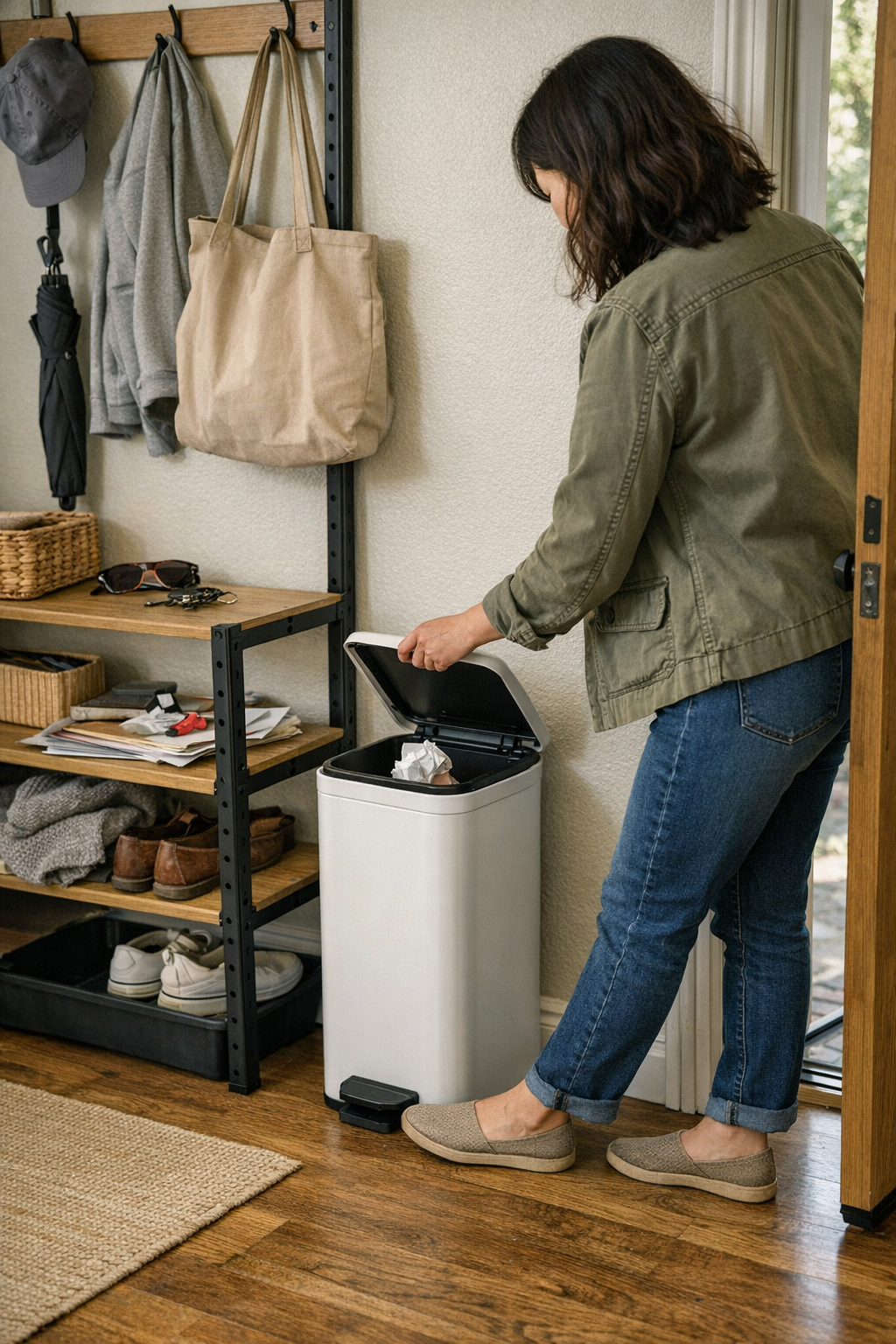
Drop a slim, lidded trash bin with a foot pedal just off the natural entry path—right alongside, not in front of, the shoe zone. Suddenly the pattern breaks: wrappers disappear the moment you step inside; unwanted mail vanishes straight from hand to bin; and that sticky “I’ll get this later” habit fades because disposal happens automatically. Surfaces stay functional because debris gets intercepted—before it can scatter, stack, or sprawl.
The difference is visible almost immediately. Within a few cycles of leaving and returning, the bin fills up—but benches stop serving as overflow, shoe racks remain for shoes, and mail organizers don’t double as trash organizers in disguise. The act of passing through the threshold now maintains order instead of undermining it, letting organization survive real-life use, not just the rare reset.
Setup Details That Matter
Entryways that resist clutter aren’t the biggest—they’re the best at intercepting junk in real time. A vertical, slim-profile bin consumes inches, not feet, preserving movement space while staying obvious enough for automatic use. Lidded designs shield against visible overflow. A foot pedal means you aren’t forced to set anything down before tossing it—vital for the “arms full, rushing in” scenario. None of that matters if the bin is tucked out of reach; the right placement means intercepting debris directly in the flow—never blocking routes, always inviting immediate use. The less extra motion reset takes, the less likely clutter advances past the drop zone in the first place.
Placing the bin elsewhere—laundry, kitchen, or any “next stop”—just guarantees more buildup in the transition space. Make waste disposal part of the entry ritual itself. The right setup doesn’t require cleanup as a separate task; it makes the reset near-automatic every time you step inside. Small design choices actively determine whether the entry stays usable through a busy week—or quietly collapses by Thursday afternoon.
The Real Difference: Entryways That Actually Keep Up
Most entryways look “organized” immediately after cleaning, or for that first round of guests. But repeated use exposes shortcuts and breakdowns fast. Without a trash bin that’s truly integrated, clever shoe racks and wall organizers lose ground to daily drift: stray edge piles, mail backup, wrapper spread, reset steps multiplied. Order grows harder to maintain with each pass. The result is never disaster, just buildup—hidden in plain sight until movement stalls and the threshold turns into a bottleneck.
Adding a trash bin is less about perfection, more about protection: protecting the function of each surface so bench, rack, and shelf remain what they’re meant to be—even in rush hour, bad weather, tight space, or full-family throughput. Clean lines don’t last by accident. A reset built into the walk-in routine is what keeps your entryway holding its ground, instead of constantly caving under daily debris.
For storage solutions and real entryway setups that actually match the pressure and pace of transitional spaces, visit Betweenry.