
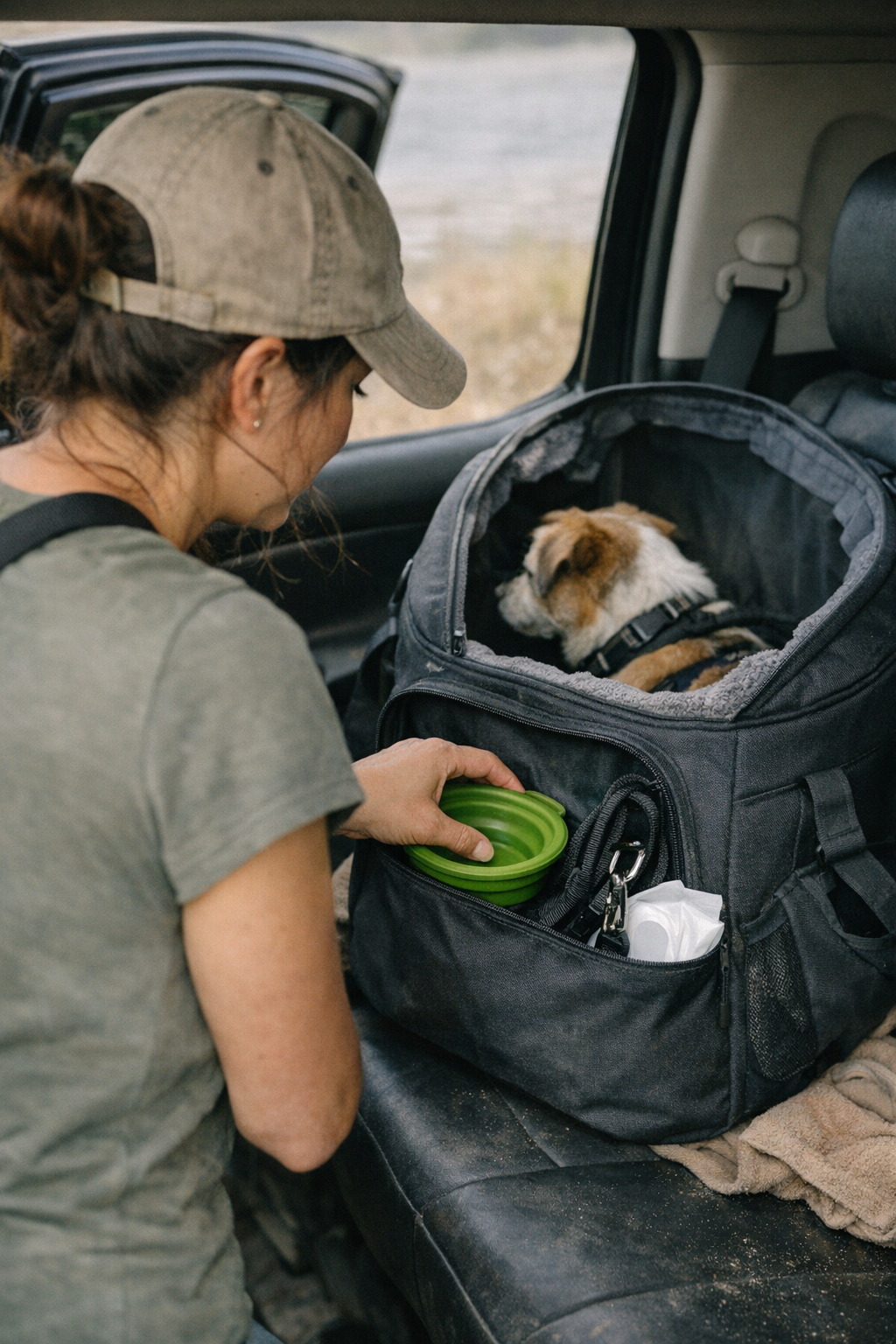
Halfway through your day, the pet carrier that looked “ready” at home starts to feel like a bad fit. The wipes you need are wedged behind a half-spilled treat pouch. Your dog’s leash is tangled under a hydration bottle. Grabbing one thing means juggling three others—right when a clean, quick reset is most urgent. With every stop-and-go, what looked neatly organized becomes an obstacle, draining patience and slowing you down. This isn’t rare inconvenience—it’s the point where most pet-travel setups quietly break under real repeated use. PawGoTravel lives in this gap: the space between gear that photographs tidy and gear that actually works at seat-side pace, with a restless animal in tow.
When “Prepared” Doesn’t Mean Practical
Looking organized is easy; actually moving through a travel day is something else entirely. Zip everything shut, label pouches, line up snacks and wipes—and five minutes after your first pit stop, real-life travel takes over. The pet wants out. The leash is under the bowl. The wipes are somewhere, but not in hand. What worked on the counter now stumbles at the curb. Equipment you placed with care at departure quickly starts to scramble itself with every short stop, every re-entry, every messy pause for a roadside break.
“Pocket for everything” seems efficient until it’s mid-trip, and now finding one item means digging, shifting, or emptying half your kit. In reality, the friction shows which setups hold up—and which just look organized until movement starts.
The Hidden Slowdown: Compartment Overload
Extra sections don’t guarantee speed—they usually delay it. A carrier packed with layered dividers and clever sleeves ends up hiding your essentials under each other. After two or three stops, the “tidy” look is gone—now you’re stuffing a damp bowl above a knotted leash, then hunting for wipes that have slipped deep into a side pocket. What felt smart in your kitchen now feels like a puzzle you get forced to resolve, again, each outing.
These recurring stumbling blocks stack up fast:
- Leash buried under a water bottle—can’t reclip your dog without unpacking half your kit
- Cleanup wipes visible, but stuck at the bottom and impossible to extract one-handed
- Comfy bedding eats up the best access pocket, so nothing is reached quickly
- Pet food gets muddled with human snacks, mixing crumbs and slowing every grab
Each “organized” layer adds another pause. Pets squirm, tempers shorten, and your trip’s rhythm breaks: now, travel is dictated by your gear’s slowest point, not the pace you need.
Scenes That Reveal the Weak Point
Returning to the Car When the Routine Breaks Down
Imagine finishing a muddy detour at the park. Dog leashed to your wrist, wipes clutched in one hand, damp bowl under your arm—you get to the car, only to find the front pocket is blocked by the treat bag you used last stop. There’s a pause, your pet gets impatient. You’re unpacking gear to extract what you need, repacking it in a slightly worse arrangement for next time. Multiply this by every pit stop, and your “organized” setup turns into perpetual reshuffling—swapping speed for slowdowns that never appeared at home.
Juggling at Quick Stops
Fast errands get complicated in seconds. Buckling your cat’s seat harness demands squeezing past a half-open package of wipes jammed on top. You close the travel bag after a water break, but reaching for the leash means digging past snack pouches while your dog pulls off-balance. What felt fine on your hallway floor collapses under real-time use—revealing the gap between a calm setup and true travel flow.
What Actually Makes the Difference?
The real fix isn’t more storage—it’s targeted, repeated-access placement. The most effective pet travel setup is the one that puts your highest-use items—wipes, leash, bowl—where they’re instantly reachable, one-handed, at the edge nearest your pet’s space, every single time.
Instead of scattering essentials in far-flung pockets, group them where your movement begins: close to the carrier opening, side pocket by the car seat, or top-flap on the travel bag. Suddenly, you go from awkward, multi-step digs to barely pausing. Each restart is swifter, routine items come out in order, and travel flow returns—no matter how many unscheduled pulls over or seat-side cleanups you run.
It’s not about extra features or more “solutions.” The real advantage is structural: the right pocket or opening ends interruption before it starts.
Why “Compartmentalized” Isn’t Always Efficient
At first, kits loaded with slots and dividers feel clever—until you’re forced to operate by their logic, not yours. A bowl jammed into a deep sleeve, a leash tangled in a mini-pocket, wipes you can’t reach without unzipping half the bag: every stop magnifies how these systems slow you down. The more you strive for order, the more your gear pushes back with micro-delays.
The contrast is clear during heavy-use days: a wide-access section beside your pet’s seat lets you dump a wet bowl, grab wipes, unclip and pocket a leash—all one motion, one hand reserved for your animal. Structure that supports repetition means fewer interruptions, and nearly immediate reinforcement that this arrangement cuts friction instead of stacking it.
Resetting the Routine — and Keeping It Moving
The best pet-travel setups are built for return-to-movement, not just for a first impression. If every stop demands re-sorting, hunting, or untangling, your gear isn’t just cluttered—it’s pushing you off schedule, and making fast cleanup feel harder every single trip.
Prioritize kits that let you:
- Snag wipes or treats without unzipping multiple sections
- Keep your own keys, snack, or coffee from colliding with leashes and bowls
- Hold onto your squirming pet while extracting cleanup supplies
- Leave each stop at the same pace you arrived—instead of losing time as the day wears on
If a bag or carrier consistently trims minutes from restarts, it isn’t just a better organizer—it’s an easier travel companion, stop after stop.
Finding Your Real “Ready” Setup
After enough returns to the car, every owner sees it: the gap isn’t between “organized” and “messy,” but between setups that let you reset in seconds, and those that keep adding micro-battles, tangles, and spillover. Carriers and bags that adapt to repeated movement—and cluster your critical items together—eliminate the hidden drag of fighting your storage over and over. Every time you restart with ease, the payoff is clear: less time fixing, more time moving, no matter how many seat-side cleanups or field-side pauses your real trip demands.
Want pet travel gear that survives more than a photo op? Focus on return-to-movement flow—not just surface-order. Fewer forced compartments, smarter front-side access, and a structure that reduces interruption instead of multiplying it. For solutions built for the real, repeated push-and-pull of road travel with pets, explore PawGoTravel’s practical solutions here.