
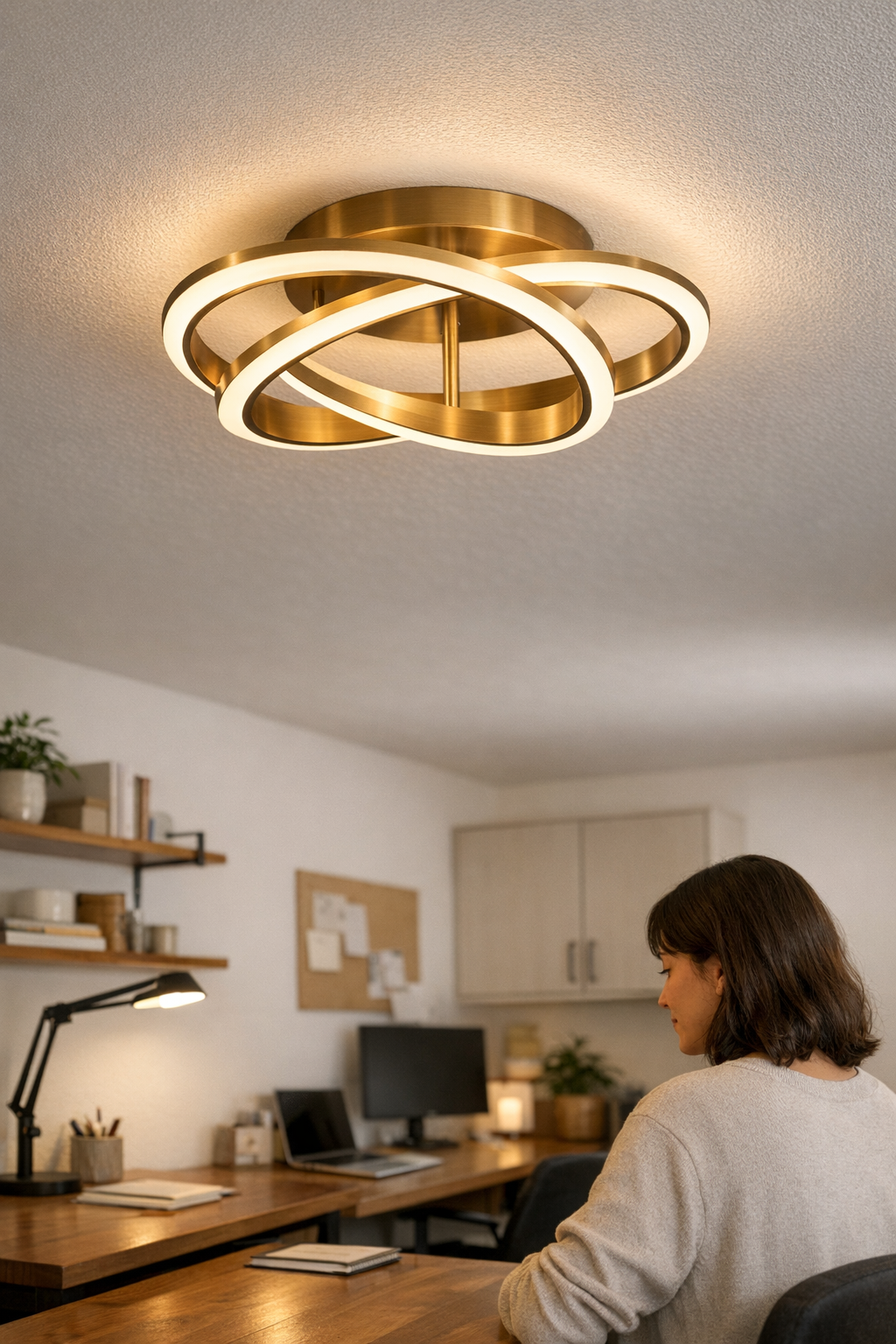
Low ceilings don’t just limit where you hang a light—they force every lighting decision to prove itself during daily use. Fitting a central fixture that looks slim in photos can still box in movement, leave you ducking exposed cable lines, or scatter glare exactly where you work. Even in clean, modern rooms, the wrong overhead setup quietly clamps down on workflow and comfort, leaving support hardware and stray shadows as daily irritants that never quite disappear.
Where Lighting Setup Turns Into Invisible Friction
In a low-ceilinged room, overhead fixtures do more than take up space—they shape every routine. A bulky or poorly placed ceiling light is not background decoration. It’s the reason you stop short when organizing a top shelf, brush fingertips against a fixture while stretching, or find yourself shifting your desk inches to avoid a glare streak left by a misaligned bracket. The supposed visual upgrade turns into a tangible source of interruption, segmenting the room and making a shared space feel even smaller with every pass-through.
It doesn’t matter how tidy the rest of the room is—if two support brackets pull the eye off-center, or a cable run stays obvious against the ceiling, those details demand attention. When those lines cut across overhead space or spill awkward shadows onto desks and tables, the cost isn’t just aesthetic. Suddenly, reaching for a book means tipping your body away from a glare patch; two people using the same work surface end up jockeying for the “good light” spot. The sum of these small frictions is real: they slow routines, wear patience thin, and make shared zones feel tight even when square footage is unchanged.
How Slim Lighting Changes the Room—And Where It Falls Short
Slim, low-profile fixtures promise relief: remove a clunky light, and your ceiling line looks higher, the room feels airier, and there’s less to dodge. The first impression delivers—until routine use cracks the illusion. When the physical fixture nearly vanishes into the ceiling, you might expect the problem is solved—but cables that won’t tuck away, brackets that don’t align, and mounting that solves the look but not the use show up almost immediately, especially where the same surface serves different needs day to day.
Real impact comes not from fixture thinness but from how support and cable logic meet repeated use. Mount a slim LED panel and clear the center, but miss cable management and the clutter relocates, snagging the eye at the room’s edge or shadowing the wrong corner. Each time you slide a desk or shift a chair, stray cables and busy mounting areas reintroduce distraction. That “clean” setup quickly grows rough at the edges, undermining comfort as real routines rub against superficial solutions.
One Room, Multiple Problems: Where the Clean Look Fades
Consider a compact shared office: one central LED panel, two desks, both in constant use. Swap the bulky fixture for something razor thin—it helps at first. But within days, both users find themselves sidestepping the same shortcomings: the bright center that throws dimness onto the farther desk edge, a sudden glare spike on one monitor, the cable snaking out and down despite best intentions. The ceiling looks less crowded, but every misaligned detail competes for attention when routines speed up.
By midweek, repeated frustration sets in. You lean out of glare more than once a day. Your co-worker tugs at the monitor to catch a clear line of sight. The once-flat cable sags, forming a lazy dip overhead. None of these faults flash red on installation day, but their persistence makes the room feel cramped, not finished. The cost isn’t theoretical: it’s the micro-irritation of posture shifts, lost desk edges, and seeing a “solution” only halfway hold up.
It’s the Accessories—and Their Placement—That Make the Real Difference
Slim lighting alone rarely fixes the lived-in discomfort of low ceilings. Durable comfort comes from precise mounting and strict cable control. The design matters, but so does each decision about bracket location and wire routing. Move from a generic bracket to a ceiling-hugging channel, bury cables inside a matching path, or nudge a fixture just enough to center light over an actual workspace, and you start preventing the return of clutter and shadow. A shift of 12 centimeters for one bracket kept the cable entirely out of sight in a real setup, transformed a patchy edge into useful workspace, and stayed stable even after furniture shuffled—which only happened because support details were chosen for actual use, not just for initial appearance.
Don’t Let “Looks Finished” Mask Real Discomfort
Many setups seem resolved once the fixture is up, but reveal flaws under constant use. A bracket that juts into the edge of a walkway, or a cable that slices an otherwise open ceiling, traps attention every time you cross the room. The illusion of “tallness” vanishes the moment someone has to duck or steer away from a repeated shadow line. People make unspoken adjustments—angling chairs, shifting routines into awkward corners—when the support structure solves appearance but not function. True success is not a day-one “after” shot, but a work week where you forget about the lighting because it never interrupts, glints, or tugs your field of view.
The Details That Decide If “Slim” Stays Practical
In the reality of low ceilings, it’s easy to upgrade only the visible fixture while letting the messy parts remain. Slim panels can outperform older ceiling lights, but if cabling winds out in plain sight or mounts pull light off target, the advantage disappears fast. Miss the far desk edge, and whoever lands there lives with eye strain. Push cables to a corner, and their new “out of the way” spot winds up as part of the everyday scenery.
- Exposed cables = unending visual noise. What starts as an invisible line soon becomes a distraction you learn to resent with every upward glance.
- Off-center brackets pull the ceiling off balance. Even a minor misalignment sets up asymmetrical shadows—most obvious over desks and group tables where illumination needs are highest.
- Old mounting points undermine new setups. Relying on legacy fixes drags fresh fixtures out of sync with today’s real needs, misplacing light and leaving shadows unaddressed.
The ceiling feels clear only when every element—panel, support, cable—works together to suit how people actually use the space, not just how it photographs on install day.
Small Fixes That Help Over Time
If rewiring isn’t practical, use adhesive cable channels color-matched to the ceiling to make runs inconspicuous. For off-center fixtures, angle brackets so that any shadow drifts away from the main desk or work area instead of across it. These are tweaks that matter: a few minutes to reposition a bracket or slide a cable out of a sightline can relieve months of low-key discomfort, letting you focus on work instead of wrestling the setup yet again.
What Makes a “Clean” Ceiling Hold Up in Real Life?
The real value of slim lighting in low-ceilinged spaces isn’t just the fixture—it’s the stability and quietness of the setup through everyday shifts. If you’re not spotting exposed cables, dodging protruding brackets, or squinting at half-lit surfaces, it means the installation matches actual routines, not just design ideals. A ceiling that stays clear is built out of discipline: cable management that lasts, support points that anticipate daily patterns, and placement that resists disruption from small movements and rearrangements.
The payoff is subtle but real—setups that never nag, rooms that invite shared work, and ceilings that recede rather than restrict. Even a small change, done with attention to real use, makes every ordinary routine noticeably smoother. For lighting and support setups that solve not just how a room looks, but how it actually works over time, visit LightSupport.