
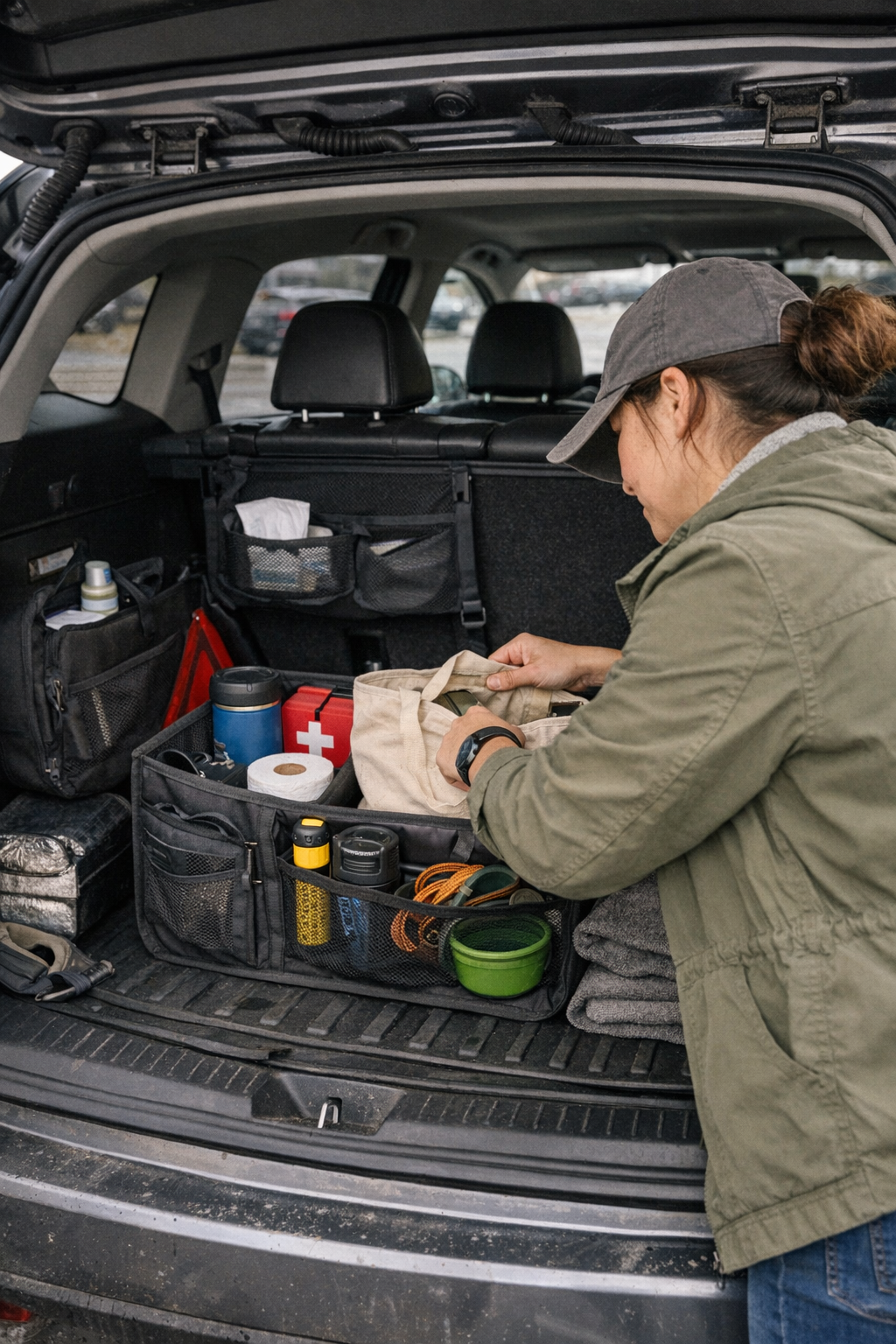
The moment you realize your car setup isn’t working for you usually comes from the floor. Maybe it’s a charging cable wrapped around your ankle, a half-crumpled wipe sliding under the pedal, a spare mask buried in grit, or a charging bank that always lands just out of reach. These aren’t major hazards—a quick trip, and you ignore them. But they build up: every errand or commute means untangling cables, scooping up the same loose gear, or feeling your hand search again for something that’s drifted away. The story isn’t about a messy car. It’s about an interior that keeps tripping you—where “tidy” never means smooth, and so-called storage solutions can actually slow you down.
When “Tidy” Isn’t Enough: What’s Missing in Your Routine
Most cars look controlled at a glance—trunk bins tucked away, cup holders open, floor mats straightened. But that appearance fades during real use. Within a week of short trips and rushed re-entries, the chaos leaks back in:
- Charging cords snake into the footwell, needing a shove aside every single morning.
- Wipes and masks shift and wedge into unreachable gaps—never waiting exactly where your hand expects.
- Loose change and sanitizer play musical chairs, drifting from shifter to door pocket to between the seats.
This isn’t about neatness for its own sake. When every return to the car means five seconds searching or shifting things—especially rushing in rain, or with arms full—it starts to wear down your routine. No “in-between” zone means every stop reopens the mess, and you’re repeating the same cable untangling and item shuffling more than actual driving.
The Hidden Costs of No “In-Between” Zone
Hidden storage doesn’t fix the problem—it just disguises it. Trunk lids close, seat bins slide under, but the tools, cables, and wipes you touch daily resist being truly stashed. Instead, they go rogue: phone cords jammed under mats or pedals, wipes escaping to the passenger side, a backup shopping bag ending up behind the seat or in the trunk after a turn. Now, every trip means finding, not just using, your essentials. With each drive, the lack of a “landing zone” multiplies micro-annoyances: yanking a cord loose, bending to hunt for a lost mask, re-cleaning the same spot because loose wipes get dusty fast. “Tidy” on paper quickly unravels without a repeatable structure for the things you use most.
Where Routine Interrupts: Real-Life Friction Points
When does this friction stand out? Try these—
The Rainy-Grocery-Run Scenario
You hurry to the car juggling bags, phone, and umbrella. You open the door—phone slips onto the angled seat, screen in pooled water. The cable has crawled out, wrapping your wrist as you reach. Wipes? Buried under two layers of yesterday’s errands. Every motion is clumsy: nudging items with your elbow, scooping under the seat, or pausing awkwardly just to find clear floor space for your foot. This isn’t rare. It’s exactly what surface-level “tidiness” misses: the way disorganization punishes you fast when just one thing needs to go smoothly.
Commuter Chaos, Interrupted
You come back to your car after a long day. The charger cable is somehow looped around the parking brake—again. The mask you need is stuck in no man’s land between the seat and door. You’re not adjusting to a new mess; you’re living with a pattern where nothing seems to stay where it should, and every commute ends with a micro-wrestle, even when the cabin still looks “clean.”
Why High-Frequency Items Need Their Own “Landing Zone”
There are two types of car gear: what you store and what you actually use. The difference feels small until you have to dig a phone from a bin mid-errand, or sweep wipes out from under a pile of mail just to sanitize your hands. High-frequency items need an always-visible, always-reachable zone—a hub, not an afterthought. This isn’t just more storage. It’s a stable site for quick deposit and grab, keeping daily-use gear in the same path, not orbiting the floor or playing hide-and-seek with every trip. Without that structure—without a physical “landing pad” for what cycles in and out of your hands—organization stays frozen and soon collapses into familiar, low-level hassle.
Making the Zone: How a Small Structure Changes the Experience
The “fix” isn’t a trunk vault or extra cupholder—it’s smart structure, right where the repeated action happens. The best upgrades sometimes look like nothing: a seat-edge organizer that catches your essentials before they hit the floor, a routed channel that keeps charging cables in a single arc, a divided tray close to the hand’s natural return. What matters is:
- Natural hand path—so you don’t have to consciously correct your motion every time.
- No pedal or seat interference—structure means flow, not new obstacles.
- Division for real needs—one spot for sanitizer, a groove for a charging plug, a slot for your must-grab mask or pass.
With this structure in place, cleanup time shrinks. Cables don’t snake onto the floor, daily wipes don’t bury themselves, and the quick-reach items actually stay quick to reach. Even a five-minute parking-lot sweep becomes easier: essentials are right where you left them, not migrated out of sight or stuck behind uneven piles.
Does Structure Actually Save Time? Real-World Results
The pace of improvement isn’t dramatic, but you notice the shift each time you drive:
- The portable charger stays in place through sharp turns.
- Wipes and masks actually stay clean and accessible—no more diving under the seat mid-commute.
- Cords trace a predictable, snag-free route every trip.
Here’s what changes: You stop hunting. Bending, scooping, untangling, or stopping to retrieve runaways drops off. Less time spent correcting little messes means more time moving, less strain on your back and patience, and—most noticeably—far less floor grit collecting against your essentials. What’s measurable? Fewer repeat cleanups and smoother transitions in and out of the car. The difference isn’t just in looks, but in ease and repetition: the proof shows in friction that’s simply gone.
Common Pitfalls: When Storage Creates More Work
It’s easy to assume more bins or deeper compartments equal instant order. But hiding daily items out of immediate reach creates its own loop of clutter and frustration. The more often you need an item, the less hidden you want it—otherwise, gear pops back into cupholders, crowding the shifter or dash, and you circle back to scrambling for what you can’t quite grab. Storage solutions should reduce steps, not add new ones—if the setup makes you dig, sidestep, or double-handle, it’s actively working against everyday flow. What was “organized” quickly becomes just another cleanup to repeat, in a slightly different place.
Setting Up a Real “In-Between Zone”—What Actually Works
The simple, repeatable upgrade: install or place an organizer right at the seat edge or under the center console—where your hand goes every time you sit or reach. The best location:
- Makes charging, grabbing, and returning items frictionless.
- Stays out of your feet’s path and doesn’t block movement.
- Allows entry and exit—no extra shuffling, no new snag points.
There’s no such thing as a flawless interior, especially in daily use. But if you’re still pulling the same charger from under the seat, or cleaning up gear that rolls everywhere after every normal trip, it’s not for lack of storage—it’s a missing “in-between zone.”
Find practical, field-tested car organizers and daily driving solutions at DriveWellSupply.