
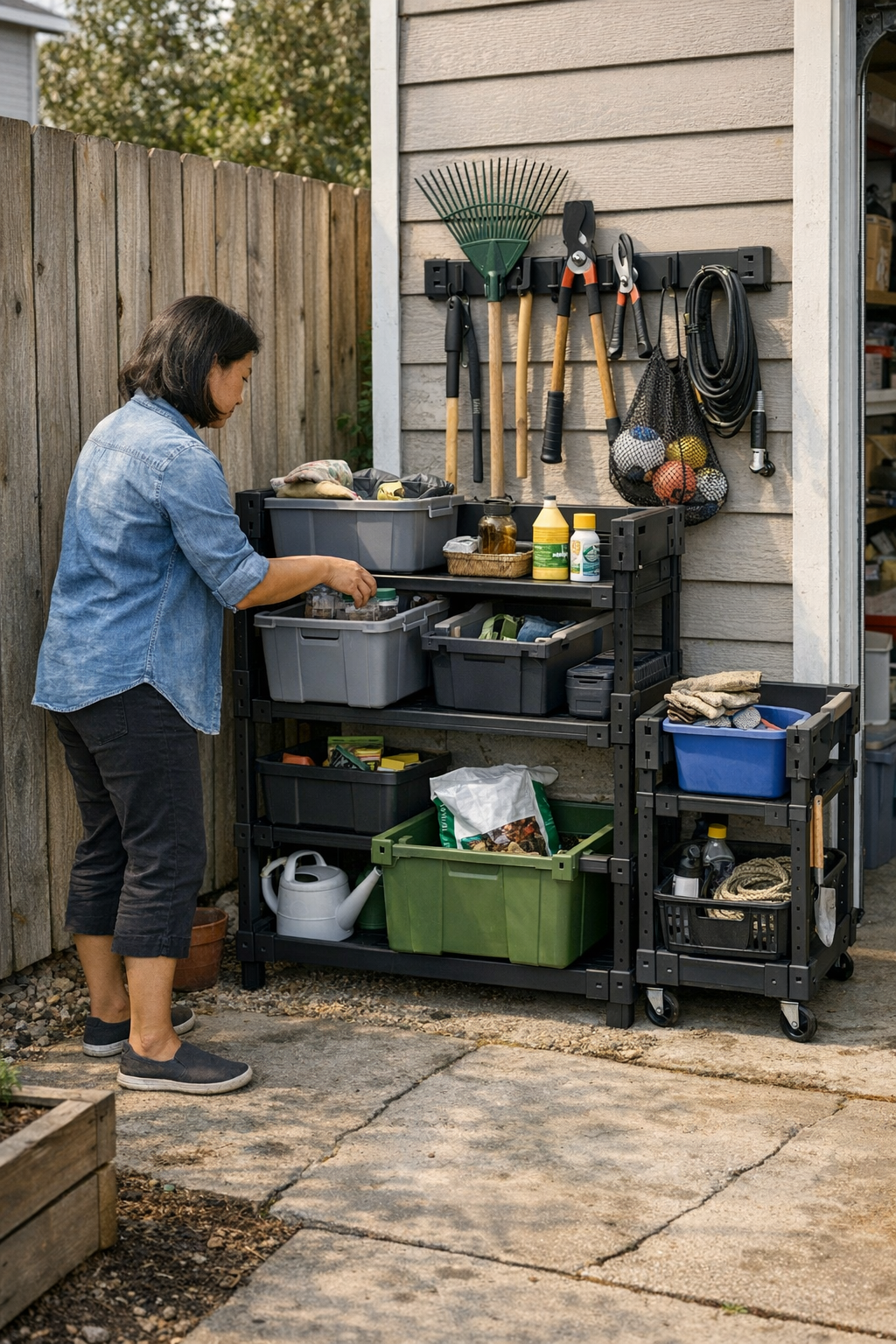
Outdoor storage promises simplicity. The wrong setup just breeds chaos. Step into any side yard or narrow backyard strip, and you know the drill: dodge a rake, step over last week’s muddy boots, dig for lost gloves beneath old pool toys. This isn’t about sloppy habits—it’s a setup problem, and it wears out fast. Where tools and gear are shared, every clever arrangement gets stress-tested by real life. The gap between “it all fits!” and “why can’t we move through here?” closes in a matter of weekends.
When Organization Breaks Down: The Everyday Grind
Storage solutions look good in catalog photos—deck boxes lined up crisp, benches closing over scattered toys, plastic sheds zipped shut. But after the first week, patterns reveal themselves. Return flow crumbles. The mower is wedged against a bin that won’t close. Random soccer balls rest wherever they roll. Folding chairs migrate to block the path entirely. As soon as any single item lacks a clear home, “just dump it here” becomes the law, and every “back to normal” reset lands on whoever loses patience first.
Clogged Paths, Small Annoyances That Add Up
The mess rarely erupts all at once. One trowel gets tossed into the deck box and vanishes under pool noodles. Later, someone piles games and bats in front of the only walkway. What looked like harmless clutter becomes gridlock: moving the mower means shifting half the shed, and the only way to find pruning shears is to did through a tangle at the bottom. Resentment simmers quietly—especially when some users contribute more than others to the piles or the cleanups.
Why “Tidy” Storage Doesn’t Fix the Routine
It’s easy to feel impressed by deep bins and big deck boxes—everything hidden, technically nothing left out. But this illusion hides the critical flaw: when returns aren’t obvious or easy, no one sticks to the reset. Layers build up inside closed bins, and once the neat “entry layer” fills, things end up dropped behind the shed, propped on fences, or stranded on the patio edge. Every storage “success” becomes a source of new friction the moment real life takes over.
The Wall System Swap: Friction That Disappears
Wall-mounted systems don’t just save space—they expose the routines that actually work. A row of hooks and wall racks leaves nothing buried. Rakes hang where you can see them, balls return to their sling or bucket, and anyone can tell immediately if something’s missing. With clear, visible spots, it’s harder to justify tossing a tool arbitrarily, and lost time sifting through the pile shrinks fast. Suddenly, what goes missing is obvious—a quiet motivator no deep bin can match.
Where Efficiency Dies: A Real Use Scene
Picture a narrow concrete corridor squeezed between a garage and a fence—a side-yard zone every house seems to inherit. There’s a “sports basket” stapled to the fence, a lidded box intended for tools, an accidental pile of folded tarps in the only dry corner. By Saturday afternoon, the area clogs: someone stacks patio cushions in the walkway, dropped gloves and balls drift into the only clear path, and a ring of gear spreads until moving the hose means untangling it from bat bags and gardening stakes. Nobody claims responsibility, so the mess builds up day by day, daring the next user to be the one who gives in and starts sorting.
Floor Storage: The Stealth Space Killer
This mess isn’t just clutter—it’s evidence of the floor setup silently losing control. Every new item on the ground multiplies work for the next person. After a month, just reaching a trimmer means shifting a “temporary” pile that’s quietly become permanent. Spaces that seemed generous on moving day shrink with each week of just-in-time stacking, till the next “quick chore” is a fifteen-minute shuffle. There’s no sense of flow—just a slow buildup of friction, one awkward maneuver at a time.
What Happens When Return Points Actually Exist
Replace the deck box with a wall-mounted rail, and the reset shifts immediately. Return time shrinks. Movement gets easier. Pressure to maintain order distributes. Each hook is dedicated—a shovel here, pruners there, each with enough space to actually swap in and out. Now the reset isn’t a vague idea; it’s thirty seconds to hang something in its slot, no pile diving needed. If something’s out of place, it’s visible to everyone. That little bit of social pressure goes further than any storage “hack.” Even on busy weekends, when overflow collects, it’s in the open—no one can ignore it for long or blame the chaos on a mysterious invisible mess.
The difference shows in ways big bins never can: No more side-stepping around lidless boxes. No gear blocking the only route from garage to gate. No drawn-out debates about whose job it is to dig out last month’s clippings. The yard flows again—routine chores don’t stall out, and normal use just works.
Still Messy Sometimes, But Manageable
Imperfection doesn’t disappear. There will always be overflow days—a stray rake, a lost ball, a wall section filling up after a party. But unlike closed storage zones, wall systems surface these lapses instantly. Each mistake is incremental, not catastrophic. Resentment—“why is this all here again?”—fades because fixing the problem is fast and obvious, not another big project waiting to pile up.
Setup Moves That Actually Improve the Routine
- Visible Homes for Each Tool: Tools need to return to a spot you can see, not just a space that “fits.” Clear, labeled wall hooks outcompete deep bins every time, especially where multiple people share the space.
- Modular Wall Systems With Purpose, Not Just Flexibility: Modularity only helps if each slot is meant for something specific—otherwise, the system just evolves into another jumble. Purposeful sections keep resets quick and spillover contained.
- Floor Storage as a Last Resort: Anything that lands on the ground multiplies obstacles. Get tools off the floor to keep walkways clear, maintain actual usable space, and stop that slow slide from “neat” to “tragic.”
Minor Tweaks, Noticeably Better Flow
Set up wall-mounted elements spaced to fit the most-used tools. Leave an “overflow” hook or two for peak usage days. If you have a stretch that always refills with stray gear, zone it as a temporary returns shelf—reset it weekly, not yearly. These small changes keep clutter visible, short-lived, and hard to ignore, so the cycle of creeping mess hits a wall before it takes over.
Function That Outlasts the Honeymoon
The goal isn’t showroom perfection—it’s daily use without daily frustration. When storage clearly matches the way the area is used, the yard, patio edge, or fence strip can stay workable week after week. Tools come and go; movement keeps happening; reset isn’t a dreaded weekly project. The difference isn’t just less mess—it’s a space that finally stops getting in its own way.