
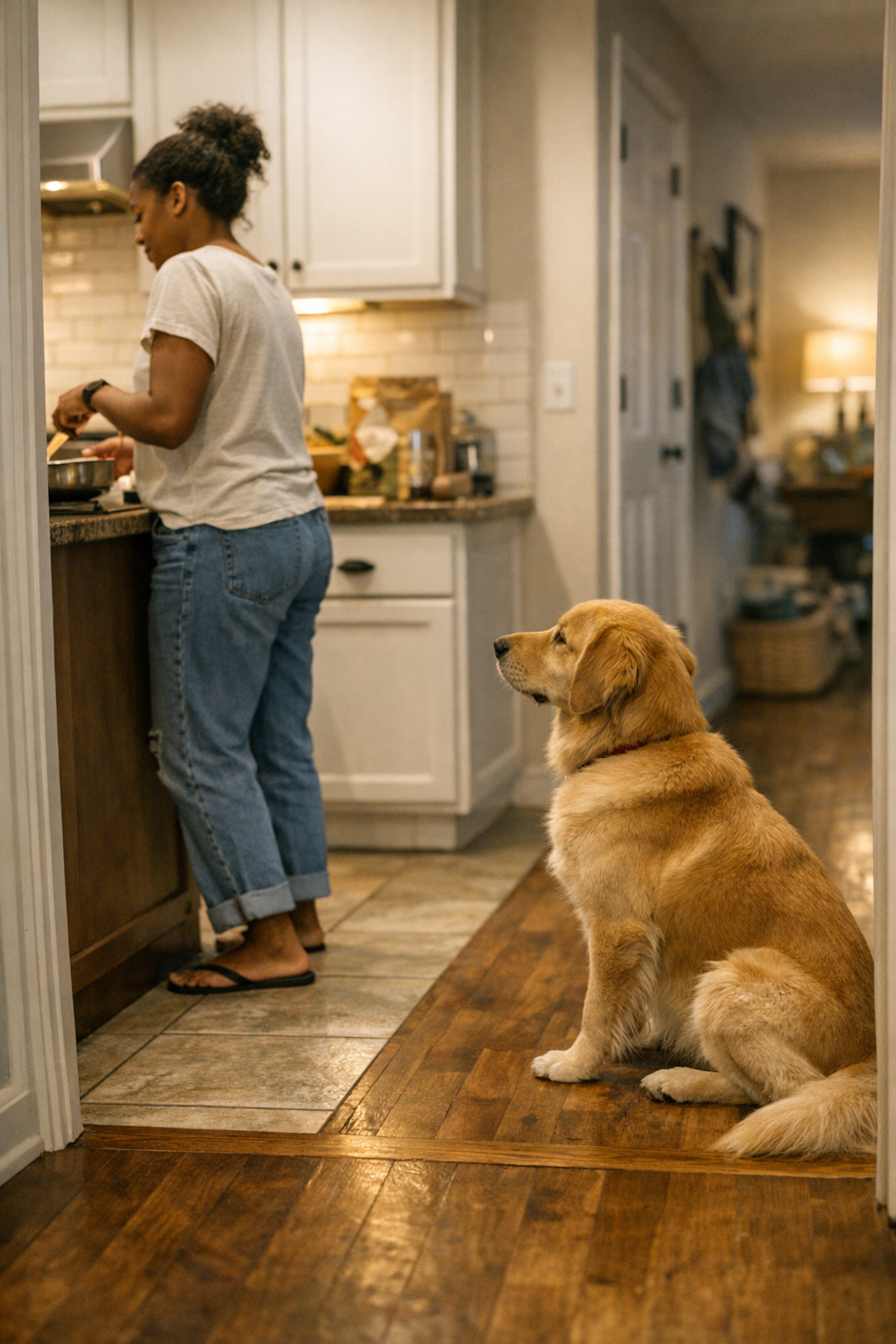
If dinnertime with your dog always feels a little more tense than it should—shadowed footsteps in the hall, glances fixed on an empty bowl, a low-grade patrol near the kitchen threshold—the problem usually isn’t just appetite. It’s a routine that keeps sending the wrong signals long before dinner’s ready. What should be an easy handoff turns into an evening standoff: you’re trying to prep food, your dog’s camped at the invisible border, and both of you are caught in a loop that keeps the whole house on edge. A few minutes of anticipation become forty minutes of restlessness, and the “neat” feeding setup that looks organized ends up ruining the flow for everyone right through bedtime. When routines force you to repeatedly work around your own setup, the cost is measured in more than a few stray kibbles—it’s felt in the drag that hangs over every evening.
When Dinner Prep Keeps Triggering Restlessness
The signs start subtle. Your dog waits at the kitchen line—always the same spot, nose just over the tile. It looks harmless: a cautious circle, a pleading look, a quick lean toward the counter then a retreat. But over a week, patterns harden. The “waiting” dog now paces the border or blocks the aisle. That patient sit mutates into a slow-motion blockade, and the edge of your kitchen becomes disputed space. Even the act of grabbing a scoop triggers a head snap. Each preparation step turns the wait into an obstacle course instead of a smooth routine.
Instead of prepping and serving with fluid timing, you find yourself dodging paws, stepping over a dog, and adjusting how you move. The bowl never quite fits in its supposed “spot.” The counter feels crowded. What used to be a five-minute task extends itself, because your setup forces human and dog to contest the same ground. Evening calm slips further away every night, quietly eroded by a ritual that’s just slightly wrong—but wrong often enough to matter.
Why Visible Bowls Signal “Start” Too Early
Bowl placement sets the rhythm, not just the look. On paper, an “organized” station—bowl on the floor, food container on a shelf—should be enough. In reality, a bowl left in view acts as a false start signal for the dog. Every rustle near the prep zone, every step toward the shelf with the bowl on it, becomes a trigger. The dog learns to start waiting early and hard, sometimes shadowing you from the first movement in the kitchen to the final scoop.
A visible bowl is a standing invitation to hover. It blurs the line between waiting and expecting, keeping your dog on constant alert long before food appears. The result is a wait that’s longer, heavier, noisier—and that tension never really resets.
The contrast appears on the few nights you keep the bowl out of sight—tucked away in a cabinet, only retrieved at the final moment. Instead of patrolling, your dog lingers further back, less alert to kitchen movements, less fixated on every prep noise. The routine runs closer to silent, the friction falls away, and the “organized” look is replaced by an actually more workable flow. This isn’t about being tidy for aesthetics—it’s about disrupting the hidden chain reaction that a poorly timed bowl launches every single night.
A Practical Example: A Dog on Patrol
Picture the evening sequence. The floor’s clear, you’re ladling out food, and you reach for the bowl—left, as always, in plain sight on its shelf. The dog clocks your move and immediately circles closer. Maybe you sidestep, maybe you stick out an elbow to hold your ground. By midweek, the dog’s planted right across the kitchen’s entrance, head up, tail stiff, waiting for any cue. Suddenly, you’re prepping with one hand, bracing with the other, and hoping to avoid knocking over a hopeful nose. Even without chaos, the friction is real: movement is blocked, timing is thrown, and what should be a transition instead becomes a negotiation every night.
Why Minor Friction Adds Up Over Time
The main pressure isn’t a single bad moment—it’s the slow grind of repeating these frictions night after night. Owners start sidestepping waiting dogs, shifting bowls mid-prep, altering meal start times to avoid the worst crowding. The kitchen gradually stops being a neutral home base and becomes a zone managed around canine anticipation. Even minor delays—forgotten ingredients, a phone ringing, a late delivery—feel bigger, because the setup pushes both ends of the leash to hurry through the tension.
Watch for the “creep”: the line where your dog once waited at the threshold now moves incrementally into prep space, until the quiet seal between dog and bowl is never truly remade. The unordered edge of the routine bleeds into the rest of the evening, dulling whatever calm might have come after dinner. Reset gets delayed; routines jam; relaxation shrinks. The root cause isn’t one wild night. It’s the repeated, slightly-wrong system that encourages all the wrong signals, every day.
The Setup Tweak That Changes the Routine
Most fixes start with chasing surface order. But the real shift comes from one simple adjustment: Keep the bowl out of sight—in a cabinet or up high—until food is ready to serve, only bringing it out at the exact moment you pour.
This doesn’t mean a full kitchen redesign. It’s a ten-second, once-per-meal change: cabinet stays closed, bowl disappears between uses, and nothing in the visible space cues your dog to begin waiting early. As soon as the bowl comes out, the dog knows: this is the moment. On most nights, you’ll see your dog hanging further away, their energy softer, and their anticipation shrunk to the moment when the food actually hits the bowl—no more full-shift patrols starting at the first sign of activity.
What Changes—and What Doesn’t
This adjustment can reset the flow—messy spots reduce, pressure at the kitchen border drops, and you have less to sweep up or resettle when it’s over. Cleanup gets less frantic. You spend more time in the actual routine and less fending off a restless dog or fixing a chain of small messes. Reset for the next step—wiping countertops, moving on to your own dinner, opening the space for other routines—takes less effort, purely because the anticipation is no longer allowed to dominate the whole zone.
It won’t turn your dog into a statue or erase all excitement—they’ll still know when food is coming, and will still hover sometimes. But the old cycle of premature cues, creeping boundaries, and split focus gets interrupted. The invisible split—“not yet” versus “now”—is finally made visible, setting a routine that both dog and owner can actually fall into, instead of constantly policing.
Noticing the Early Warning Signs
Recognize these friction points before they turn into nightly habits. Early restlessness around feeding isn’t dramatic, but over time it soaks into every detail:
- Pacing or circling the kitchen’s edge, never fully settled
- Holding a “guard” position right where you need to move next
- The “waiting line” sliding closer every few nights, until you’re squeezed between the counter and the dog
- Short, sharp barks or frustrated whines as anticipation stretches out
- An earlier and earlier start to waiting—sometimes before you even get food out
Individually, these are only nuisances. But together, they tighten the window for everything else in your evening. Every delay sharpens the standoff; every missing spoon or late delivery disrupts not just your meal but your dog’s state of mind. The wrong setup keeps stacking small costs until “feeding the dog” becomes a mini-battle zone nightly.
It’s About Function, Not Just Tidiness
A common mistake? Mistaking a neat-looking bowl on a coordinated mat for a working system. Rearranging shelves or matching storage bins might make the setup look managed, but if the bowl stays visible, the built-in pressure remains. The point isn’t a more attractive lineup—it’s a structure that sets clear boundaries on waiting, makes the start of the routine unmistakable, and limits false cues from sabotaging the timing every night.
Real improvement comes not from better visuals, but from noise reduction: a setup that insulates prep from anticipation, letting you decide when the wait should really begin. This is the point where friction drops, routines speed up, and evenings regain their lost calm—because signals are actually under your control for the first time.
A Setup That’s Easier to Reset After Feeding
When prep tension drops, so does the leftover clutter. Dinner ends; the bowl vanishes; the reset is instant. Cleanup—wiping down, resetting for the next meal, or switching zones for a walk or play—is simpler because the feeding items aren’t spread into shared paths or stuck in “wait mode.” You’re not rescuing the process with a last-minute reshuffle or dodging a tail on a tight kitchen swing. Even after a muddy walk, when you return for towels or wipes, feeding gear won’t be lingering underfoot and slowing another routine.
The