
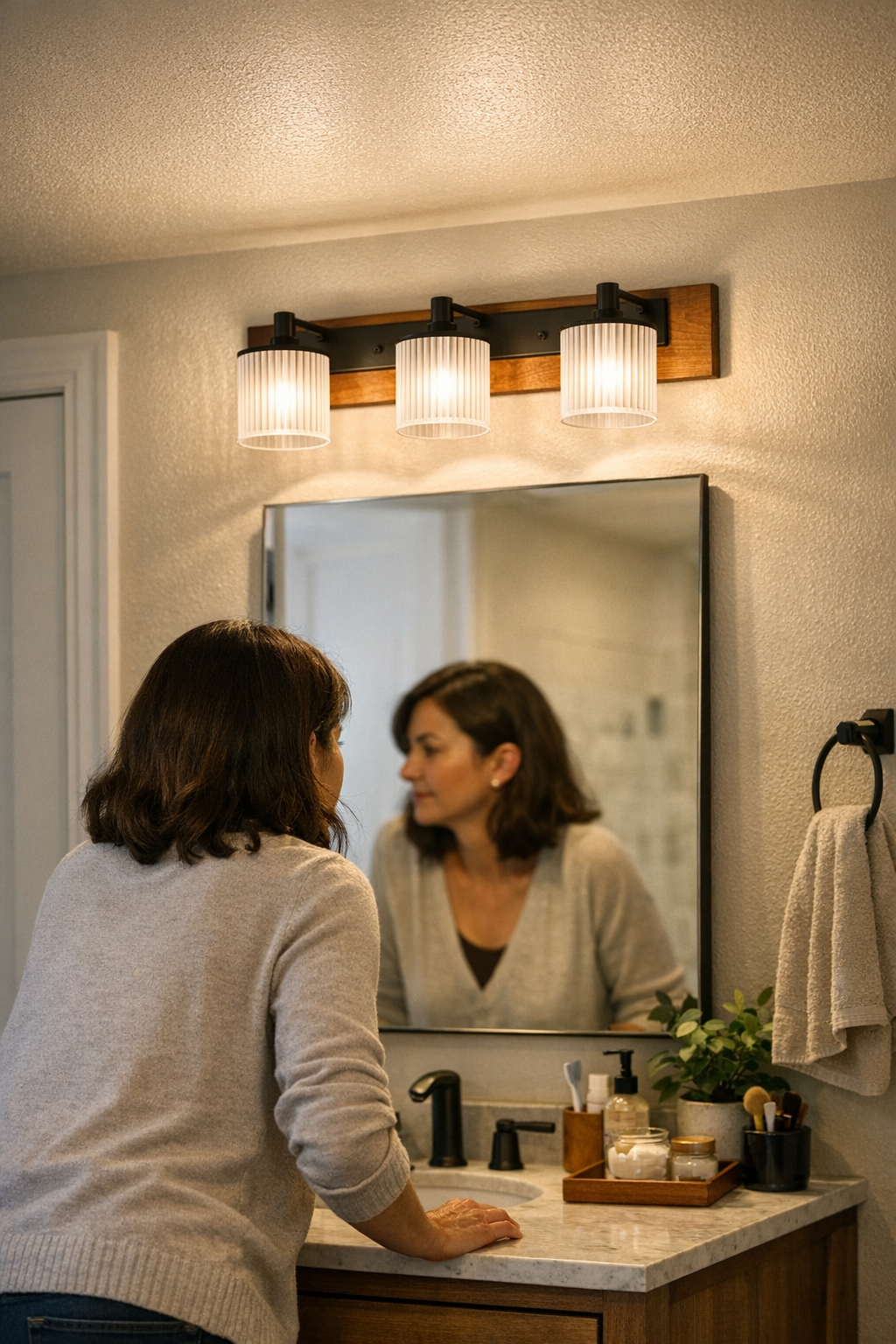
Most indoor lighting problems wait until routine kicks in. A hallway looks bright at a glance—but one step in, your heel slows at a shadowed stair edge or faded landing. In the bathroom, overhead bulbs promise “full illumination,” but the moment you reach the mirror, glare hits your eyes or your reflection slips into shadow, making basic grooming awkward rather than effortless. These aren’t rare annoyances—they’re clear signs that lighting comfort doesn’t come from wattage or first impressions, but from how a fixture lines up with actual, everyday use.
Why Lighting Problems Hide in Plain Sight
Rooms fool you at installation. The day a new fixture goes up, the lounge, corridor, or stairway reads as “complete.” But routines expose misses: a semi-flush hallway light shines straight down, casting the center bright but leaving corners dim and alcoves in shadow. A bathroom sconce looks gentle from afar but suddenly throws unwanted glare right into your morning routine. These misses don’t announce themselves on day one—they trip you when you’re moving fast or relying on habit, not when you’re standing still admiring the upgrade.
The problem isn’t brightness—it’s coverage and direction. The wrong fixture leaves part of the room underlit, shadows in high-use corners, or glare where your eyes need comfort. You spot it only when you resume real patterns: walking the hall at midnight, using the kitchen counter, or leaning in close at the bathroom mirror.
Hallway and Stair Lighting: Looks Bright, Moves Slow
Hallways and stairs are classic for this. Stand at the entrance and the area looks flooded with light. Start walking, and you slow down at the landing or stair turn, feeling the edge blur into shadow or the wall go dim. The trouble isn’t how much light—the trouble is where it falls. Ceiling fixtures often create a bright central spot but miss the critical path around corners or onto each stair’s edge. Subtle shadow bands make people hesitate or miscalculate footing.
If you want safety, don’t just assess standing still. Walk the actual route in real lighting—notice where you slow, hesitate, or feel a step less visible. Often the fix is not buying another fixture, but tweaking placement—a broader flush mount over the bend or repositioned ceiling light to hit the stair wall directly, softening those trouble spots and keeping pace steady.
Vanity and Mirror Zones: Where Glare and Shadows Sneak In
Bathroom lighting reveals its real character the first morning you use it. Over-mirror bars and ceiling globes often leave cheeks and eyes blanched while jawlines vanish into shadow. Glare jumps back from the glass right at eye level. The mirror appears well-lit from a distance, but up close, details drown or shift into awkward shadows. Daily tasks, from shaving to makeup, become a small battle against the light instead of a seamless step in the morning.
The solution isn’t just dialing up bulb wattage. The gain comes from structural change—lensing that smooths the throw of a fixture, or a wall-mounted vanity light long enough to balance horizontal and vertical shadows. When the right light softens and broadens at the right height, grooming stops feeling like guesswork in a spotlight.
Shadowed Work Surfaces: When “Bright Enough” Isn’t Useful
Kitchens and laundry rooms often fail the real test: task surfaces end up shadowed by your own body, even in “bright” rooms with modern panels. You stand at the counter, hands in the path of a ceiling beam, and the chopping board falls half in gloom. Reach for detergent, and the shelf edge is lost in murk. People slide sideways or settle for “good enough” visibility—until the next time a task slows down or a knife hesitates mid-chop.
True fix? Don’t flood the room—target the actual working line. Under-cabinet or fixed task lighting makes the countertop, sink, or laundry shelf not just visible but easy to use from any angle, at any time. Problems vanish not with more light, but with better-placed, purpose-driven light.
Real Patterns, Real Friction: The Cost of Everyday Interruptions
Lighting failures aren’t always dramatic—they chip away gradually: a hallway walk that’s “almost fine” until one section feels risky at night; the daily workaround to dodge glare at the sink; hands casting their own shadows over a workspace that only seemed bright enough. These repeats have a cost: minor hesitation, eye strain, and a steady undercurrent of inconvenience that becomes background irritation.
If your routine feels interrupted or awkward where the room “should” be covered, you’re witnessing the weak spots in real time. Most homes are left at “good enough” once the room registers as generally bright. But the difference between “lit” and “fits your life” is noticed only when routines expose the same shadow lines and glare points, again and again.
Practical Fixes: Focusing on Placement and Structure
Patching these gaps doesn’t mean adding endless fixtures. Improvement comes from noticing real-use patterns and refining coverage: swapping a narrow spot for a broad flush mount in a corridor, choosing a damp-rated sconce for horizontal light in the bathroom, or adding strip lighting beneath cabinets instead of hoping overhead bulbs will reach. Payoff is practical: smoother hallway crossings, safer stairs, no more dodging the mirror, and work surfaces that stay clear without awkward maneuvering.
Tip: Test setups with real routines. Walk the hallway at night. Lean in at the mirror. Prep food or fold laundry as you normally do. Where you squint, pause, or sidestep, that’s your structural clue—not just a sign for brighter bulbs, but for smarter placement or fixture shift.
Lighting That Adapts to Real Use—Not Just the Paper Plan
Good lighting isn’t measured by empty-room brightness, but by what stops being awkward in daily use. The first days after power returns, or after new installs, are prime for catching the spots where the plan falls short—before those hidden shadows and glare patches settle into your norm. An adjusted fixture, a new zone of coverage, can change the story of how a space is used—making light feel less like a static backdrop and more like a responsive tool for actual living.
For practical, repeat-use focused indoor lighting—covering hallways, stairs, vanities, work zones, and all the lived-in corners where light needs to pull its weight—visit LightHelper.