
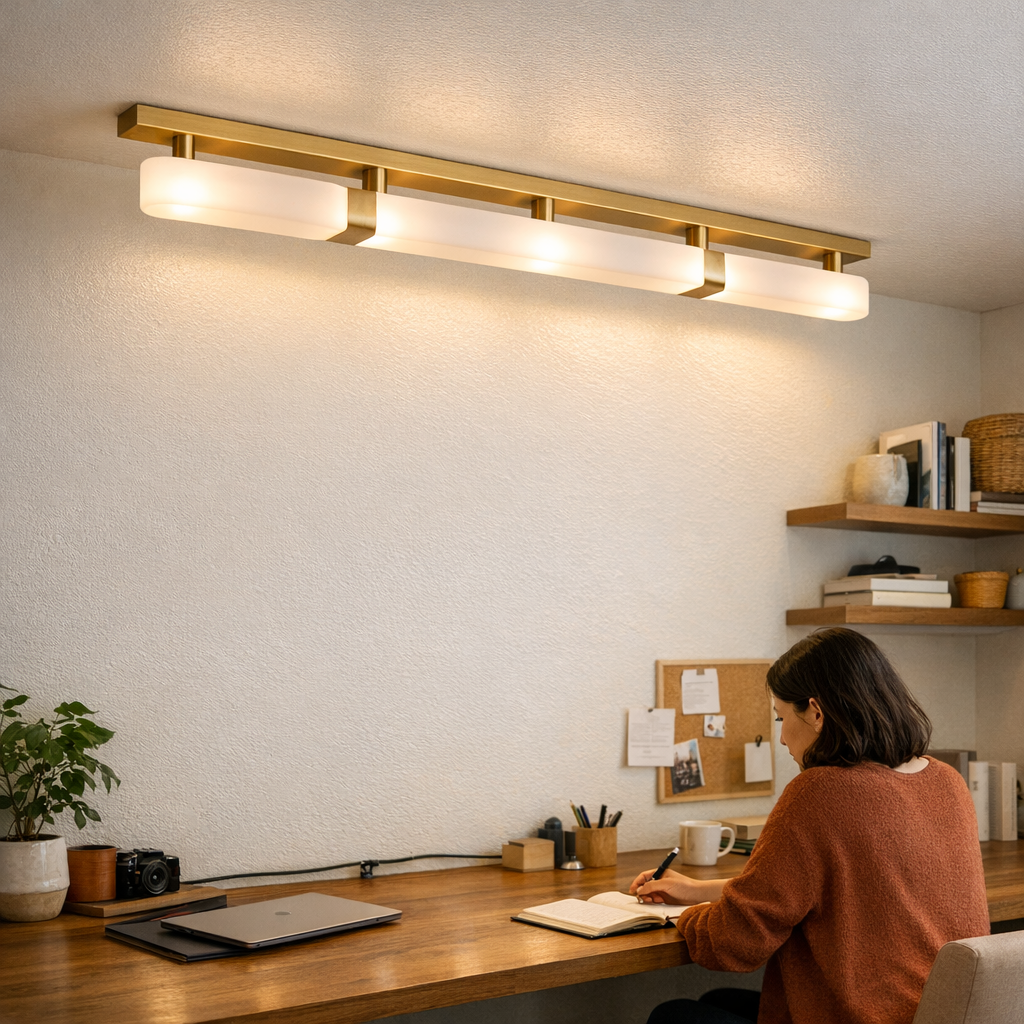
Ceiling lights promise a finished workspace—until routine use exposes what’s actually unsolved. The desk looks clean, the panels line up, but after a week or two, the comfort cracks start: glare over the screen, dim strips at the far edge, or stubborn shadows under a shelf you use every day. The ceiling stays uniform, but reaching for what you need still brings back awkward cables and uneven light.
The Problem With “Finished” Ceiling Lighting
Step into any “ready” workroom: lights overhead, desk surfaces staged, everything seemingly planned. Yet by the end of the first month, a familiar discomfort returns. Ceiling panels that made the room look seamless end up spotlighting glare right where you sit, or leave the back third of your work surface faded and easy to avoid. The difference shows not in brightness numbers, but in small, daily disruptions: screen reflections, awkwardly reached power strips, and the recurring appearance of table lamps meant to be “temporary.” Everything on the surface seems stable, but every session makes the mistake clearer—light that pleased your eyes on day one quickly fails the real test of use.
This isn’t a dramatic collapse—it’s a pattern of small, persistent hassle. One side of a shared desk feels usable while the other always loses out, as shadows cross the work area no matter how you shift. A shelf that needs to be bright stays dimly out of reach. Moving your monitor, adding another lamp, or trying to reposition a panel doesn’t solve it—if anything, exposed cords and workarounds pile up until the “tidy” setup is visibly cluttered again. The desk won the ceiling game but keeps losing at the surface, session after session.
Linear vs. Panel: Why The Difference Matters During Real Use
Panel and linear ceiling lights claim the same territory: a “resolved” overhead appearance. But the lived results often split in two. Panels spread soft light broadly—but mostly at the center, fading at the edges where you actually need coverage for reading, detail work, or shared surfaces. Once tasks move to the outside, the shortfall is clear. It’s not obvious at first, but over time, under-lit desk edges and shadowed perimeters become a daily inconvenience you can’t ignore.
Here’s the real divide: Wherever a work zone meets a wall or stretches across two users, panel lights rarely reach every inch. That leaves the edges dim, so you and a coworker either bunch in the middle or set up rival lamps—cable mess and new glare included. “Finished” overhead look, but now surfaces turn into problem zones: one end useful, the other a home for drifting cables and unread papers. The problem isn’t lack of lumens, it’s the mismatch between clean ceilings and real, reachable tasks.
Linear fixtures, especially when installed parallel to the desk edge, flip this outcome. Light follows the length of the surface, so the whole depth is activated—no dead edges, no “good” vs. “bad” seats. You use both sides of the table, not just the sociable middle, and the full span stays equally readable. Instead of layering on more add-ons, one support solves the job at the structural level, giving you practical, everyday relief, not just a neater overhead.
Everyday Friction: What a Poor Setup Really Means
Repeat annoyances expose system failure—here’s how it adds up with most panel setups:
- Your laptop always needs nudging to the brightest strip, while the outer desk edge gets ignored or left dark.
- Shared spaces ration “good” light, so one user habits the shadow, or both jockey for the bright spot.
- Clamp-on or clip-on lamps multiply cords, crowd power strips, and tangle setups just to light the edge.
- Reconfiguring shelves or rotating lights never fixes the persistent shadows along the work-back or wall.
- None of this is dramatic, but every session, something feels compromised—appearance wins, routine loses.
It’s not a hardware defect, but a real mismatch between ceiling calm and surface confusion. Desks look composed once, but as soon as you’re actually searching for notes, plugging in a charger, or setting up side-by-side, the problems repeat: shifting shadows, odd glare, exposed cabling intruding where you wanted clarity. These little dysfunctions become the rhythm of your room, replacing order with improvised solutions and never quite solving the strain around cords, corners, and coverage.
The Real-World Shift When Lighting Is Oriented For Use
Consider a real adjustment: After steady frustration with shadows and cord nests on a shared workbench, switching to a linear fixture—mounted just out from the wall and parallel to the work surface—immediately killed the recurring dimness at the back edge. Suddenly, every seat along the table was equally usable, and reading across the whole surface felt natural. No one needed to angle extra lamps just so a notebook was visible; stray power cords faded under the desk, not dragging across the top. The visual calm finally matched the routine: work areas stayed tidy because the main light now reached what people actually touched and read.
At first, not everything looks transformed—but over each week, the improvement deepens. Gone is the shuffle of moving lamps, chasing the last unlit inch, or overloading outlets for the sake of a brighter edge. No more dealing with blind spots, low contrast, or last-minute cable jumps to reach an ignored corner. The space becomes quietly easy. Use feels smoother, glare recedes, and you spend less time “fixing” what your lighting should have covered from the start.
Supporting the Setup With Clean Cable Management
The benefit extends past light path: with a planned, well-supported linear fixture, cable management gets dramatically easier. Wires follow neat, hidden routes—clipped along brackets or tucked behind supports, not looping in the open or creeping toward work surfaces. Nobody notices a perfect cable run, but everyone relaxes when cords stop hijacking the first glance or getting in the way, session after session. Good support strategy—choosing correct brackets, planning conduit paths, setting up stable mounts—means less visible clutter and more dependable comfort, so the setup holds its own under real traffic, not just on photo day.
What Makes A Lighting Setup That Lasts?
The measure isn’t a perfect ceiling or day-one wow factor—it’s whether your lights make routine work easier after weeks, not just hours. Well-chosen, properly supported lighting keeps every surface usable, brackets and cords where they belong, and distractions out of the path. This isn’t an aesthetic upgrade: it’s daily stress prevention, the result of matching support hardware and fixture orientation to the way you actually use the space.
If you’re living with dim desk edges, repeat glare, or constant cable drift, take a closer look: does your ceiling lighting actually solve the conditions you deal with at the surface? For most, orienting a linear fixture with real cable management is the detail that finally delivers the working comfort promised by overhead panels. It’s not about trends; it’s about fewer friction points—light where you need it, cables where you never see them, and a workspace that stays as clear to use as it looks.