
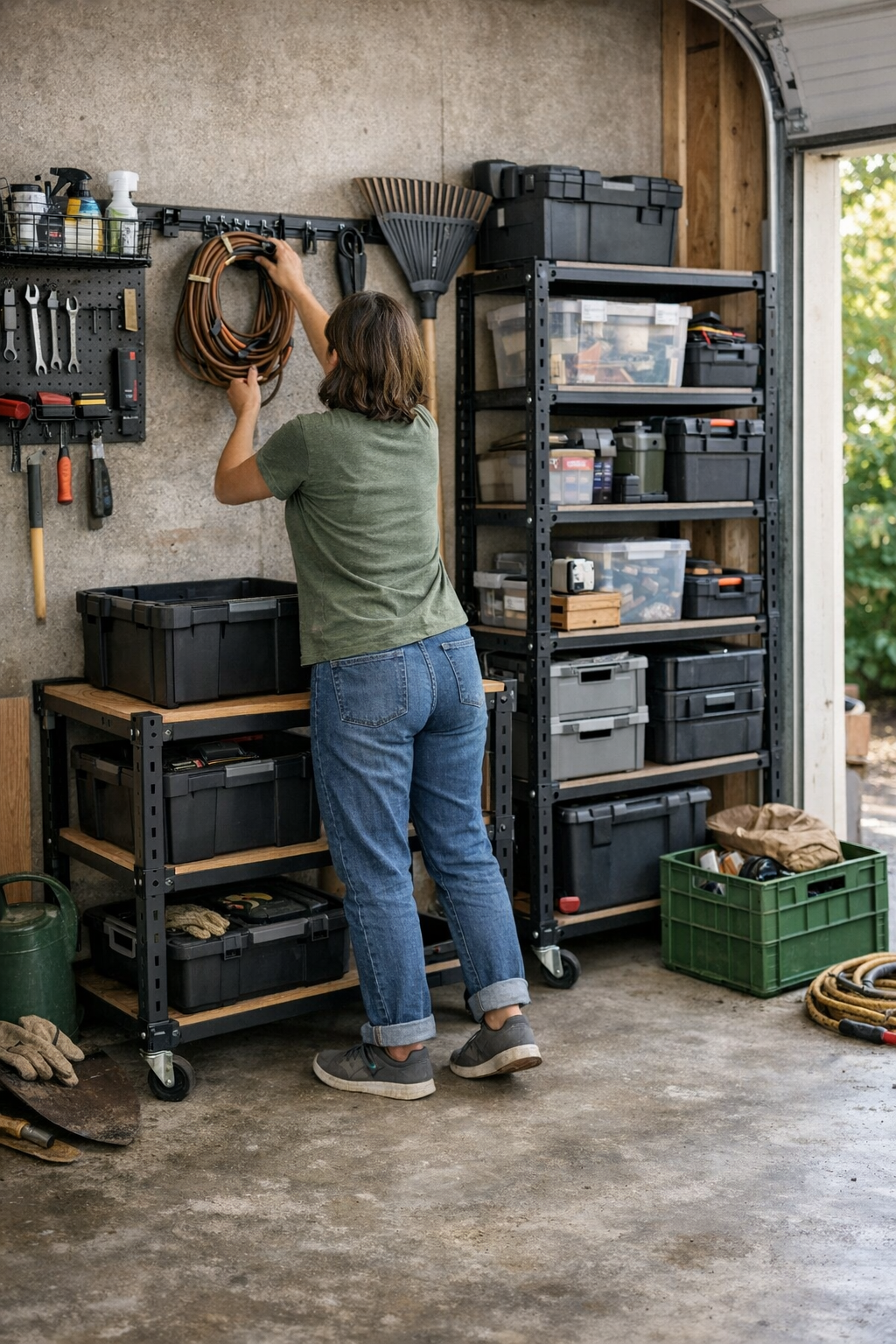
The real mark of an organized garage or workshop isn’t how it looks after a deep clean—it’s whether you can move, grab, and reset gear easily, day after day. The frustration comes not from a pile of clutter, but from a setup that turns every reset into a minor obstacle course. For all the talk of order, a space that seems “organized” on Saturday morning can quietly unravel by Wednesday, especially when floor units trap movement and collect overflow. In contrast, wall-mounted storage supports your routines—keeping paths clear and resets near effortless, no matter how many projects run back-to-back.
Beyond the First Clean-Up: Where Friction Actually Starts
That first hour after a big reorganization—rows of floor bins lined up, racks standing tall—feels like a transformation. Tools are sorted, everything visible, the floor reclaimed. But the testing ground isn’t the “after” photo. It’s what happens when you’re coming in with muddy boots one day and switching out garden gear the next. Racks inch into walkways. Bins scoot closer to doorframes. Suddenly, the space that felt wide open becomes a series of small detours and awkward hesitations.
By the second or third reset, the cracks really show. Shoes pause at the edge of a shelving unit that’s crept forward, or you hesitate before rolling a cart that’s blocking the main lane—again. Resets go from a sweep of the hand to a multi-step dance: move this, shift that, just to reclaim the movement you thought you’d built in.
The Hidden Problem with Floor-Based Storage: Movement Interruptions
Floor units organize your gear—but claim your space in the process. There’s an initial calm: modular bins, racks, and carts suggest flexibility. Then daily reality intrudes. You haul out a lawn mower, return with a half-used tool bag, or grab a cleaning bucket in a hurry. A bin doesn’t make it back perfectly flush. A cart is left halfway between bench and exit, subtly wedged where you need to walk.
Soon, what once held overflow becomes a magnet for it. A shovel is nudged to the wrong side of a freestanding shelf and stays there all week. Gear piles up against the “front row.” High-use zones morph into clutter traps, while corners sit empty or awkwardly unused, since floor storage is hard to move once overflow collects.
Real Example: When Floor Overflow Slows Everything
Picture the typical weekend reset. Hoses dry out by the wall, boots come off in a hurry, an overstuffed bin lands where you normally turn the cart. By Wednesday, you need to slide that bin aside just to carry groceries through, then shove a project crate back in line. The five-minute tidy becomes a multi-step routine: move-bin, pick-up, restore-path, repeat. The result isn’t chaos, but a slowing drag—more shuffling, less progress, every single week.
Wall-Mounted Rails: Preserving the Flow of a Working Space
A simple rail along the studs, a tidy bank of wall hooks, or a mounted rack seems almost insignificant at setup. But the shift in daily use is profound. No more stepping around bins or finding the cart’s in your way again. The floor stays open, with clear lanes through every high-traffic area—even on the busiest days.
Returning a broom or tote is a direct movement, not a puzzle. The “return path” never gets choked with overflow, because everything parks above ground zero. The result: access stays quick, resets shrink back to seconds, and the garage feels ready for actual work—not just for show.
Resetting Doesn’t Have to Get Harder—If the Floor Isn’t in Play
Take away just two freestanding bins and you feel it instantly: straight-line movement between entry and workbench, no more weave-and-dodge through awkward footprints. Overflow tucks onto the wall or hangs in dead vertical space that never got used before. Resetting stops being a chore because there’s nothing left to drag, stack, or shuffle first. The area simply works, over and over, without a hitch.
The True Cost of “Making Room” Again and Again
Any floor footprint—no matter how efficient on paper—becomes a bottleneck with regular use. Quiet Tuesday? No problem. Three weekends in? The rack near the workbench now demands a sidestep every time you cross the room. Routine movement slows to a shuffle. Tools get left out, not from laziness, but because the path back is cluttered.
This slow build-up—the quiet reshuffling, the subtle blockades—creates a hidden tax on your time and willingness to put things back. Before you know it, tasks get put off, not because you don’t want to do them, but because you’ve learned to expect a micro-hassle just to find a clear route.
Designing for Routine: Why Floor Space Matters Most
Order should support movement—not interrupt it. The setups that actually last aren’t just about maximizing storage, but about minimizing interference with the everyday flow. Wall-mounted racks don’t fight with carts, tubs, or boots—they slip seamlessly into the backdrop. There’s rarely a need to “make room,” and resets keep their original speed even as the area gets busy.
Practical Tip: Protect Your Return Path First
When rethinking your space, don’t just count storage slots—walk the actual route from entry to bench to door. Any item that repeatedly needs shifting—a cart, a bin, that “temporary” rack—is a candidate for the wall or for removal. Sometimes eliminating a single floor piece opens up an entire workflow and stops overflow before it ever starts.
How Wall vs. Floor Storage Really Performs
Why do wall-mounted rails keep things simple? It’s all about keeping the reset direct: grab, use, return—in one motion, with nothing to step around. The floor stays clear for work, and overflow never gathers in the main lane, so daily order is easy to maintain.
Where do floor systems fall short? Anything that sits where you walk will become a landing spot for stray gear, stray bags, and the unfinished business of daily projects. More steps, more shifting—and more frustration with every round of cleanup.
What are the pitfalls of wall setups? Overcrowd a wall or misplace the hooks, and you end up with dead corners or a jumble of tools that don’t really see use. However, unlike floor clutter, these issues don’t block movement—they just waste potential, which is a much easier fix.
Reset Routines That Make Sense After Real Use
The best setups don’t just look good on reset day—they stay easy for months of actual, messy use. Wall-mounted storage keeps lanes open and routines intact, so you spend less time reshuffling and more time actually working. Clutter has nowhere to collect and it’s clear what belongs where—so there’s never a question of “where to put this” when you’re done.
If you want storage that works with your movement, not against it, start with the return path and keep your floor as free as possible. See storage options built for real-world resets at StackNest.