
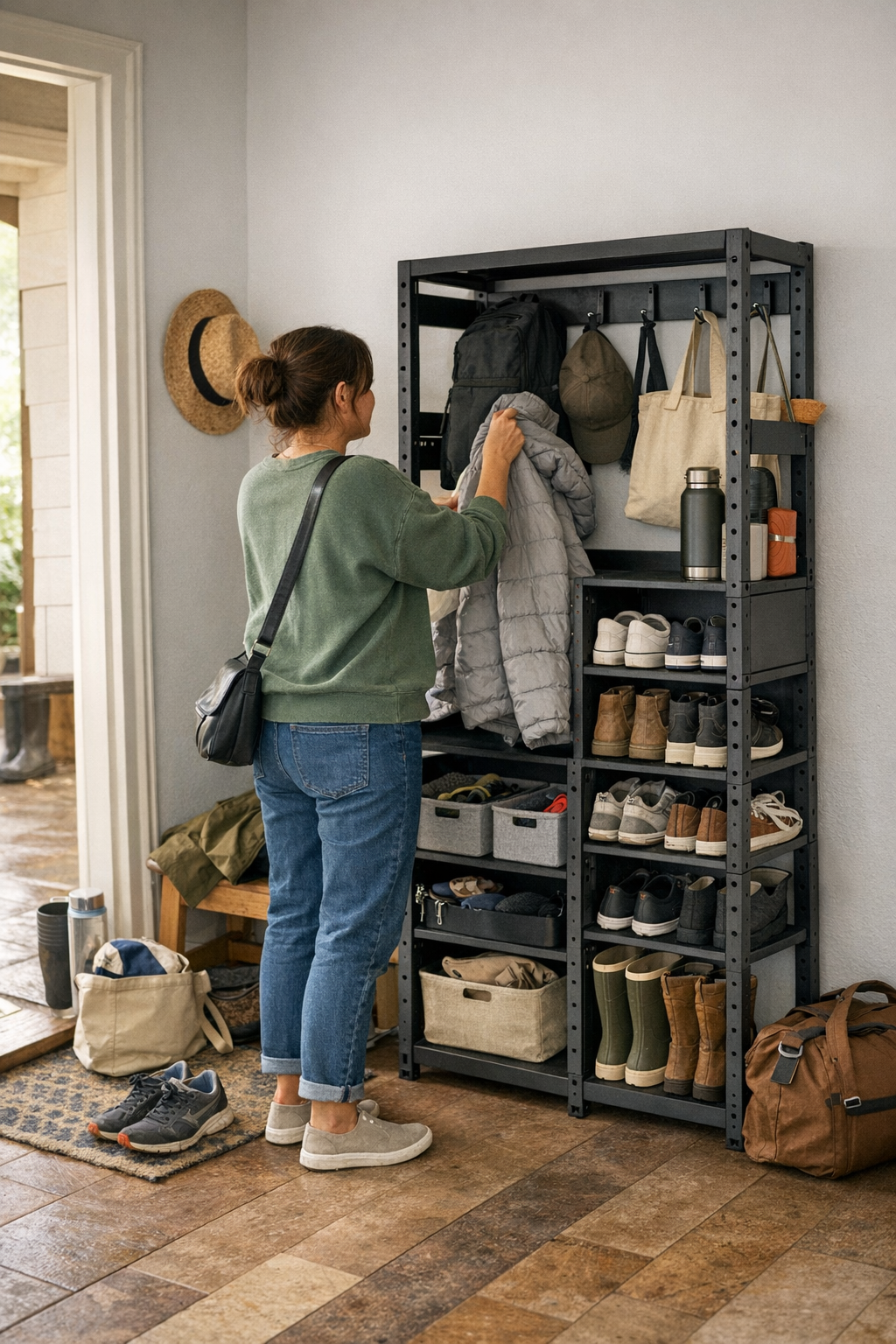
An entryway doesn’t fail because it looks messy—it fails the moment it can’t bounce back from your real, repeated comings and goings. You set up shelves, a bench, maybe a few baskets. At first, everything holds. By midweek, though, shoe rows sprawl past their bounds, bags edge toward the door, and the bench—meant for a quick sit—gets buried. What started as “just for now” becomes the default: gym bag on the bench edge, umbrella halfway off, out-of-season boots waiting for a spot but never quite making it back. The problem isn’t a lack of storage. It’s the way the system starts dragging—resetting takes too long, categories blur, and the pressure to maneuver through the threshold grows every day. The entry space you wanted to smooth your routines now slows every exit and return.
Where Well-Intentioned Setups Break Down
On paper, a couple of shoe shelves, a low bench, and a few baskets tick all the boxes. In actual use, their limits show up fast. Shoes stray and multiply, forming new lines along the tight walkway, forcing you to zigzag instead of stride. The bench? It hosts one bag, then two, then a scarf, then the mail—a seat turning into an obstacle course. Temporary piles go ignored, then harden into permanent clutter, as each rushed day lets the overflow stay put. Five days later, the “system” looks intact but works against you every time you need to move quickly or share the space.
Blocked movement is the early warning sign. If grabbing a coat requires unstacking a pile or shifting three bags, your storage isn’t keeping up with your pace. Instead, it piles on friction—forcing micro-decisions and repeat work each time you step in or out.
After the Initial Calm: Signs of Creep and Drift
Organized storage holds just long enough to deceive you: it looks fine day one, even day two. But watch the space after back-to-back school runs or two wet days in a row:
- Shoes overflow, forming a second, unofficial row at the entry to the hall.
- Bags and spare gear huddle in corners, squeezing out space for daily grabs.
- The “just for a minute” bench pile becomes a layer you have to move before sitting.
- Mail, bottles, and odd objects wedge their way onto any flat edge, crowding out the gear that should be easiest to reach.
Category drift takes over: Items blend zones, half-in, half-out. Suddenly, there are boots in the mail tray and keys tangled with hats. The more surfaces get used, the more you improvise—and the more time and energy every reset demands.
Real Rush, Real Friction: Everyday Use Scenes
The Drop and the Backslide
Picture the morning rush: someone searching for shoes among the pile, backpack half-zipped on the edge of the bench, keys missing under yesterday’s scarf. Cubbies and bins exist, but full or wet hands make shortcuts tempting—so items settle on the closest open spot, even if it blocks the path. One stray bag turns three shoe spots into trip hazards. Instead of grab-and-go, you get bottlenecks, sidesteps, and forced apologies just crossing the threshold.
The Spread of “Just for Now”
Deep bins and big baskets hide the mess at first, but by Wednesday, you’re fishing for a glove under last week’s mail or shifting art projects to reach today’s essentials. Every temporary dropzone raises the barrier to a true reset. Give it a few days, and it’s no longer a quick pick-up—now it’s an hour-long dig, or nothing at all. By Thursday, the “cleanup” isn’t a routine, but a postponed project.
Vertical Versus Horizontal: Why Shape Wins Under Pressure
The orientation of your storage controls your entry flow. Wall-mounted racks and slim, segmented vertical units force each item type—shoes, bags, hats—into a visible, easy-access zone. There’s nowhere to let clutter hide. Vertical shapes preserve walkways, so overflow can’t sprawl across your only path out. Category boundaries stay obvious, making it clear what’s out of place and where the reset should happen.
By contrast, benches and deep horizontal bins invite trouble. The broader the surface, the wider the slow spread: shoes crawl out, stray mail stacks up, and the “quick grab” zone clogs up by midweek. Heading out means shifting things just to make space—which quietly lengthens every re-entry and exit.
Making Returns Effortless: What Actually Holds Up
The best setups that last through real-life pressure all do the same things:
- Shallow, divided landing spots: Each item group has a clear zone. Returning it is direct and visual. Deep bins disguise the mess but never make routines easier.
- True open access: Shoes or bags drop back into place with one hand. No stacking or re-arranging to find a spot—meaning less excuse for “just for now” piles.
- Pathways stay open: Walkways never narrow around collected gear, because vertical setups fence in drift. You pass through, not around, your storage.
- No awkward steps: If the return takes too much effort—moving other items, opening lids—the routine breaks. Survival setups make returning a habit, not a task.
The difference is measurable each time you reset: a clear, segmented structure shrinks “reset” from minutes to seconds. The urge to just drop things disappears when the return spot is unavoidable and easy. By the end of a wild week, a quick pass is all that’s needed—not a drain of your Sunday energy.
Signs Your Setup Is Quietly Failing
- Are you always shifting something just to reach the door?
- Do shoes and bags disperse further by Friday than they began on Monday?
- Does restoring order mean committing half an hour, not half a minute?
- Are deep bins and closed cabinets used for offloading, not daily routines?
If any sound familiar, your entryway isn’t disorganized—it’s working against you. It looks passable, but eats up extra effort with every threshold crossing. Until each category gets a fast, reliable home—visible, ready, easy—you’ll keep battling the same cycle: drift, delay, and rework.
How Better Structure Cuts Down on Reset
The only setups that survive repeated, real-world use are those that match the way you (and other people) move through the threshold—hurried, unplanned, loaded down. A segmented vertical rack, clearly split for shoes and bags, redirects every item back to its corner. Shoes don’t flare into walkways. Bags don’t seed new drop zones by the door. Everything returns with less effort, so the reset is a minute, not a mood.
The gain isn’t in showroom looks or first-day perfection. It’s day-five function: smooth entries, clear paths, friction cut down to size. The entry zone won’t ever be spotless, but it won’t slow you down. In a space built for real-life churn, you notice: the biggest change is how little you have to think about it after the setup actually fits your routine.
For practical storage setups that actually stand up to rushes, weather, and the routine drift of real life—not just the first day’s organization—visit Betweenry.