
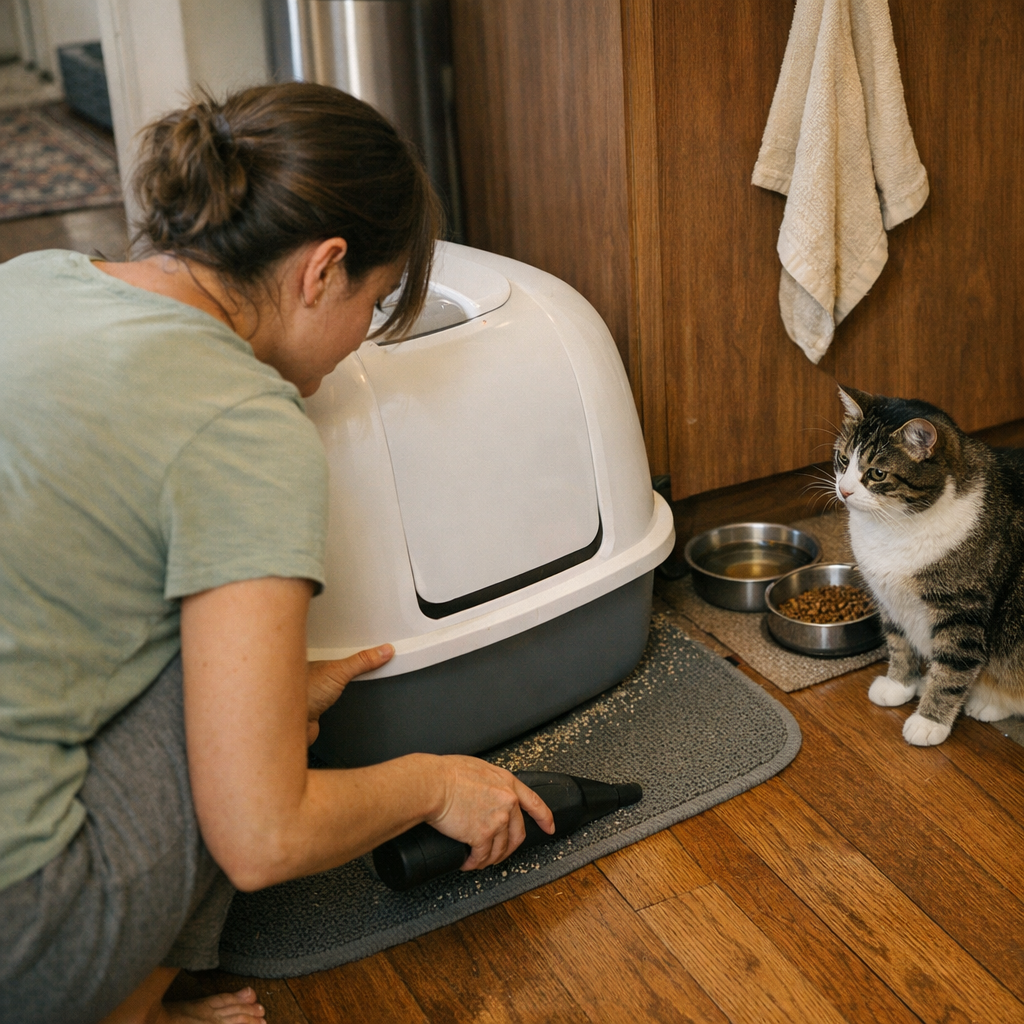
Most indoor cat homes look clean after a quick sweep, but under the surface, the real mess keeps returning—and keeps interrupting your day. You wipe the visible rim, vacuum a few scattered grains, call it handled. But by the time you’re resetting a feeding area, topping up water, or moving a mat to reach the edge, the friction comes back: persistent litter in the same thin strip where box, mat, and floor meet. Each “clean” reset buys hours, not days. The routine repeats—a little slower, a little less comfortable, one more unseen patch spreading into the paths you actually use.
The Problem Line: Where the Litter Box Looks Clean but Feels Wrong
Setups often start with a covered box on a mat, bowls nearby, a towel or cushion for comfort. On day one, this all feels in control. But a silent weak point emerges fast: the narrow margin at the rim where plastic meets floor and mat. Tracked litter sneaks out every time a cat jumps in, digs, or you do a late-evening scoop. It builds invisibly in those thin bands, just past the mat’s edge or under its curled lip.
No matter how expensive the box or how plush the mat, grains cluster in the border that escapes daily cleaning. You notice it when kitchen socks crunch, or dinner prep means rescuing crumbs from under a baseboard. Each refill, scoop, and bowl reset pushes more grit where it’s least expected. Even a swept surface doesn’t hold up: comfort for the cat becomes inconvenience for you, as mess spreads on repeat through your regular paths—right where you prepare a meal or walk barefoot in the morning.
Why Most Quick Cleans Don’t Stop the Mess
Broom or vacuum runs clear the obvious, but ignore the thin, resistant band along the box’s rim and mat border. If your litter setup sits near a main walk-through, every daily overlap—from topping up cat food, to reaching for the vacuum, to stepping out of the bedroom—nudges more grains into circulation. Freshly swept looks mislead: new hard crumbs show up in the bathroom, or you stop mid-task to wipe the kitchen before breakfast.
You end up spot-clearing more than planned. A brush for baseboards. A hand-wipe under the water station. Crumbs that evade every pick-up tool. The main problem isn’t neglect—it’s that surface-level cleaning can’t block mess that tucks itself just out of reach, only to emerge hours later in a smoother, once-clean room.
The Weekly Edge Clean: Small Adjustment, Big Difference
There’s one shift that cuts the cycle: moving the litter box every week—just enough to reach behind and under the rim. This isn’t a full reset or deep overhaul; it’s about breaking the chain at its quietest link. Pick up or nudge the box a few inches. Run a handheld vacuum, brush, or damp cloth right along the edge. Peel back the mat, shake out the grains, and collect the litter that never appears on a daily walkthrough.
This little reset prevents the “invisible spillway” from seeding your home with new grit. You don’t need to revamp your routine—just intercept the edge before it turns into a bigger problem. Within days, you see the pressure points fade:
- Less litter stuck in mat corners or pressed into floor seams
- Cleaner zones around food and water stations, so you don’t have to reach for a wipe between breakfast and litter scooping
- Fewer surprise crunches underfoot on main walkways and kitchen entries
- A cutoff in the chain-transfer of mess from the “litter zone” to every shared corner of your living space
More than anything, your reset routine shrinks—and the cycle of endless touch-ups starts to taper off.
What Real Use Looks Like: The Slow Spread vs. The Quick Reset
Picture the test: a litter box pressed against a wall, mat underneath, food and water bowls a foot away. It looks tidy after a sweep, but by day two, there’s a tactile reminder—a grainy edge under your hand when you reach for a bowl, or stray litter showing up when you drag over a chair. Topping up water? You’re pausing to swipe a finger between mat and floor. Shifting toys? There’s a pocket of grit pooling in the crease. In the hallway or by shared space, edge buildup multiplies faster—cat routines and human routines keep dragging more litter further afield.
The real-world sign: When your hand reaches for the refill scoop and you feel edge grit you missed. When supplies are in place but shielded by persistent crumbs. When a mat that looked settled turns out to be hiding a full new cleanup job underneath. That’s the signal: the setup is working against you, spreading out slow inconveniences until resets and walkways both start to drag and routines that initially felt “good enough” now require triple the attention just to stay under control.
Making the Edge Part of the Routine: How and When It Matters
The true test isn’t surface appearance, but how a full-use cycle exposes the edge buildup. Weekly edge cleaning isn’t glamorous or complicated, but it flips the long-term upkeep equation. How to work it in, so you stop trailing the problem:
- Time it with your routine. Reset the edge during refill or scoop days—when the box already moves and the surface is open for a quick pass.
- Shift, don’t just wipe. Even nudging the box a few inches reveals pockets of hidden grains along the rim.
- Pull and check the mat. Fold or lift one side, and run a hand or vacuum along the border, especially if the mat sits up against a wall or cabinet base.
- Target the margin—not just what you see. Where mat, box, and floor overlap, debris collects at double the usual rate and hides from typical sweeps.
- Use a vacuum for tight edges. Cordless or handheld vacuums pull up embedded litter without recirculating the scatter that a broom just redistributes.
The next day, you’ll experience the difference—fewer grains migrating past food bowls, less unplanned spot cleaning around high-traffic zones, and quicker resets that don’t turn into mini-projects.
Compact Homes, Bigger Impact—Why Small Spaces Can’t Ignore the Edge
In smaller apartments or multi-use rooms, tiny missed piles become instant interruptions. A forgotten margin spills into the kitchen, across the hallway, or under the only clear workspace. If you’ve ever switched steps to avoid a gritty patch or paused in the middle of breakfast to pick up litter stuck to a mat, you’ve seen how fast a small overlooked area can hijack flow in a compact space.
Edge cleaning becomes a high-value routine in these places. That two-minute weekly swipe means fewer loops across the entire room. Instead of always seeming one cycle behind, your litter corner, mat, and shared paths start working together—less sidetracking, less reshuffling, fewer last-minute pauses to rescue the rest of your day from scatter overload.
Mats Slow Tracking—But Only If the Hidden Zones Get Their Turn
No mat stops grain migration entirely—especially not at the box/mat/floor border. Textured surfaces help, but most litter follows the path with the easiest escape: under mat edges, against baseboards, and deep along rim lines. Choosing a better mat is only half the fix. The true pain point is what gets shielded by a box pressed tightly into place, where you rarely check except during a full reset.
Solution: weekly, lift or fold the mat, shake out trapped grains, check the border strip, and use a quick vacuum pass. These few seconds matter more than adding new surfaces or deeper grooves—this is how you actually keep litter from drifting into high-traffic areas before it becomes a pattern.
The Takeaway: Why Edge Cleanups Matter More than Cosmetic Fixes
Edge care isn’t a finishing touch. It’s the lever that keeps resets short and your rooms truly walkable. If you ignore the spot where rim, mat, and floor merge, you’ll always be caught by surprise crumbs and repeat cleanups. Put friction where it belongs—pick up the edge mess before it cycles out into every living area. The result: less backtracking, more usable space, and a setup that doesn’t steal time on each pass. Suddenly, even chaotic days don’t push your home into another mess spiral.
See more practical indoor-cat-life ideas at StillWhisker.