
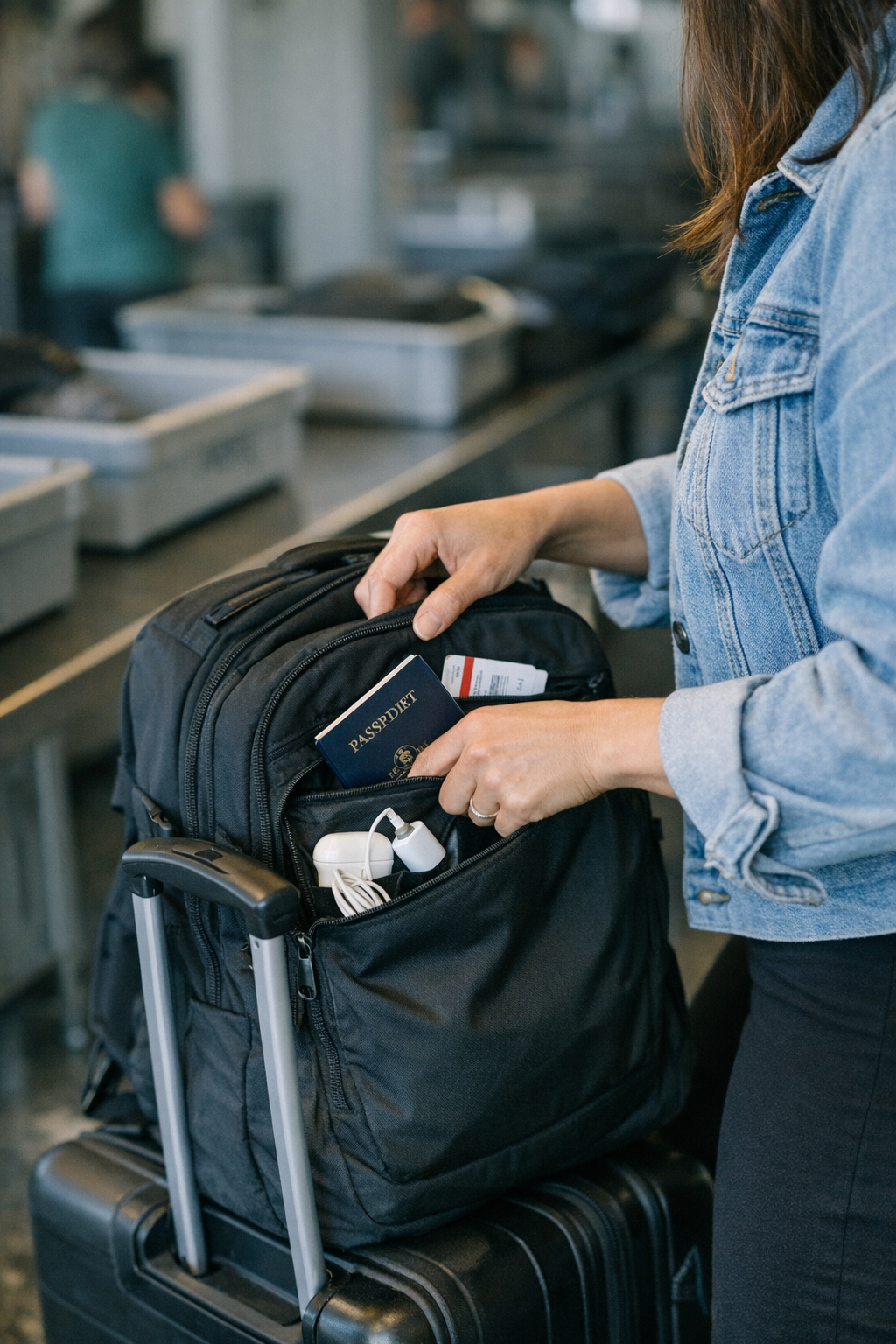
If your carry-on feels organized at home but slows you down at every airport checkpoint, you’re not alone. The real test isn’t how sharp your bag looks on the hotel bed—it’s whether you can grab your passport or charger without stopping, unzipping, and digging through layers while the line behind you tightens. Every extra zipper, every layered pouch, every “system” that hides essentials adds real friction in transit: delays at boarding, shuffling at the security tray, irritation when your boarding pass is a step too deep, or that public fumble when your setup blocks the flow.
Where “Order” Meets Real Travel: The Hidden Cost of Slow Access
From the outside, a carry-on can look ready for anything: crisp lines, packed pouches, stacked organizers. The weakness only shows when pressure hits—right as you need to produce a document under watchful eyes, or reach your charger in a gate area packed with other travelers. The supposed order becomes a liability. A routine document check turns clumsy as you unzip, dig under a mesh pouch, and repack while the queue moves on. If every retrieval or return is “just a few extra steps,” those steps start to weigh on you in motion.
Packing details that look finished at home often break down in use. Slowdowns build in seconds—choosing the wrong pouch, opening the main compartment for a cable you’ll need twice before landing, fishing for a boarding pass that’s trapped under your toiletries. Delays accumulate each time you loop through security or face another document check, making every movement with your bag feel heavier than it should.
Repeated Friction: When Packing Choices Start to Backfire
Take the boarding line: you join, bag slung confidently, only to freeze when asked for one last document. Your “organized” setup demands you unzip, sift through two pouches, then repack before you can move on. By the time you’re done, the gap ahead of you has closed and you’ve felt that slow, visible inconvenience. The more flights you catch, the more these tight spots stack up—making the initial feeling of control evaporate each time you repeat the same slow access under minor pressure.
The Real Difference: How Quick-Access Packing Alters Your Trip
A carry-on that actually works isn’t about symmetry or perfect layers—it’s about immediate reach for your high-frequency essentials. When a gate agent requests a document, or you need your charger with people crowding around, the difference is clear: can you retrieve and return that item without breaking your flow or repacking mid-stride?
Looks can deceive: every quick-use item buried behind organizers or in an inner mesh section triggers a “pause and reshuffle” cycle. What seemed like tidy packing turns on you—two zippers here, a dig there, then restoring order for the next stop. Repeated exposures—security, boarding, in-seat—make hidden inefficiencies leap out. The payoff of control fades with each loop; the cost of inconvenience increases the more you travel.
Scene in Motion: The Airport Security Tray Test
Pressure spikes at the security trays. If your laptop or passport is even one zipper too far, you turn into the person halting the line, spreading pouches and chargers across the tray. Flawless-looking setups collapse here, turning your neat arrangement into a scramble as you repack under glances from agents and travelers alike. Even a “smart” organizer system can trip you up: time pressure, fiddly pockets, and the disruption of getting order back in seconds rather than at your own pace.
Why “Looks Organized” Is Not the Same as “Works Fast”
Visual order—neat stacks, symmetrical kits, perfectly zipped mesh—only solves for appearance. Once travel routines kick in, slow access becomes a repeating tax: longer pauses at every check, exposure as you search for one charger, control lost as a single retrieval disrupts your layered system. The evidence isn’t a catastrophic mess, but constant, minor interruptions that keep you from moving cleanly from point A to point B.
A practical, movement-focused setup emphasizes separation for quick-use items. Visual neatness might take a hit—creases on your outer pocket, pouches that show wear—but deliberate priority puts your high-frequency tools within a snap of your hand. The result? Fewer hesitations, less awkwardness, and a daily travel flow that feels lighter both physically and mentally.
Every Cycle Magnifies Weak Spots
With each round—boarding, tray, hotel check-in, seat entry—the gap widens between a setup that “looks right” and one that “moves right.” Essentials that start one pouch too deep on day one seem to drift further as you repack in a rush. You feel it when your movement is stalled not by airport crowds but by the reach, search, and repair your own bag demands each time you need something fast.
Practical Shifts: Packing for Movement, Not Just Appearance
Anything you’ll need more than once or twice—passport, charger, frequent documents—should live in its own dedicated, easily reached outer area. Forget deep-stacked organizers for these. Store them where you can reach by muscle memory while moving, without the drama of a mid-queue unpack. This alone transforms the entire tempo of travel: single-motion retrieval instead of clumsy repacking, immediate access instead of one more bottleneck overtaking your careful appearance.
Over repeated trips, the benefit is obvious: after a few airport cycles, that worn outer pocket becomes your functional command zone while everything else can stay locked down. Visual perfection fades, but flow improves with each use—no more restoring lost order after every checkpoint interruption.
Resisting the “Catch-All” Trap
The easy mistake is treating outer pockets like dumping grounds. That only piles on confusion. Instead, assign a purpose to every quick-access zone: passport and documents in one, charger and earphones in another, each item chosen for frequency, not category. The real measure: can you retrieve and return it by touch, even with your eyes on the gate, keeping the flow moving? That kind of functional separation pushes your bag to serve your route—not just your sense of order.
Spotting the Signals: When Your Setup Isn’t Working
Weak setups reveal themselves early. Red flags: needing to open multiple areas for one passport, having to stack kits onto the security tray just to reach a charger, pausing with your bag splayed on the terminal floor to rebuild a tidy arrangement. The stress isn’t about the size of the bag, but about the break in movement each time your carry-on fails to keep up with the pace of the journey itself.
This isn’t one dramatic setback. Instead, it’s a string of minor, repeated barriers—a buried boarding pass requiring a pause, a tech pouch that can’t be managed on the fly, or the subtle annoyance of reordering everything after a single fast access. Your setup looks good for photos, but never feels tuned to the pace of real travel.
True Test: After a Day of Real Use
After one day—boarding, tray, hotel, and surprise document checks—the practical difference is unmistakable. A bag structured around real-world reach stops getting in your way. Suddenly, you’re no longer prioritizing appearances over actual travel motion: flow matters more than perfectly zipped mesh. When your carry-on starts to wear in the spots you touch most, it’s a cue you’ve designed it to move with you, not show off control you lose after the first checkpoint.
Packing for Flow: Form Follows Frequency
The setup that works isn’t a perfect packing diagram—it’s one tuned to repeated access. Let frequency of use dictate pocket placement. Reserve deepest storage for kit and backup; devote the most accessible spaces to what you’ll actually grab, scan, or charge before boarding and after landing. Ignore the “like with like” impulse if it adds steps to every retrieval. Visual wear on a quick-access pouch isn’t a flaw; it’s a sign you’ve made your travel setup serve your actual habits instead of your ideal plan.
In the end, the right carry-on isn’t designed to stay untouched and pretty—it’s built for the unglamorous, repeated grabs that keep your trip moving. You’ll notice it not when you pack, but every time you skip a line pause, avoid a scramble at security, or move straight to your seat with only the essentials exposed and ready. That’s what CarryOnSupply is built for: turning repetition into flow, and letting order work for you—not the other way around.