
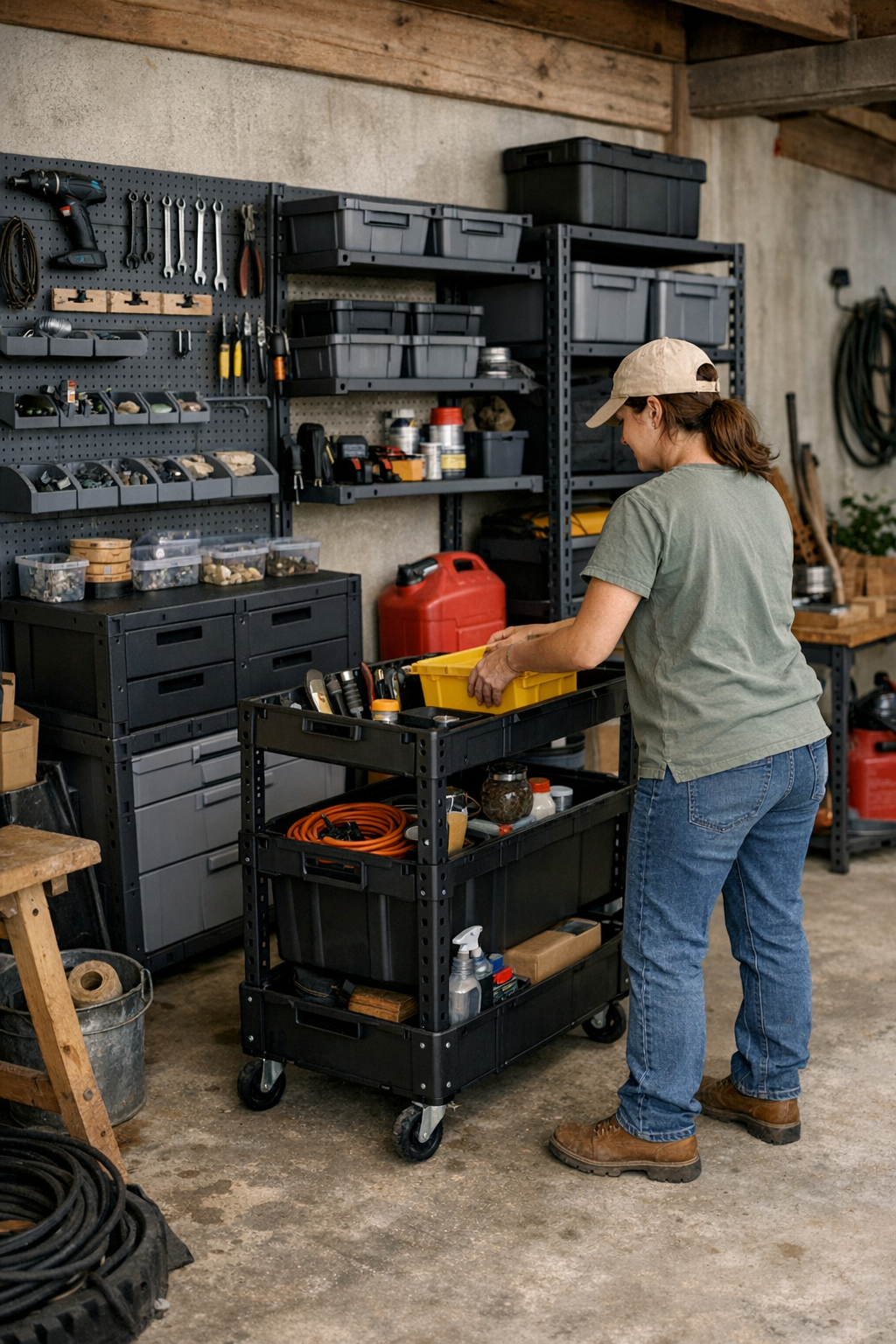
Why “Organized” Setups Break Down So Fast
The first day a storage makeover goes live—racks assembled, mobile carts perfectly aligned, bins labeled and stacked—it looks like order has finally landed. But fast-forward a week or two, and reality creeps in. The cart that once hugged the wall is now parked in the middle, always in the way. You wedge a bin out from under a shelf, only to realize there’s nowhere to set it down. That easy-access corner starts collecting orphaned screw packs and paint cans. The promise of simplicity is replaced by small, draining obstacles: shuffling equipment just to reach a cabinet, returning a tool only to find everything’s too tight to slide it in. The fix that was supposed to speed you up now takes extra time, every single reset.
The Practical Reset Test: Is Your System Actually Useable?
This is the truth no catalog photo shows: if it takes longer than thirty seconds to put something away or clear a section, your “system” isn’t holding up under real use. Order can survive a few rounds, but daily routines push layouts in ways pretty pictures never predict. That thirty-second mark isn’t arbitrary—it’s the difference between a setup that quietly works in the background and one you avoid whenever possible. The longer the reset, the more you’ll cut corners, pile up “just for now” overflow, and sidestep the area entirely. You start to resent the space that’s supposed to make things easier.
Where Setup Friction Really Builds
Take what seems like a small win: a modular rack that finally clears floor space. It feels right until the slots tighten and returning a saw or drill means balancing it on the end, out of place. That mobile cart? On day one, it glides between work zones. But now its turning radius means swinging it wide just to open a cabinet, or nudging it out of the path over and over. Each detour or awkward step is a few seconds lost. Spread across a project or weekend, you’re losing genuine working time—just from a footprint that almost fits, or a route that almost stays clear. Resetting stops being a non-event and starts feeling like a penalty.
The Moment a Setup Shows Its Weakness
Most storage solutions don’t fail at installation—failure becomes obvious on the fifth time you need to restock, late at night when you just want to clean up, or during a rush to find the right gear. What reveals the flaws?
- One section that always overflows—junk, tools, spare fasteners—because it’s closer or easier to dump things “just for now.”
- A cabinet that looks tidy, but forces you to extend your reach well past comfort, straining against crowded shelves for every simple return.
- Mobile units technically clear the floor but force you to sidestep, roll, or even pick up equipment just to reach what’s behind them.
On the surface, everything looks fine. But beneath, slow resets and awkward movement start stacking up. Go past thirty seconds on a routine reset and the whole workflow gets slower—by inches, then by yards.
The Slip: Watching Efficiency Unravel Over a Weekend
Here’s how it played out in real life: I set up a combination of wall-mounted storage for tools and a sturdy, low-footprint cart for fast-access hardware. Day one, all’s well—everything goes back where it belongs, open floor space, nothing in the way. By Sunday? The cart becomes a magnet for spare screw boxes and cable ties—random overflow that doesn’t “fit” anywhere else. The upper rack turns into a balancing act just to reach commonly used screws, while returning tools means walking the long way around the now-in-the-way cart. What was seamless for three resets becomes a gauntlet by the fourth or fifth—the signs of friction multiplying until avoiding the setup entirely almost seems easier.
Design for the Thirty-Second Return
The turning point isn’t more storage—it’s building everything around a fast, frictionless reset window. If putting something away, clearing a bench, or restocking a bin ever drags beyond thirty seconds, that section’s layout needs rethinking. Here’s what changed my setup:
- Unblocking main paths: I moved the cart and reconsidered shelf depth, so neither blocked my go-to routes.
- Simplifying actions: Every motion—returning a drill, grabbing a bit, sliding a bin—became a one-step process, achievable with a turn or short reach.
- Fixing spillover traps: Corners that caught overflow got assigned clear, open spots. When overflow appeared, it was fixed in real time, not left to grow into another pile.
Fast resets keep disorder from snowballing—even after repeated use, there’s no sludge of awkward workarounds to slow you down.
Identifying and Breaking Real-World Chokepoints
When a space feels off—when a cart lives in your direct path, or the same shelf overflows again and again—you know the setup’s costing you. More bins or hooks won’t fix it; adjusting the flow will. Hunt for:
- Footprints—large or small—that edge too close to main walk zones, breaking up natural movement.
- Overflow magnet areas—low shelves, ends of carts, that become “temporary” but end up permanent holding zones.
- Reset points—bins or cabinets—where you always have to rethink how to stack, slide, or sort, instead of simply returning things.
Targeting these pain points doesn’t just clean up the layout—it frees up both physical space and mental bandwidth. The usual friction disappears before it starts.
How to Keep Resets Effortless
- Preserve open space. Never overfill racks or cabinets. Leave gaps so you’re not forcing tools back in, even when you’re in a rush.
- Time your resets. If putting anything away starts to drag, trim, rearrange, or split up sections until every action hits that quick thirty-second mark.
- Attack overflow at the source. The moment you spot a pile-up zone, adjust the layout so it never becomes a dumping ground. Fix layout friction, not just symptoms.
The Difference Between Looking Organized and Working Seamlessly
The setups that really last aren’t polished photo shoots—they’re the behind-the-scenes workhorses that reset as fast on the fiftieth use as the first. What matters isn’t cramming more in, but creating layouts that you can clear, recover, and start fresh—without friction getting baked into your everyday routine.
When maintenance becomes second nature because of design, not daily effort, you get your time and space back. That’s what separates a layout that “looks” organized from one that actually works—again and again, for the long haul.