
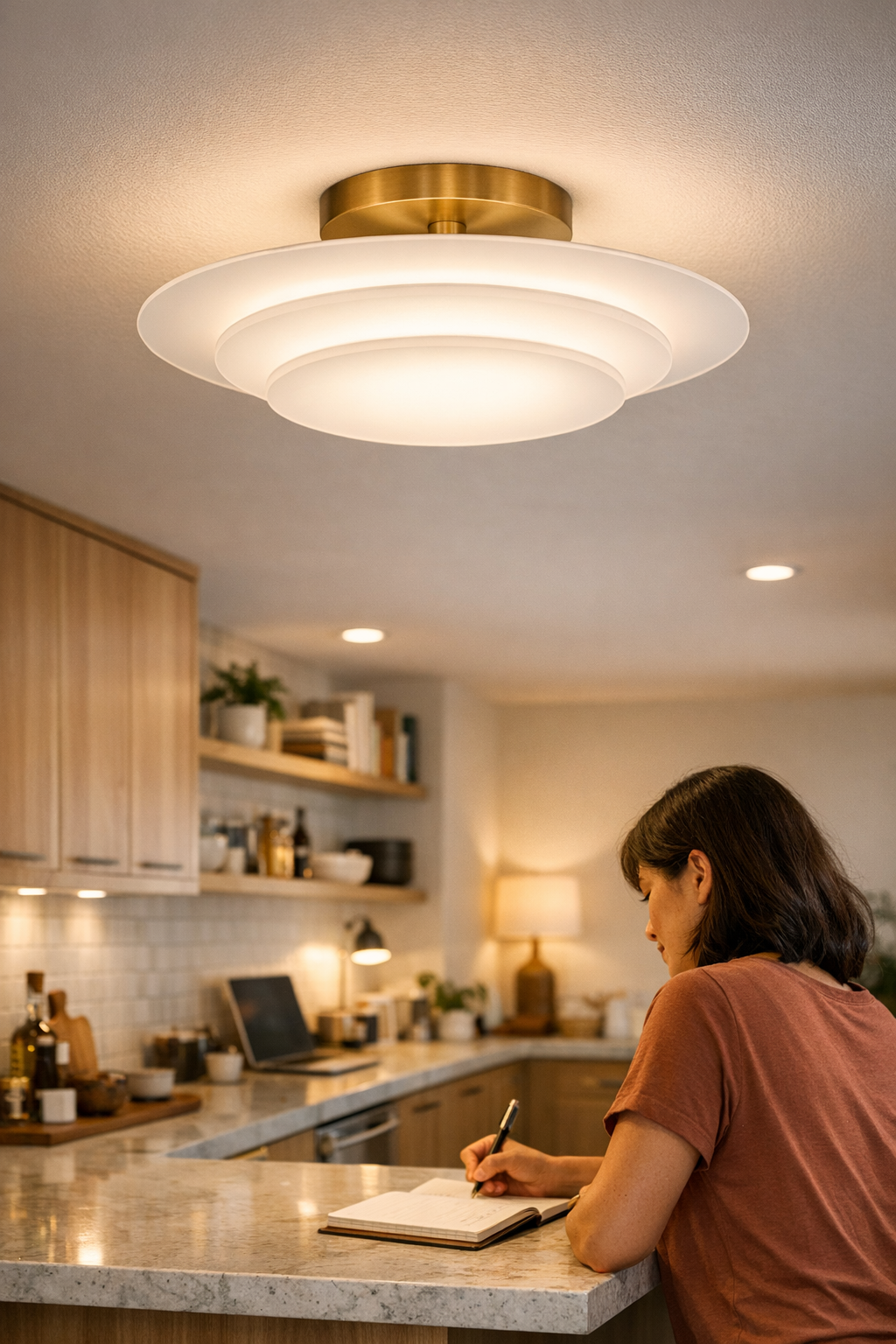
The difference between ceiling lighting that looks resolved and lighting that actually works shows up fast: the countertop zone left dim while every cable still catches your eye, the glare off one side of a desk, the shadowed half you avoid at night because it feels like a hassle to fix. A “minimal” fixture or tidy flush-mount promises a seamless look but in practice, it’s the edges, corners, and work surfaces that get ignored. After using the space for a week, you stop bothering with the kitchen backsplash, read from only one side of the shared table, and start stacking stray items under shelves where the lighting gives up first. Glare, patchy coverage, and cable clutter don’t fade—they become part of the routine.
How Looks-First Lighting Choices Create Everyday Friction
The first mistake is picking a ceiling fixture for its shape, not for how it really lights up your routine. You like the uncluttered ceiling—until two evenings later, when the central glare means you stand off to the side to avoid squinting, or shrug and leave half the island in shadow. Even when cables are “out of the way,” you keep noticing a drooping line or a support bracket just off your main sightline. Clean layouts on paper rarely survive the irritation of moving seats to stay out of glare, or leaving pantry shelves for “later” because you can’t see what’s near the wall.
This friction adds up: a corner used only to pile stuff, a desk edge avoided after dark, fresh cable marks on the ceiling where you tried to fix the last misalignment. The workarounds pile up—and the room’s weak zones gradually become baked into daily habits.
The Quiet Difference of Linear and Panel Ceiling Lights
Switching from a single-point fixture to a linear or panel ceiling light doesn’t guarantee solved lighting—unless placement, mounting, and cable management work with your real room layout. Linear and panel lights break up harsh, central glare, spread brightness to side zones, and make the edges of counters and tables actually usable. Suddenly, prep work doesn’t crowd into one patch, papers don’t migrate from shadow to light, and the awkward “dead” zones get back into play after dinner. Evening comes and the whole surface stays visible—instead of one bright spot shrinking as you move away from the center.
The risk: even a well-designed linear fixture can look as unfinished as a bulky flush-mount if you allow bent cable lines, loose brackets, or a slightly off-center install. “Low-profile” only helps if alignment and support disappear; otherwise, minor setup errors take over your visual focus and make the upgrade feel like another compromise.
Spotlight Troubles With Single-Point Flush Mounts
Flush or globe fixtures offer one dramatic oval of brightness—then leave the rest of the room fading into dull perimeter. Directly under the light, your eyes catch a sharp reflection off glossy surfaces or a too-bright patch on the desk. Move an inch toward the edge and you’re stuck squinting, shifting a laptop, or giving up on the far end for the night. Seeing cables first, light second, becomes normal—and glare makes every late-night cleanup or paperwork session feel like a negotiation.
Real-World Setups: When Routine Use Picks Winners (and Exposes Weaknesses)
Think of a shared workspace or family kitchen. A single overhead fixture keeps one spot serviceable—while everything outside its reach gets assigned to “some other time.” You don’t choose the best zone, just the one that isn’t in shadow. It’s not by design; it’s by lighting default.
Over weeks, this creates lighting hierarchies you never planned: one side cleaned daily, the other side avoided by default; the shelf with nothing but backstock because reaching things there after sunset risks a stubbed finger. Most telling: during real routines, clutter grows exactly where light fails, not where storage runs out. A crowded prep counter is rarely a storage problem—it’s a lighting boundary.
Moving to a linear fixture with supports hidden behind cabinet lines and cables wedged tight to a ceiling beam, the difference is immediate: consistent light lands across the whole work surface, flimsy excuses for not using half the room disappear, and after dark, there’s no need to chase down extra lamps or dodge stray reflections. The “good” spot isn’t the only one available—whole stretches of counter or desk finally stay in play. No empty corners, no shifting tasks when the light moves.
The Real Impact: A Concrete Example
Switching a four-foot linear light to run parallel with the kitchen counter rewrote how the space worked—especially at night. For the first time, the entire counter—from sink edge to back wall—stayed visible right through after-dinner cleanup. Brackets vanished behind trim, and an unruly cable tucked out of sight. Suddenly, routine movements flowed: prepping, rinsing, packing leftovers—no one hunting the old countertop “hot spot” and no stray lamp left in the way. Edge work and minor tasks could shift around without ever feeling half-lit or sidelined.
Setting Up for Steady, Usable Light—Not Just a Finished Look
Map out real traffic and task patterns before placing a single fixture. A desk isn’t just a rectangle: check where hands, eyes, and tools move, and run linear lights the same way. For kitchens, place panel or linear lights to hit counter spans evenly, with support brackets avoiding sightlines and cables routed away from overhead storage or walkways. Spreading out the light and securing attachment hardware does more for usable surface than another showy fixture ever could.
Support hardware—brackets, cable management, anchor points—holds equal weight with the fixture. Skip corners with flimsy supports or exposed lines and every cleaning run turns into a reminder: the cable path was never finished, the bracket line shows in every photo, or that “almost” centered panel throws shadow every time you actually use the space. A neat install means cables follow the room’s lines, not your last workaround.
Lighting Decisions That Outlast the First Impression
Installing a ceiling fixture that solves “brightness” but skips coverage or cable control is a short-lived fix. The missing detail isn’t subtle: dim or half-lit corners, stacks and devices shifted for better light, and that tired “I’ll get to it later” feeling in every missed task zone. Ignore visible cables while mounting and you’ll catch your sleeve on one, or lose cleaning patience as crumbs pile up near the exposed edge. A room that feels “done” for photos still falls flat in daily use if movement and sightlines don’t match real routines.
Consistency means more than symmetry: spread fixtures to reach deep work edges, not just the center; use soft-edge diffusion to prevent abrupt light-drop; disguise cables against beams or seams so they disappear from view. A linear light that’s too long distracts, while a short run leaves zones out. Picture your routines running through the finished layout—routine reveals every oversight your first impression misses.
When the Setup Holds, You Notice What’s Missing—Fewer Adjustments, Less Compromise
The best setup stops reminding you it’s there. If a week goes by without adjusting your posture for glare, moving piles out of shadow, or scrubbing around an exposed supply line, the improvement’s clear. Tasks spread out naturally rather than being dictated by the nearest patch of light. Those “just out of reach” cords, crumbs near the wall, or reading glasses left by the glare—these habits fade as steady, even light turns more of your space into usable territory.
But even the right fixture fails without honest, clean setup. No panel, bracket, or under-cabinet light will stay invisible if cable droops, anchor points drift, or sightlines cut across ordinary work. Choosing light is only half the job; it’s the support, the cable route, and the final alignment that divide rooms you use from ones you tolerate.