
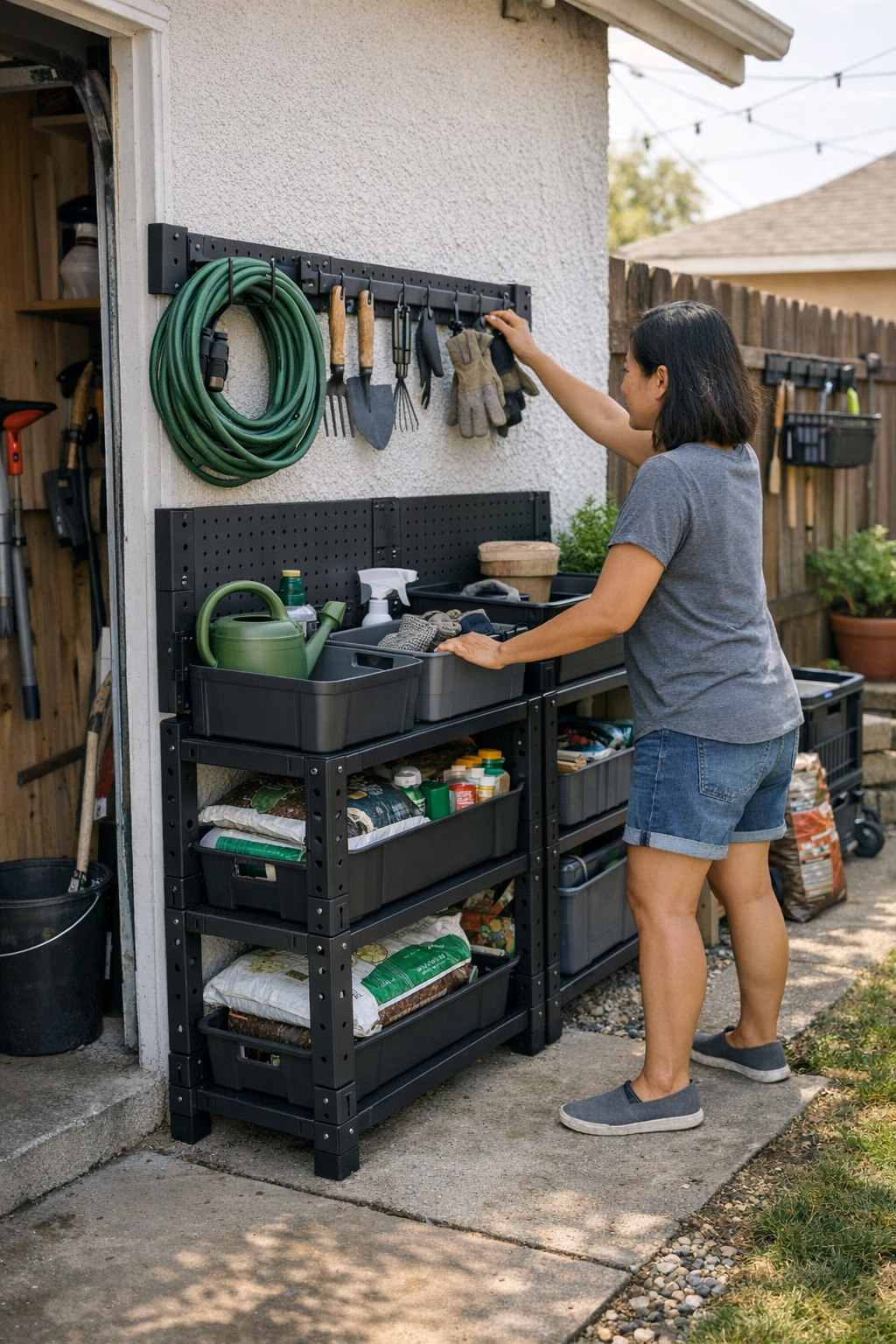
Outdoor clutter rarely explodes all at once—it seeps in, one mislaid shovel or lopsided bin at a time. You organize your side yard or garage edge, snap the lids shut, and stand back with relief. But give it three weeks: a rake abandoned outside the chest, a bin jammed half-open near the gate, a narrow route made tighter by something that never quite finds its way back. Even with a picture-perfect setup, the wrong system turns routine cleanup into a slow-motion obstacle course.
Why Even Neat Setups Collapse Under Real Use
The confidence of installing a fresh rack or shiny new bin fades quickly once daily life gets rolling. At first, you’re careful: tools get returned, gear tucked away. Then one rushed morning, the hand trowel lands on the floor instead of inside the chest. Later, the mower wedges awkwardly beside a bulky bin you swore would stay out of the path. Each retrieval means another shuffle—the subtle start of storage that resists, rather than supports, your routine.
These tiny detours don’t seem urgent at first. But when you’re bending over to pull items from behind a trunk or inching sideways past an overflowing tub, efficiency evaporates. By the middle of summer, all those small interruptions form a single grind: your storage looks passable, but moving through it is work.
How Floor Storage Puts Your Routine in Reverse
Picture your most-used outdoor corner—a side-yard strip lined with standing bins, or a patio edge with a deck chest. It holds everything, so it must be working, right? Until the next weekend when the kids’ boots collect near the threshold, the coiled hose stays slouched in the walkway, and you step over a garden fork blocking a bin you can’t quite reach without moving something else.
This is how a “solution” thickens into a new set of problems: Returning the trimmer means sliding a bin out with your foot. Hanging up a rake is delayed by a stray tarp atop the chest. Corners gather random piles because actually accessing the main trunk feels tedious. Organizing by type or squeezing in extra bins just creates more surfaces for the next overflow—and the movement path you need is choked by the very system meant to organize it.
What Changes When the Walls Carry the Load
Now swap that bin cluster for a chest-high wall rail along your fence or garage edge. Hooks and mounts stage every daily tool—broom, shovel, clippers—exactly where your arm expects them. The ground isn’t just visible, it’s clear. No lid-lifting, no pile-shifting, no side-stepping around a chest angled too close to the walking line.
- Returning clippers? Two steps up, done. No bending or skirting past obstacles.
- Broom missing? It’s right there—not buried, not displaced, not interfering with anything else.
This isn’t about overloading the fence—it’s about transforming the essential movement zone. The wall system pulls gear off the floor, so returns become a smooth, natural reach, not a ritual of moving things just to get through. What looks like a small layout shift actually unlocks “reset power”—gear returns are frictionless, and movement through the area stays wide open, not rerouted by overflow.
Small Shift, Huge Return: An Everyday Test
It’s one thing to imagine: here’s what happens after the change. Swapping a bulky deck chest for a wall-mounted rail instantly opened up nearly a foot of cramped side-yard space. The difference landed on the first busy Saturday—clutter stopped sneaking back into the walkway, and routine gear returns required zero step-over or reshuffle. No more fishing for stuck handles mid-task, no more closing the lid atop a tangle of misplaced stuff.
Over a month, the improvement held. Bikes came and went; spades back on hooks after use; footpaths stayed passable. Overflow didn’t drift into corners. The new boundary was physical, not wishful—movement and storage started reinforcing each other instead of generating friction with every reset.
Spotting (and Fixing) Return Friction in Your Setup
The best outdoor storage is invisible when rushed, not just tidy when staged. So ask yourself:
- Does putting away a rake trap a bucket behind a flipped bin?
- Are you shifting containers every time you reopen the main path?
- Is there a corner that magnetically collects piles despite “systems”?
- Is your normal return slowed or derailed by one awkward holdout?
If yes, it’s the system’s routine, not just its order, that’s failing. Labels and categories don’t rescue a layout that keeps the ground busy and the core route in flux. Even color-coded bins mean nothing if you’re caught untangling the same traffic jams after every project.
Wall Real Estate Beats Floor Real Estate—Every Time
Ground you don’t have to cross is value you feel instantly. Open floor space means fewer stumbles, cleaner lines, and a real path even in high season. A wall rail or rack lets every tool move separately—no shifting the domino row if you need something in the middle.
And unlike “discipline-dependent” systems, this method doesn’t falter the first time you skip a perfect reset. Good wall setups hold the line, quietly shaping your returns and routines for weeks—while floor bins, however pretty, turn into storage speedbumps as soon as life speeds up.
Practical Tip: Walk the Reset—Don’t Just Map It
Before calling your setup done, physically act out your busiest reset. Grab the usual mess: shovel, bucket, rake, boots. Set them down, put them back, retrace your steps. Does the system slow you or make you adjust to it? If you’re looping or hopping over obstacles, keep refining. The best setup is the one you barely notice once real life resumes.
The True Goal: Storage That Disappears Into Your Routine
Functional outdoor organization isn’t hidden, it’s harmonious: the side yard, the fence line, the garage threshold—all work together, not against your daily paths. The right setup earns its keep by keeping movement clear and reset simple, no matter how many times you use the area. When your path stays open—and storage quietly stays aligned—you stop fighting the corner, and your space starts making sense for how you actually live outside.