
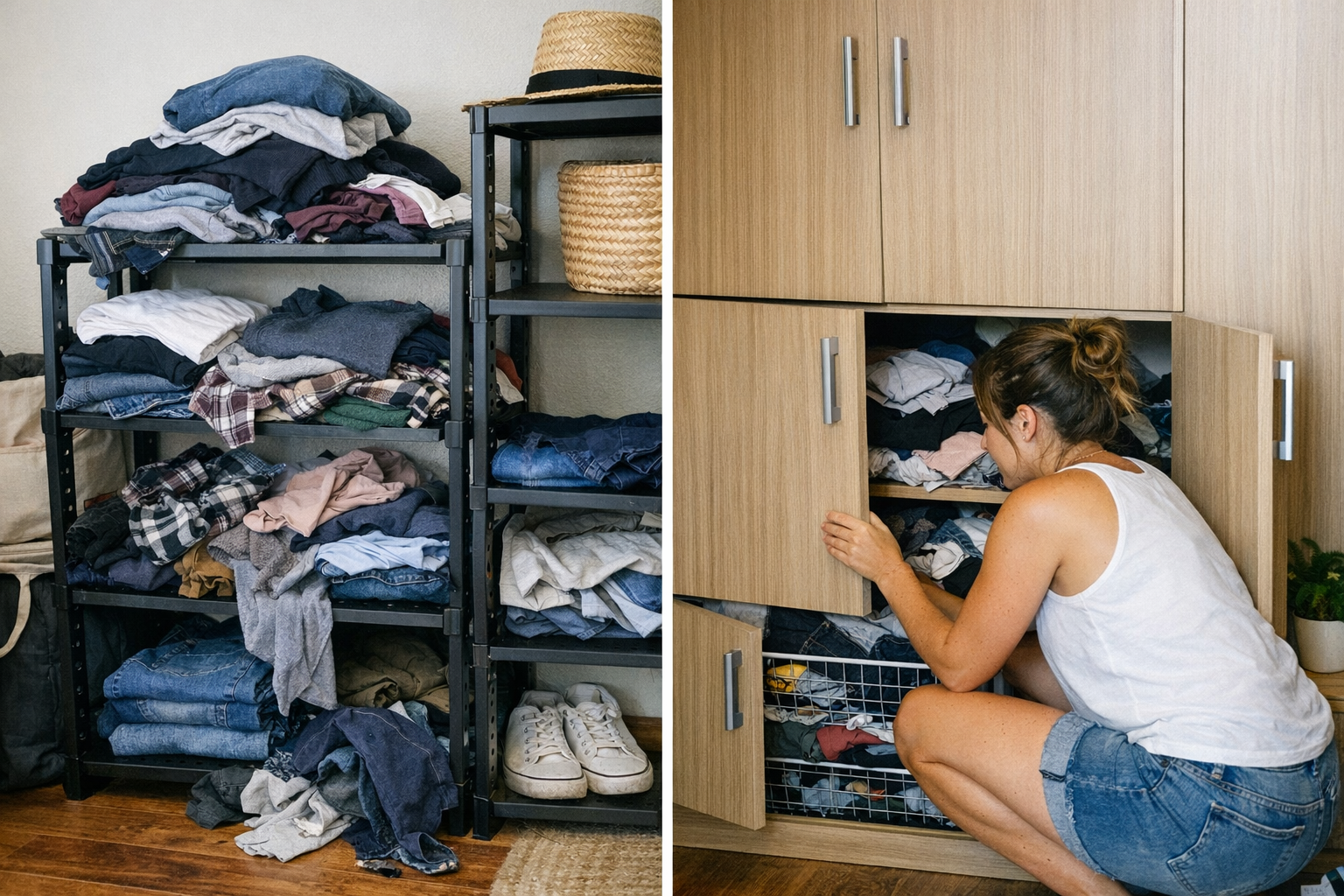
Closets unravel faster than anyone admits. Shelves look pristine on move-in day; every row of T-shirts, jeans, or sweaters says you’ll be the person who always knows where everything is. But within a week, the truth sets in. Each quick reach pulls a sleeve out of place or collapses a stack. What should’ve been “grab and go” becomes “search and rescue” as clothes mingle, piles slide, and yesterday’s neatness becomes today’s barely-contained chaos. The friction isn’t just cosmetic. The daily grind—finding, returning, reshuffling—chips away at your morning and adds one more invisible obstacle before you walk out the door.
Open Shelving: Fast Starts, Messy Finishes
Open shelves invite bold organization—until the real world intervenes. That first week, there’s no barrier: you spot your favorite shirt, snatch it, and the closet feels like an efficient extension of your routine. But by Thursday, that stack of T-shirts sags, half folded and half slumped onto yesterday’s jeans. A single stray item—a gym towel, a ball cap—slides in and suddenly your “T-shirt section” is just a general pile. Every movement tries to be one-handed and quick, and in the race, categories blur. Before long, the entire shelf is contested ground.
The upside—immediate access—is also its downfall. Open shelving turns small slips into big messes. One rushed grab leaves shirts spilling into sweaters; a couple of forgotten refolds later and half the closet is in disarray. Instead of one shelf for each category, you end up defending shelf borders from accidental invasions every time you reach for something tucked in the back. Minor disorder grows visible and persistent, demanding regular resets most people never get around to.
Closed Cabinets: Calm Outside, Chaos Inside
Closed cabinets give the illusion of control—at least until you open them. Doors shut, clutter disappears, and from the outside, everything looks calm. For anyone craving less visual noise, cabinets seem like a peace treaty. And in tight spaces or high-traffic entryways, that’s no small benefit.
But function tells a different story. Simple retrieval becomes a chore. Need a shirt near the bottom? You’ll move two stacks to get at it. Looking for a rarely-worn sweater? It’s buried behind months of accumulated “someday” clothes. Over time, out-of-rotation items slink to the back: a single jacket gets lost behind bins, socks vanish behind spare shoes, and entire categories quietly mix until you’re not sure what you own. Cabinets protect from dust, but also hide the warning signs—disorder multiplies unseen, until “just grab that thing” turns into a mini excavation.
When Out of Sight Means Out of Control
The surface order of cabinets discourages touch-ups, and that’s the trap. Because clutter isn’t visible, you let things slide; then, when you finally hunt for the winter hat or last clean hoodie, half the contents spill onto the closet floor. Cabinets make it easy to hide problems, but harder to maintain a functional sort. You don’t see the blend of categories or the collapse of folded stacks until you’re knee-deep in stuff you forgot about.
Why Routines Break Even the Best-Laid Storage Plans
Most storage “systems” fail where daily habits collide with ideal setups. Maybe you start with jeans, tees, and hoodies in distinct rows on a shelf. After a week, jeans have invaded the T-shirt section, and the original logic is long gone. Or you fill a cabinet with winter gear in April and, months later, aren’t sure what’s in the back anymore—just that it’s in the way when you’re hunting for an everyday item.
Routines are ruthless: kids jam clothes wherever there’s space; adults toss scarves or bags on the closest shelf. The result? Shelves that crowd too fast, bins that become grab-bags, and closets where each section gradually loses its role. You start with “zones,” but by mid-month, you’re just hoping things don’t fall on your feet. Resetting everything after each use isn’t realistic—a true system should survive imperfect routines, not collapse under them.
Divide and Contain: Practical Fixes That Actually Stick
You don’t need a renovation, just a few targeted shifts. Start with shelf dividers: a vertical insert here doesn’t just separate stacks, it prevents jeans from tipping into shirts and keeps the edge of your shelf from morphing into a jumble. With real walls guiding each pile, stacks retain shape longer and category lines stop drifting. Instead of re-folding everything after each morning, you just nudge a sleeve back inside its zone—small, fast corrections instead of full resets.
Segmentation gives your closet structure its backbone. For deep shelves, store light, high-use items upfront and keep heavier, rare-use pieces at the back, so the stacks in front don’t tip. In kids’ closets, label bins (“Socks,” “PJs”) so even in a hurry, putting things back mostly right is realistic. Consistency matters more than precision, and small changes—dividers, bins, labels—create pockets of order that survive rushed routines.
Mix and Match: Stacking the Odds for Lasting Order
One storage style rarely solves all problems. Pair open shelves (for everyday items) with closed cabinets or deep bins (for what you use less often or seasonally). Overlay dividers or bins inside both. This mixed approach cuts down the “closet domino effect”—where one broken section brings the whole system down. Open shelves stay resettable and visible, while cabinets swallow clutter you don’t need right now—without turning every retrieval into a hunt.
Clues Your Storage Isn’t Working—And What to Do Next
How do you know you’re heading for trouble? If you’re constantly reshuffling the same stack or losing track of what goes where, those are red flags. The shelf you restack every two days, or the cabinet that absorbs things you never find again—these are cues, not failures. Tweak high-friction zones first: add a divider, assign a bin, or shift categories so “hot spots” get special treatment without reorganizing everything at once.
The real test is resilience, not perfection. When a closet lets you put things back close enough after a busy day—and makes it obvious what belongs where—chaos stays contained. What matters isn’t how flawless your closet looks for a photo, but how easily it bounces back from daily use.
Making Storage Work for Your Life, Not Just for Show
Open shelving shines for speed, but demands frequent touch-ups or clever dividing. Cabinets offer peace to the eye, but can quietly sabotage daily access if left unmanaged. Most lives need a blend, plus smart zoning inside each section. Watch for trouble spots in your routine—crowded shelves, mixed bins, or perpetual reshuffling—and adjust with practical fixes instead of chasing closet perfection. The goal is not showroom neatness, but a closet that never slows you down, no matter how hectic the week.
Find practical storage systems designed for real daily use at ClosetWorks.