
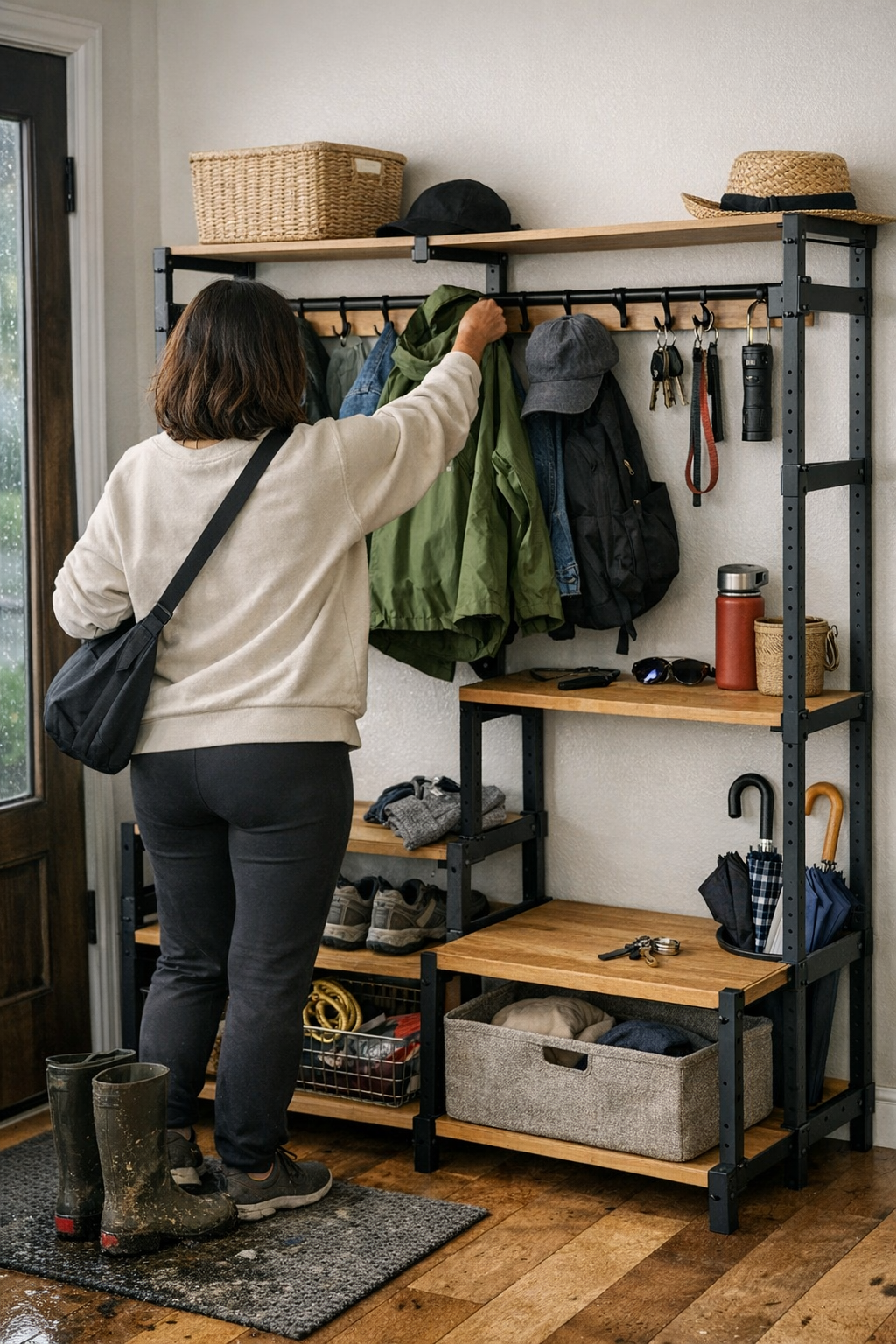
The entryway never stays controlled for long—especially if your “solution” relies on hiding daily chaos behind closed doors or under lid-covered benches. In real homes, setups that look neat after cleaning almost always buckle by midweek: shoes spill past their row, bags drift from hooks to the floor, and key gear vanishes behind shut cabinet doors. You notice the friction not as visible clutter at first, but as a missing glove, a misplaced umbrella, or the backup light buried somewhere unreachable—right when you’re about to leave and time is short. The moment the system interrupts your path or adds another search step, you’re feeling the hidden cost of a layout that isn’t keeping up with daily re-entry pressure. Every “out of sight” item risks becoming “out of circulation” when the threshold crowds up under real use.
When Hidden Storage Turns into Bottleneck
Cloaked organization—closed cabinets, covered drawers, cushioned benches—promises control, but often trades off immediate access. The more steps it takes to store or retrieve the things you use most, the faster temporary placement becomes a default: shoes abandoned outside the cubby, bags left on the floor near the bench, hats and gloves piled on top of closed bins because opening them slows the routine. The subtle trap is delay by concealment—a routine item quietly drifting out of reach until that familiar crunch: you’re blocked at the door, trying to remember where you stashed the spare keys as the clock keeps moving.
Neat Surfaces, Slow Movement
The visual calm of shut storage rarely survives everyday pressure. Test it on a rainy Tuesday, not just after the weekend reset: The bench that looked controlled is collecting undone mail and gym bags. Drawers hide a missing glove, while an umbrella, once folded away out of sight, never finds its way back. The real signal is always in the interruption—a last-second hunt, a blocked threshold, one more delay that turns a “neat” entry into a morning bottleneck.
Open Storage: Clutter You Can Actually Control
Visible storage systems—wall rails, open shelves, exposed hooks—can look a little more crowded, but they produce a useful kind of pressure: you see exactly what’s missing the moment something slips away. There’s no silent drift. A single glance answers: are there six shoes or seven? Is the flashlight back or still missing? Swapping one deep drawer for a wall rail or bench-top tray rewires the whole reset—what’s being used stays in circulation instead of slipping into dead storage. A row of shoes directly on a rail stays roughly contained—even as use increases—because correction is immediate. Overflow doesn’t sneak up: it’s right there, nudging you to fix it instead of hiding until everything grinds to a halt.
Overflow at the Edge—Where the Real Battle Is
No system is immune to drift. Open setups shift the problem from invisible delay to visible nudge. Benches morph into catchalls: bags land “just for now,” mail piles up, coats edge their way across the line. But with visible storage, this edge clutter signals reset points. You notice right away when a bag blocks the path or shoes spread past their zone. Instead of silent failure, these setups make every misstep correctable, and help keep the entry moveable, even when routines slip.
What Breaks Down Under Real Pressure
Most entryway solutions fail during stress, not during setup. When your hands are full, the dog’s leash tangles, and the door sticks, do your things return smoothly, or is “putting away” another mini project? The closed bin swallows gloves until none are matched in a hurry; the stylish bench traps a week’s worth of mess. By Thursday, umbrellas are still missing in action—and one muddy pair of boots blocks the entire space. The patterns are clear: if your system needs two steps just to return something, that “later” pile is only going to grow. Quick access and direct return flow determine whether the area works for the actual family cycle, not just during Sunday resets.
Return Flow vs. Buildup: How to Spot the Real Trouble
Every threshold zone is a test of how easily things move in and back out. Systems that slow down restocking—requiring lids to be lifted, bins shifted, or doors opened—quietly train everyone to drop gear wherever, breaking down the intended order. The more your entry setup demands, the steeper the drop-off between “put away perfectly” and “dump it somewhere for now.” If you find yourself shuffling piles or re-clearing the same spot every week, your system isn’t matching the pressure of repeated use. Open racks and fixed spots let you spot the moment a basket overflows; closed systems make it easy for items to vanish, only to resurface when the season changes.
Small Upgrades, Big Differences
It doesn’t take a remodel to restore flow—sometimes a single swap is enough to make problems visible and correction automatic. The day you replace a deep, slow-drawer with a short wall rail near the door, the contrast hits immediately: keys, leashes, and flashlights cycle in and out, instead of getting lost in “storage.” Family members gravitate toward the open spot—a sixteen-inch rail becomes the in-and-out command center, exposing anything missing before it becomes a snag that slows everyone down. Resets take seconds, not another round of opening, shifting, or sorting what’s supposed to stay ready.
Entry Routine Tweaks That Actually Stick
- Expose your high-frequency grab-and-go items. Put hooks and baskets where they’re most needed for shoes, bags, keys—everything that circulates daily.
- Limit closed storage to overflow or low-rotation gear. If it’s not touched this week, it can live behind a lid—but retrieval still needs to be easy, not a project.
- Watch for benches turning into “edges.” Repeated landing spots signal your system is missing a needed touchpoint—use a wall pocket or rail to intercept those drops before they build up.
- Test your reset faster—midweek, under pressure. The real stress test is whether you can restore order in under a minute, not just after a deep clean. If it doesn’t pass, your flow probably needs redirecting.
Know When to Adjust—Not Just When to Clean
The biggest red flag in threshold storage isn’t always a mountain of clutter. Sometimes it’s that single repeated slow-down: detours for a missing hat, awkward steps to dodge a bag that’s in the way, a narrow path getting blocked earlier in the week than you expect. If you’re sliding gear around just for the door to open, shuffling piles off a bench midweek, or repeatedly dealing with the same clogs, your setup is asking for a new strategy. Pay attention to where you’re improvising, not just where things “look” off—daily, visible access usually trumps forced neatness if the goal is to keep everyone moving in and out with a minimum of resets and reroutes.
Transition Spaces That Actually Keep Up
An entryway only counts as organized if it works under pressure—not just after staging. Systems that build in visible feedback (and make stray items harder to ignore) correct themselves, using open cues to nudge resets before disorder spreads. Real organization lets you notice what’s broken sooner—before the next trip out the door costs you another three minutes hunting for an umbrella or clearing a bench. The right mix of open and closed storage doesn’t stop at “tidy”—it keeps up with shifting routines, absorbed clutter at the edge, and the true test: day-to-day traffic that never moves in perfect order.
Find more transition-space storage ideas and solutions at Betweenry.