
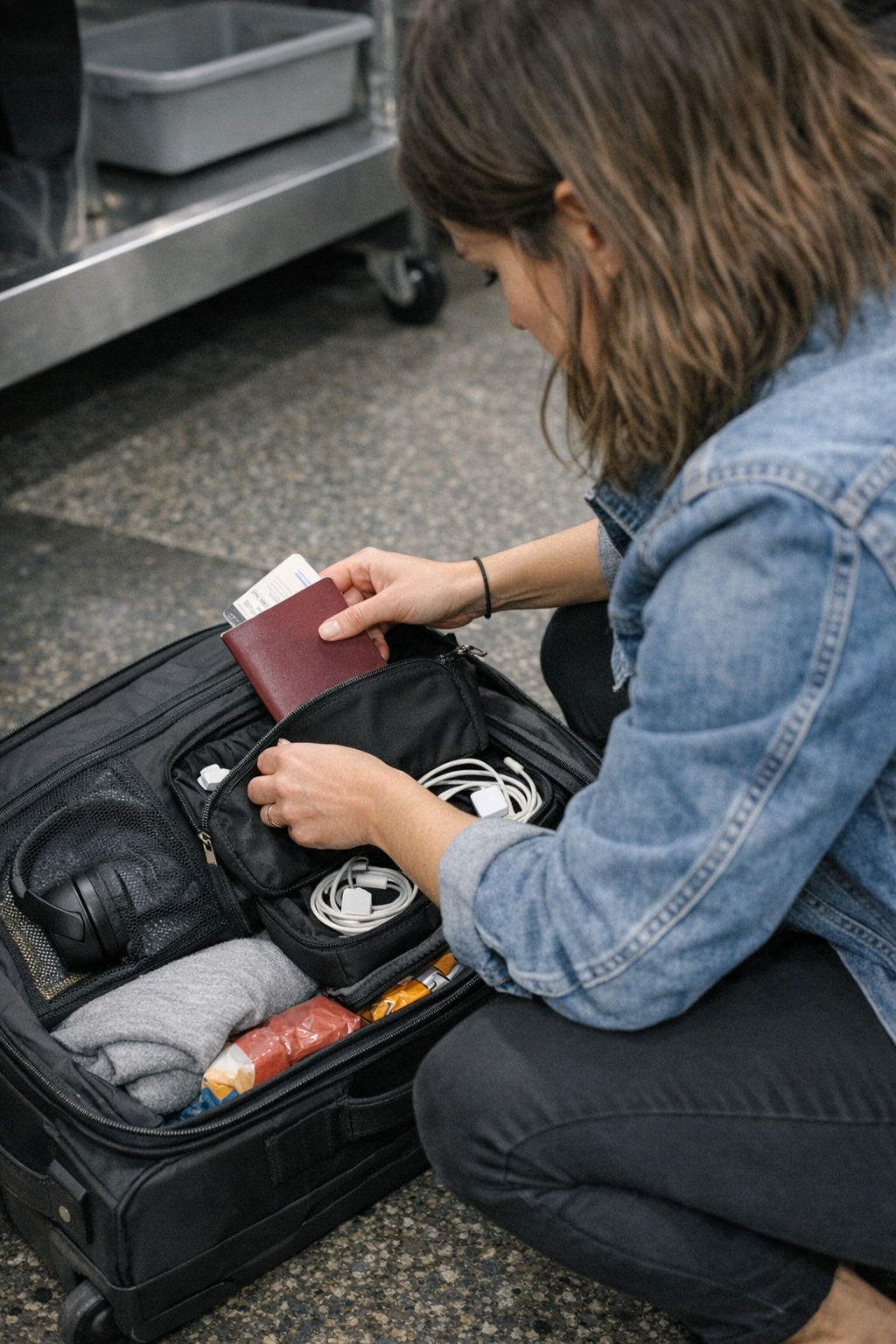
The weak point in your carry-on setup never shows up in your living room—it attacks mid-trip, always when you need speed the most. You close your bag at home, every item locked into its space, and walk out feeling ready. Then security hits, boarding calls, terminal sprints—the first real reach for a passport or charger in a crowd breaks that order immediately. The flaw isn’t visible until the pace picks up, lines close in, and the smallest delay—unzipping twice, fumbling through a mixed pouch—becomes a routine frustration. The carry-on that looked controlled at home is suddenly an obstacle, forcing extra rummaging or repacking when you’re just trying to keep up.
Why Orderly Packing Doesn’t Guarantee Easy Access
Every traveler has watched their “perfect” home packing melt into a hassle at the first checkpoint. Neatly stacked cables and passports slump together; that streamlined pocket turns into a blind search when a security agent asks for your ID. The airport exposes a reality that home organization hides: visual order doesn’t block friction. Chargers slide under documents, snacks hide behind cords, and every “catch-all” pocket becomes a slowdown the first time you need one specific thing—especially when standing, pressed for time, or moving with one hand free.
The Hidden Cost of Overlapping Access Patterns
On the packing table, grouping “frequent essentials” in one go-to spot seems efficient. At the airport, it’s exposed as a design flaw: jamming tech and documents together forces you to untangle cords just to get at your boarding pass, or move a granola bar to find your passport. Every overlap between categories is a subtle, recurring snag. What started as a logical main pocket drags the trip into a loop of micro-hesitations—each reach for an item becomes a mini-chore, especially under pressure. The setup that looked minimal now imposes a cost: repeated interruption whenever access actually matters.
Real-World Triggers: When Carry-On Structure Fails You
Security: Where the Overlap is Exposed
Security trays force your hand. You reach for the passport and pull out headphone wires instead. One tug on a charger sends documents sliding out, scattering smaller items across the tray. Someone in line beside you resets their bag in seconds; you’re still double-checking for missing items as the trays pile up. This is where a single mixed pouch, once “justified” at home, becomes a slow-motion mess.
Boarding and In-Seat Access: The Stationary Headache
Boarding lines drag and the difference in structure is clear. Some travelers unzip a visible sleeve, flash documents, and drop them back without breaking stride. When your own layout means flipping through wrapper-filled pockets, wrestling open secondary zippers, or even stepping aside for a repack, the price of that all-in-one compartment is impossible to ignore. Quick access is blocked not by disorder, but by too much in one place.
Mid-Trip Retrieval: Rummaging and the Repacking Spiral
Once in your seat, trying to grab headphones brings out a cable tangle, loose snacks, possibly your passport. Every retrieval jumbles the previous order; each repacking is messier than the last. By the time you land, “efficient” storage translates into a layered, tangled bundle that delays hotel check-in as you search yet again for essentials you swore were under control.
Direct Access: How Separation Solves the Repeating Problems
True travel relief surfaces after just a few use cycles: when you separate items by how and when you actually reach for them, friction drops away. Grouping by event—security, boarding, in-seat—not type or size, means each access is cleaner, every routine is faster.
Practical setup example: A single dedicated sleeve for travel documents. No chargers, snacks, or headphones inside—just what you’ll show repeatedly. Tech cables are sealed away in their own pouch; comfort items (like an eye mask) get their own spot, nowhere near documents. Now, reaching for a passport means one quick unzip and zero detours. Headphones are found minus the cord-web. Each routine—checkpoint, seat setup, snack break—moves without unnecessary crossover, and the bag stays workable even after multiple shuffles or transfers.
Recognizing and Fixing the Sneakiest Weak Point
This overlapping-access problem wins by staying hidden through small, repeated slowdowns. Your bag doesn’t look wrong—it simply grows more clumsy to use, one checkpoint or seat change at a time. The worst setups stay photogenic but quietly sap your attention and time; every quick grab becomes a small decision; every reset—however tidy—makes you work harder, not smoother.
Once you strip out all layered paths, micro-hesitation fades. You stop pausing at every checkpoint. You don’t have to trace which zip holds the passport, or repack mid-aisle after missing one item. The outcome isn’t flash—it’s a bag tuned so your mind tracks the trip, not the next hidden pocket or tangled reach.
How to Make Setup Work for Real Travel
- One zip, one function: Assign each pouch, pocket, or sleeve a single repeated-use purpose—documents, tech, comfort items. Don’t double up.
- Group by rhythm, not appearance: Resist clustering by look or size at home. Instead, group by movement: ask what you’ll need repeatedly in line, at your seat, or in a security tray.
- Check after each stage: After running security or boarding, did you need to open two bags for one thing? Did anything else fall out by accident? Use this as your friction test.
- Tweak, don’t tolerate: If you find yourself repacking more than once per segment, shift the setup—documents out of tech pouches, chargers given a solo spot, travel docs always in a visible, quick-access sleeve.
The Bag That Works—Not Just Looks Good
Most carry-on setups unravel after a few rounds of real movement. The winning bag is not the one that promises everlasting neatness, but the one that keeps retrieval direct and friction low after repeated cycles of standing, lifting, and retrieving—without the need for a full reset. Each trip row—from curb to seat to hotel counter—will test your layout.
What matters isn’t a photo-perfect interior, but a structure that makes each access shorter, every retrieval cleaner, and the bag itself less of a focus than your trip. The visible win isn’t order, but time saved, awkward moments avoided, and one less carry-on decision stealing your attention every two gates. The right setup pays for itself in motion, not just looks.
Visit CarryOnSupply for carry-on travel tools designed for real movement.